Cultural Advice: Winifred's memoir is an historical document and, as such, reflects the attitudes and language of the era in which it was written.
Brisbane season. Return to Melbourne. Aborigines. Fairbridge. Mikado Matinee. Plans for journey home
A FTER three months our tour of New Zealand came to an end. Apart from the big cities where we'd stayed for a week or two, the tour had included many 'one-night stands' in the smaller towns. It had been a wonderful experience, if strenuous.
From Sydney we went to Brisbane. I was disappointed that we didn't go still further north to Cairns and Townsville where we should have seen something of the Great Barrier Reef, but it would no doubt have been rather trying to play in the operas in the heat of a sub-tropical climate. And it was to be followed by a return visit to Melbourne, where we had spent three months during the previous year.
It was then I realized even more fully than before the friendliness of the Australians. As I arrived at my hotel the commissionaire greeted me with a 'Welcome home, Miss Lawson'; and my room was full of flowers, not only from friends, but from the hotel staff.
While we were in Melbourne, Yehudi Menuhin, accompanied by his family, came out to give a series of concerts in Australia. But we were not able to hear him play, as we had to be in the theatre. But that great baritone, Ezio Pinza, who came over with the lovely operatic soprano, Elizabeth Rethberg, gave an afternoon concert. And what a joy it was to hear their exquisite rendering of Mozart duets from The Marriage of Figaro and Don Giovanni.
From Melbourne we went to Perth in Western Australia; and of all the journeys we made during our tour of Australia and New Zealand, that journey across the desert was the most interesting.
The train itself was designed for comfort, being air-conditioned and having spacious parlour-cars with large windows through which you had an uninterrupted view of the scenery. The journey takes three days and crosses the Nullarbor Plain (so named because it is treeless), and the railway runs without a curve for over 300 miles, which is a world's record for a 'straight.' In all its length of more than 1,051 miles the line does not cross a single permanent stream of water.
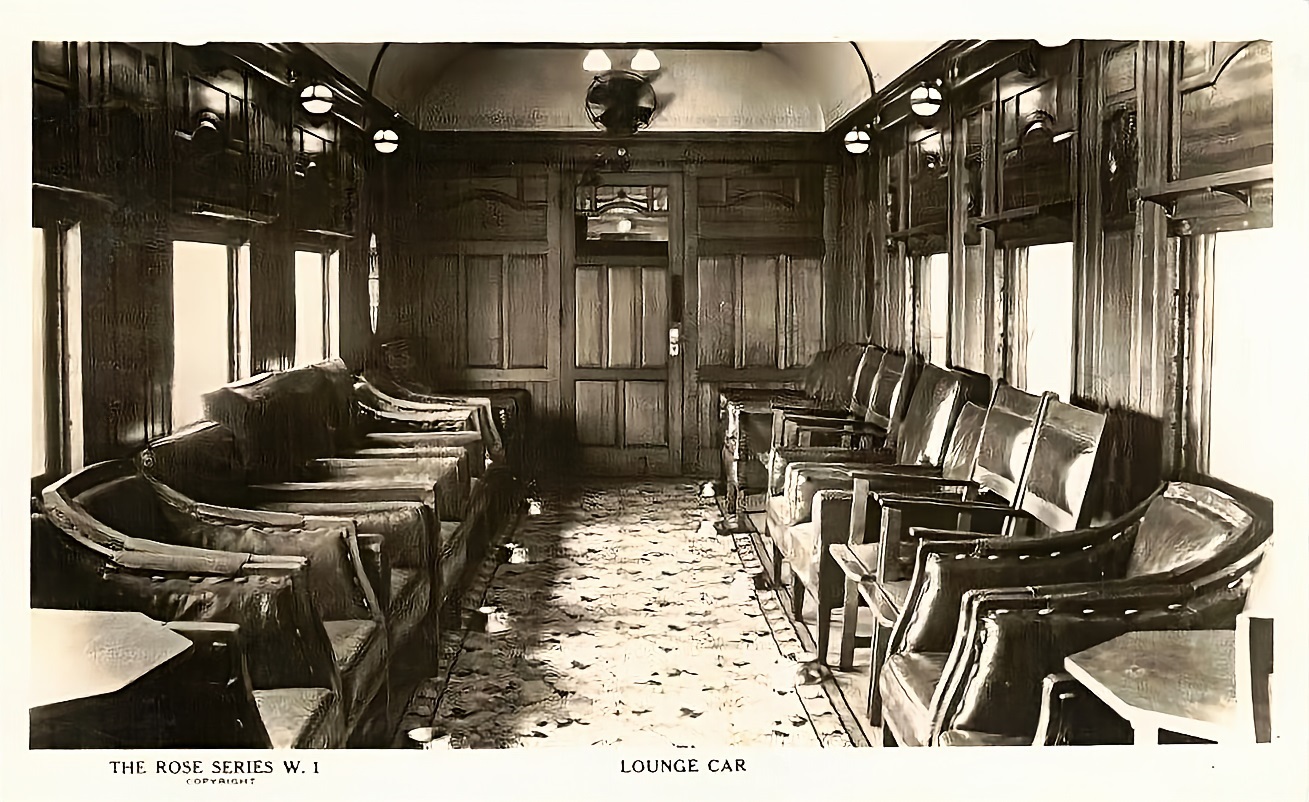 Lounge Car on the Trans-Australian Railway (National Library of Australia, Canberra)
It was fascinating to watch the hilly country gradually giving place to plains, and to see how the vegetation changed in character as we approached the desert. No longer could anyone complain of the 'eternal gum tree' in this Australian landscape, though sandalwood and mulga were equally unfamiliar to our English eyes. In the desert itself grew bluebush with its ghostly colouring, and saltbush whose leaves are so constructed that they can absorb the moisture from every chance shower of rain and from the dew that falls heavily in these parts; and sheep feed on the leaves. There is a fascination about these vast open plains, different from, but in its way as great as the fascination of forest and mountain.
Again, the aboriginal names of the little towns intrigued us, 'Wirrapa,' 'Pimba,' 'Ooldea,' 'Loongana.' At one station where we halted a crowd of aborigines flocked round the train, and out came the company's cameras as we snapped each other grouped with our black companions. They were a motley crew: dressed in rags and tatters, their hair matted with dirt. Our contralto [Evelyn Hall] gave one of the women a little money and asked her what she was going to buy with it.
The 'abbo' beamed. 'Buy'um sugar! buy'um tea!'
'What about soap?' said Eve, feeling that this was even more necessary.
'Yes! Buy'um soap! Washem up big!' said the 'abbo,' gesticulating wildly with her hands.
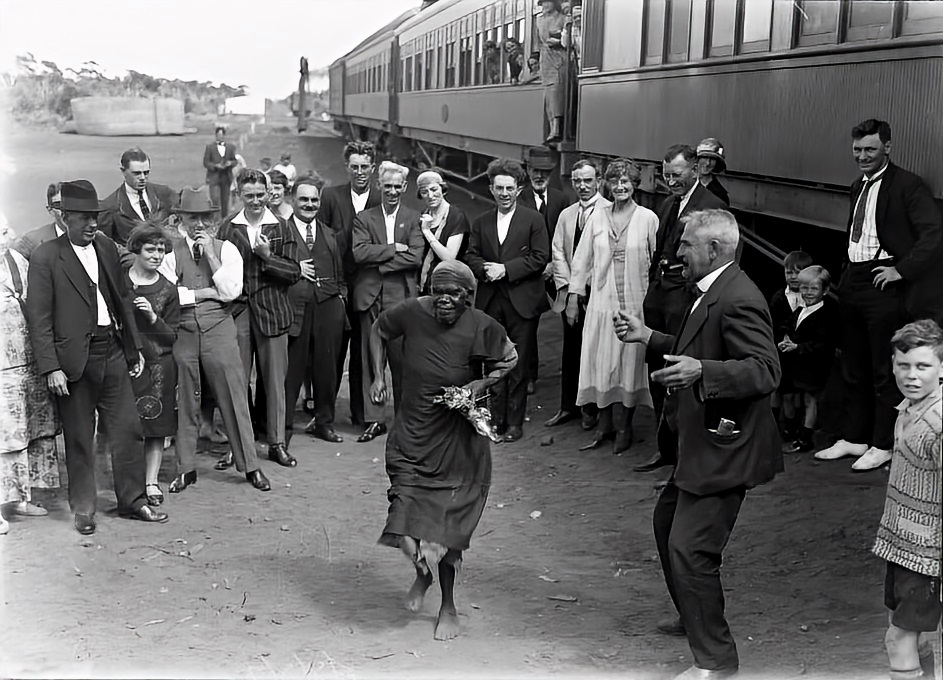 Trans-Australian railway passengers entertained by an aboriginal dancer during a stopover. (National Library of Australia, Canberra)
I bought a boomerang from one of the men, but the guard of the train took it from me and had it washed in disinfectant before letting me handle it. I never acquired the aborigines' skill in throwing it. It persistently refused to fly in a beautiful curve and come back into my hand.
When the company got to Perth, I had one or two free evenings when I was not playing in the opera. So I availed myself of Mr and Mrs Patterson's invitation to pay them a visit and spent a long week-end in Fairbridge Farm School at Pinjarra. It was the most wonderful experience and the sight of all these happy, healthy youngsters, in these delightful surroundings and warm sunny climate, filled me with enthusiasm for this most successful emigration scheme.
Apart from the Pattersons, my little protege David Lund was a host in himself, and shyly but proudly showed me round the Farm, and on Sunday morning after church he and his friends took me for a walk to visit Kingsley Fairbridge's grave. I was very touched by the way their noisy shouts subsided as soon as the grave came in sight. The following Sunday I came back again for the day with some other members of the opera company, and we gave a concert before an audience of about four hundred boys and girls.
And the odd thing was that, although we were accustomed to playing every night of the week before large audiences in the theatre, at this concert we were all petrified with nerves. Which only shows what utterly unpredictable things nerves are.
During our season in Perth our manager, Mr Mitchell, made a very kindly gesture. He said that if I would like to invite David and four or five of his friends from Fairbridge he would give them seats for a matinee of The Mikado. The choice of friends was difficult; but there were two who were certain of being included in the party: David's brother and sister Ruth had previously come out from England to Fairbridge and Ruth now had a domestic post in Perth. His elder brother, Sam, had also left Fairbridge for a job on a 'station' (or farm, as we would call it in England) and happened to be on holiday in Perth just then. So the two brothers and their sister were reunited. Mr Mitchell arranged for the whole party to have lunch before the matinee at the best hotel in the town, which must have been something of a treat after the rough-and-ready school meals; and all the children behaved beautifully and looked so spick-and-span dressed in their best clothes.
I think it was the first time any of them had been to the theatre, and when the curtain went down they all came round on to the stage where a long trestle-table was set with tea and cakes and sandwiches. All the principals came in their stage costumes to chat with them, and the children were shown how the curtain went up and down, and the intricacies of stage lighting. Then when it was time to go, anything that was left over from tea was packed up for them to take back in their car to Fairbridge.
They all wrote very nice little letters of thanks the next day. A photograph had been taken and appeared in the local paper with the caption: 'Miss Winifred Lawson with her young protege David Lund and some of his friends.'
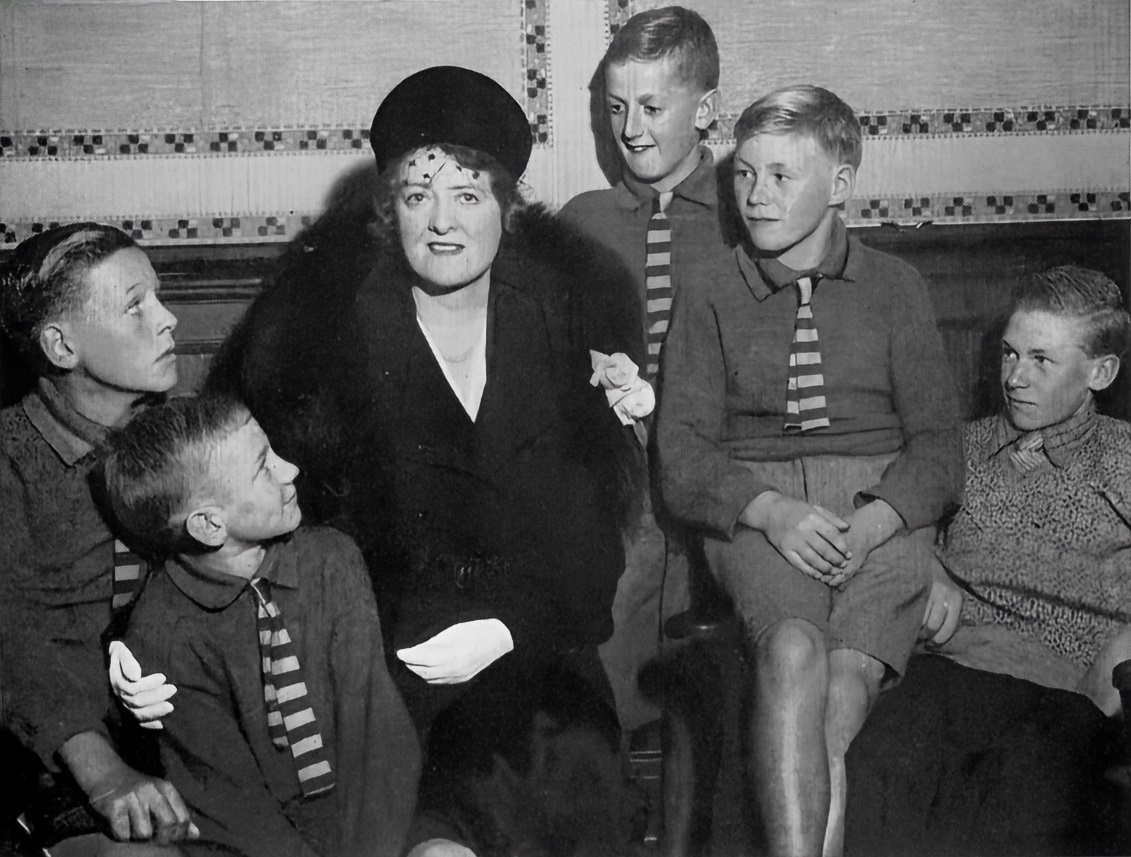 Winifred Lawson with her protégé David Lund and friends of the Kingsley Fairbridge Farm School, Perth, WA
One of the boys wrote: 'Dear Mr Mitchell, I looked for my name everywhere in the paper but couldn't find it. This may not mean much to you, but it means a great deal to me!'
Another wrote: 'Thank you very much for my good dinner and the Mikado. I enjoyed my dinner very much!'
I had taken a furnished flat for my stay in Perth, and a day or two after this party there was a ring at my bell. I went to the door and found nobody there, but on the mat there was a brown-paper parcel. I opened it, and inside was a charming little statuette of a girl holding a fan behind her head (as Yum Yum does in The Mikado), and there on a scrap of paper was written, 'Miss Lawson. Thanks. Sam.'
It was really very touching. Sam was not a very articulate sort of boy, but he had already written me a charming letter of thanks, and he must have spent at least a week's wages on this little statuette. I got rather out of touch with them all during the war, but I wrote not long ago and now have all the latest news of the family. Their mother has gone out from England to join them. Ruth has married a boy from Fairbridge who has done very well, and is now second in charge of the Department of Civil Aviation at Darwin, and they have two children. Sam left his sheep station to join the Commandos during the war, and now is back at his old job. David worked for a time on the station with his brother and is now married and has two lovely children of his own.
While we were in Perth the English Test Cricket team arrived, accompanied by Neville Cardus and Bruce Harris, and we shared a special train on our journey back to Sydney. As Bruce Harris said, it was unusual to find a train entirely filled with people whose job it was, one way or another, to entertain the public.
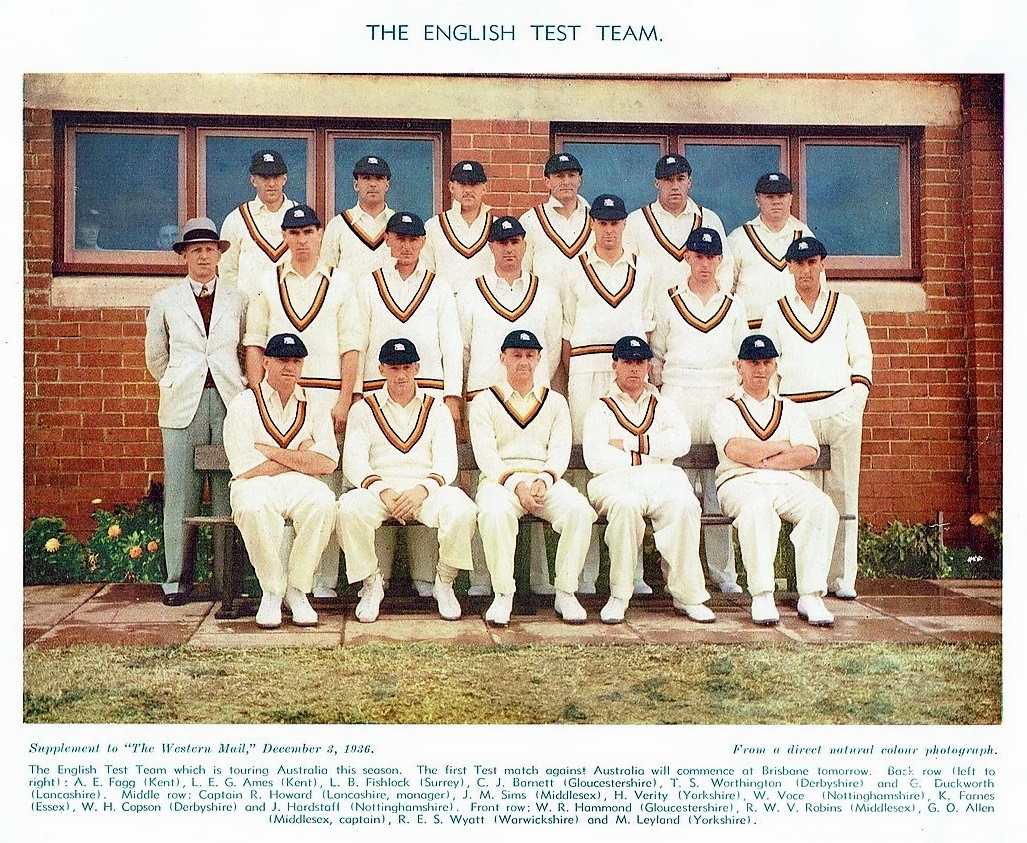
It was quite an experience to travel with the cricketers. Quiet little stations all along the route were thronged with people who had come from goodness knows where to get a glimpse of the team.
In London or elsewhere cricket enthusiasts naturally take an interest in the Test. But in Australia it seems to be a matter of life or death to the entire population, male and female.
When we got to Sydney, I stayed in a most delightful hotel called the Garden Club [sic - most likely the Clifton Gardens Hotel in Mosman], run by a Mrs Coleman, a most kindly, motherly sort of woman. While I was there England won the first match. Depression settled like a pall on all my fellow guests. I felt I should walk on tiptoe and speak in hushed whispers. I was taken one afternoon to a matinee at the theatre, and we sat in the front row of the stalls. When the orchestra came back to their places after the interval my hostess got up and, leaning over the orchestra, asked anxiously, 'Is Bradman still in?'
There is a certain part in Iolanthe where Phyllis the shepherdess has to go all round the stage curtseying to all the peers in turn. They had been on the stage for some time while I'd been off and able to hear the latest score, and with a sweet smile I would murmur as I bowed with my back to the audience '104 not out'—'104 not out!'
People would take sandwiches and sit on the edge of the pavement in St Martin's Place to watch the electrical moving newsband on the buildings opposite, which gave the latest score. Cricket was top-line news.
One day I was invited to go and see the aborigines who were taking part in a film called, if I remember rightly, Uncivilised. I was told to go and meet someone called Mr Archie, who, however, turned out to be an Italian girl named Miss Starace. We were joined by Dennis Hoey, who had just arrived from England to take the lead in this film, and proceeded to the location where all the 'abbos' were assembled complete with the most terrifying-looking collection of enormous snakes. These 'abbos' were very different from the poor creatures we had met on our way across the Nullarbor Plain. They were, of course, 'hand-picked' for the film, and were strong and healthy-looking and of fine physique. Their hair was well groomed and their bodies were streaked with war paint. The snakes which writhed about their shoulders were apparently poisonous, but they knew how to handle them, and showed us how to hold them so as to be well out of range of their venomous fangs. The men performed a war dance for us, which was most impressive and very alarming.
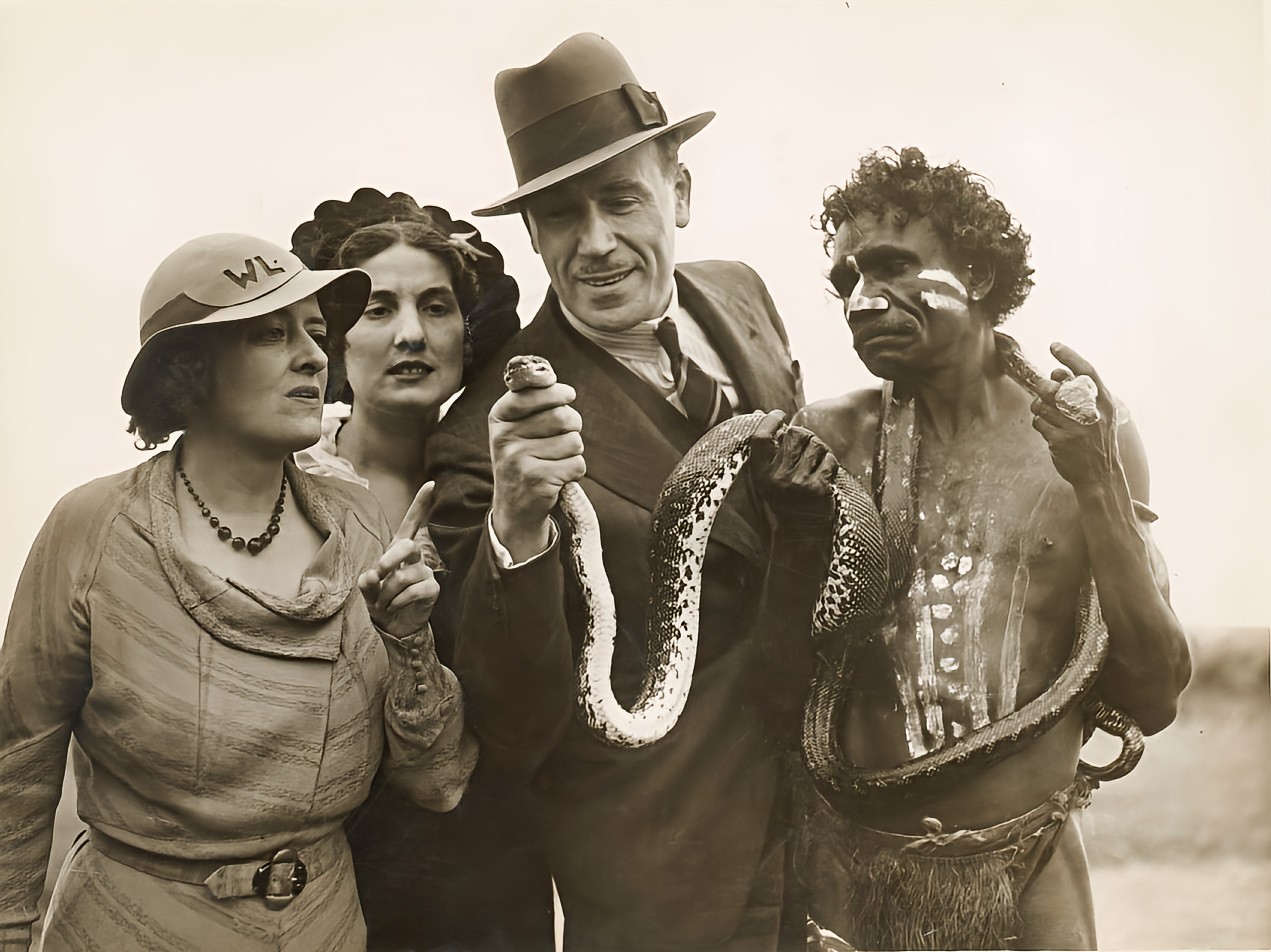 Winifred Lawson with Nina Starace, Dennis Hoey & unidentified snake-handler on location for Uncivilised (photo by Sam Hood, Mitchell Library, Sydney)
By now my contract was almost at an end and my thoughts turned homeward. My brother wrote, however, and pointed out that once home I should remain there for a long time and why not see something of the world while I was in the Antipodes. He drew a little sketch of their house, with rain pouring down, trees bending over in the wind, and himself battling along with his umbrella blown inside out; and underneath he'd written, 'What! come home to this!' That gave me furiously to think.
It did seem rather unenterprising in any case to go back the way I'd come out, via Colombo and the Suez.
So I got a map of the world and pored over it, working out various routes from Sydney to London—a pastime I can thoroughly recommend to anyone.
I had been working hard for a very long time. There was no particular reason to hurry home, and finally I decided to take my time over the journey and, as Cecil had suggested, see something of the world.
After consultations with helpful assistants in shipping offices, I decided to go via New Guinea and the Philippines to China where I would spend a month. Then I would have a month in Japan before going across America to England.


It was the time of the Coronation of King George VI, and so many people were going home for this great event that I could not get a berth on any ship for more than two months. So I stayed on in Sydney. The first summer we'd spent there when we were working so hard with rehearsals and extra performances during the Christmas holidays, I'd found the heat most exhausting. Sometimes I used to wonder how I'd ever have enough energy to give a performance. But now with leisure to have a siesta during the hottest part of the day, and perhaps being by now acclimatized, I found the heat delightful and revelled in the perpetual sunshine.
My friends in Sydney gave me such a wonderful time: there were bathing parties, motoring out to distant beaches, of which there is such a vast choice, cocktail parties, tea at the Rose Bay Golf Club, evenings at the Ballet, which was a great treat for me, not having been in front in a theatre for two years at least.
Colonel de Basil had brought out his Russian Ballet Company to Australia, where they had an enormous success. I met some of the company at a picnic one day: Woizikowsky, Serge Unger, Raievska, etc. They were talking about a certain ballerina, and somebody said, 'She's very young, isn't she?' 'Oh, no,' said Woizikowsky, 'she's nineteen!' I nearly fell over the sea wall to let the sharks get me; I felt that anyone as old as I should not be allowed to go on living.

Leon Woizikowsky as the golden slave and Nina Raievska as Zoebeide in Scheherazade, Monte Carlo Russian Ballet, 1937 (photo by Russell Roberts Ltd.)
(National Library of Australia, Canberra)

Norman Lindsay painting of Scheherazade, reproduced as the theatre programme cover for the Monte Carlo Russian Ballet season for JCW.
(National Library of Australia, Canberra)
I was still staying at the Garden Club [sic - again, most likely the Clifton Gardens Hotel in Mosman], where I had a large room with a private bath. Mrs Coleman, the proprietress, said to me one day, 'You ought not to be spending so much on your room now that you're not working,' and she offered me a smaller one that had become vacant and which was much less expensive. That has always seemed to me the most extraordinarily kind and uncommercial thing for a hotel proprietress to do. Her worst enemy couldn't have called her mercenary. I liked that room far better than the other one. It was on a corner and had two windows, one overlooking the harbour and the other the road where there was a flame tree and a jacaranda, both just then in full bloom. The jacaranda blossom comes out before any green leaves are showing; the whole tree was a mass of the most exquisite lilac-blue flowers, which as the petals fell formed a lovely carpet under the tree. And the brilliant red blossom of the flame tree made a dramatic contrast.
Every now and then I would call at the shipping office to see if there was a berth available for the voyage home; and at last they got me a cabin in the Neptuna, a small ship which only took eighty passengers and which was leaving for Hong Kong in a month's time. Then began the usual preparations: inoculations for typhoid, etc., lists of addresses of the best shops in which to buy souvenirs, letters of introduction from friends. Before leaving I also broadcast once or twice for the Australian Broadcasting Corporation groups of French songs, as a change from Gilbert and Sullivan.
Now that my stay in Australia was coming to an end I got more and more miserable at the idea of saying good-bye to all my friends, and the prospect of 'seeing the world' all on my own no longer seemed so attractive.
When the day came for me to leave I said good-bye to Mrs Coleman and the Garden Club, and went off with a party of friends to the ship. There I found that my cabin was full of flowers and presents and telegrams, which helped to soften the pain of parting.
Australians have a delightful habit when ships are leaving of throwing coloured paper streamers to friends on deck, so that with each holding one end of the streamer, those on board are still linked with their friends ashore. Then as the ship moves slowly away, a rainbow of streamers stretches out over the side till finally the last one breaks, and you're off to sea.
* * * * * * * * * * * * * * * * * * * *
First published in A Song to Sing-O! by Winifred Lawson [Michael Joseph: London, 1955], pp. 157 - 165
* * * * * * * * * * * * * * * * * * * *
Endnotes
compiled by Rob Morrison
Brisbane JCW G&S season at His Majesty’s Theatre
(Musical Director: Andrew McCunn)
- The Gondoliers – Monday, 1 June to Wednesday, 3 June 1936
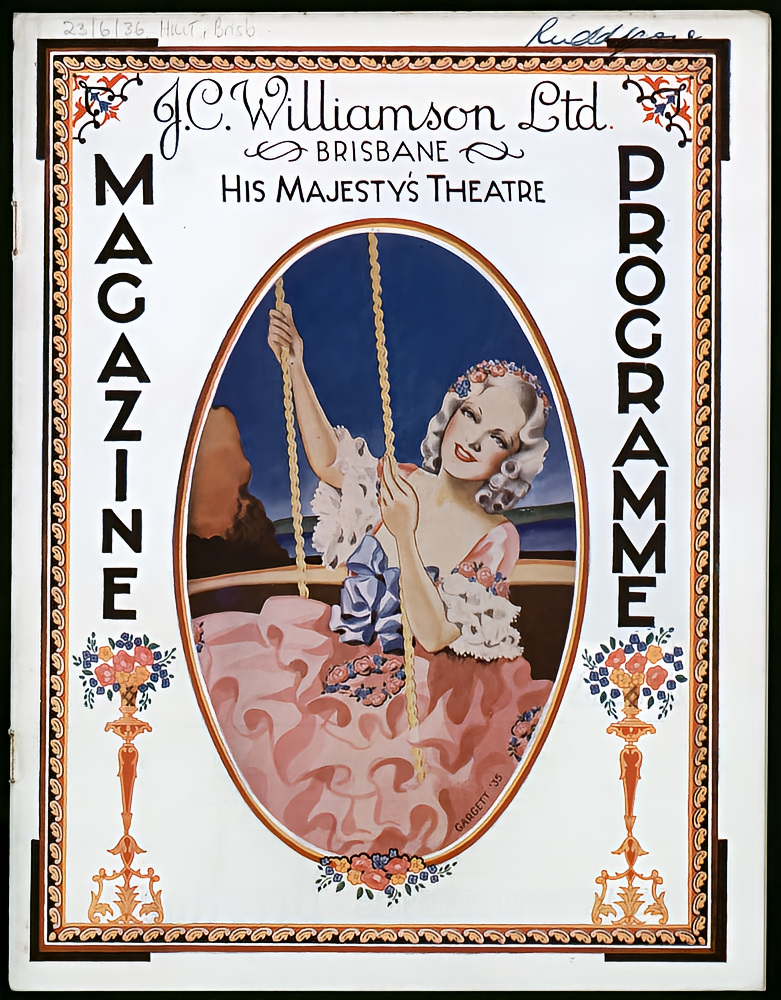
- The Mikado – Thursday, 4 June to Saturday, 6 June (matinee)
- The Yeomen of the Guard – Monday, 8 June to Wednesday, 10 June
- Iolanthe – Thursday, 11 June to Saturday, 13 June
- Patience – Monday, 15 & Tuesday, 16 June
- The Pirates of Penzance & Trial by Jury – Wednesday, 17 June & Thursday, 18 June
- The Mikado – Friday, 19 June (“In response to Thousands of Requests”)
- H.M.S. Pinafore & Cox and Box – Saturday, 20 June (matinee only)
- The Gondoliers – Saturday, 20 June (evening only) (“In response to Thousands of Requests”)
- The Yeomen of the Guard – Monday, 22 June
- Ruddigore – Tuesday, 23 June
- The Gondoliers – Wednesday, 24 June (mat.)
- Grand Gala Farewell – Potpourri Programme – Trial by Jury, Second Act of Pirates of Penzance & First Act of Iolanthe – Wednesday, 24 June (eve.)
* * * * * * * * * * * * * * * * * * * *
Youthful Australian's Quick Rise to High Place in Savoy Opera
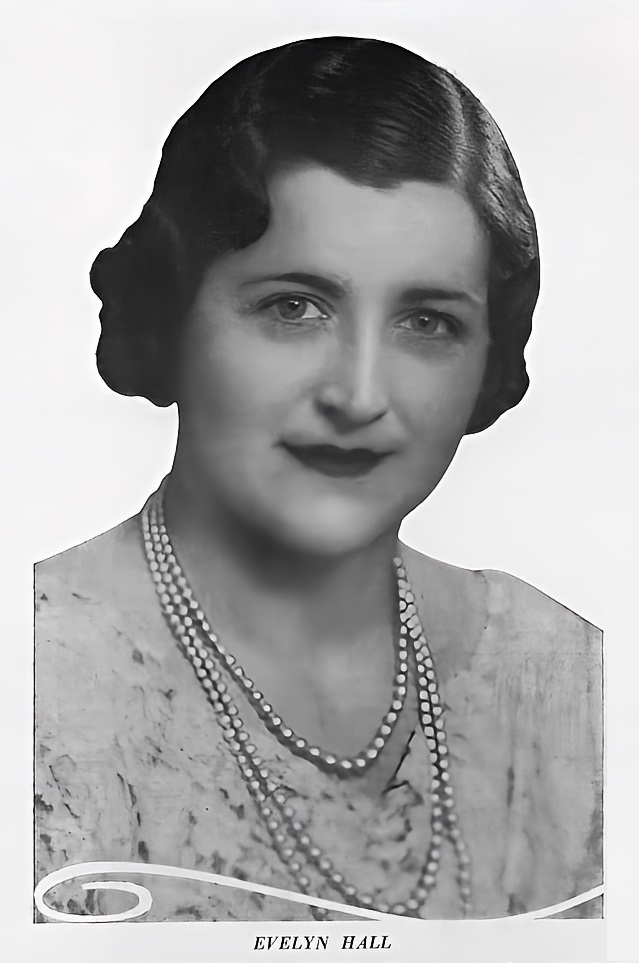
Miss Evelyn Hall Scores
When Miss Evelyn Gardiner, who had been "loaned" by the D'Oyly Carte company to J. C. Williamson for the Savoy Opera, was recalled to England during the company's tour in New Zealand, the problem of replacing her was an acute one. It was solved, however. Behind the debut last night of Miss Evelyn Hall in "The Gondoliers" at His Majesty's is the story of how another young Australian made good on the stage—and at extremely short notice.
Six weeks of coaching in a small room in Melbourne studying nine Savoy opera roles . . . fourteen hours a day without a respite . . . two nights in the train (not a panacea for nervous ills) . . . an hour and a half of rehearsal with the other stars of the company . . . not a single dress rehearsal, and with no experience whatever with the orchestra and the chorus, or even with the scenery as a background . . .these were the remarkable circumstances under which Miss Hall made her debut.
Afer the show Miss Hall said, "Thank Heaven it's over . . . but I feel that all the hard work was worth it."
Miss Minnie Everett, the veteran ballet mistress and producer, who during the last six weeks has coached Miss Hall in nine operas, said, "She's got the goods. When she has more experience, she will show us with a vengeance that there is no need to import stars from abroad to play these roles."
SIX WEEKS' TOLL.
It was in a small room in Melbourne that Miss Hall and Miss Everett have been working for the past six weeks, the one the teacher, the other the pupil, and the lesson has been the nine contralto roles of the Gilbert and Sullivan operas.
It was slavery for 14 hours a day. Not only had Miss Hall to learn from Miss Everett, who knows every detail in every opera, every phase of the interpretive side of her work, but also those thousand and one details— deportment, diction, gesture, and the timing of every movement. In the six weeks everything Miss Hall had to do and say while on the stage was learned, without the presence of chorus or orchestra or other principals.
Train travelling by night is an enervating business. Having gone through this gruelling preparation, this hardworking pair set out for Brisbane, and when Miss Hall stepped on to the stage last night few of the audience could have realised that she had just endured two successive nights in jolting trains as a preliminary to the ordeal of her debut.
STRAIN OF PREPARATION.
But the strain was on as soon as she set foot in Brisbane. At the theatre yesterday afternoon Miss Hall met the remainder of the cast for the first time in a professional sense. With them she was put through her paces again, and Miss Everett was her shadow, walking beside her, giving her quiet spoken hints.
"She had no dress rehearsal, no orchestral rehearsal; in fact, she did not know what the scenery was really like," said Miss Everett after the show.
"STAR OF THE FUTURE."
"And you are satisfied with it all?" she was asked.
"Yes, I am in a sense," she replied.
"But I am a task master. My standard is perfection and I've got to produce the goods. I verily believe that Miss Hall has it in her to develop into a star of the first magnitude. She needs experience. The real test is before the footlights. So many of them are great in rehearsal but crack up when the show starts. Miss Hall did not do that. That is why I think she is going to be a success. I had to start right from the beginning with her and teach her ....everything. It has been a long job but I think it has been worth while. There is no justification for importing people from abroad when we have such talent as this here. Miss Hall is not alone. There are plenty of girls like her. But they've got to be licked into shape.
I am proud of her Katisha in 'The Mikado.' I think it is a great piece of work for an artist of her limited experience. When they sent her to me for a tryout I was told to give her a fortnight to see whether she had it in her. I told them that she had the makings of the star in her. And I believe I was right."
TRIBUTE TO TEACHER.
"I owe everything to Miss Everett," said Miss Hall. "And the rest of the cast has been wonderful to me. I feel a nervous wreck now, but I feel very glad for all the hard work has been worth while."
Miss Hall has nine roles to do, many of them far more exacting than that in "The Gondoliers," and in some of them she will have to do as she did last night ... go on without a full dress rehearsal.
Miss Hall's career began in 1929 when she sang small parts in the Gonzalez Opera Company. Since then she had bigger parts in the 1932 grand opera season, has sung under Sir Hamilton Harty and under Maurice D'Abravanel in the A.B.C. opera series, and studied with Franz Izol, the Italian teacher, from whom she declares, she acquired her vocal technique.
The Telegraph (Brisbane) Tuesday, 2 June 1936, Page 3
* * * * * * * * * * * * * * * * * * * *
* * * * * * * * * * * * * * * * * * * *
SAVOY OPERA
Warm Welcome to "The Gondoliers"
A Richly Endowed Company
AGAIN theatrical folk have come amongst us and distilled the magic essence represented by the names of that incomparable pair, Gilbert and Sullivan. A company that promises great things for us in the next three weeks opened its season at His Majesty's Theatre with, of course, "The Gondoliers."
No company could have received a more enthusiastic welcome. An audience, claimed to be the biggest Monday evening opening audience for years, showed unmistakably during the first appearance of the artists how glad it was to welcome them. There was no mistaking the enthusiasm, and the players must have felt its inspiring influence, for it seemed to be reflected in the verve and sparkle of the opening choruses. When Winifred Lawson, Ivan Menzies, and Evelyn Hall — representing respectively the Star from Abroad, the Old Favourite, and the Young Australian making her Debut — stepped from the gondola, the applause was deafening.
CHORAL AND ORCHESTRAL STRENGTH.
It appears to be a better company than that which visited us two years ago, although memory may recall, perhaps, the art of John Ralston, Maisie Ramsay, Marie Bremner and Mary Hotham to make comparisons—and John Ralstons do not appear with anything like a monotonous regularity. In two respects, especially the performance last night, reached unprecedented heights—in the work of the chorus and of the orchestra, surely the joint foundation of a good Savoy opera company. The chorus was opulent in its tone, and trained to perfect cohesion and balance. The orchestra, composed mainly of southern musicians, since a full orchestra could not be recruited here, was a splendidly trained and disciplined band, which responded to Mr. Andrew MacCunn's baton with crispness and delicacy. The result of these two qualities in the ensemble of the company was a third—a wonderful buoyancy in the rhythm, and magnificence in the tone in the bigger chorus that was truly inspiring.
VOCAL RICHES IN PRINCIPALS.
HAVING, so to speak, put the cart before the horse, we must turn with apologies to the stars of the company. Here we find vocal riches and no small reserve of experience to draw upon. Miss Winifred Lawson comes to us with an established London reputation in Savoy Opera. She has a voice perfectly suited to her work, a stage presence that lacks nothing, and a pleasant personality that communicates itself to the audience as soon as she appears. Her singing last night was for the most part completely satisfying, though, strangely enough, there seemed to be abroad amongst most of the feminine principals of the company a tendency to produce tone with an edge on it in the upper registers of the voice.
Godfrey Stirling, the new English tenor, has a voice of accommodating power and subtlety. "Take a Pair of Sparkling Eyes" was his test piece, as it were, and the proof of the performance was in the repetitions that were called for. It is a voice of singularly beautiful quality in some parts of the register, and one incidentally that will add lustre and charm to the quartet ensembles that occur at intervals through these operas.
Ivan Menzies, of course, was his usual self. His Duke of Plaza-Toro is perhaps a slightly less "cock-sparrowish" fellow than was the case two years ago, but he still capers about the stage in a manner that is quite irresistible. His is perhaps a more restrained performance, and yet one more in keeping with the part as we have come to know it. Richard Watson's Don Alhambra was a splendid performance in every way. A fine stage presence, and a voice of quite impressive proportions, allowed him to give full play to the pompous pleasantries entrusted to this Grand Inquisitorial figure.
A POLISHED ARTIST.
Mr. Gregory Stroud is an old and well tried favourite. He possesses a natural charm of manner before the footlights that is matched by no-one else in the company. It is a mixture of graceful masculinity and a fine voice, which has earned him a permanent place in our affections. He is the perfect Gilbert and Sullivan artist. Clifford Cowley, who took his place in this piece two years ago, when Mr. Stroud was ill, is here again, this time as a star. He played Luiz with enthusiasm and aplomb.
A STAR'S DEBUT.
Three ladies in this cast of personalities deserve a paragraph all to themselves. Miss Evelyn Hall, making her first appearance in Gilbert and Sullivan opera, in circumstances that are extra ordinary, and which are outlined else where in these columns, played the Duchess as to the manner born. She has a beautiful rich voice, a commanding presence, and plenty of personality. One sees in her the artist who may fill contralto roles in future Savoy opera companies in Australia for many years to come. After all, why import English contraltos for these roles when we have such an artist as this?
TESSA AND GIANETTA.
Misses Helen Langton. a Western Australian. and Eileen Kelly, a Victorian, filled the exacting roles of Gianetta and Tessa respectively. They, of course, have had time to settle down to their work. Tessa and Gianetta are two of the most attractive and charming women in the whole of the Savoy series. Vocally these two young ladies are admirably equipped. Yet last night they were inclined to allow their vocal riches to run riot. The daintiness of their presence should be suggested in their singing as in their bearing. Sometimes this vocal delicacy was not always as marked as it might have been— in Tessa's "When a Maiden Marries," for instance, and Gianetta's "Kind Sir, You Cannot Have the Heart." But there was a great deal that was admirable in their work.
The gaiety and charm of "The "Gondoliers," however, shines unmistakably through this performance. It is, in truth, a company richly endowed, with which Brisbane can look forward again to renewing acquaintance with all those diversified characters, from Patience to Pooh-Bah, and from the Pirate King to Katisha, which go to populate that magic realm we know as the Savoy opera.
A.H.T.
"The Gondoliers" will be repeated to-night and to-morrow (matinee and evening). Next Thursday "The Mikado" will be presented, with Ivan Menzies as the Lord High Executioner, Winifred Lawson as Yum-Yum, Godfrey Stirling as the wandering minstrel. Richard Watson as Pooh-Bah, Gregory Stroud as Plsh-Tush. Evelyn Hall as Katisha, and Bernard Manning as the Mikado.
The Telegraph (Brisbane) Tuesday, 2 June 1936, Page
* * * * * * * * * * * * * * * * * * * *
Melbourne return season at His Majesty’s Theatre
(Musical Director: William Quintrell)
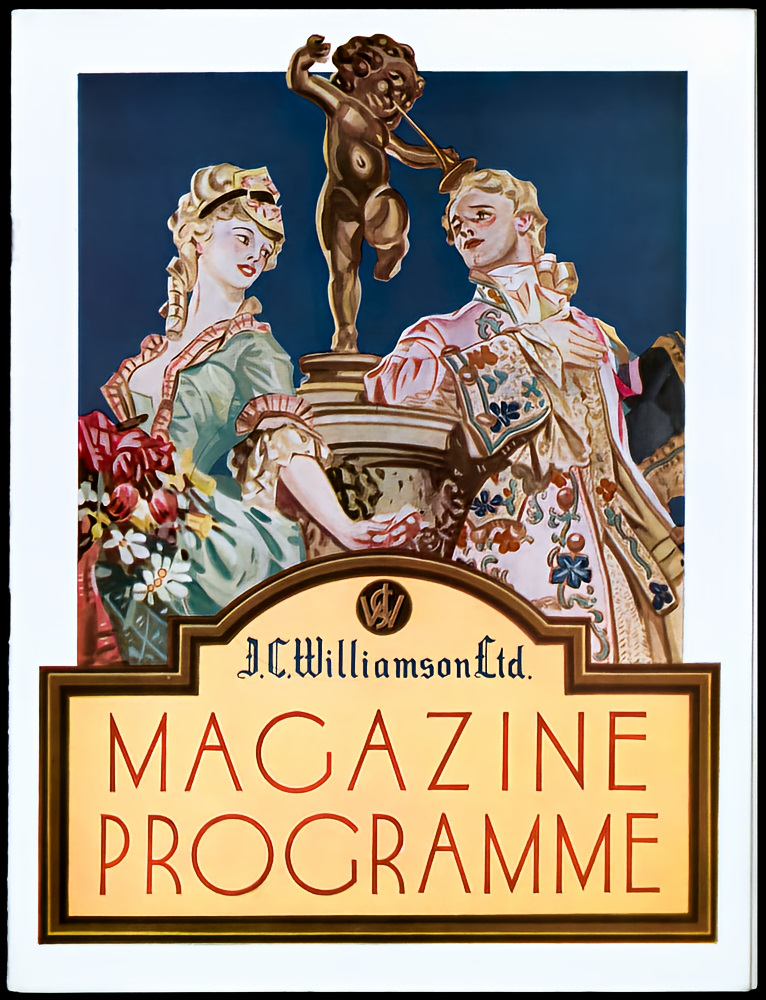
- The Mikado – Saturday, 27 June to Friday, 3 July (matinees on Mon., 29 June {King’s birthday} & Wed., 1 July)
- Ruddigore – Saturday, 4 July (matinee) to Friday, 10 July
- The Pirates of Penzance & Trial by Jury – Saturday, 11 July (matinee) to Monday, 13 July
- Iolanthe – Tuesday, 14 July & Wednesday, 15 July (mat. & eve.)
- Patience – Thursday,16 July & Friday, 17th July
- Princess Ida – Saturday, 18 July (matinee) to Friday, 24 July 1936
- The Gondoliers – Saturday, 25 July (mat.) to Friday, 31 July
- H.M.S. Pinafore & Cox and Box – Wednesday, 5 August (mat. & eve.) to Saturday, 8 August (mat.)
- The Yeomen of the Guard – Saturday, 8 August (eve.) to Tuesday, 18 August
- The Mikado – Wednesday, 19 August (mat. & eve.)
- The Pirates of Penzance & Trial by Jury – Thursday, 20 & Friday, 21 August
- Paul Jones (Planquette) (Gala premiere for the G&S tour) – Saturday, 22 August (mat.) to Saturday, 29 August 1936
* * * * * * * * * * * * * * * * * * * *
"Gagging" in the G&S operas, of which Ivan Menzies was the chief culprit, continued to receive coverage in the Melbourne Press - both pro and con.
* * * * * * * * * * * * * * * * * * * *
TRADITIONS OF GILBERT
"Horrors" of Gag
Savoyards' Conflict
Is the Savoy tradition a myth? Does "gagging" by a comedian in Gilbert and Sullivan opera cause anyone that intense suffering which humorists delight in depicting? The buzz that may be heard in the foyer after one of the current performances of "The Mikado" leaves no doubt that the audience has recognised the substitution of "crooning serenader" for "nigger serenader" in Ko-Ko`s "little list," but is the general opinion really hostile to these topical alterations in Gilbert’s libretto? At least, no one has yet walked out as a protest against the jazz effects in the encore to "The Flowers That Bloom in the Spring." On the other hand Mr Frank Tate, former director of education and a Savoyard of the old school, admits that he has not attended a Savoy revival for years because the increasing tendency to "gag" has done violence to his memories of the performances of Vernon, Woodfield, Forde, and the rest. Doubtless there are others like him.
"The essence of the Gilbertian method was to treat absurd situations with a gravity that intensified their absurdity," Mr Tate said yesterday. "As soon as they are burlesqued, they lose their zest. In later years even Howard Vernon had a tendency to fall from grace in this respect. Therefore I prefer my memories of the Savoy operas as they were."
If Howard Vernon's departure from pure Gilbertian gesture annoyed Mr Tate and those of his mind, what anguish they would suffer if they saw "The Mikado" as presented in San Francisco in 1931, with three conjuring acts and a vaudeville turn included in the "business." Professor G S Browne, another educationist of note who is also a Savoyard, saw this performance, and he described it last night with horror in his voice. "I have seen all the operas performed in England, and I have become so accustomed to the D'Oyly Carte tradition that when a local allusion is plunged into the middle of any of the numbers I jump about a foot." He said. "Nevertheless I realise that it is not much good trying to make jokes in Australia about the chief of the London Fire Brigade of 50 years ago, and I believe that slight and judicious introduction of local and topical allusion is justifiable; it might even help to keep the operas alive, but it must be done very judiciously and very skilfully."
Mr Menzies, whose performance of Ko-Ko has set the foyers buzzing, has a ready reply to his critics. "It is part of the Savoy tradition to criticise Ko-Ko," he says. "It is done with all the companies in England and I play Ko-Ko as I learnt to play it there under J M Gordon. I am confident that Gilbert continually altered his topical allusions as the original ones staled, and I believe that he would continue to do it if he were alive now."
Against this defence we have the statement of the president of the Gilbert and Sullivan Society (Professor E W Skeats) that Gilbert insisted upon strict adherence to the libretto although he permitted one or two alterations in the provinces comparable with the "Little Bourke Street" which has the sanction of custom in performances of "The Mikado" in Melbourne.
"The Savoy operas are products of the Victorian era," Professor Skeats said. "They are classics, and they should be kept within the restrained limits of their era, otherwise they degenerate into mere musical comedy or farce or revue."
The Argus (Melbourne), Tuesday 30 June 1936, p.8 – https://trove.nla.gov.au/newspaper/article/11045873
* * * * * * * * * * * * * * * * * * * *
Letters to the Editor
Traditions of Gilbert
Sir, Playgoers are apt to forget that the success of "The Mikado" was, and is, due to the music, not the libretto. When, therefore, it is revived, something must be done to pep up the play. If ever a part was open to gagging it is that of Sir Joseph Porter in "Pinafore," yet Mr. Ivan Menzies makes him a character almost of pathetic dignity. The acid humour of Gilbert belongs to a generation which has almost passed away. Sullivan's music formerly interpreted is a joy for ever. Yours, &c.
SENEX.
July 4
The Argus (Melbourne), Tuesday 7 July 1936, p.8
* * * * * * * * * * * * * * * * * * * *
The Melbourne G&S season concluded with a revival of the 1889 comic opera Paul Jones (music by Robert Planquette, English adaptation by H.B. Farnie, based on Surcouf by Henri Chivot and Alfred Duru), making its debut on the tour, directed by Minnie Everett (who had also directed the previous JCW revival of the opera in 1915), with musical direction by Will Quintrell.
* * * * * * * * * * * * * * * * * * * *
PAUL JONES IS A WOMAN
THE title role of Paul Jones will be played at His Majesty's today by Evelyn Ilall, who, after intensive training under the guidance of Minnie Everett, went into the Gilbert and Sullivan Opera Company a few months ago, and filled a number of roles with remarkable success.
Paul Jones was originally written for a woman, but several men have appeared in the role. Bernard Manning. the skipper of the Yankee privateer in the present revival, claims the distinction of having been the first male Paul Jones in England. His voice was lighter then.
Minnie Everett, the producer, says that male portrayers of Paul Jones have not been nearly as satisfactory as women in Australian productions.
Florence Young appeared in the last revival in Melbourne in 1915.
Much depends on the public's reaction to this old comic opera.
Mr Frank S. Tait, a managing director of J. C. Williamson Ltd., says that if "Paul Jones" is successful, the Firm will present the Gilbert and Sullivan Opera Company in a number of good old operettas and comic operas next year.
J. C. Williamson Ltd. does not want to disband the company when it has completed its present tour, Mr Tait says, but it will not present Gilbert and Sullivan opera again for three years. If the public wants other productions which were formerly very successful it will get them. The run of "Paul Jones" will be regarded by the Firm as a guide to the support which would be given to other productions of a similar type.
The Herald (Melbourne) Saturday, 22 August 1936, p.20
* * * * * * * * * * * * * * * * * * * *
New Shows Reviewed
By "THE ARGUS" CRITICS
His Majesty's
"PAUL JONES"
Naive Entertainment
The members of the Gilbert and Sullivan Opera Company are to be congratulated upon the enthusiastic industry with which, in the revival on Saturday afternoon of Planquette's musical extravaganza “Paul Jones," they sang fought, danced, exchanged well-worn jokes, and manufactured new ones. Much of the humour is of an elementary order. The brightest moments are those in which Mr Clifford Cowley and Mr. Tommy Jay rely upon their own comic invention and discuss the traffic problem, slum clearance, and the talents of Adrian Quist,
It is fortunate for this naive entertainment that Planquette's music still retains its easy charm. A feminine 'hero," who unites the attractions of the traditional pantomime boy with the noble qualities and dazzling wage-earning capacity of the best fairy prince, is too incredible a figure to engage the sympathies of a realistically minded audience of 1936. Miss Evelyn Hall had only to sing, however, and artificialities were forgotten. The contralto was in excellent voice, and achieved immediate and well-deserved success. Another good performance was given by Miss Helen Langton, who sang and acted prettily as the faithful Yvonne. Miss Eileen Kelly was a conscientiously vehement Chopinette, but less exaggerated methods would have produced more convincing results. Mr. Richard Watson contributed a well prepared character study of the garrulous Bicoquet. and looked magnificent in a sombrero of cart-wheel dimensions. The Spanish Governor is so preposterous a figure as to provide small opportunities for dramatic skill.
A combined long-high jump, by which Mr Ivan Menzies arrived on the shoulder of the stately Mr. Godfrey Stirling, was, however, a cheery interlude which delighted the audience by its suggestion of Olympic qualifications. As the worthless rival of the heroic Paul, Mr Stirling never looked a possible winner. This scheming traitor was obviously resigned to his fate, and allowed himself to be trampled upon with good-natured composure. Mr Bernard Manning did all that was possible with the small part of the Yankee skipper, and wore the celebrated "lollipop' trousers with an air. Miss Bryl Walkley appeared for the first time this season as the picturesque Malaquena, and the chorus sang admirably, whether as fishermen, privateers' men, Spanish officers, creoles, American sailors, or ladies of St Malo. The dances were received with much enthusiasm the dressing was bright and colourful, and the orchestra, directed by Mr. Will Quintrell, dealt confidently with the tuneful score.
The Argus (Melbourne), Monday 24 August 1936, p.4

Clifford Cowley

"Tommy" Jay
* * * * * * * * * * * * * * * * * * * *
Adelaide return season at the Theatre Royal
(Musical Director: Leo Packer)
- The Mikado – Saturday, 5 September (eve.) to Thursday,10 September 1936
- H.M.S. Pinafore & Trial by Jury – Friday, 11 September
- Iolanthe – Saturday, 12 (mat. & eve.) & Monday, 14 September
- The Pirates of Penzance & Trial by Jury – Tuesday, 15 September
- The Yeomen of the Guard – Wednesday, 16 (mat. & eve.); Thursday, 17 & Friday 18 September
- The Gondoliers – Saturday, 18 (mat. & eve.) & Monday, 21 September
* * * * * * * * * * * * * * * * * * * *
Perth season at His Majesty’s Theatre
(Musical Director: Leo Packer)
- The Gondoliers – Saturday, 26 September (eve.) to Thursday, 1 October 1936
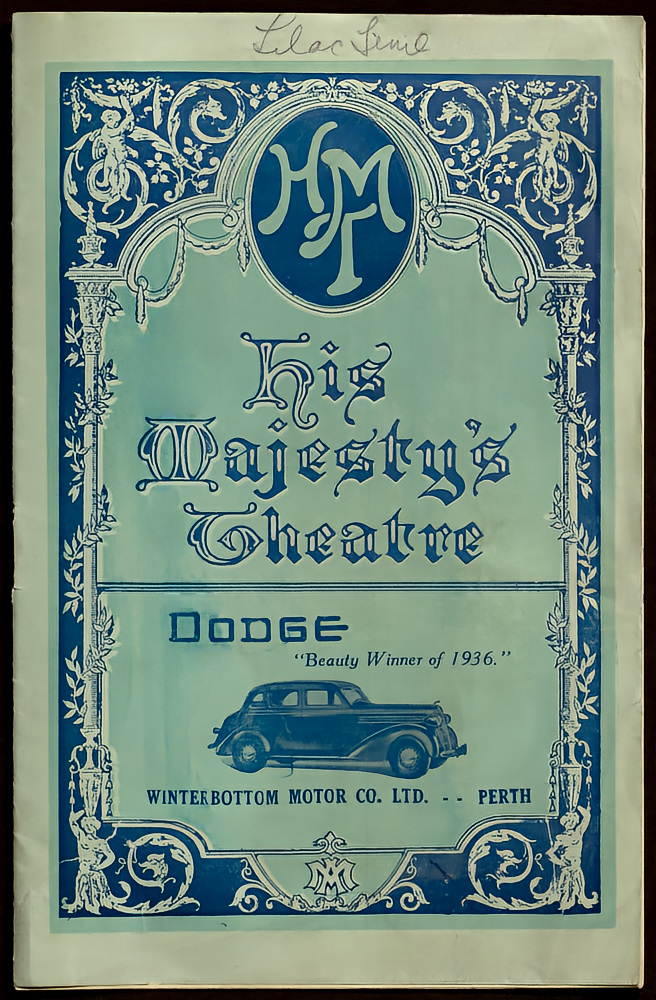
- H.M.S. Pinafore & Trial by Jury – Friday, 2 October
- The Pirates of Penzance & Trial by Jury – Saturday, 3 October (mat. & eve.) to Tuesday, 6 October
- The Mikado – Wednesday, 7 October (mat. & eve.) to 13 October
- The Yeomen of the Guard – Wednesday, 14 October 1936 (mat.) to Friday, 16 October
- Iolanthe – Saturday, 17 October (mat. & eve.) & Monday, 19 October 1936
- Lilac Time (Gala premiere for the tour) – Tuesday, 20 October to Friday, 23 October
- Paul Jones – Saturday, 24 October (mat. & eve.)
* * * * * * * * * * * * * * * * * * * *
Gregory Stroud took over the title role of Paul Jones from Evelyn Hall for the Perth season and retained it for the rest of the tour.
* * * * * * * * * * * * * * * * * * * *
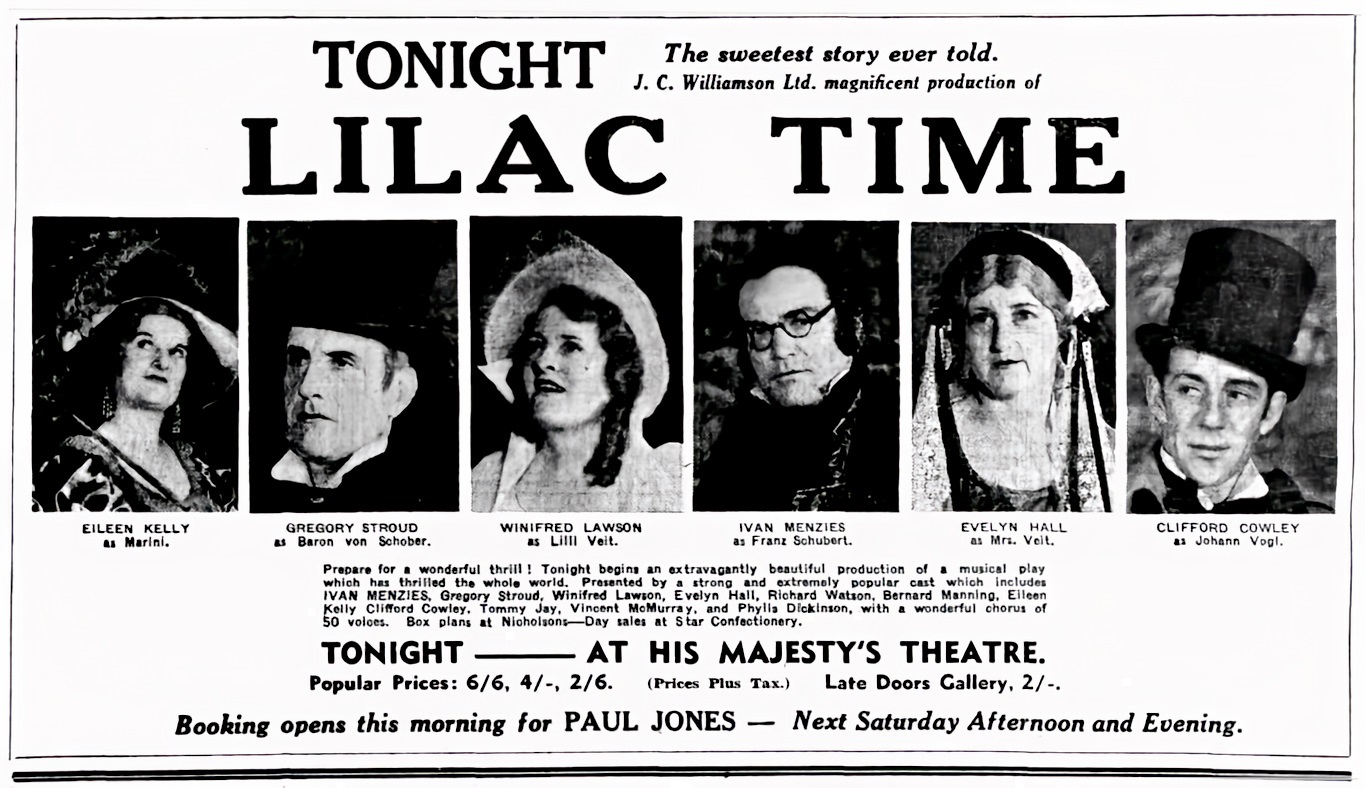 The Western Australian (Perth), Tuesday, 20 October 1936, p.2
Lilac Time was revived in the repertoire of the G&S company during its Perth season, with Winifred Lawson as Lili Veit, a role that she had first played on the British provincial tour of the piece in 1928. The operetta had previously been revived as part of the G&S company’s repertoire during its earlier Australian tour in 1932– 1933 and Gregory Stroud, Bernard Manning and Clifford Cowley reprised their respective roles of Baron Franz von Schober, Christian Veit and Johann Michael Vogl that they had played on that tour. But Ivan Menzies, who had played the comic detective Novotny in the earlier production, was now cast in the sympathetic role of Franz Schubert; a radical departure for the company’s principal comedian duly commented upon in the Perth newspaper reviews.
Tap here and here to view the Perth cast list for Lilac Time, and here to view the remaining Musical Numbers.
* * * * * * * * * * * * * * * * * * * *
“Lilac Time's” Charm
Departing from its Gilbert and Sullivan repertoire last night, the J. C. Williamson Company played “Lilac Time” to the evident satisfaction of yet another big house at His Majesty's Theatre.
This colorful “play with music by Franz Schubert,” as the programme labels it, takes daring liberties with the life story—so tragically brief—of the great Austrian composer, whose 600-odd songs were but a part of the amazing musical output of his 31-year existence.
The arrangement of the many sweet Schubertian melodies which the joint authors of the piece have interwoven in the score is, like the biographical side of the play, distinctly unconventional. The general effect, however, is the provision of an entertaining blend of operetta and musical comedy, and as in 1933, when Perth last saw and heard “Lilac Time,” the tunefulness and ingenuous humor of the production were gladly acclaimed last evening.
MENZIES' NEW ROLE
With affectionate memories of the late John Ralston in the role of Franz Schubert, the bulk of the audience had doubtless indulged in puzzled speculation as to how Ivan Menzies, thought of so happily in terms of Koko, the Duke of Plaza-toro, Jack Point, the Lord Chancellor, and so on, would manage to acquit himself in the antithetical role of the Viennese composer. The answer to the problem was an agreeable surprise. Mr. Menzies admirable restraint and delicate handling of the mild-mannered and absurdly altruistic Schubert of “Lilac Time” might have impelled a newcomer to the theatre to think that the little actor had never essayed to play the “private buffoon” or the “lord high executioner.”
Vocally Mr. Menzies did remarkably well for one who is customarily a purveyor of “patter” songs. His rendering of the “Tit Willow” ditty in “The Mikado” had certainly hinted at more than a little sweetness in his voice, and last night this fleeting impression was amplified in his creditable treatment of “Hark, Hark the Lark,” “Underneath the Lilac Bough” and other numbers.
Mr. Gregory Stroud made a brave figure as the poet, Baron Franz von Schober, whose task of deputising for the timid Schubert as singer of a love song leads to such distressing complications for the composer. Mr. Stroud's fine baritone was heard to particularly good effect in the lovely “I Carve Her Name in Every Tree.”
Misses Winifred Lawson, Nina Robbins and Phyllis Dickenson sang and acted charmingly as the three daughters of Christian Veit, and Mr. Bernard Manning supplied much broad humor as their father.
Miss Eileen Kelly was duly exotic as Marini, and Messrs. Frank Birmingham, Clifford Cowley and Vincent McMurray were capital boon companions of Schubert. Mr. Tommy Jay got many a laugh as a comic detective.
The old-world setting and costuming of the piece were well carried out, and the orchestra handled the tuneful score excellently.
“Lilac Time” will be presented for three more nights, and on Saturday 'Paul Jones' will be staged.
The Daily News (Perth, WA), Wednesday, 21 October 1936, p.3
* * * * * * * * * * * * * * * * * * * *
"LILAC TIME."
Performance at His Majesty's.
(By Neville Cardus.)
The present writer has heard "Lilac Time" in several cities of Europe, and it was a curious experience to listen to the music in Perth, far from Vienna. I went to His Majesty's Theatre last night resigned to the worst—and the worst always occurs when indifferent artists do their best. Last night's performance was, all things considered, surprisingly good. A small orchestra, shorn of one or two parts, played well enough, though no orchestral player not a Viennese can get the lift of the Landler Waltz, any more than a Viennese instrumentalist can play an Irish jig. These things are racial.
The acting was agreeable, despite much unnecessary overacting by people who could surely afford to play within themselves. Art is bad when it is in italics—like the letters of Queen Victoria. Mr. Ivan Menzies achieved a tour de force. It is well known that all comedians have secret ambitions towards romance or tragedy, much as all tragedians wish to be comic. Dan Leno wanted to play "Hamlet" (which no doubt he would have done), and Henry Irving never enjoyed himself so much as on the occasion when he fooled about in an adaptation of the "Pickwick Papers"; his part was Jingle, and he sat on his own hat and made himself laugh immoderately.
Mr. Menzies avoided the issue, so to say; he left the bowling alone. He has not a tenor voice; sometimes he has no voice at all—that is, speaking of voices from the vocal point of view. Schubert in this light opera should be sung by a tenor; Mr. Menzies sang it rather as Schubert himself probably did. No great composer has ever had a voice. Mr. Menzies was a model of discretion; he was restrained and skilful in judging what he could and what he could not do. The opera travesties Schubert, makes him into a milksop, wallowing in nauseating sentiment—Schubert, mind you, one of Vienna's gayest sons and lovers in a great period. It was not Mr. Menzses's fault, but the fault of the authors who arranged the libretto, that Schubert last night seemed a man more capable of composing the songs of Tosti, than the C major quintet and the C major symphony. With admirable taste, Mr. Menzies conformed to the moonshine of Willner and Reichert, the perpetrators of the llbretto. It is worse in English than it is in the original; there is no mistaking the lineage of jokes such as "on this suspicious—I mean auspicious occasion." And "I suspish" instead of "I suspect." All that is needed to force these epigrams home is an umbrella and a red nose. Mr. Bernard Manning, as Christian Veit—the funny man of the piece—missed no chance: he hit them for sixes. The old school of musical comedy humour knew its job, and always gave us half an hour's notice of the approach or advent of a joke. Mr. Manning could easily practice reserve; but he has gusto, feels the breadth of his conception, and enjoys himself.
World's Greatest Love Songs.
The other parts were admirable, more or less. The last time I heard and saw Miss Winifred Lawson was in Gilbert and Sullivan during a foul week of fog in Manchester. She is naturally singing better in Perth than all the archangels in Heaven could sing in Manchester. Her interpretation of Lilli is charming. Mr. Gregory Stroud sang well as Schober; he has the privilege of singing one of the world's greatest love songs "Ich schnit es gern in alle rinden ein" ("I Carve Her Name in Every Tree"), a song which this opera rips from its context, as it does many other airs of Schubert. The song comes in the cycle of "Die schone Mullerin," and I can only hope that "Lilac Time" has the effect of driving many people to the unadulterated source of Schubert himself.
'"Lilac Time" is a pleasant and enjoyable musical play; the score is an ingenious pastische, and if you do not know Schubert well, it can be listened to without qualms. None the less, the "arrangers," for all their dexterity, commit sins almost unforgivable. The opening of the "Unfinished" Symphony is suddenly decapitated, and we are plunged into the most hackneyed of the "Moments Musical." The worst, offence is the mess that is made of "Wohin"; last night I did not hear the equally heinous transformation of the first song of the "Winterrelse" cycle into a waltz. Given the accommodating point of view, "Lilac Time" is, as I say, a charming piece of work; but in fairness to the memory of Schubert "Lilac Time" should be regarded as little more than a musical comedy in which the hero could with ample point have been called Horace Vere de Vere, or the Austrian equivalent of such a name. Schubert was a gay spirit on the surface; underneath he understood the tragic sense of life, as any fool could understand from one hearing of his Goethe settings. It is fantastical to represent Schubert as a weakling, who allows another man to make love for him, and then when he is rightly thrown over, slobbers to the audience: "Others have life and love; I have my music." Schubert composed the finale of the C major symphony, one of the most masculine and powerful things in music.
In their various parts, we were given excellent work by Vincent McMurray, Frank Birmingham, Clifford Cowley, Phyllis Dickinson, Nina Robbins, Evelyn Hall, Eileen Kelly, and Tommy Jay. The settings, and dresses were adequate; but I did not recognise the Prater in Act III; probably it was different in 1826 than it was when I walked through it a few weeks ago. Mr. Leo Packer conducted with much sensibility an orchestra with a piano in it.
The West Australian (Perth, WA), Wednesday 21 October 1936, p.20
* * * * * * * * * * * * * * * * * * * *
Sydney return season at the Theatre Royal
(Musical Director: Andrew McCunn)
- The Gondoliers – Saturday, 31 October (mat. & eve.) to Friday, 6 November 1936
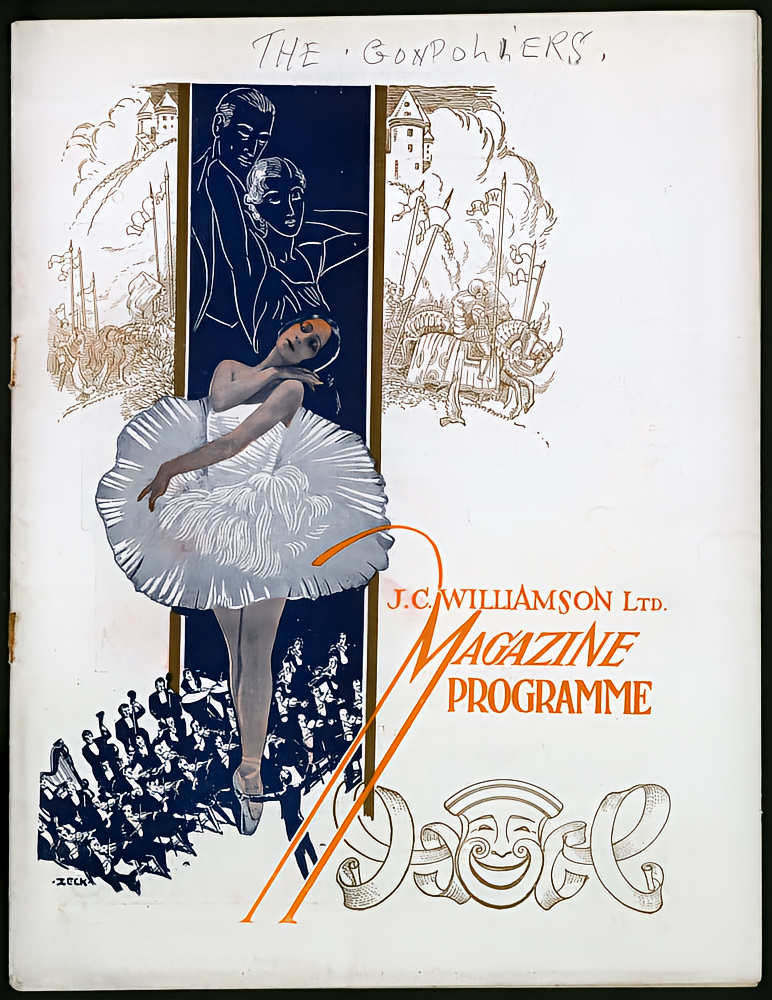
- The Yeomen of the Guard – Saturday, 7 November (mat. & eve.) to Friday, 13 November
- The Pirates of Penzance & Trial by Jury – Saturday, 14 November (mat. & eve.) to Friday, 20 November
- Princess Ida – Saturday, 21 November (mat. & eve.), Monday, 23 & Tuesday, 24 November
- H.M.S. Pinafore & Cox and Box – Wednesday, 25 November (mat. & eve.) to Friday, 27 November
- The Mikado – Saturday, 28 November (mat. & eve.) to Friday, 4 December
- Ruddigore – Saturday, 5 December (mat. & eve.), Monday, 7 & Tuesday, 8 December
- Patience – Wednesday, 9 December (mat. & eve.) to Friday, 11 December
- Iolanthe – Saturday, 12 December (mat. & eve.) to Thursday, 17 December
- The Mikado – Friday, 18 December
- Paul Jones – Saturday, 19 December (mat. & eve.), Monday, 21 & Tuesday, 22 December
- The Mikado – Wednesday, 23 December (mat. & eve.)
The G&S company then departed for its second tour of New Zealand on 24 December, but without Winifred Lawson, who chose not to renew her contract. Australian soprano, Strella Wilson was engaged to play the principal soprano roles for the remainder of the tour, which she had previously played on the JCW G&S Opera Company's Australasian tours of 1920–22 and 1926–28.
Colonel de Basil's Monte Carlo Russian Ballet commenced its Sydney season at the Theatre Royal on Saturday, 26 December with a triple-bill of Les Sylphides, Scheherazade and Aurora's Wedding, and remained at the theatre for the next two months performing its repertoire of ballets, which concluded on Friday, 26 February 1937.
Winifred remained on holiday in Sydney until late February, giving a radio recital of French songs for the ABC from the 2FC studios on National relay on Tuesday, 16 February at 9.30 p.m., with a further broadcast of ballads from station 2BL on Sunday, 21 February at 9.05 p.m..
Sydney telephone directories of the 1930s (digitised on Trove), do not list any hotel known as the "Garden Club", which was most likely a mistaken reference by Winifred to the Clifton Gardens Hotel at Mosman overlooking the harbour that she misremembered when writing her memoirs in the early 1950s.
TRAVELLERS
List of prominent passengers per m.s. Neptuna, leaving Sydney at 11 a.m. to-day for Hongkong, from No. 22 Pyrmont: — Miss Winifred Lawson, operatic singer, lately with J. C. Williamson. Travelling to United Kingdom, via China, Japan and America…
Daily Commercial News and Shipping List (Sydney), Wednesday, 24 February 1937, p.4
* * * * * * * * * * * * * * * * * * * *
Postscript:
In the opening paragraph of chapter 23 of her memoirs (on page 184), Winifred Lawson wrote:
‘Came the War,’ as they say in the films. Earlier in the year I had decided to go back to Australia and had made all the necessary arrangements. My flat was let—my furniture was to put into store—and my luggage was packed ready for me to sail on September 8, 1939. But when war was declared, on September 3, all my plans had to be changed. I felt my own country was the place for me in war-time.
Winifred did not specify whether her proposed return to Australia was prompted by an invitation by J.C. Williamson’s to head the company’s next mooted tour of G&S revivals (which did not commence until mid-March of 1940 at the Theatre Royal, Sydney with Viola Wilson as principal soprano), or whether she was returning under her own steam for a possible concert tour, but in the event she did remain in Britain during the war years and performed on tour in concerts under the auspices of ENSA (Entertainment National Services Association), and CEMA (Council for the Encouragement of Music and the Arts – precursor to the later Arts Council of Great Britain), and later joined an ENSA concert party taking classical music to the troops stationed in Egypt, Africa and the Middle East. Winifred’s 1935– ’36 tour with the JCW G&S Opera Co. thus marked her sole visit to Australia and New Zealand.
* * * * * * * * * * * * * * * * * * * *
Additional Picture Sources
Digitised Theatre programme scans from the National Library of Australia, Canberra