Leo Packer
-
A Song to Sing-O! Downunder - Part 2

 Following a season of just under 17 weeks at His Majesty's Theatre, Melbourne, the J.C. Williamson G&S Opera Company members took the train to Sydney to commence the next stage of their Australasian tour at the Theatre Royal, as WINIFRED LAWSON related in a further chapter of her autobiography A Song to Sing-O! published in 1955.
Sydney—mainly about people
EVENTUALLY we left Melbourne for Sydney with its more Americanized atmosphere. Many places in Australia, districts, streets and flats are called after places in England. My first address in Sydney was 'Hampton Court, King's Cross.' My brother said he was afraid of getting mixed up and writing to me at 'Buckingham Palace, Euston.' I moved afterwards to the Garden Club, where I had a room overlooking the wonderful Sydney Harbour.
 Members of the JCW G&S Opera Co. arrive at Sydney Central Station from the Melbourne express, including Winifred Lawson(centre), Helen Langton (left), Eileen Kelly (right - in spotted dress), next to Gregory Stroud, with Godfrey Stirling(at the far right). (photo by Sam Hood, Mitchell Library, Sydney)
At first I didn't care for Sydney as much as Melbourne. For one thing the weather was now very hot and the damp heat very trying. One day we had lunched in the pleasant coolness of an air-conditioned restaurant in town. As I opened the door to come out into the street, the hot air rose from the pavement like a blast from an oven in which the Sunday joint is cooking.
Andrew MacCunn was to conduct the orchestra during our Sydney season, and that of course meant extra rehearsals. But whenever we could escape, we rushed off to one of the many beaches in the harbour and lay basking on the sand among the throngs of bronzed Australians, or plunged into the sea.

 The G&S company in rehearsal with Godfrey Stirling and Gregory Stroud at front stage - "We're called gondolieri" (photo by Sam Hood, Mitchell Library, Sydney)
One wonders when the men do their work, for at hours of the day you saw hundreds of them, obviously habitues of the beaches, their bodies tanned dark brown by the sun, lying about the sand, or riding the great breakers on a surf board or boat. Perhaps they burnt the midnight oil to make up for it.

WALKABOUT, 1 November 1935, p.22
But one couldn't just bathe anywhere, as in England, because of the sharks. On all the main beaches there was a 'shark patrol,' a team of men trained in life-saving, whose job it was to keep a look-out. Generally an aeroplane would patrol the beaches, and if they saw a shark they would drop streamers, or make some kind of prearranged signal, whereupon the man on duty on the beach would ring a bell, and all the bathers would dash hurriedly ashore.
Carnivals were held during the summer, when teams from all the different beaches—Palm Beach, Bondi, Manley, etc.—would parade in their distinctive bathing costumes, and compete in life-saving contests and surf-boat riding: a really magnificent spectacle.

It was strange to spend Christmas in the height of the Australian summer. The heat became more and more exhausting, especially on days when there was a high humidity, and the hotter it grew, the more rehearsals Minnie Everett arranged. As we played one opera we rehearsed the next, and at Christmas time there were extra matinees. Never shall I forget playing Ida with the temperature somewhere in the hundreds—wearing chain armour and a heavy cloak of thick white fur.
But after all the operas in the repertoire had been gone through for the Sydney season, we had a little more free time and were able to enjoy the many pleasures Sydney had to offer.
We all went to the Zoo one day, to have some un-conventional photos taken for the papers. They had arranged all sorts of stunts for us to do. Eve Gardiner lay on the ground while the elephant walked over her without touching her recumbent and somewhat flinching form. I was photographed sitting on the elephant's bent knee with his trunk wound round my waist. Richard Watson sparred with the kangaroo, who boxed like a man. And Gregory Stroud sat astride the elephant's trunk while he hoisted him up into the air. That looked to me the best fun of all. 'Oh! I'd like to try that,' I said, 'but not for a photo.' 'Well you'd better sit side-saddle,' said the attendant. But I was afraid I'd fall off, so I too sat astride; and in spite of my protests, click went the cameras as the elephant wafted me aloft.
Funnily enough, I never saw a rabbit all the time I was in Australia, though had we been able to get away from the towns on to a sheep or cattle station I've no doubt we should have seen plenty, as in the country they are a serious pest.
Nor did I ever see a kangaroo, except in the Zoo, though I saw many of the smaller varieties, the wallabies. But it was a real thrill to see brilliantly-coloured parrots in their natural surroundings, and to hear the Kookaburra laughing away like a human being in the trees.
Gregory Stroud, always very public-spirited, used to collect sixpence a week from every member of the company. When he had the requisite amount of money he organized a day's outing for the whole company. He chartered a launch to take us up the Hawkesbury River and we bathed and played cricket and had lunch on board and sailed up the river through the most glorious scenery imaginable.

The Hawkesbury River is famous for its oysters, which are very delicious as well as being very cheap. At the time we were out there you could have a plate of a dozen oysters for 1s. 6d., with coffee and brown bread and butter included. Looking back now it seems incredible.
Richard Watson had a great partiality for oysters, and one day ordered a dozen to be sent to his dressing-room during the interval of The Mikado. Unlike most people, he liked salt with them which of course was not provided. Looking round the room, which he shared with a fellow artiste who shall be nameless [Shh! – Bernard Manning], he saw what he took to be a salt-cellar on the dressing-table. He sprinkled some on his oyster but it didn't seem to add to the flavour, so he gave the next one a double dose, which again had no effect. Then he examined the salt-cellar more closely and found to his dismay that it was a sort of powdered cement used for keeping false teeth in position!
This reminds me of an incident that happened one night when I was playing Princess Ida. King Hildebrand, very warlike in full armour, has come with an army to rescue his son Prince Hilarion from his dungeon cell. The Princess, backed by her Amazons, defies him. I had just snapped my fingers in his face as he stood on the footlights, and as I turned to sing to the girls, 'Deny them! We will defy them!' I saw that the whole chorus was convulsed with laughter. Fortunately for my own composure I hadn't seen what had upset them. But it appeared that Hildebrand, as I snapped my fingers in his face, had growled at me so fiercely through his beard that he blew his false teeth out. They just missed me as I turned to the girls, he caught them in mid-air, turned his back on the audience and put them in again before anyone except perhaps those in the front row of the stalls had realized what had happened.

Winifred Lawson as 'Princess Ida'

Winifred Lawson in 1922
Australian hospitality is famous the world over, and the people of Sydney certainly did their best to see that we fully appreciated their beautiful city.
The worst of travelling is that one meets so many people and makes so many friends, from whom one is for ever after cut off by vast distances. How often have I longed to be able to pop over to Australia for the weekend, just to have a chat with the people who for a year or so were a part of my everyday life! One does one's best to keep in touch by letters, but these are a poor substitute for the actual contact. There are exceptions, of course.
There were Commander (now Rear-Admiral) Brownfield ('Brownie' inevitably), and his wife Sylvia, whom I first met in Sydney. Being naval folk I ran into them later at various times in all sorts of unexpected places. In Alexandria, for instance, I spent a weekend with them during a war-time ENSA concert tour.
I am reminded of a cocktail party to which I was invited some years later—after the war—when Brownie was Captain of the Naval College at Greenwich.
It was a large party of a hundred or so guests, none of whom I'd previously met. But Brownie and Sylvia, being the world's best hosts, saw to it that I was introduced to all the people with whom I'd have the most in common. I was enjoying myself very much, when I realized my nose was probably in need of a little powder. I searched in my hand-bag for my compact, and as I took it out something fluttered to the carpet. A naval officer retrieved it, and with courtly grace and a smiling, 'I think you've dropped something,' handed me—a piece of toilet paper!
What fun it can sometimes be to be 'not so young.' In my teens, this would have caused me the most acute embarrassment. I should have blushed and stammered and been generally covered in confusion. As it was the incident and my explanation caused such laughter, I was the success of the party, and was invited to stay on to dinner, after the rest of the guests had departed.
But to return to Australia and pre-war days.
One day when they were giving an opera in which I didn't appear, I was engaged to do a broadcast from a radio station in the Blue Mountains. It was getting dark as I motored there, so I missed seeing the panorama from the mountain road. And by the time I came back to my hotel from the studio it was quite dark. So there was nothing to prepare me for the magnificent sight that met my eyes when I drew the curtain and looked out of my window next morning.
I positively gasped. The hotel was built on the top of a ridge of mountains. (From my window it seemed to be on the edge of a steep precipice) with a deep valley below. And beyond the valley stretched range after range of tree-covered mountains. One has heard the expression 'blue distance' and often seen it—but never have I seen such colour as this. Their name, 'Blue Mountains,' couldn't have been more appropriate.
 Travel poster designed by James Northfield - 1930s
While we were in Sydney, news came of the serious illness of King George V, and the people's anxiety was evident. When his death was announced all the shops and public buildings were draped in purple and everywhere flags were flown at half-mast. Almost the whole population appeared in mourning or wearing black arm-bands. The loyalty of the Australians was such that even if it had not been decided to close the theatre, there was not one member of the company who would willingly have played that night.
In time our three months' stay in Sydney came to an end and we left for Newcastle. And again we changed our conductor. This time is was Leo Packer who was to come with us on our tour of New Zealand. Leo was a delightful person, young and with a dry sense of humour. He was of Russian extraction, and very dark, with a large generous mouth, and thick black eyebrows. When Eve Gardiner was first introduced to him, she said in her abrupt manner, 'How do you do? Are you half Turkish?' This tickled Leo, and after that, if he had occasion to write me a note about rehearsals or anything, he used to sign himself 'Ahyoo Arfaturk.'

We stayed at the big railway hotel in Newcastle, amid the smoke and noise of the trains. I could never understand why the hotel had not been built only five minutes' walk farther away and overlooking the magnificent beach with its great waves and white sand. But nobody seemed to bother about the beach, which was built around with little factories and huts and shacks. I suppose it is a case of 'What is one beach among so many?'
While watching these huge breakers one day we saw a great man-eating shark. It came in on a wave, and for a brief moment before the wave broke you could distinctly see the dark sinister shape of the shark through the transucent green water, outlined against the sky.
(To be continued...)
* * * * * * * * * * * * * * * * * * * *
First published in A Song to Sing-O! by Winifred Lawson [Michael Joseph: London, 1955], pp. 145 - 151
* * * * * * * * * * * * * * * * * * * *
Endnotes
compiled by Rob Morrison
 Proscenium of the Theatre Royal, Sydney - remodelled in 1921
The Sydney G&S season at the Theatre Royal commenced with The Gondoliers on the evening of Saturday, 5 October 1935, while all subsequent operas received their first performance of the season at the 2 p.m. Saturday matinees, followed by a “Gala” performance in the evening at 8 p.m. The Gondoliers was succeeded by The Pirates of Penzance and Trial by Jury (26 October to 8 November); The Yeomen of the Guard (9 to 22 November); H.M.S. Pinafore and Cox and Box (23 November to 6 December); Iolanthe (7 to 20 December); The Mikado (21 December to 24 January); Princess Ida making its first appearance on the tour (11 to 17 January); Patience (18 to 24 January); and Ruddigore also made its first appearance on the tour on Saturday, 25 January until Friday, 31 January 1936.
Additional holiday season matinees were given of The Mikado on Thursday, 26 December (Boxing Day); Saturday, 28 December; Wednesday, 1 January and Saturday, 4 January; Pirates on Friday, 27 December; Yeomen on Thursday, 2 January; and Iolanthe on Friday, 3 January 1936 at the reduced prices of 5/-, 3/- and 2/- (= $29.32, $17.59 and $11.73 in today’s currency), with Children half-price. Regular prices for the season were 6/6, 4/- and 2/- for matinees (= $38.11, $23.45 and $11.73); 7/-, 4/6 and 2/6 for week nights (= $41.04, $26.38 and $14.66); and 8/-, 5/- and 3/- for Saturday nights (= $46.90, $29.32 and $17.59), plus tax..
The season concluded with revivals of The Gondoliers on Saturday, 1 February (Matinee and Evening); Pirates on Monday, 3 February; Iolanthe on Tuesday. 4 February; Yeomen on Wednesday, 5 February (Matinee and Evening); and Mikado on Thursday, 6 February 1936 for a total run of 18 weeks.
* * * * * * * * * * * * * * * * * * * *
The Productions Reviewed
-
The Gondoliers (Saturday, 5th October at 8 p.m.)
Tap hereto view the cast list for the Sydney season.

Evelyn Gardiner as the 'Duchess of Plaza-Toro'
"THE GONDOLIERS."
POPULAR REVIVAL.
In Australia, as in England, the Gilbert and Sullivan operas have become an institution. It is certain that a large proportion of Saturday night's audience at the Theatre Royal knew every bar of "The Gondoliers" in advance. In these days of mechanically reproduced music there can be hardly a person in the community who has not at least a bowing acquaintance with the score, even though he may never have seen the opera on the stage. As for things like "Take a Pair of Sparkling Eyes," they are inescapable.
When operas like these come back season after season, comparisons between one production and another cannot be avoided. In fact, the genuine Gilbert and Sullivan enthusiast thrives on such discussions of relative merit. And so—to come to the point without more ado—it must be set down that the present company, at a general estimate, falls somewhat below the standard of those in earlier years. Even staunch favourites like Miss Evelyn Gardiner and Mr. Gregory Stroud, seemed to have grown a little tired of their parts, and sometimes delivered in routine manner the humorous points that must display zest and sparkle for complete success. The temptation to become off-hand and over-comfortable after years in Gilbert and Sullivan must be very great. Its results were most apparent on Saturday in the first act. The second went with a more convincing swing.
Among the newcomers, the most significant was Miss Winifred Lawson, who appeared as Casilda. Her voice, while not remarkable, was definitely pleasant in quality, and it was obvious that, unlike one or two of her fellow actors, she had had a serious and thorough training in the business of the stage. Her gestures were eloquent and admirably schooled, and she moved with consistent grace, especially in the lovely court dress of act two.
The two contadine, Gianetta and Tessa, were played by Australians, Miss Helen Langton and Miss Eileen Kelly. The former, in particular, showed promise of being a notable acquisition to the Gilbert and Sullivan ranks. Her voice was clear and true; her appearance attractively vivacious.
The Grand Inquisitor was Mr. Richard Watson, a South Australian, who has been singing in England for some years. Vocally, he was equal to the role, but in this case character-portrayal is even more important than voice. In the latter respect he succeeded up to a point. Perhaps it is unfair to him to remember a certain late lamented exponent of the Inquisitor, who made that functionary more interesting. But, in dealing with Gilbert and Sullivan, these comparisons insist on emerging.
The Marco was Mr. Godfrey Stirling. His greatest success was in "Take a Pair of Sparkling Eyes." Otherwise, he participated with acceptable liveliness in such concerted numbers as "In a Contemplative Fashion," though his stage deportment lacked polish. This quartet proved highly popular with the audience. So did the Gavotte, "I Am a Courtier Grave and Serious," which was many times encored. At each repetition Mr. Ivan Menzies, as the Duke of Plaza-Toro, added a few more complicated skips and hops about the stage, until at the last he was running into the wings and emerging again, with a Nijinski-like leap in the background. Mr. Menzies' representation of the Duke seemed somewhat detached in manner, but the bits of business he has thought out and woven into the part are so utterly farcical in themselves that they always rouse a response. Mr. John Fraser appeared as Luiz.
The singing of the chorus was an excellent feature of the production. If Miss Minnie Everett, the producer, could only get to work and make the singers look as though they believed a little more ardently in the sentiments they utter, the effect of the opera would be much enhanced. Mr. Andrew MacCunn directed the musical side of "The Gondoliers," with an orchestra of 25 players.
The Sydney Morning Herald, Monday, 7 October 1935 , p. 2 – http://nla.gov.au/nla.news-article17207245
* * * * * * * * * * * * * * * * * * * *
-
The Pirates of Penzance & Trial by Jury (Saturday, 26th October at 2 p.m.)
Tap here to view the cast list for the Sydney season.
 A rocky sea-shore on the coast of Cornwall with a group of pirates headed by Bernard Manning - "I am a Pirate King" (photo by Sam Hood, Mitchell Library, Sydney)
THEATRE ROYAL
"PIRATES OF PENZANCE."
AN EXCELLENT PRODUCTION.
“The Pirates of Penzance" was produced with a great deal of spirit on Saturday night at the Theatre Royal. The performance was so lively and enjoyable, in fact, that one could scarcely believe this to be the same company which had wandered listlessly through the first night of "The Gondoliers". Not only the actors on the stage, but the orchestra, too, under the baton of Mr. Andrew MacCunn, rose to the occasion surprisingly. This is the best piece of conducting that Mr. MacCunn has done for some time. It had clear definition, good accent, and a contagious zest.
The performance had a special point of interest because it brought forward a young Western Australian singer, Miss Helen Langton, who is on the way to becoming an admirable soprano for light opera. She had appeared as Gianetta in "The Gondoliers" and had won favourable notice, but, except for the famous "Take a Pair of Sparkling Eyes," "The Gondoliers" does not give anyone such sustained opportunities as "The Pirates." "Poor Wandering One" is, of course, the song with which Mabel makes her spectacular entrance, and in this Miss Langton at once caught the fancy of the audience. There were two encores: and there might have been more, had not Mr. MacCunn proceeded determinedly with the next business of the play. Miss Langton has a voice of rich, warm quality, and she used it fluently, particularly in the difficult staccato ornaments to the melody. What is more, her appearance and manner are both attractive. In the duet with Frederic in the second act she won another success, though here the unrelieved mezza-voce singing became a shade monotonous.
The work of the chorus was excellent throughout. The producer, Miss Minnie Everett, had obviously worked hard to embellish the acting of the pirates, of the policemen and of General Stanley's multitudinous daughters with a wealth of picturesque detail. Nothing was overstressed, to distract the eye by too ample a movement, yet the behaviour of each individual was completely convincing. Even the make-up of the pirates was far more skilful than is usual with an Australian male chorus.
Musically, the ensembles were remarkably fine. "Hail Poetry!” in which Gilbert and Sullivan lapse, for once, into a really serious choral number had a brilliant resonance and a keen balance of tone which made it memorable. The audience responded with thunders of applause. One encore was essential and more could have been given had not Mr. MacCunn once again, wisely decided to press on. Too many encores are always unwise. In the long run, they spin out a play, and make it tiresome.
The Frederic was Mr. Godfrey Stirling. Vocally, he was consistently equal to the occasion. "Oh, Is There Not One Maiden Breast?” and the duets with Mabel brought forth a tenor quality unforced, radiant and charming. But Mr. Stirling is, as yet, no actor. Even a little attention to make-up (of which he wore hardly any) would improve matters. Mr. Bernard Manning appearing for the first time during the present season, provided a rousing and full-flavoured impersonation of the Pirate King. In voice, too, he was well equipped. "Oh, Better Far to Live and Die," in the first act, was a sterling achievement. So was Mr. Clifford Cowley's character study as the pirate lieutenant Samuel—a fearsome creature but with traces of odd geniality expressing themselves occasionally through expanses of exposed and variegated teeth. Ruth was played by Miss Evelyn Gardiner, and played with highly acceptable vividness
Mr. Ivan Menzies proved to be at his best as that lonely orphan boy, Major-General Stanley. He filled out the part with a multitude of clever touches neither over-emphasising nor under-emphasising—faults into both of which he falls at different times—but preserving just the right balance for the greatest possible pungency of comic effect. Mr. Richard Watson led the troop of redoubtable London [sic] policemen with many clever strokes of the grotesque. He developed gifts of comedy which had remained unsuspected in "The Gondoliers". Miss Eileen Kelly, Miss Phyllis Dickinson, and Miss Nina Robbins were all graceful and humorous in the parts of Edith, Kate, and Isabel.
"The Pirates of Penzance" was preceded by that delicious satire on law courts and on grand opera, "Trial By Jury. " The whole thing went with a swing, and there were many splendid pieces of comic acting—among them, Miss Eileen Kelly's impersonation of the breach of promise plaintiff; that of Mr. Tommy Jay as the usher; and that of Mr. Richard Watson as the learned Judge. Others who appeared included Mr. Lennox Brewer (the defendant), Mr. Gregory Stroud (counsel for the plaintiff); Mr. Mick Brien (foreman of the jury), and Mr. Don Burnett (the associate).
The Sydney Morning Herald, Monday, 28 October 1935, p. 6 – http://nla.gov.au/nla.news-article17220992
[For London policemen to be on patrol in Penzance in the county of Cornwall on the British south coast would be well outside their regular beat!]
* * * * * * * * * * * * * * * * * * * *
-
The Yeomen of the Guard (Saturday, 9th November at 2 p.m.)
Tap here to view the cast list for the Sydney season.
 Jack Point (Ivan Menzies) attempts to amuse the Lieutenant of the Tower (Gregory Stroud) - "I've jibe and joke" (photo by Sam Hood, Mitchell Library, Sydney)
THEATRE ROYAL
"The Yeomen of the Guard."
Taken at a general view, it cannot be said that Saturday night’s production of "The Yeomen of the Guard" at the Theatre Royal equalled that of "The Pirates of Penzance," which had come before it. Yet there was much to enjoy; and certain aspects were particularly well presented. At any rate, the audience worked itself up into a great state of enthusiasm; and, by the second act, was encoring everything in sight—though it must be remarked that the actors needed little provocation to bring them back to the stage. The great number of repetitions ended by making this last act drag. If Gilbert and Sullivan had thought so many extra verses desirable they would probably have added to the existing text of the play.
Still, for the authentic Gilbert and Sullivan enthusiast, there cannot possibly be too much of a good thing. "The Yeomen" has won itself a specially favoured place in public esteem because its music is more serious and more solid than that of any other opera in the series. Such gems as "When Our Gallant Norman Foes," "I Have a Song to Sing O," and "Were I Thy Bride" bid fair to become immortal. The singing on Saturday night was of a variable order, but more often good than otherwise.
A specially favourable impression was made by Mr. Godfrey Stirling, as the unlucky Colonel Fairfax. Hitherto during the season, Mr. Stirling has seemed a rather gauche and unconvincing actor. But this time—principally because he avoided unnecessary movement—he managed to keep the character quietly poised, yet intensely alive. The dialogue leading up to "Is Life a Boon?" was spoken with a reserve and dignity which greatly enhanced the effect of the song when it came. Vocally, Mr. Stirling was always exceedingly pleasant.
The Jack Point was Mr. Ivan Menzies. If memory serves its purpose faithfully, Mr. Menzies's characterisation is not so significant or so moving as when he last played it in Sydney. Somehow or other, it seems to have lost in sincerity and to be more preoccupied with surface details, such as the quaint attitudes of the Merryman’ s legs. The distress of poor Jack Point at his final entry, when he seems to have become completely crazed, is too exaggerated to be poignant. Still, Mr. Menzies was by no means negligible either as an actor or as a singer, and the part had many passages which were irresistibly amusing. The Elsie Maynard was Miss Winifred Lawson. Though vocally uneven, Miss Lawson portrayed the strolling player with agreeable spirit.
Mr. Richard Watson essayed the role of that dourly whimsical fellow, Wilfred Shadbolt, and made a great success of it. His appearance was calculated to strike alarm into the most intrepid prisoner; and with this fierce background as a foil Wilfred's jokes shone forth with unexampled grimness. Still, it always seems a mistake to make Wilfred too repulsive; for pretty Phoebe Meryll shows signs of marrying him in the end. Phoebe was played on Saturday by Miss Eileen Kelly. At first, Miss Kelly's acting was stilted, but it improved as the play went on, and as one looks back, her performance as a whole is pleasantly remembered. Miss Helen Langton, the other young Australian girl in the company, had only a small part as Kate, but she made it stand out with excellent effect through the delightful clearness and expressiveness of her singing.
Mr. Gregory Stroud gave forceful incisive outline to the role of Lieutenant of the Tower; Mr. Bernard Manning sang well as Sergeant Meryll; and Miss Evelyn Gardiner made a declamatory Dame Carruthers. Mr. Lennox Brewer, appearing as Leonard Meryll, has a promising tenor voice but he still has everything to learn about stage deportment. Mr. Andrew MacCunn directed the orchestra; and Miss Minnie Everett had produced. The two scenic backgrounds proved specially attractive and convincing.
The Sydney Morning Herald, Monday, 11 November 1935, p.6 – http://nla.gov.au/nla.news-article17222159

Godfrey Stirling as 'Colonel Fairfax'

Winifred Lawson as 'Elsie Maynard'
* * * * * * * * * * * * * * * * * * * *
-
H.M.S. Pinafore & Cox and Box (Saturday, 23 November at 2 p.m.)
Tap here to view the cast list for the Sydney season.

Bernard Manning as 'Dick Deadeye'

Richard Watson as 'Bob Becket'
"H.M.S. PINAFORE."
Helen Langton as Josephine.
Sir Joseph Porter, together with his numerous sisters, cousins, and aunts; the villainous Dick Deadeye; Captain Corcoran, who addressed his seamen with such marked respect; the love-lorn Ralph Rackstraw; the equally disconsolate Josephine; that round, red creature, dear little Buttercup—all these and more were gathered on the stage of the Theatre Royal on Saturday night. In brief, the play was "HMS. Pinafore". Strangely enough, for the first time during the present season, some empty seats were to be seen in the auditorium. "Pinafore" does not, like "The Pirates of Penzance" and "The Mikado," delight the eye with pretty costumes. Hebe and her gang of sisters, cousins, and aunts appear in severe cream yachting outfit; and the uniform of a British tar is not calculated to cater for a love of the picturesque. Yet "Pinafore" contains splendid humour, and a great deal of delightful music. There seems to be no reason why this opera should decline in public esteem while its fellows in the series go marching on from triumph to triumph.
Saturday night's performance was the means of Miss Helen Langton winning another substantial success. This young Australian singer has an unusually clear, fluent, and sympathetic voice; her appearance is attractive; and she is obviously applying herself diligently to the cultivation of an acceptable style of acting. As Josephine, "Sorry Her Lot Who Loves Too Well" was her principal test-piece; and the audience delivered its verdict by applauding with might and main. In the trio, "Never Mind the Why or Wherefore," Josephine fluttered to and fro with engaging delicacy and lightness, adding the poetry of motion to the stimulating charm of song.
The Ralph Rackstraw of this season is Mr. Godfrey Stirling. He took the part quietly, and thus emphasised the lyrical feeling in much of Ralph's music. "The Nightingale," with which Ralph makes his entrance, singing plaintively of his passion for the lady so far above him in station, introduced some pianissimo singing of an exceedingly pleasant sort. In the duet, "Refrain, Audacious Tar," both Ralph and Josephine entered fully into the spirit of the scene.
Mr. Ivan Menzies's portrait of Sir Joseph was unfailingly amusing as a piece of grotesque character-study. In the scene where the First Lord hands the Boatswain's Mate a copy of the trio, "A British Tar is a Soaring Soul," he spent several minutes in wordless pantomime, engrossed in the difficulties of handling three sheets of music and a piece of red ribbon at the same time. Towards the end of the second act, he gave free rein to all sorts of bright irrelevant foolery.
As Dick Deadeye, Mr. Bernard Manning achieved a masterpiece of make-up. The twisted hand of this poor creature, his seamed and peculiar face, kept him well in the notice of the audience as a caricature, apart from Mr. Manning's excellent acting. Mr. Gregory Stroud was brisk and business-like as Captain Corcoran. He registered clearly the adverse effects on Corcoran's morale brought about by Sir Joseph's absurd strictures, and sang efficiently the music allotted to him. Miss Evelyn Gardiner was jovial and suitably buxom as Buttercup; Mr. Richard Watson as the Boatswain's Mate and Mr. Clifford Cowley as the Carpenter's Mate both provided many humorous moments; Miss Eileen Kelly made a bright Hebe, and Miss Joyce Mundy was the Midshipmite.
"HMS Pinafore" was preceded by "Cox and Box." In this amusing little extravaganza. Mr. Clifford Cowley had a specially marked success as Cox, the journeyman hatter. The other two actors, Mr. Lennox Brewer (Box) and Mr. Richard Watson (Sergeant Bouncer), both behaved with much gaiety, and the touches of parody—especially the grand operatic leanings of the music—were well dealt with.
The Sydney Morning Herald, Monday 25 November 1935, p.6 - http://nla.gov.au/nla.news-article17218256
* * * * * * * * * * * * * * * * * * * *
-
Iolanthe (Saturday, 7th December 1935 at 2 p.m.)
Tap here to view the cast list for the Sydney season.
 The Lord Chancellor (Ivan Menzies) joins the Peers - "The law is the true embodiment" (photo by Sam Hood, Mitchell Library, Sydney)
"IOLANTHE."
Enthusiastic Audience.
A large audience assembled at the Theatre Royal on Saturday night to greet the revival of "Iolanthe". The popularity of this particular Gilbert and Sullivan achievement was evident in the thunders of applause which welcomed each favourite number. In fact, as the evening went on one realised that every number was a favourite; practically none of the music was allowed to pass without an encore.
After an absence of two weeks, Miss Winifred Lawson returned to the company to play the role of Phyllis. She gave it a good deal of graciousness and charm. More than anyone else in this season's cast she has developed the finesse of stage movement, eloquent yet delicate, natural yet restrained in style. She added to this visible grace a pleasant voice, and thus made the total effect a striking one.
Mr. Gregory Stroud was the Strephon, also good to look upon in his Arcadian silks and satins. The Iolanthe was Miss Eileen Kelly. She sang the part with clearness and good judgment, and made a fine impression in the last scene, where Sullivan has clothed Iolanthe’s plea for Strephon's happiness in some music of serious operatic calibre.
Mr. Ivan Menzies was in great form as Lord Chancellor. Over the fundamental theme of the old man's fidgety dignity and pomp the comedian wove countless variations of foolery, all of them pleasantly adroit. For instance, in the trio, "He Who Shies at Such a Prize," the Chancellor was continually forgetting his exalted rank and performing merry dance steps, until the severe gaze of Earl Tolloller and Earl Mountararat brought him sharply to his senses. Mr. Godfrey Stirling bestowed on Tolloller, together with an arrogant monocle, an air of general superiority and frigidity which made this personage unfailingly amusing. As Mountararat, Mr. Bernard Manning scored a great success with "When Britain Really Ruled the Waves." There was a double encore for this.
Mr. Richard Watson gave an appropriate mellow humour to the part of Private Willis, the sentry, who has to open the second act with "When All Night Long a Chap Remains." Willis's glee and astonishment when his fairy wings grew were something to be genially remembered. Miss Evelyn Gardiner proved a redoubtable and dictatorial Fairy Queen. Her diction is always exceptionally clear and she conveyed the wit of her lines to the audience with great success. Miss Phyllis Dickinson, Miss Nina Robbins and Miss Carmen Burridge were Leila, Celia, and Fleta, the three fairies who lead the dogged "tripping hither, tripping thither" of their innumerable sisters.
The singing of the chorus was a specially enjoyable feature of the performance, as at earlier operas in the season. Under Mr. Andrew MacCunn's direction, the orchestra gave flexible and well-balanced support to the action on the stage. Miss Minnie Everett was the producer.
The Sydney Morning Herald, Monday 9 December 1935, p. 6 - http://nla.gov.au/nla.news-article17234071

Winifred Lawson as 'Phyllis'

Evelyn Gardiner as the 'Queen of the Fairies'
* * * * * * * * * * * * * * * * * * * *
-
The Mikado (Saturday, 21st December at 2 p.m.)
Tap here to view the cast list for the Sydney season.
 Pish-Tush (Gregory Stroud), Ko-Ko (Ivan Menzies) and Pooh-Bah (Richard Watson) contemplate the candidate for a beheading to fulfil the Mikado's edict - "I am so proud" (photo by Sam Hood, Mitchell Library, Sydney)
"THE MIKADO."
An Excellent Production.
The town of Titipu hung out its temple bells on Saturday night; burst into a simultaneous bloom of cherry trees and chrysanthemums, and displayed its quaint civic customs, all to the immense satisfaction of a large audience. "The Mikado" has always been a favourite among the Gilbert and Sullivan series. Presented with a nice taste in kimonos and lacquer, it makes a strong appeal to the eye, as well as to the ear, and the music itself is among the brightest that Arthur Sullivan's facile pen ever committed to ruled paper. At any rate, Saturday’s audience at the Theatre Royal was kept in a constant turmoil of approval. The atmosphere remained more exactly that of a gala performance than has been the case earlier in the season.
As producer, Miss Minnie Everett brought to life her imaginings about the venerable city of Titipu in a way that must captivate both young and old—both the adolescents, who are seeing Ko-Ko and Pooh-Bah for the first time, and the greyheads, who proudly recount that they saw Howard Vernon and W. H. Woodfield as these dignitaries in 1885. When "The Mikado" was newly written, it reflected in comic exaggeration, the life of an authentically existing Japan. Now that the Oriental islands have awakened from their reveries about cherry tree festivals and the tea ceremony, and become active participants in the age of steel and chromium, the play begins to add the melancholy glory of an historical document to its more immediate and visible elements of comedy.
But there was no time on Saturday night for such meditative overtones to intrude themselves. Laughter held the stage from beginning to end. Whether it was the Christmas spirit, or whether "The Mikado" makes a particular appeal to actors as well as to audience, the whole cast seemed to be at the top of its form, and determined to raise the jollity of the proceedings to the third or fourth power. Even in "The Gondoliers," where he reached a certain pitch of extravagance, Mr. Ivan Menzies (the Ko-Ko) had never worked so hard for laughs, nor succeeded in getting them in such grateful volleys. Even his curious little fluttering run across the stage was a triumph of the grotesque, especially when it followed hard on the heels of Mr. Richard Watson's truculently striding Pooh-Bah. One great joy which these two comedians unfailingly provide is an impeccably clear-cut diction. The spectator does not have to spend a conscious effort in listening. Their talk comes rushing out across the footlights to capture him irresistibly by storm. This is the greatest lesson which dramatic visitors from overseas have to impart to Sydney enthusiasts who have some practical association with the theatre.
The Three Little Maids from School were represented with a splendidly picturesque and resourceful eye to decorative grouping, by Misses Winifred Lawson, Eileen Kelly, and Phyllis Dickinson. There were occasions when Miss Lawson's singing of Yum-Yum became a trifle uneven, but her acting possessed such wit and polish and sense of style that the whole characterisation reached a genuinely distinguished level. Mr. Gregory Stroud emphasised the attractive conventionalised attitudes of the fan ceremonial in working out his portrait of Pish-Tush. Mr. Bernard Manning and Miss Evelyn Gardiner gave splendid performances as the Mikado and Katisha.
It was a great night for Mr. Andrew MacCunn. One need not emphasise, at this stage in the season, his admirable training of the chorus. On Saturday, he worked up the orchestra, as well to a singular liveliness and incisiveness of effect.
The Sydney Morning Herald, Monday 23 December 1935, p.3 - http://nla.gov.au/nla.news-article17225842
[In fact, Minnie Everett was responsible for the training of the chorus, as the reviewer had apparently overlooked the fact that the company had commenced its 1935 tour of the G&S operas in Adelaide and Melbourne.]
* * * * * * * * * * * * * * * * * * * *
-
Princess Ida (Saturday, 11 January 1936 at 2 p.m.)
Tap here to view the cast list for the Sydney season.
 King Gama (Ivan Menzies) enquires of Florian (Gregory Stroud) whether his king is a fool, while King Hildebrand (Richard Watson) looks on (photo by Sam Hood, Mitchell Library, Sydney)
"PRINCESS IDA."
A Parody on Feminism.
If the plot of "Princess Ida" has dated to a greater extent than those of other Gilbert and Sullivan operas, the music preserves its old, potent charm. The two soprano songs allotted to the Princess are gems of melody; and the trio for Hilarion, Florian, and Cyril in the second act stands out as one of the jauntiest pieces that Sullivan ever wrote. All this was accepted with joy by Saturday night's audience at the Theatre Royal.
When "Princess Ida" first came to the stage, Tennyson had recently caused some stir by writing "The Princess," a poem which has long since passed down the dark avenues of history. "The Princess" was a Victorian essay in feminism; and it was this early urge towards woman's emancipation which Gilbert set out to parody. In these days, when women are town councillors and lawyers and doctors and analytical chemists, the parody, as well as "The Princess," has lost a good deal of its point. Still, underneath the placid outward surface of "equality," the battle of the sexes continues to rage vigorously in 1936. In many a suburban drawing-room, arguments can be heard concerning the relative intellectual abilities of woman and of man. Thus, although few people can take the general idea of "Princess Ida" seriously any more, some of the individual lines in the play still strike a response. That was obvious on Saturday night, when little ripples of laughter went floating happily round the auditorium.
Miss Winifred Lawson brought dignity and charm of bearing to the part of the Princess. The more one sees of Miss Lawson's work, the more conscious one becomes of her schooling in the great tradition of the D'Oyly Carte productions. Miss Evelyn Gardiner also made the most of every opportunity as Lady Blanche. Her facial expressions were admirable; and the booming, authoritative voice rolled itself richly round the ambitious Blanche's interminable philosophical platitudes. Miss Helen Langton and Miss Eileen Kelly were bright in manner as Lady Psyche and Melissa
The three young men who intrude into Castle Adamant wearing the academic robes of demure young female students were represented by Mr. Vincent McMurray (Hilarion), Mr. Godfrey Stirling (Cyril), and Mr. Gregory Stroud (Florian). Their grotesque antics when they donned the unaccustomed robes were exaggerated a little beyond what the Victorian reserve of Gilbert and Sullivan seems to require; but they were clever, and acceptably animated. The audience, at any rate, seemed to enjoy them hugely. Mr. Richard Watson sang well as King Hildebrand; Mr. Ivan Menzies screwed a good deal of humour from the comparatively short role of Gama; and the three droll sons of Gama, clattering about in medieval harness, were represented by Messrs Bernard Manning, Frank Birmingham, and Chester Harris.
A specially laudable feature of the production was the work of the orchestra, under the baton of Mr. Andrew MacCunn. The instrumentalists succeeded more than once in distracting attention from some weak point in the singing.
The Sydney Morning Herald, Monday 13 January 1936, p.5 - http://nla.gov.au/nla.news-article17216945

Richard Watson as 'King Hildebrand'
photo by Sam Hood, Mitchell Library, Sydney
* * * * * * * * * * * * * * * * * * * *
Discography:
"Now hearken to my strict command''- Richard Watson & chorus (rec. 1932)
"Minereva! Oh hear me"- Winifred Lawson (rec. 1924)
"Audacious tyrant...Since you enquire''- Richard Wastson, Muriel Dickson & chorus (rec. 1932)
"I built upon a rock" - Winifred Lawson (rec. 1924)
* * * * * * * * * * * * * * * * * * * *
-
Patience (Saturday, 18 January 1936 at 2 p.m.)
Tap here to view the cast list for the Sydney season.

Ivan Menzies as 'Reginald Bunthorne'
photo by Sam Hood, Mitchell Library, Sydney

Richard Watson as 'Colonel Calverley"
photo by Sam Hood, Mitchell Library, Sydney
"PATIENCE."
A GENTLE PLAY.
Looking at "Patience" nowadays is like inhaling the fragrance of some old dried lavender that has tumbled out of a drawer. A vanished period and all its pleasant affectations suddenly flash before the mind's eye. Everything moves languidly and remotely. There is a dash of humour; but humour of the gentlest sort. Nothing could be more completely contrasted with the glitter, the outspokenness and the speed of musical plays in 1936, when "anything goes." Strange to think that in bygone days "Patience," by striking topically at the "aesthetic" movement, set the town alight!
Saturday night's production at the Theatre Royal emphasised the comedy's deliberate unhurried gait. The charming and oft repeated melodies allotted to the love-sick maidens maintained their appropriately swooning air until the end. Only once, before that final emergence in dashing mid-Victorian fashions, did the maidens desert their drawling state of trance. That was in the admirable finale to the first act, where Archibald Grosvenor wandered into the scene. With one accord, and with amusing access of animation, the maidens tore themselves from the arms of their dragoon lovers so that they might flock about the poet. The presentation of this finale was decidedly one of the most successful passages in Saturday's version of the play.
The part of Reginald Bunthorne was played by Mr. Ivan Menzies. He had made himself up excellently to represent a character from Murger's "Scenes de Ia Vie de Boheme" transplanted picturesquely into knee-breeches of velveteen. During the early part of the action, Mr. Menzies gave a splendid performance, polished to the utmost in every detail. But as time wore on, as though intoxicated by his own funniness, he began to exaggerate. It has been his chief fault throughout the season. All these squeakings and grimaclngs and roarings undoubtedly amused the audience—and Mr. Menzies sometimes acknowledged the laughter by twinkling at people in the front rows—but they were, undoubtedly a good deal removed from the gracious spirit of the authentic "Patience."
Much quieter, but none the less entertaining, was Mr. Gregory Stroud as Archibald Grosvenor. Mournful and hard-featured, this idyllic poet grotesquely belied his pretensions to facial perfection. Of the three dragoons who turn aesthetic in self-defence, the most amusing was Mr. Clifford Cowley, as Major Murgatroyd. The other two were Mr. Richard Watson and Mr. Vincent McMurray. Mr. Tommy Jay made the most of his fleeting appearance as Bunthorne's extraordinary solicitor.
On the feminine side of the cast, Miss Winifred Lawson looked charming as Patience, the egregiously innocent dairymaid. Miss Evelyn Gardiner exercised her declamatory voice to the delight of the audience in "Sad is That Woman's Lot," with its grotesque interludes on the violoncello. The extraordinary sweeping garments that she wore enhanced the "massive" quality which is emphasised in the text; and the acting maintained an effective comic level. The other three love-sick maidens with solos to sing were the Misses Helen Langton (Angela); Eileen Kelly (Saphir), and Phyllis Dickinson (Ella). Mr. Andrew MacCunn directed the orchestra with pleasant animation.
The Sydney Morning Herald, Monday 20 January 1936, p.6 - http://nla.gov.au/nla.news-article17208572
[The Cole Porter musical Anything Goes had its Australian premiere at Sydney’s Theatre Royal at the conclusion of the G&S season on 8 Saturday, February 1936.]
* * * * * * * * * * * * * * * * * * * *
-
Ruddigore (Saturday, 25 January 1936 at 2 p.m.)
Tap here to view the cast list for the Sydney season.

Ivan Menzies as 'Robin Oakapple'

Richard Watson as 'Sir Despard Murgatroyd'
"RUDDIGORE."
A BRIGHT PRODUCTION.
Although it has never achieved quite the popularity of "The Mikado" or "The Pirates of Penzance," "Ruddigore" is one of Gilbert and Sullivan’s quaintest conceits. The music is fresh and gay, and sometimes very lovely indeed. The quips in the dialogue include some of the most famous sayings in this whole operatic series. The characters, within their sphere of parody, have been admirably drawn. All these features, coinciding as they did with a splendid production by Miss Minnie Everett, made "Ruddigore" on Saturday one of the most thoroughly agreeable first nights which the present season has provided. The Theatre Royal was by no means completely filled but this arose probably from the period of mourning for the King. The spectators who were present exerted themselves with a will, so that encores had to come thick and fast. There seemed in fact to be an atmosphere of particular cordiality.
A number of the actors excelled any of their efforts in the previous plays. Mr. Godfrey Stirling, for example, displayed an infectious geniality in the part of Richard Dauntless, the man-o’-war’s man. Dick’s frequent colloquies with his heart—an organ which makes bold to call Dick by his Christian name, and gives him excellent advice—had just the right touch of absurdity in them, and his hornpipe was a triumph of vivacity. The little ballet at this point, where the girls, in their demure, old-world costumes, suddenly break into the same hearty motions as Dick Dauntless, has a delicious grotesqueness which equals any of the self-conscious strivings after similar effect to be found in the high-speed musical comedies of the present day.
Miss Eileen Kelly appeared in quite a new guise as Mad Margaret, a sort of mock Ophelia, who comes bedecked with wheat sheaves and poppies, to sing broken snatches of song in the main street of Rederring, the little Cornish fishing village. The young actress had made herself up to perfection, and she succeeded in creating quite a virtuoso piece out of this curious passage in the play. She made an extremely clever effect, also, in the second act where Mad Margaret sings a duet with Sir Despard Murgatroyd, who has now become a mild nonconformist, complete with umbrella. The utterance of the name, "Basingstoke," as a signal that Margaret must control herself and calm down, was an admirable piece of comic business, as set forth by Mr. Richard Watson. Mr. Watson won great success also in his first-act solo, "Oh, Why Am I Moody and Sad?"
Miss Winified Lawson was extremely gracious, as usual, in the part of that extravagantly good and smug young woman, Rose Maybud. She sang her first song, "If Somebody There Chance to Be," in clear, fluent style, and gave much humour to the interview with Mad Margaret concerning the bold, bad baronet. Mr. Ivan Menzies wove his customary accomplished embroideries of fun round the role of Robin Oakapple. Not so exaggerated in style as Bunthorne in "Patience," this was a consistently entertaining performance. Miss Evelyn Gardiner was Dame Hannah; Mr. Bernard Manning, Sir Roderic Murgatroyd; Mr. Clifford Cowley, Adam Goodheart and Miss Phyllis Dickinson and Miss Nina Roberts the two principal bridesmaids.
Mr. Andrew MacCunn made the orchestral work a specially enjoyable feature of the evening’s proceedings. This Gilbert and Sullivan season with its large orchestra has allowed him to achieve some striking effects.
The Sydney Morning Herald, Monday 27 January 1936, p.3 - http://nla.gov.au/nla.news-article17217921
* * * * * * * * * * * * * * * * * * * *
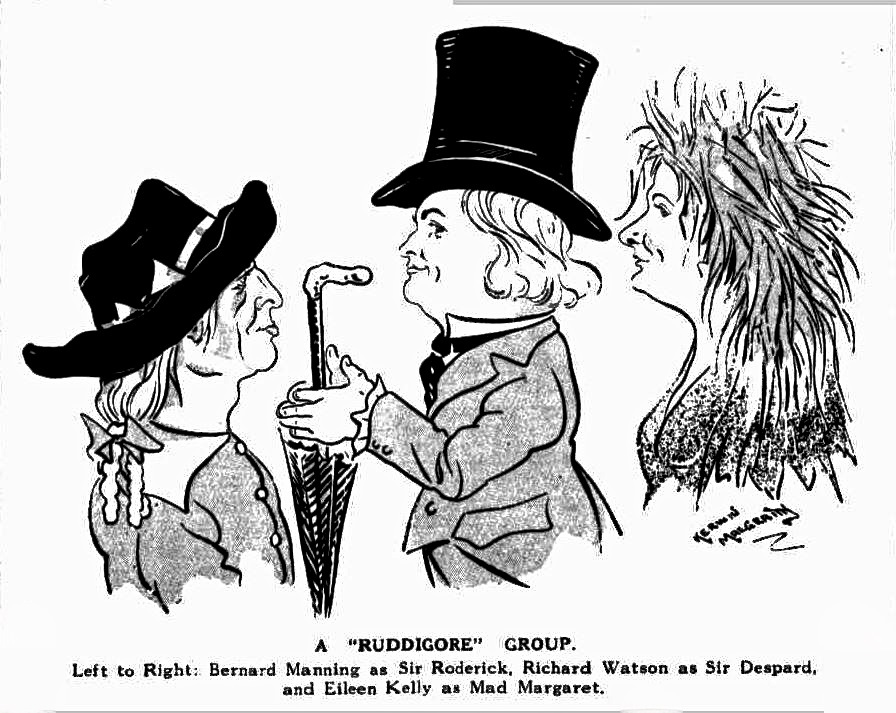 Kerwin Maegraith caricature for The Sydney Mail, 29 January 1936
Discography:
"Oh, why am I moody and sad?" - Richard Watson & chorus (rec. 1950)
"You understand? I think I do" - Richard Watson & Leonard Osborn (rec. 1950)
"I once was a very abandoned person"- Richard Watson & Ann Drummond-Grant (rec. 1950)
"My eyes are fully open" - Richard Watson, Martyn Green & Ann Drummond-Grant (rec. 1950)
* * * * * * * * * * * * * * * * * * * *
FINAL CURTAIN.
GILBERT AND SULLIVAN SEASON.
ENTHUSIASTIC SCENES.
There were enthusiastic scenes in the Theatre Royal last night at the conclusion of the performance of "The Mikado," which marked the close of the Gilbert and Sullivan season.
The theatre was crowded, and many encores were demanded during the performance. At the end of the final scene, the producer (Miss Minnie Everett) and the principals were laden with bouquets and other gifts. Each made a brief farewell speech, and the audience remained in the theatre until the last word had been spoken. The players and members of the audience then joined in singing the National Anthem.
Miss Everett was applauded when she threw a flower from the stage to the musical director (Mr. Andrew McCunn). She praised J. C. Williamson Ltd., and the artists. The chorus, she said, had been one of the finest Sydney audiences had heard.
Mr. Ivan Menzies, after expressing pleasure at having played during the season, commended the Oxford Group to his hearers. "It is up to us to put the world right," he said.
"From the bottom of my heart, I thank you," said Miss Evelyn Gardiner.
Mr. Gregory Stroud said he hoped the company would soon return to Sydney.
Mr. Bernard Manning said that this was his third season of Gilbert and Sullivan in Sydney, and the operas seemed to be growing more and more popular. He made a plea for more public appreciation of the operas "Princess Ida" and "Ruddigore," which, he declared, were "the cleverest of the lot."
Miss Winifred Lawson, Mr. Richard Watson, Mr. Godfrey Stirling, Miss Eileen Kelly, and Miss Helen Langton also spoke.
TO VISIT NEWCASTLE.
The company will leave to-day for Newcastle for a season of five nights and two matinees. This is the first Gilbert and Sullivan company that has visited Newcastle for many years.
The company, which comprises 140 members, will leave Newcastle on Friday for a tour of New Zealand.
The Sydney Morning Herald, Friday, 7 February 1936, p.12
* * * * * * * * * * * * * * * * * * * *
The G&S company’s season in Newcastle at the Victoria Theatre commenced with The Gondoliers at the matinee and evening of Saturday, 8 February, followed by The Pirates of Penzance and Trial by Jury on Monday, 10; The Yeomen of the Guard on Tuesday, 11; H.M.S. Pinafore and Cox and Box at the matinee on Wednesday, 12 with Iolanthe in the evening and The Mikado on Thursday, 13. The company then departed for its New Zealand tour on Friday, 14 February 1936. (The Newcastle Sun reported that the company included a chorus of 50 with a full orchestra under the direction of Mr. Leo Packer).
* * * * * * * * * * * * * * * * * * * *
Additional Picture Sources
Digitised Theatre programme scans from the National Library of Australia, Canberra
-
-
A Song to Sing-O! Downunder (Part 4)

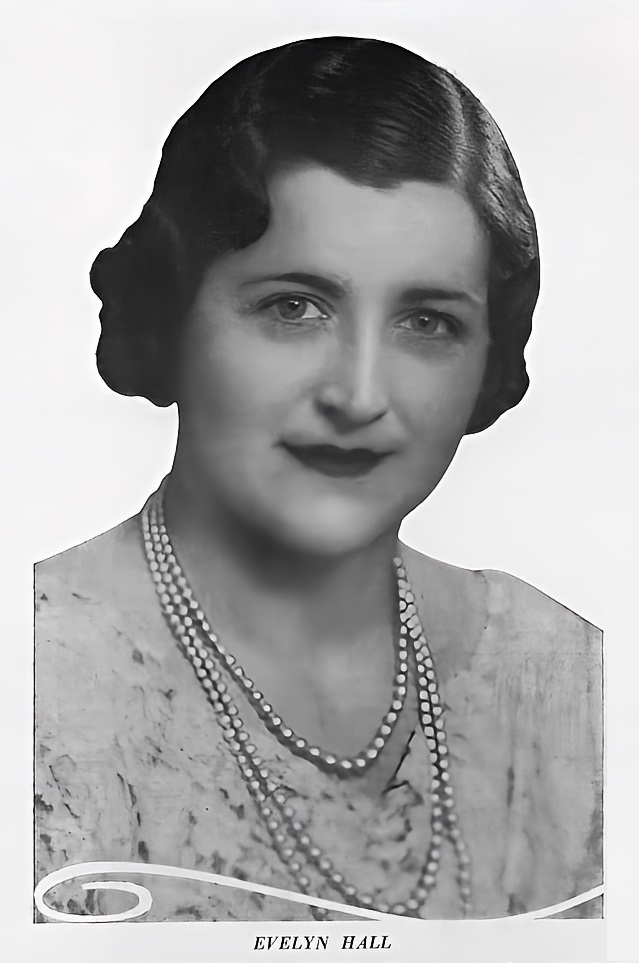
 Following the tour of New Zealand the JCW G&S Opera Company returned to Australia to commence their season in Brisbane, where they were joined by Australian contralto, Evelyn Hall, who took over the roles vacated by Evelyn Gardiner. Winifred Lawson concludes her reminiscence of her Australasian tour in a further chapter of her autobiography A Song to Sing-O! published in 1955.
Cultural Advice: Winifred's memoir is an historical document and, as such, reflects the attitudes and language of the era in which it was written.
Brisbane season. Return to Melbourne. Aborigines. Fairbridge. Mikado Matinee. Plans for journey home
A FTER three months our tour of New Zealand came to an end. Apart from the big cities where we'd stayed for a week or two, the tour had included many 'one-night stands' in the smaller towns. It had been a wonderful experience, if strenuous.
From Sydney we went to Brisbane. I was disappointed that we didn't go still further north to Cairns and Townsville where we should have seen something of the Great Barrier Reef, but it would no doubt have been rather trying to play in the operas in the heat of a sub-tropical climate. And it was to be followed by a return visit to Melbourne, where we had spent three months during the previous year.
It was then I realized even more fully than before the friendliness of the Australians. As I arrived at my hotel the commissionaire greeted me with a 'Welcome home, Miss Lawson'; and my room was full of flowers, not only from friends, but from the hotel staff.
While we were in Melbourne, Yehudi Menuhin, accompanied by his family, came out to give a series of concerts in Australia. But we were not able to hear him play, as we had to be in the theatre. But that great baritone, Ezio Pinza, who came over with the lovely operatic soprano, Elizabeth Rethberg, gave an afternoon concert. And what a joy it was to hear their exquisite rendering of Mozart duets from The Marriage of Figaro and Don Giovanni.
From Melbourne we went to Perth in Western Australia; and of all the journeys we made during our tour of Australia and New Zealand, that journey across the desert was the most interesting.
The train itself was designed for comfort, being air-conditioned and having spacious parlour-cars with large windows through which you had an uninterrupted view of the scenery. The journey takes three days and crosses the Nullarbor Plain (so named because it is treeless), and the railway runs without a curve for over 300 miles, which is a world's record for a 'straight.' In all its length of more than 1,051 miles the line does not cross a single permanent stream of water.
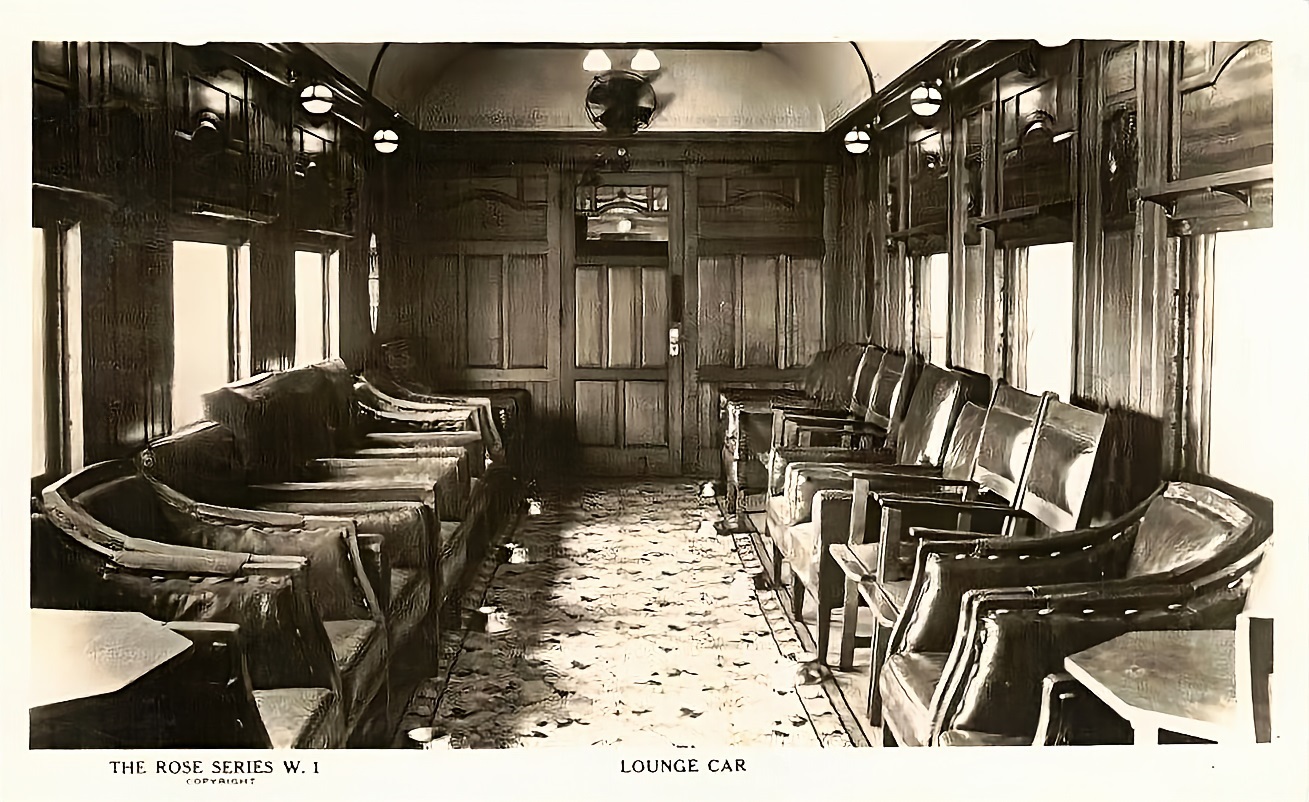 Lounge Car on the Trans-Australian Railway (National Library of Australia, Canberra)
It was fascinating to watch the hilly country gradually giving place to plains, and to see how the vegetation changed in character as we approached the desert. No longer could anyone complain of the 'eternal gum tree' in this Australian landscape, though sandalwood and mulga were equally unfamiliar to our English eyes. In the desert itself grew bluebush with its ghostly colouring, and saltbush whose leaves are so constructed that they can absorb the moisture from every chance shower of rain and from the dew that falls heavily in these parts; and sheep feed on the leaves. There is a fascination about these vast open plains, different from, but in its way as great as the fascination of forest and mountain.
Again, the aboriginal names of the little towns intrigued us, 'Wirrapa,' 'Pimba,' 'Ooldea,' 'Loongana.' At one station where we halted a crowd of aborigines flocked round the train, and out came the company's cameras as we snapped each other grouped with our black companions. They were a motley crew: dressed in rags and tatters, their hair matted with dirt. Our contralto [Evelyn Hall] gave one of the women a little money and asked her what she was going to buy with it.
The 'abbo' beamed. 'Buy'um sugar! buy'um tea!'
'What about soap?' said Eve, feeling that this was even more necessary.
'Yes! Buy'um soap! Washem up big!' said the 'abbo,' gesticulating wildly with her hands.
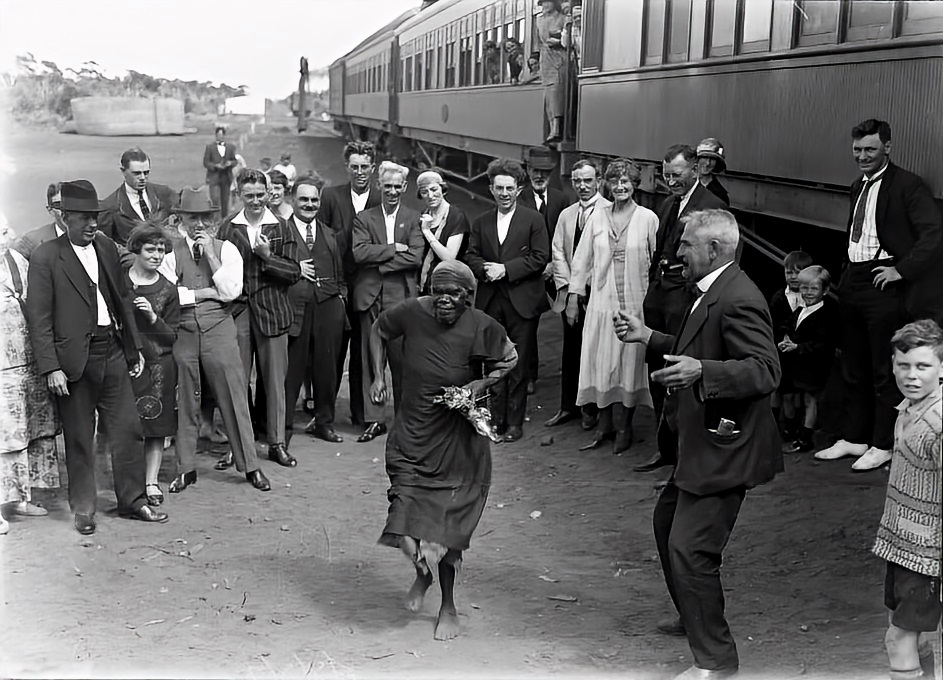 Trans-Australian railway passengers entertained by an aboriginal dancer during a stopover. (National Library of Australia, Canberra)
I bought a boomerang from one of the men, but the guard of the train took it from me and had it washed in disinfectant before letting me handle it. I never acquired the aborigines' skill in throwing it. It persistently refused to fly in a beautiful curve and come back into my hand.
When the company got to Perth, I had one or two free evenings when I was not playing in the opera. So I availed myself of Mr and Mrs Patterson's invitation to pay them a visit and spent a long week-end in Fairbridge Farm School at Pinjarra. It was the most wonderful experience and the sight of all these happy, healthy youngsters, in these delightful surroundings and warm sunny climate, filled me with enthusiasm for this most successful emigration scheme.
Apart from the Pattersons, my little protege David Lund was a host in himself, and shyly but proudly showed me round the Farm, and on Sunday morning after church he and his friends took me for a walk to visit Kingsley Fairbridge's grave. I was very touched by the way their noisy shouts subsided as soon as the grave came in sight. The following Sunday I came back again for the day with some other members of the opera company, and we gave a concert before an audience of about four hundred boys and girls.
And the odd thing was that, although we were accustomed to playing every night of the week before large audiences in the theatre, at this concert we were all petrified with nerves. Which only shows what utterly unpredictable things nerves are.
During our season in Perth our manager, Mr Mitchell, made a very kindly gesture. He said that if I would like to invite David and four or five of his friends from Fairbridge he would give them seats for a matinee of The Mikado. The choice of friends was difficult; but there were two who were certain of being included in the party: David's brother and sister Ruth had previously come out from England to Fairbridge and Ruth now had a domestic post in Perth. His elder brother, Sam, had also left Fairbridge for a job on a 'station' (or farm, as we would call it in England) and happened to be on holiday in Perth just then. So the two brothers and their sister were reunited. Mr Mitchell arranged for the whole party to have lunch before the matinee at the best hotel in the town, which must have been something of a treat after the rough-and-ready school meals; and all the children behaved beautifully and looked so spick-and-span dressed in their best clothes.
I think it was the first time any of them had been to the theatre, and when the curtain went down they all came round on to the stage where a long trestle-table was set with tea and cakes and sandwiches. All the principals came in their stage costumes to chat with them, and the children were shown how the curtain went up and down, and the intricacies of stage lighting. Then when it was time to go, anything that was left over from tea was packed up for them to take back in their car to Fairbridge.
They all wrote very nice little letters of thanks the next day. A photograph had been taken and appeared in the local paper with the caption: 'Miss Winifred Lawson with her young protege David Lund and some of his friends.'
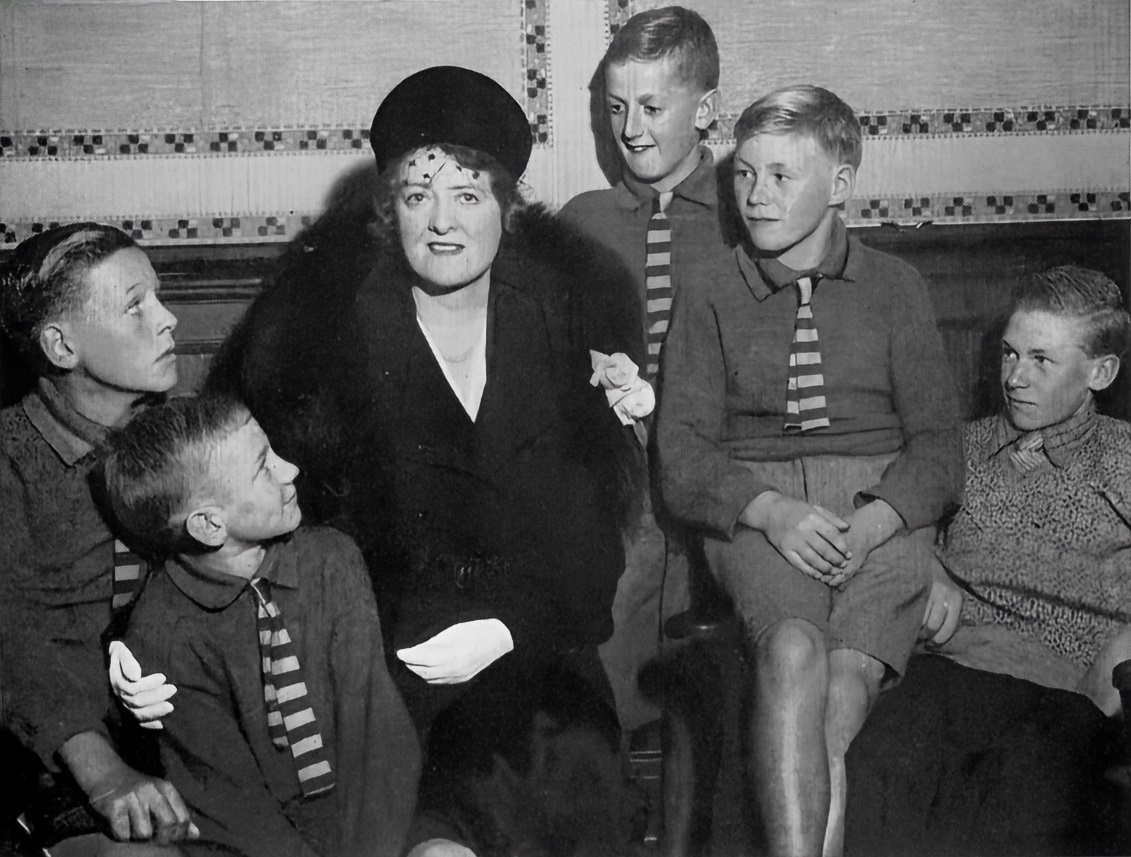 Winifred Lawson with her protégé David Lund and friends of the Kingsley Fairbridge Farm School, Perth, WA
One of the boys wrote: 'Dear Mr Mitchell, I looked for my name everywhere in the paper but couldn't find it. This may not mean much to you, but it means a great deal to me!'
Another wrote: 'Thank you very much for my good dinner and the Mikado. I enjoyed my dinner very much!'
I had taken a furnished flat for my stay in Perth, and a day or two after this party there was a ring at my bell. I went to the door and found nobody there, but on the mat there was a brown-paper parcel. I opened it, and inside was a charming little statuette of a girl holding a fan behind her head (as Yum Yum does in The Mikado), and there on a scrap of paper was written, 'Miss Lawson. Thanks. Sam.'
It was really very touching. Sam was not a very articulate sort of boy, but he had already written me a charming letter of thanks, and he must have spent at least a week's wages on this little statuette. I got rather out of touch with them all during the war, but I wrote not long ago and now have all the latest news of the family. Their mother has gone out from England to join them. Ruth has married a boy from Fairbridge who has done very well, and is now second in charge of the Department of Civil Aviation at Darwin, and they have two children. Sam left his sheep station to join the Commandos during the war, and now is back at his old job. David worked for a time on the station with his brother and is now married and has two lovely children of his own.
While we were in Perth the English Test Cricket team arrived, accompanied by Neville Cardus and Bruce Harris, and we shared a special train on our journey back to Sydney. As Bruce Harris said, it was unusual to find a train entirely filled with people whose job it was, one way or another, to entertain the public.
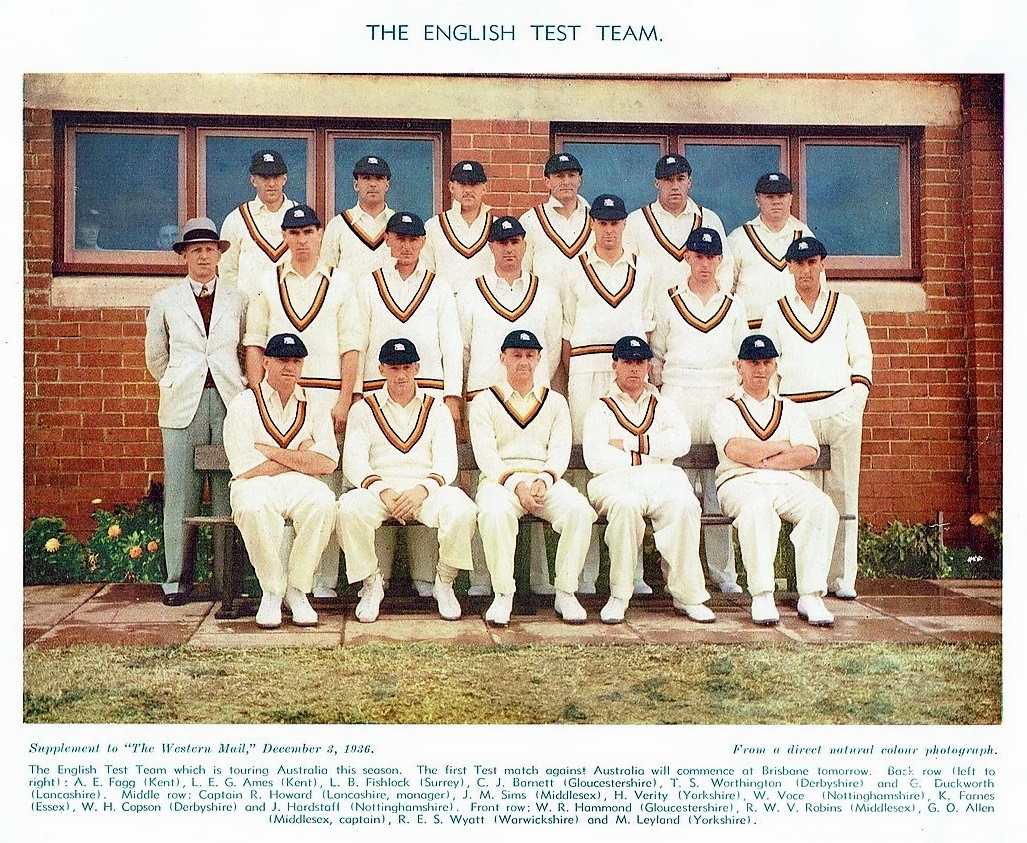
It was quite an experience to travel with the cricketers. Quiet little stations all along the route were thronged with people who had come from goodness knows where to get a glimpse of the team.
In London or elsewhere cricket enthusiasts naturally take an interest in the Test. But in Australia it seems to be a matter of life or death to the entire population, male and female.
When we got to Sydney, I stayed in a most delightful hotel called the Garden Club [sic - most likely the Clifton Gardens Hotelin Mosman], run by a Mrs Coleman, a most kindly, motherly sort of woman. While I was there England won the first match. Depression settled like a pall on all my fellow guests. I felt I should walk on tiptoe and speak in hushed whispers. I was taken one afternoon to a matinee at the theatre, and we sat in the front row of the stalls. When the orchestra came back to their places after the interval my hostess got up and, leaning over the orchestra, asked anxiously, 'Is Bradman still in?'
There is a certain part in Iolanthe where Phyllis the shepherdess has to go all round the stage curtseying to all the peers in turn. They had been on the stage for some time while I'd been off and able to hear the latest score, and with a sweet smile I would murmur as I bowed with my back to the audience '104 not out'—'104 not out!'
People would take sandwiches and sit on the edge of the pavement in St Martin's Place to watch the electrical moving newsband on the buildings opposite, which gave the latest score. Cricket was top-line news.
One day I was invited to go and see the aborigines who were taking part in a film called, if I remember rightly, Uncivilised. I was told to go and meet someone called Mr Archie, who, however, turned out to be an Italian girl named Miss Starace. We were joined by Dennis Hoey, who had just arrived from England to take the lead in this film, and proceeded to the location where all the 'abbos' were assembled complete with the most terrifying-looking collection of enormous snakes. These 'abbos' were very different from the poor creatures we had met on our way across the Nullarbor Plain. They were, of course, 'hand-picked' for the film, and were strong and healthy-looking and of fine physique. Their hair was well groomed and their bodies were streaked with war paint. The snakes which writhed about their shoulders were apparently poisonous, but they knew how to handle them, and showed us how to hold them so as to be well out of range of their venomous fangs. The men performed a war dance for us, which was most impressive and very alarming.
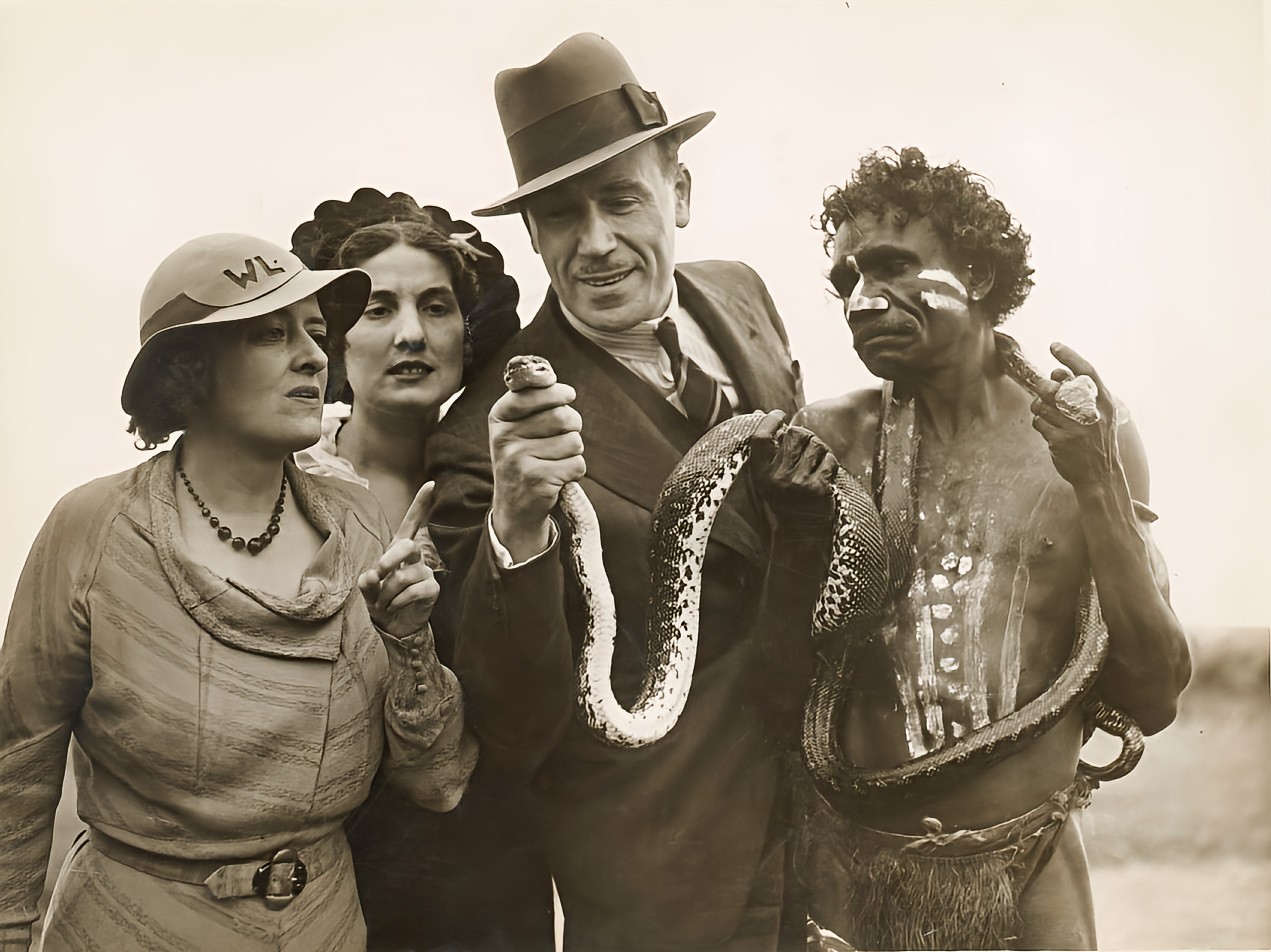 Winifred Lawson with Nina Starace, Dennis Hoey & unidentified snake-handler on location for Uncivilised (photo by Sam Hood, Mitchell Library, Sydney)
By now my contract was almost at an end and my thoughts turned homeward. My brother wrote, however, and pointed out that once home I should remain there for a long time and why not see something of the world while I was in the Antipodes. He drew a little sketch of their house, with rain pouring down, trees bending over in the wind, and himself battling along with his umbrella blown inside out; and underneath he'd written, 'What! come home to this!' That gave me furiously to think.
It did seem rather unenterprising in any case to go back the way I'd come out, via Colombo and the Suez.
So I got a map of the world and pored over it, working out various routes from Sydney to London—a pastime I can thoroughly recommend to anyone.
I had been working hard for a very long time. There was no particular reason to hurry home, and finally I decided to take my time over the journey and, as Cecil had suggested, see something of the world.
After consultations with helpful assistants in shipping offices, I decided to go via New Guinea and the Philippines to China where I would spend a month. Then I would have a month in Japan before going across America to England.


It was the time of the Coronation of King George VI, and so many people were going home for this great event that I could not get a berth on any ship for more than two months. So I stayed on in Sydney. The first summer we'd spent there when we were working so hard with rehearsals and extra performances during the Christmas holidays, I'd found the heat most exhausting. Sometimes I used to wonder how I'd ever have enough energy to give a performance. But now with leisure to have a siesta during the hottest part of the day, and perhaps being by now acclimatized, I found the heat delightful and revelled in the perpetual sunshine.
My friends in Sydney gave me such a wonderful time: there were bathing parties, motoring out to distant beaches, of which there is such a vast choice, cocktail parties, tea at the Rose Bay Golf Club, evenings at the Ballet, which was a great treat for me, not having been in front in a theatre for two years at least.
Colonel de Basil had brought out his Russian Ballet Company to Australia, where they had an enormous success. I met some of the company at a picnic one day: Woizikowsky, Serge Unger, Raievska, etc. They were talking about a certain ballerina, and somebody said, 'She's very young, isn't she?' 'Oh, no,' said Woizikowsky, 'she's nineteen!' I nearly fell over the sea wall to let the sharks get me; I felt that anyone as old as I should not be allowed to go on living.

Leon Woizikowsky as the golden slave and Nina Raievska as Zoebeide in Scheherazade, Monte Carlo Russian Ballet, 1937 (photo by Russell Roberts Ltd.)
(National Library of Australia, Canberra)

Norman Lindsay painting of Scheherazade, reproduced as the theatre programme cover for the Monte Carlo Russian Ballet season for JCW.
(National Library of Australia, Canberra)
I was still staying at the Garden Club [sic - again, most likely the Clifton Gardens Hotelin Mosman], where I had a large room with a private bath. Mrs Coleman, the proprietress, said to me one day, 'You ought not to be spending so much on your room now that you're not working,' and she offered me a smaller one that had become vacant and which was much less expensive. That has always seemed to me the most extraordinarily kind and uncommercial thing for a hotel proprietress to do. Her worst enemy couldn't have called her mercenary. I liked that room far better than the other one. It was on a corner and had two windows, one overlooking the harbour and the other the road where there was a flame tree and a jacaranda, both just then in full bloom. The jacaranda blossom comes out before any green leaves are showing; the whole tree was a mass of the most exquisite lilac-blue flowers, which as the petals fell formed a lovely carpet under the tree. And the brilliant red blossom of the flame tree made a dramatic contrast.
Every now and then I would call at the shipping office to see if there was a berth available for the voyage home; and at last they got me a cabin in the Neptuna, a small ship which only took eighty passengers and which was leaving for Hong Kong in a month's time. Then began the usual preparations: inoculations for typhoid, etc., lists of addresses of the best shops in which to buy souvenirs, letters of introduction from friends. Before leaving I also broadcast once or twice for the Australian Broadcasting Corporation groups of French songs, as a change from Gilbert and Sullivan.
Now that my stay in Australia was coming to an end I got more and more miserable at the idea of saying good-bye to all my friends, and the prospect of 'seeing the world' all on my own no longer seemed so attractive.
When the day came for me to leave I said good-bye to Mrs Coleman and the Garden Club, and went off with a party of friends to the ship. There I found that my cabin was full of flowers and presents and telegrams, which helped to soften the pain of parting.
Australians have a delightful habit when ships are leaving of throwing coloured paper streamers to friends on deck, so that with each holding one end of the streamer, those on board are still linked with their friends ashore. Then as the ship moves slowly away, a rainbow of streamers stretches out over the side till finally the last one breaks, and you're off to sea.
* * * * * * * * * * * * * * * * * * * *
First published in A Song to Sing-O! by Winifred Lawson [Michael Joseph: London, 1955], pp. 157 - 165
* * * * * * * * * * * * * * * * * * * *
Endnotes
compiled by Rob Morrison
Brisbane JCW G&S season at His Majesty’s Theatre
(Musical Director: Andrew McCunn)
- The Gondoliers – Monday, 1 June to Wednesday, 3 June 1936
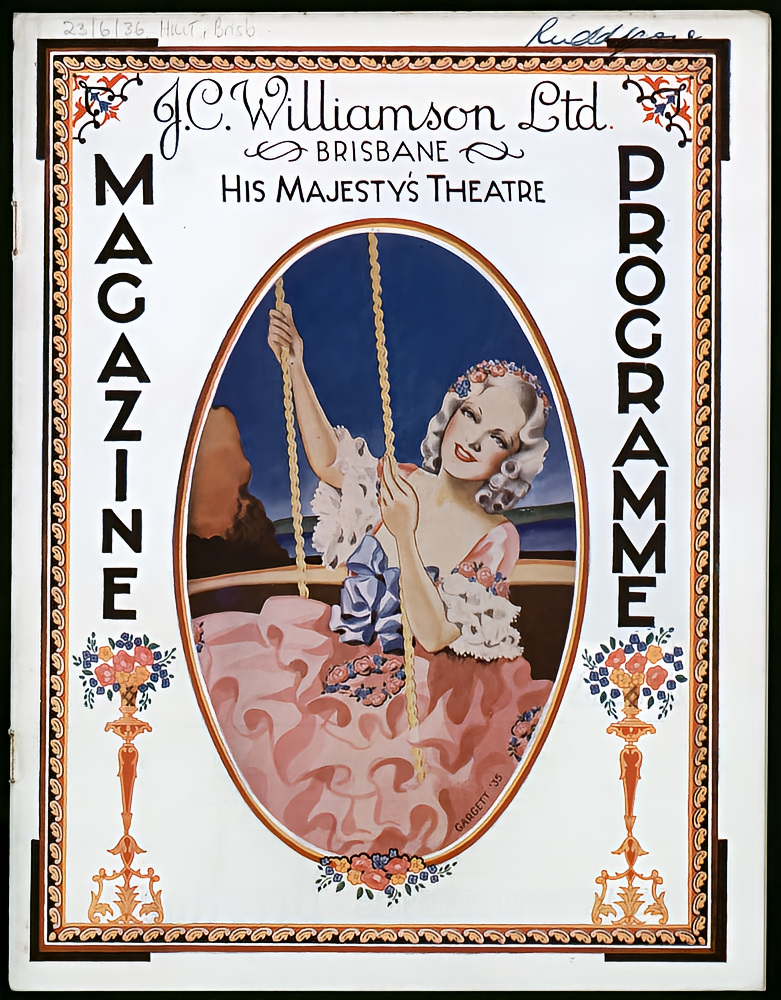
- The Mikado – Thursday, 4 June to Saturday, 6 June (matinee)
- The Yeomen of the Guard – Monday, 8 June to Wednesday, 10 June
- Iolanthe – Thursday, 11 June to Saturday, 13 June
- Patience – Monday, 15 & Tuesday, 16 June
- The Pirates of Penzance & Trial by Jury – Wednesday, 17 June & Thursday, 18 June
- The Mikado – Friday, 19 June (“In response to Thousands of Requests”)
- H.M.S. Pinafore & Cox and Box – Saturday, 20 June (matinee only)
- The Gondoliers – Saturday, 20 June (evening only) (“In response to Thousands of Requests”)
- The Yeomen of the Guard – Monday, 22 June
- Ruddigore – Tuesday, 23 June
- The Gondoliers – Wednesday, 24 June (mat.)
- Grand Gala Farewell – Potpourri Programme – Trial by Jury, Second Act of Pirates of Penzance & First Act of Iolanthe – Wednesday, 24 June (eve.)
* * * * * * * * * * * * * * * * * * * *
Youthful Australian's Quick Rise to High Place in Savoy Opera
Miss Evelyn Hall Scores
When Miss Evelyn Gardiner, who had been "loaned" by the D'Oyly Carte company to J. C. Williamson for the Savoy Opera, was recalled to England during the company's tour in New Zealand, the problem of replacing her was an acute one. It was solved, however. Behind the debut last night of Miss Evelyn Hall in "The Gondoliers" at His Majesty's is the story of how another young Australian made good on the stage—and at extremely short notice.
Six weeks of coaching in a small room in Melbourne studying nine Savoy opera roles . . . fourteen hours a day without a respite . . . two nights in the train (not a panacea for nervous ills) . . . an hour and a half of rehearsal with the other stars of the company . . . not a single dress rehearsal, and with no experience whatever with the orchestra and the chorus, or even with the scenery as a background . . .these were the remarkable circumstances under which Miss Hall made her debut.
Afer the show Miss Hall said, "Thank Heaven it's over . . . but I feel that all the hard work was worth it."
Miss Minnie Everett, the veteran ballet mistress and producer, who during the last six weeks has coached Miss Hall in nine operas, said, "She's got the goods. When she has more experience, she will show us with a vengeance that there is no need to import stars from abroad to play these roles."
SIX WEEKS' TOLL.
It was in a small room in Melbourne that Miss Hall and Miss Everett have been working for the past six weeks, the one the teacher, the other the pupil, and the lesson has been the nine contralto roles of the Gilbert and Sullivan operas.
It was slavery for 14 hours a day. Not only had Miss Hall to learn from Miss Everett, who knows every detail in every opera, every phase of the interpretive side of her work, but also those thousand and one details— deportment, diction, gesture, and the timing of every movement. In the six weeks everything Miss Hall had to do and say while on the stage was learned, without the presence of chorus or orchestra or other principals.
Train travelling by night is an enervating business. Having gone through this gruelling preparation, this hardworking pair set out for Brisbane, and when Miss Hall stepped on to the stage last night few of the audience could have realised that she had just endured two successive nights in jolting trains as a preliminary to the ordeal of her debut.
STRAIN OF PREPARATION.
But the strain was on as soon as she set foot in Brisbane. At the theatre yesterday afternoon Miss Hall met the remainder of the cast for the first time in a professional sense. With them she was put through her paces again, and Miss Everett was her shadow, walking beside her, giving her quiet spoken hints.
"She had no dress rehearsal, no orchestral rehearsal; in fact, she did not know what the scenery was really like," said Miss Everett after the show.
"STAR OF THE FUTURE."
"And you are satisfied with it all?" she was asked.
"Yes, I am in a sense," she replied.
"But I am a task master. My standard is perfection and I've got to produce the goods. I verily believe that Miss Hall has it in her to develop into a star of the first magnitude. She needs experience. The real test is before the footlights. So many of them are great in rehearsal but crack up when the show starts. Miss Hall did not do that. That is why I think she is going to be a success. I had to start right from the beginning with her and teach her....everything. It has been a long job but I think it has been worth while. There is no justification for importing people from abroad when we have such talent as this here. Miss Hall is not alone. There are plenty of girls like her. But they've got to be licked into shape.
I am proud of her Katisha in 'The Mikado.' I think it is a great piece of work for an artist of her limited experience. When they sent her to me for a tryout I was told to give her a fortnight to see whether she had it in her. I told them that she had the makings of the star in her. And I believe I was right."
TRIBUTE TO TEACHER.
"I owe everything to Miss Everett," said Miss Hall. "And the rest of the cast has been wonderful to me. I feel a nervous wreck now, but I feel very glad for all the hard work has been worth while."
Miss Hall has nine roles to do, many of them far more exacting than that in "The Gondoliers," and in some of them she will have to do as she did last night... go on without a full dress rehearsal.
Miss Hall's career began in 1929 when she sang small parts in the Gonzalez Opera Company. Since then she had bigger parts in the 1932 grand opera season, has sung under Sir Hamilton Harty and under Maurice D'Abravanel in the A.B.C. opera series, and studied with Franz Izol, the Italian teacher, from whom she declares, she acquired her vocal technique.
The Telegraph (Brisbane) Tuesday, 2 June 1936, Page 3
* * * * * * * * * * * * * * * * * * * *
* * * * * * * * * * * * * * * * * * * *
SAVOY OPERA
Warm Welcome to "The Gondoliers"
A Richly Endowed Company
AGAIN theatrical folk have come amongst us and distilled the magic essence represented by the names of that incomparable pair, Gilbert and Sullivan. A company that promises great things for us in the next three weeks opened its season at His Majesty's Theatre with, of course, "The Gondoliers."
No company could have received a more enthusiastic welcome. An audience, claimed to be the biggest Monday evening opening audience for years, showed unmistakably during the first appearance of the artists how glad it was to welcome them. There was no mistaking the enthusiasm, and the players must have felt its inspiring influence, for it seemed to be reflected in the verve and sparkle of the opening choruses. When Winifred Lawson, Ivan Menzies, and Evelyn Hall — representing respectively the Star from Abroad, the Old Favourite, and the Young Australian making her Debut — stepped from the gondola, the applause was deafening.
CHORAL AND ORCHESTRAL STRENGTH.
It appears to be a better company than that which visited us two years ago, although memory may recall, perhaps, the art of John Ralston, Maisie Ramsay, Marie Bremner and Mary Hotham to make comparisons—and John Ralstons do not appear with anything like a monotonous regularity. In two respects, especially the performance last night, reached unprecedented heights—in the work of the chorus and of the orchestra, surely the joint foundation of a good Savoy opera company. The chorus was opulent in its tone, and trained to perfect cohesion and balance. The orchestra, composed mainly of southern musicians, since a full orchestra could not be recruited here, was a splendidly trained and disciplined band, which responded to Mr. Andrew MacCunn's baton with crispness and delicacy. The result of these two qualities in the ensemble of the company was a third—a wonderful buoyancy in the rhythm, and magnificence in the tone in the bigger chorus that was truly inspiring.
VOCAL RICHES IN PRINCIPALS.
HAVING, so to speak, put the cart before the horse, we must turn with apologies to the stars of the company. Here we find vocal riches and no small reserve of experience to draw upon. Miss Winifred Lawson comes to us with an established London reputation in Savoy Opera. She has a voice perfectly suited to her work, a stage presence that lacks nothing, and a pleasant personality that communicates itself to the audience as soon as she appears. Her singing last night was for the most part completely satisfying, though, strangely enough, there seemed to be abroad amongst most of the feminine principals of the company a tendency to produce tone with an edge on it in the upper registers of the voice.
Godfrey Stirling, the new English tenor, has a voice of accommodating power and subtlety. "Take a Pair of Sparkling Eyes" was his test piece, as it were, and the proof of the performance was in the repetitions that were called for. It is a voice of singularly beautiful quality in some parts of the register, and one incidentally that will add lustre and charm to the quartet ensembles that occur at intervals through these operas.
Ivan Menzies, of course, was his usual self. His Duke of Plaza-Toro is perhaps a slightly less "cock-sparrowish" fellow than was the case two years ago, but he still capers about the stage in a manner that is quite irresistible. His is perhaps a more restrained performance, and yet one more in keeping with the part as we have come to know it. Richard Watson's Don Alhambra was a splendid performance in every way. A fine stage presence, and a voice of quite impressive proportions, allowed him to give full play to the pompous pleasantries entrusted to this Grand Inquisitorial figure.
A POLISHED ARTIST.
Mr. Gregory Stroud is an old and well tried favourite. He possesses a natural charm of manner before the footlights that is matched by no-one else in the company. It is a mixture of graceful masculinity and a fine voice, which has earned him a permanent place in our affections. He is the perfect Gilbert and Sullivan artist. Clifford Cowley, who took his place in this piece two years ago, when Mr. Stroud was ill, is here again, this time as a star. He played Luiz with enthusiasm and aplomb.
A STAR'S DEBUT.
Three ladies in this cast of personalities deserve a paragraph all to themselves. Miss Evelyn Hall, making her first appearance in Gilbert and Sullivan opera, in circumstances that are extra ordinary, and which are outlined else where in these columns, played the Duchess as to the manner born. She has a beautiful rich voice, a commanding presence, and plenty of personality. One sees in her the artist who may fill contralto roles in future Savoy opera companies in Australia for many years to come. After all, why import English contraltos for these roles when we have such an artist as this?
TESSA AND GIANETTA.
Misses Helen Langton. a Western Australian. and Eileen Kelly, a Victorian, filled the exacting roles of Gianetta and Tessa respectively. They, of course, have had time to settle down to their work. Tessa and Gianetta are two of the most attractive and charming women in the whole of the Savoy series. Vocally these two young ladies are admirably equipped. Yet last night they were inclined to allow their vocal riches to run riot. The daintiness of their presence should be suggested in their singing as in their bearing. Sometimes this vocal delicacy was not always as marked as it might have been— in Tessa's "When a Maiden Marries," for instance, and Gianetta's "Kind Sir, You Cannot Have the Heart." But there was a great deal that was admirable in their work.
The gaiety and charm of "The "Gondoliers," however, shines unmistakably through this performance. It is, in truth, a company richly endowed, with which Brisbane can look forward again to renewing acquaintance with all those diversified characters, from Patience to Pooh-Bah, and from the Pirate King to Katisha, which go to populate that magic realm we know as the Savoy opera.
A.H.T.
"The Gondoliers" will be repeated to-night and to-morrow (matinee and evening). Next Thursday "The Mikado" will be presented, with Ivan Menzies as the Lord High Executioner, Winifred Lawson as Yum-Yum, Godfrey Stirling as the wandering minstrel. Richard Watson as Pooh-Bah, Gregory Stroud as Plsh-Tush. Evelyn Hall as Katisha, and Bernard Manning as the Mikado.
The Telegraph (Brisbane) Tuesday, 2 June 1936, Page
* * * * * * * * * * * * * * * * * * * *
Melbourne return season at His Majesty’s Theatre
(Musical Director: William Quintrell)
- The Mikado – Saturday, 27 June to Friday, 3 July (matinees on Mon., 29 June {King’s birthday} & Wed., 1 July)
- Ruddigore – Saturday, 4 July (matinee) to Friday, 10 July
- The Pirates of Penzance & Trial by Jury – Saturday, 11 July (matinee) to Monday, 13 July
- Iolanthe – Tuesday, 14 July & Wednesday, 15 July (mat. & eve.)
- Patience – Thursday,16 July & Friday, 17th July
- Princess Ida – Saturday, 18 July (matinee) to Friday, 24 July 1936
- The Gondoliers – Saturday, 25 July (mat.) to Friday, 31 July
- H.M.S. Pinafore & Cox and Box – Wednesday, 5 August (mat. & eve.) to Saturday, 8 August (mat.)
- The Yeomen of the Guard – Saturday, 8 August (eve.) to Tuesday, 18 August
- The Mikado – Wednesday, 19 August (mat. & eve.)
- The Pirates of Penzance & Trial by Jury – Thursday, 20 & Friday, 21 August
- Paul Jones (Planquette) (Gala premiere for the G&S tour) – Saturday, 22 August (mat.) to Saturday, 29 August 1936
* * * * * * * * * * * * * * * * * * * *
"Gagging" in the G&S operas, of which Ivan Menzies was the chief culprit, continued to receive coverage in the Melbourne Press - both pro and con.
* * * * * * * * * * * * * * * * * * * *
TRADITIONS OF GILBERT
"Horrors" of Gag
Savoyards' Conflict
Is the Savoy tradition a myth? Does "gagging" by a comedian in Gilbert and Sullivan opera cause anyone that intense suffering which humorists delight in depicting? The buzz that may be heard in the foyer after one of the current performances of "The Mikado" leaves no doubt that the audience has recognised the substitution of "crooning serenader" for "nigger serenader" in Ko-Ko`s "little list," but is the general opinion really hostile to these topical alterations in Gilbert’s libretto? At least, no one has yet walked out as a protest against the jazz effects in the encore to "The Flowers That Bloom in the Spring." On the other hand Mr Frank Tate, former director of education and a Savoyard of the old school, admits that he has not attended a Savoy revival for years because the increasing tendency to "gag" has done violence to his memories of the performances of Vernon, Woodfield, Forde, and the rest. Doubtless there are others like him.
"The essence of the Gilbertian method was to treat absurd situations with a gravity that intensified their absurdity," Mr Tate said yesterday. "As soon as they are burlesqued, they lose their zest. In later years even Howard Vernon had a tendency to fall from grace in this respect. Therefore I prefer my memories of the Savoy operas as they were."
If Howard Vernon's departure from pure Gilbertian gesture annoyed Mr Tate and those of his mind, what anguish they would suffer if they saw "The Mikado" as presented in San Francisco in 1931, with three conjuring acts and a vaudeville turn included in the "business." Professor G S Browne, another educationist of note who is also a Savoyard, saw this performance, and he described it last night with horror in his voice. "I have seen all the operas performed in England, and I have become so accustomed to the D'Oyly Carte tradition that when a local allusion is plunged into the middle of any of the numbers I jump about a foot." He said. "Nevertheless I realise that it is not much good trying to make jokes in Australia about the chief of the London Fire Brigade of 50 years ago, and I believe that slight and judicious introduction of local and topical allusion is justifiable; it might even help to keep the operas alive, but it must be done very judiciously and very skilfully."
Mr Menzies, whose performance of Ko-Ko has set the foyers buzzing, has a ready reply to his critics. "It is part of the Savoy tradition to criticise Ko-Ko," he says. "It is done with all the companies in England and I play Ko-Ko as I learnt to play it there under J M Gordon. I am confident that Gilbert continually altered his topical allusions as the original ones staled, and I believe that he would continue to do it if he were alive now."
Against this defence we have the statement of the president of the Gilbert and Sullivan Society (Professor E W Skeats) that Gilbert insisted upon strict adherence to the libretto although he permitted one or two alterations in the provinces comparable with the "Little Bourke Street" which has the sanction of custom in performances of "The Mikado" in Melbourne.
"The Savoy operas are products of the Victorian era," Professor Skeats said. "They are classics, and they should be kept within the restrained limits of their era, otherwise they degenerate into mere musical comedy or farce or revue."
The Argus (Melbourne), Tuesday 30 June 1936, p.8 – https://trove.nla.gov.au/newspaper/article/11045873
* * * * * * * * * * * * * * * * * * * *
Letters to the Editor
Traditions of Gilbert
Sir, Playgoers are apt to forget that the success of "The Mikado" was, and is, due to the music, not the libretto. When, therefore, it is revived, something must be done to pep up the play. If ever a part was open to gagging it is that of Sir Joseph Porter in "Pinafore," yet Mr. Ivan Menzies makes him a character almost of pathetic dignity. The acid humour of Gilbert belongs to a generation which has almost passed away. Sullivan's music formerly interpreted is a joy for ever. Yours, &c.
SENEX.
July 4The Argus (Melbourne), Tuesday 7 July 1936, p.8
* * * * * * * * * * * * * * * * * * * *
The Melbourne G&S season concluded with a revival of the 1889 comic opera Paul Jones (music by Robert Planquette, English adaptation by H.B. Farnie, based on Surcouf by Henri Chivot and Alfred Duru), making its debut on the tour, directed by Minnie Everett (who had also directed the previous JCW revival of the opera in 1915), with musical direction by Will Quintrell.
* * * * * * * * * * * * * * * * * * * *
PAUL JONES IS A WOMAN
THE title role of Paul Jones will be played at His Majesty's today by Evelyn Ilall, who, after intensive training under the guidance of Minnie Everett, went into the Gilbert and Sullivan Opera Company a few months ago, and filled a number of roles with remarkable success.
Paul Jones was originally written for a woman, but several men have appeared in the role. Bernard Manning. the skipper of the Yankee privateer in the present revival, claims the distinction of having been the first male Paul Jones in England. His voice was lighter then.
Minnie Everett, the producer, says that male portrayers of Paul Jones have not been nearly as satisfactory as women in Australian productions.
Florence Young appeared in the last revival in Melbourne in 1915.
Much depends on the public's reaction to this old comic opera.
Mr Frank S. Tait, a managing director of J. C. Williamson Ltd., says that if "Paul Jones" is successful, the Firm will present the Gilbert and Sullivan Opera Company in a number of good old operettas and comic operas next year.
J. C. Williamson Ltd. does not want to disband the company when it has completed its present tour, Mr Tait says, but it will not present Gilbert and Sullivan opera again for three years. If the public wants other productions which were formerly very successful it will get them. The run of "Paul Jones" will be regarded by the Firm as a guide to the support which would be given to other productions of a similar type.
The Herald (Melbourne) Saturday, 22 August 1936, p.20
* * * * * * * * * * * * * * * * * * * *
New Shows Reviewed
By "THE ARGUS" CRITICS
His Majesty's
"PAUL JONES"
Naive Entertainment
The members of the Gilbert and Sullivan Opera Company are to be congratulated upon the enthusiastic industry with which, in the revival on Saturday afternoon of Planquette's musical extravaganza “Paul Jones," they sang fought, danced, exchanged well-worn jokes, and manufactured new ones. Much of the humour is of an elementary order. The brightest moments are those in which Mr Clifford Cowley and Mr. Tommy Jay rely upon their own comic invention and discuss the traffic problem, slum clearance, and the talents of Adrian Quist,
It is fortunate for this naive entertainment that Planquette's music still retains its easy charm. A feminine 'hero," who unites the attractions of the traditional pantomime boy with the noble qualities and dazzling wage-earning capacity of the best fairy prince, is too incredible a figure to engage the sympathies of a realistically minded audience of 1936. Miss Evelyn Hall had only to sing, however, and artificialities were forgotten. The contralto was in excellent voice, and achieved immediate and well-deserved success. Another good performance was given by Miss Helen Langton, who sang and acted prettily as the faithful Yvonne. Miss Eileen Kelly was a conscientiously vehement Chopinette, but less exaggerated methods would have produced more convincing results. Mr. Richard Watson contributed a well prepared character study of the garrulous Bicoquet. and looked magnificent in a sombrero of cart-wheel dimensions. The Spanish Governor is so preposterous a figure as to provide small opportunities for dramatic skill.
A combined long-high jump, by which Mr Ivan Menzies arrived on the shoulder of the stately Mr. Godfrey Stirling, was, however, a cheery interlude which delighted the audience by its suggestion of Olympic qualifications. As the worthless rival of the heroic Paul, Mr Stirling never looked a possible winner. This scheming traitor was obviously resigned to his fate, and allowed himself to be trampled upon with good-natured composure. Mr Bernard Manning did all that was possible with the small part of the Yankee skipper, and wore the celebrated "lollipop' trousers with an air. Miss Bryl Walkley appeared for the first time this season as the picturesque Malaquena, and the chorus sang admirably, whether as fishermen, privateers' men, Spanish officers, creoles, American sailors, or ladies of St Malo. The dances were received with much enthusiasm the dressing was bright and colourful, and the orchestra, directed by Mr. Will Quintrell, dealt confidently with the tuneful score.
The Argus (Melbourne), Monday 24 August 1936, p.4

Clifford Cowley

"Tommy" Jay
* * * * * * * * * * * * * * * * * * * *
Adelaide return season at the Theatre Royal
(Musical Director: Leo Packer)
- The Mikado – Saturday, 5 September (eve.) to Thursday,10 September 1936
- H.M.S. Pinafore & Trial by Jury – Friday, 11 September
- Iolanthe – Saturday, 12 (mat. & eve.) & Monday, 14 September
- The Pirates of Penzance & Trial by Jury – Tuesday, 15 September
- The Yeomen of the Guard – Wednesday, 16 (mat. & eve.); Thursday, 17 & Friday 18 September
- The Gondoliers – Saturday, 18 (mat. & eve.) & Monday, 21 September
* * * * * * * * * * * * * * * * * * * *
Perth season at His Majesty’s Theatre
(Musical Director: Leo Packer)
- The Gondoliers – Saturday, 26 September (eve.) to Thursday, 1 October 1936
- H.M.S. Pinafore & Trial by Jury – Friday, 2 October
- The Pirates of Penzance & Trial by Jury – Saturday, 3 October (mat. & eve.) to Tuesday, 6 October
- The Mikado – Wednesday, 7 October (mat. & eve.) to 13 October
- The Yeomen of the Guard – Wednesday, 14 October 1936 (mat.) to Friday, 16 October
- Iolanthe – Saturday, 17 October (mat. & eve.) & Monday, 19 October 1936
- Lilac Time (Gala premiere for the tour) – Tuesday, 20 October to Friday, 23 October
- Paul Jones – Saturday, 24 October (mat. & eve.)
* * * * * * * * * * * * * * * * * * * *
Gregory Stroud took over the title role of Paul Jones from Evelyn Hall for the Perth season and retained it for the rest of the tour.
* * * * * * * * * * * * * * * * * * * *
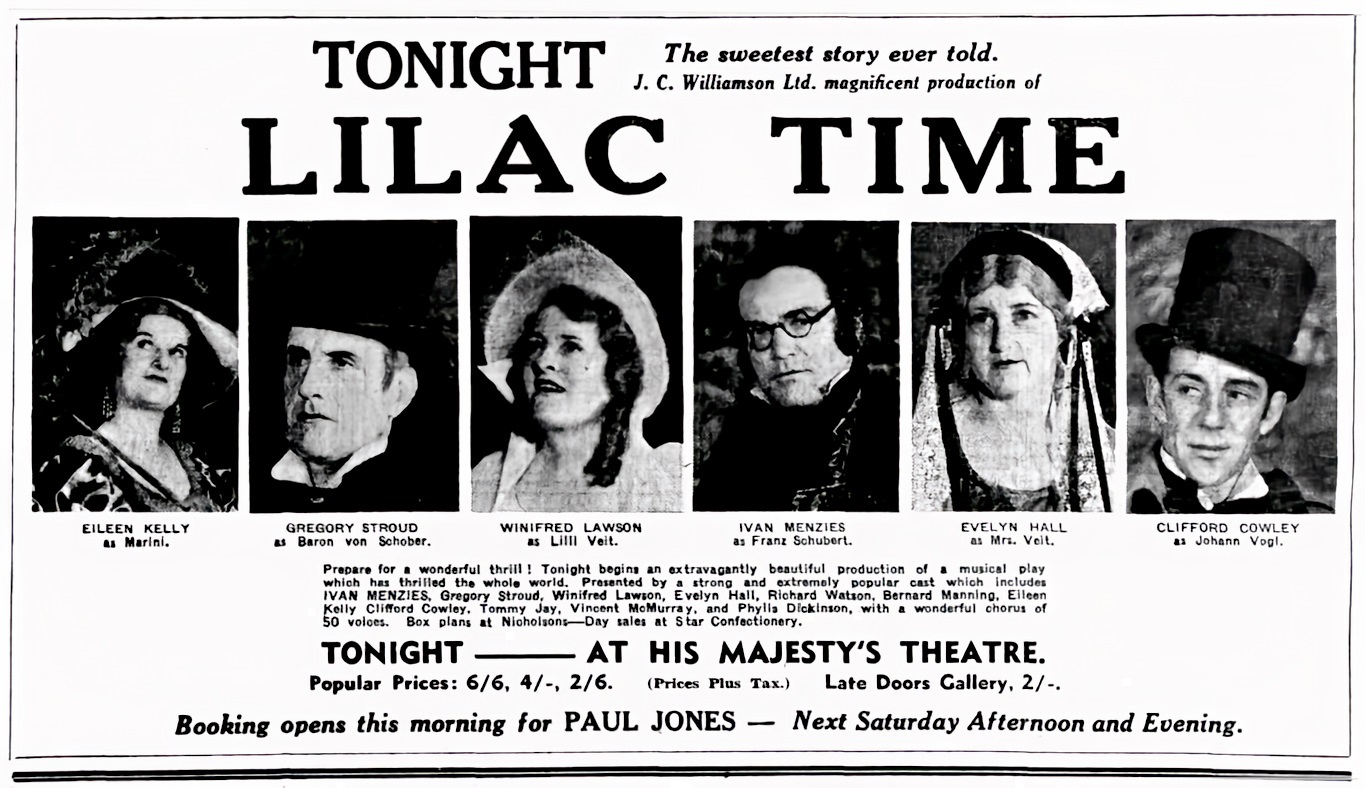 The Western Australian (Perth), Tuesday, 20 October 1936, p.2
Lilac Time was revived in the repertoire of the G&S company during its Perth season, with Winifred Lawson as Lili Veit, a role that she had first played on the British provincial tour of the piece in 1928. The operetta had previously been revived as part of the G&S company’s repertoire during its earlier Australian tour in 1932– 1933 and Gregory Stroud, Bernard Manning and Clifford Cowley reprised their respective roles of Baron Franz von Schober, Christian Veit and Johann Michael Vogl that they had played on that tour. But Ivan Menzies, who had played the comic detective Novotny in the earlier production, was now cast in the sympathetic role of Franz Schubert; a radical departure for the company’s principal comedian duly commented upon in the Perth newspaper reviews.
Tap here and here to view the Perth cast list for Lilac Time, and here to view the remaining Musical Numbers.
* * * * * * * * * * * * * * * * * * * *
“Lilac Time's” Charm
Departing from its Gilbert and Sullivan repertoire last night, the J. C. Williamson Company played “Lilac Time” to the evident satisfaction of yet another big house at His Majesty's Theatre.
This colorful “play with music by Franz Schubert,” as the programme labels it, takes daring liberties with the life story—so tragically brief—of the great Austrian composer, whose 600-odd songs were but a part of the amazing musical output of his 31-year existence.
The arrangement of the many sweet Schubertian melodies which the joint authors of the piece have interwoven in the score is, like the biographical side of the play, distinctly unconventional. The general effect, however, is the provision of an entertaining blend of operetta and musical comedy, and as in 1933, when Perth last saw and heard “Lilac Time,” the tunefulness and ingenuous humor of the production were gladly acclaimed last evening.
MENZIES' NEW ROLE
With affectionate memories of the late John Ralston in the role of Franz Schubert, the bulk of the audience had doubtless indulged in puzzled speculation as to how Ivan Menzies, thought of so happily in terms of Koko, the Duke of Plaza-toro, Jack Point, the Lord Chancellor, and so on, would manage to acquit himself in the antithetical role of the Viennese composer. The answer to the problem was an agreeable surprise. Mr. Menzies admirable restraint and delicate handling of the mild-mannered and absurdly altruistic Schubert of “Lilac Time” might have impelled a newcomer to the theatre to think that the little actor had never essayed to play the “private buffoon” or the “lord high executioner.”
Vocally Mr. Menzies did remarkably well for one who is customarily a purveyor of “patter” songs. His rendering of the “Tit Willow” ditty in “The Mikado” had certainly hinted at more than a little sweetness in his voice, and last night this fleeting impression was amplified in his creditable treatment of “Hark, Hark the Lark,” “Underneath the Lilac Bough” and other numbers.
Mr. Gregory Stroud made a brave figure as the poet, Baron Franz von Schober, whose task of deputising for the timid Schubert as singer of a love song leads to such distressing complications for the composer. Mr. Stroud's fine baritone was heard to particularly good effect in the lovely “I Carve Her Name in Every Tree.”
Misses Winifred Lawson, Nina Robbins and Phyllis Dickenson sang and acted charmingly as the three daughters of Christian Veit, and Mr. Bernard Manning supplied much broad humor as their father.
Miss Eileen Kelly was duly exotic as Marini, and Messrs. Frank Birmingham, Clifford Cowley and Vincent McMurray were capital boon companions of Schubert. Mr. Tommy Jay got many a laugh as a comic detective.
The old-world setting and costuming of the piece were well carried out, and the orchestra handled the tuneful score excellently.
“Lilac Time” will be presented for three more nights, and on Saturday 'Paul Jones' will be staged.
The Daily News (Perth, WA), Wednesday, 21 October 1936, p.3
* * * * * * * * * * * * * * * * * * * *
"LILAC TIME."
Performance at His Majesty's.
(By Neville Cardus.)
The present writer has heard "Lilac Time" in several cities of Europe, and it was a curious experience to listen to the music in Perth, far from Vienna. I went to His Majesty's Theatre last night resigned to the worst—and the worst always occurs when indifferent artists do their best. Last night's performance was, all things considered, surprisingly good. A small orchestra, shorn of one or two parts, played well enough, though no orchestral player not a Viennese can get the lift of the Landler Waltz, any more than a Viennese instrumentalist can play an Irish jig. These things are racial.
The acting was agreeable, despite much unnecessary overacting by people who could surely afford to play within themselves. Art is bad when it is in italics—like the letters of Queen Victoria. Mr. Ivan Menzies achieved a tour de force. It is well known that all comedians have secret ambitions towards romance or tragedy, much as all tragedians wish to be comic. Dan Leno wanted to play "Hamlet" (which no doubt he would have done), and Henry Irving never enjoyed himself so much as on the occasion when he fooled about in an adaptation of the "Pickwick Papers"; his part was Jingle, and he sat on his own hat and made himself laugh immoderately.
Mr. Menzies avoided the issue, so to say; he left the bowling alone. He has not a tenor voice; sometimes he has no voice at all—that is, speaking of voices from the vocal point of view. Schubert in this light opera should be sung by a tenor; Mr. Menzies sang it rather as Schubert himself probably did. No great composer has ever had a voice. Mr. Menzies was a model of discretion; he was restrained and skilful in judging what he could and what he could not do. The opera travesties Schubert, makes him into a milksop, wallowing in nauseating sentiment—Schubert, mind you, one of Vienna's gayest sons and lovers in a great period. It was not Mr. Menzses's fault, but the fault of the authors who arranged the libretto, that Schubert last night seemed a man more capable of composing the songs of Tosti, than the C major quintet and the C major symphony. With admirable taste, Mr. Menzies conformed to the moonshine of Willner and Reichert, the perpetrators of the llbretto. It is worse in English than it is in the original; there is no mistaking the lineage of jokes such as "on this suspicious—I mean auspicious occasion." And "I suspish" instead of "I suspect." All that is needed to force these epigrams home is an umbrella and a red nose. Mr. Bernard Manning, as Christian Veit—the funny man of the piece—missed no chance: he hit them for sixes. The old school of musical comedy humour knew its job, and always gave us half an hour's notice of the approach or advent of a joke. Mr. Manning could easily practice reserve; but he has gusto, feels the breadth of his conception, and enjoys himself.
World's Greatest Love Songs.
The other parts were admirable, more or less. The last time I heard and saw Miss Winifred Lawson was in Gilbert and Sullivan during a foul week of fog in Manchester. She is naturally singing better in Perth than all the archangels in Heaven could sing in Manchester. Her interpretation of Lilli is charming. Mr. Gregory Stroud sang well as Schober; he has the privilege of singing one of the world's greatest love songs "Ich schnit es gern in alle rinden ein" ("I Carve Her Name in Every Tree"), a song which this opera rips from its context, as it does many other airs of Schubert. The song comes in the cycle of "Die schone Mullerin," and I can only hope that "Lilac Time" has the effect of driving many people to the unadulterated source of Schubert himself.
'"Lilac Time" is a pleasant and enjoyable musical play; the score is an ingenious pastische, and if you do not know Schubert well, it can be listened to without qualms. None the less, the "arrangers," for all their dexterity, commit sins almost unforgivable. The opening of the "Unfinished" Symphony is suddenly decapitated, and we are plunged into the most hackneyed of the "Moments Musical." The worst, offence is the mess that is made of "Wohin"; last night I did not hear the equally heinous transformation of the first song of the "Winterrelse" cycle into a waltz. Given the accommodating point of view, "Lilac Time" is, as I say, a charming piece of work; but in fairness to the memory of Schubert "Lilac Time" should be regarded as little more than a musical comedy in which the hero could with ample point have been called Horace Vere de Vere, or the Austrian equivalent of such a name. Schubert was a gay spirit on the surface; underneath he understood the tragic sense of life, as any fool could understand from one hearing of his Goethe settings. It is fantastical to represent Schubert as a weakling, who allows another man to make love for him, and then when he is rightly thrown over, slobbers to the audience: "Others have life and love; I have my music." Schubert composed the finale of the C major symphony, one of the most masculine and powerful things in music.
In their various parts, we were given excellent work by Vincent McMurray, Frank Birmingham, Clifford Cowley, Phyllis Dickinson, Nina Robbins, Evelyn Hall, Eileen Kelly, and Tommy Jay. The settings, and dresses were adequate; but I did not recognise the Prater in Act III; probably it was different in 1826 than it was when I walked through it a few weeks ago. Mr. Leo Packer conducted with much sensibility an orchestra with a piano in it.
The West Australian (Perth, WA), Wednesday 21 October 1936, p.20
* * * * * * * * * * * * * * * * * * * *
Sydney return season at the Theatre Royal
(Musical Director: Andrew McCunn)
- The Gondoliers – Saturday, 31 October (mat. & eve.) to Friday, 6 November 1936
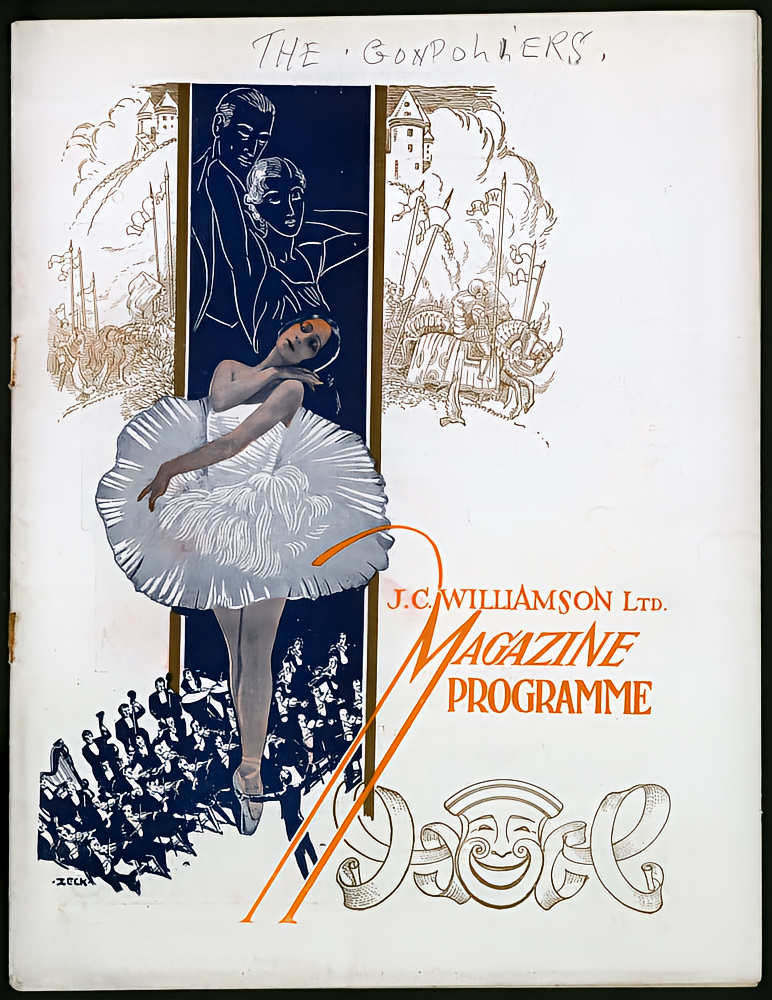
- The Yeomen of the Guard – Saturday, 7 November (mat. & eve.) to Friday, 13 November
- The Pirates of Penzance & Trial by Jury – Saturday, 14 November (mat. & eve.) to Friday, 20 November
- Princess Ida – Saturday, 21 November (mat. & eve.), Monday, 23 & Tuesday, 24 November
- H.M.S. Pinafore & Cox and Box – Wednesday, 25 November (mat. & eve.) to Friday, 27 November
- The Mikado – Saturday, 28 November (mat. & eve.) to Friday, 4 December
- Ruddigore – Saturday, 5 December (mat. & eve.), Monday, 7 & Tuesday, 8 December
- Patience – Wednesday, 9 December (mat. & eve.) to Friday, 11 December
- Iolanthe – Saturday, 12 December (mat. & eve.) to Thursday, 17 December
- The Mikado – Friday, 18 December
- Paul Jones – Saturday, 19 December (mat. & eve.), Monday, 21 & Tuesday, 22 December
- The Mikado – Wednesday, 23 December (mat. & eve.)
The G&S company then departed for its second tour of New Zealand on 24 December, but without Winifred Lawson, who chose not to renew her contract. Australian soprano, Strella Wilson was engaged to play the principal soprano roles for the remainder of the tour, which she had previously played on the JCW G&S Opera Company's Australasian tours of 1920–22 and 1926–28.
Colonel de Basil's Monte Carlo Russian Ballet commenced its Sydney season at the Theatre Royal on Saturday, 26 December with a triple-bill of Les Sylphides, Scheherazade and Aurora's Wedding, and remained at the theatre for the next two months performing its repertoire of ballets, which concluded on Friday, 26 February 1937.
Winifred remained on holiday in Sydney until late February, giving a radio recital of French songs for the ABC from the 2FC studios on National relay on Tuesday, 16 February at 9.30 p.m., with a further broadcast of ballads from station 2BL on Sunday, 21 February at 9.05 p.m..
Sydney telephone directories of the 1930s (digitised on Trove), do not list any hotel known as the "Garden Club", which was most likely a mistaken reference by Winifred to the Clifton Gardens Hotel at Mosman overlooking the harbour that she misremembered when writing her memoirs in the early 1950s.
TRAVELLERS
List of prominent passengers per m.s. Neptuna, leaving Sydney at 11 a.m. to-day for Hongkong, from No. 22 Pyrmont: — Miss Winifred Lawson, operatic singer, lately with J. C. Williamson. Travelling to United Kingdom, via China, Japan and America…
Daily Commercial News and Shipping List (Sydney), Wednesday, 24 February 1937, p.4
* * * * * * * * * * * * * * * * * * * *
Postscript:
In the opening paragraph of chapter 23 of her memoirs (on page 184), Winifred Lawson wrote:
‘Came the War,’ as they say in the films. Earlier in the year I had decided to go back to Australia and had made all the necessary arrangements. My flat was let—my furniture was to put into store—and my luggage was packed ready for me to sail on September 8, 1939. But when war was declared, on September 3, all my plans had to be changed. I felt my own country was the place for me in war-time.
Winifred did not specify whether her proposed return to Australia was prompted by an invitation by J.C. Williamson’s to head the company’s next mooted tour of G&S revivals (which did not commence until mid-March of 1940 at the Theatre Royal, Sydney with Viola Wilson as principal soprano), or whether she was returning under her own steam for a possible concert tour, but in the event she did remain in Britain during the war years and performed on tour in concerts under the auspices of ENSA (Entertainment National Services Association), and CEMA (Council for the Encouragement of Music and the Arts – precursor to the later Arts Council of Great Britain), and later joined an ENSA concert party taking classical music to the troops stationed in Egypt, Africa and the Middle East. Winifred’s 1935– ’36 tour with the JCW G&S Opera Co. thus marked her sole visit to Australia and New Zealand.
* * * * * * * * * * * * * * * * * * * *
Additional Picture Sources
Digitised Theatre programme scans from the National Library of Australia, Canberra
- The Gondoliers – Monday, 1 June to Wednesday, 3 June 1936


