Ruth Vincent
-
Horace Stevens (Part 4)
 DAVID HIBBARD's overview of the life and times of the Australian bass-baritone Horace Stevens continues with Part 4.
From January to March 1920, Stevens gave concert performances in Edinburgh, Belfast and London, Wagner featuring regularly. Returning to Australia in April 1920, to receive his discharge and pack up his family in preparation for a return to Britain, he nevertheless found time to perform in Melbourne. A Savage Club Concert at the Melbourne Town Hall in June,1 a Royal Victorian Liedertafel concert in August,2 and on 26August he made a triumphant return to the Royal Melbourne Philharmonic as Elijah, under Alberto Zelman. “All accounts agree on a very fine performance, with Mr Horace Stevens the outstanding feature of the performance”.3
He departed from Melbourne with his wife, Nellie, and his three sons; Kemble, Southerland and Dudley on 28 August 1920, to undertake a brand-new life as a full-time concert artist at the age of 44.4

Elsa Stralia, 1922
State Library of South Australia, Adelaide

Eugene Goossens, 1922
National Portrait Gallery, London
1920-1926
As outlined towards the end of Part Three, Horace Stevens began his professional career in Britain during 1919 while awaiting demobilisation back in Australia. In 1919 the Brand Lane Concerts for that year advertised a sterling line-up of musicians including Dame Nellie Melba, Clara Butt, Ferrucio Busoni, Alfred Cortot, and “there is to be a new Elijah from whom the highest things are expected, in the person of Captain Horace Stevens, Madame Stralia, Miss Astra Desmond, and Mr John Coates also appearing in the same oratorio”.5 The Brand Lane concerts were popular concerts, founded by G.W. Lane in 1894. Elsa Stralia, who appeared with Horace was an Australian dramatic coloratura soprano. Born Elsa Fischer, from Adelaide, she was six years younger than Horace but had been singing principal roles at Covent Garden since 1912.6
On the 29 September 1919, Horace Stevens performed in his first Promenade Concert. The “Proms” were the brainchild of Sir Henry Wood and Robert Newman (1858-1926), an ex-stockbroker turned impresario. In accordance with the Victorian Ideal of “improving” the masses, the concerts were designed to bring affordable music, well performed, to the middle classes. They occurred in The Queens Hall until it was bombed in May 1941.7 The first Promenade concert occurred on 10 August 1895,8 and the tradition has continued unbroken to the present.
Prom 38 for the 1919 season, on Monday, 29 September, began with the entire first half as an extensive, all-Wagner program, conducted, as usual by Wood. The concert included excerpts from Siegfried, Tannhäuser, Lohengrin, Götterdämmerung, Die Walküre, and Die Fliegender Holländer. Stevens performed ‘Wotan’s Farewell’ (to his daughter Brünnhilde) from Act Three of Die Walküre, an extensive extract that leads into the ’Magic Fire Music’ that concludes the opera. It is reasonable to presume that his coaching with Sir Henry under the ’Non-Military employment scheme’ was probably to perform this very piece.9 This performance of Wotan’s Farewell began a lasting association between Stevens and this work, perhaps only exceeded by his connection to the role of Elijah. On 6 June 1930, he recorded the ‘Farewell’ for Decca, conducted by Julian Clifford. Because Decca decided to include the Fire Music section on this recording, it appears this may be the first studio recording of the whole, dramatic scene.10
In 1920 Horace sailed for Australia to be demobilised. On his return to Britain, on 28 August, he almost immediately made his first recordings at the London studios of the Vocalion Recording Company. These recordings were listed as taking place in August 1920. They are two songs from a group of Four Songs of the Fair, by Easthope Martin (1882-1925):11 ‘Fairings’ and ‘The Ballad Monger’. The songs were composed for low voice in 1912. Pleasant, but undemanding music, the quality of the recordings is remarkably good. The Vocalion company pressed the recordings on red, rather than black shellac, which was not as robust.
On 1 December 1920 he performed in Purcell’s King Arthur, with the Westminster Choral Society at the Central Hall. The reviewer found that “on the whole, the performances was remarkably successful, considering the difficult conditions”. “The five soloists gave us some good things; Miss Carrie Tubb was very well suited by the Cupid recitatives, Mr Arthur Jordan was splendidly rhythmic in ‘Come if you dare’ and Mr Horace Stevens made much of the broad phrases of the greeting to Britannia”.12
In 1921 Stevens performed with the Leeds Symphony Orchestra under the direction of Beecham’s protégé, Eugene Goossens (1893-1962). There was an extensive programme for the two concerts. Stevens sang for the first time the two lengthy monologues for Hans Sachs from Wagner’s Die Meistersinger von Nürnberg. The first, listed in the programme as ’The Elder’s Scent’, which I believe to be ’Was düftet doch die flieder ‘or the ‘Flieder Monologue’ (and more correctly ‘the Lilac’s scent’), is a five-and-a-half-minute monologue, where Hans Sachs compares the poetry of Walther von Stoltzing, the noble poet, to the scent of the lilac that sweetly rises into the air. The second (of three), ‘Mad! Mad!’ (Wahn, Wahn, überall Wahn), is just over six minutes. Goossens programmed them one after the other, which is quite an effort for the vocalist. Despite this, they are perfect Horace Stevens repertoire, vocally. The odd thing about programming these two, lengthy solos is that, taken out of context from the drama of the opera, they require a degree of acting ability to successfully achieve a connection with the audience. For a performer who was yet to stand on an operatic stage, this must have been quite intimidating. Later in the concert, following performances of Dvorak’s Symphony ‘From the New World ‘and Sibelius’s En Saga, Stevens performed the beautiful song cycle Songs of Sun and Shade, by Samuel Coleridge Taylor (1875-1912). Composed the year before the composer’s death, they are a dreamy, mature work, comprising five songs.

Lauritz Melchior
Society of Swedish Literature in Finland

Horace Stevens as Wotan
The Australian Musical News, 1 December 1923
In August 1921, Horace Stevens returned to the Proms with further extensions to his Wagnerian repertoire. At the second Proms concert, on 15 August, he performed the Dutchman’s exciting aria ‘Die Frist ist um’, from The Flying Dutchman, as well as the scene for the Dutchman and Senta, ’Wie aus der ferne’. Although the Proms archive lists their programmes in the language of composition, it appears the singers performed in their own language. Sir Henry Wood writes that performances would be in English, German and in one famous case, Danish.13 At Prom No.14 of 1921 Stevens sang the parts of both Wotan and Alberich in excerpts from Das Rheingold, the prologue to Wagner’s ‘Ring Cycle’. In Prom No. 20 he sang in concert performances of both Acts One and Three of Die Walküre, which also marked the British debut of the legendary heldentenor, Lauritz Melchior (1890-1973). Australian compatriot, bass Malcolm McEachern (1883-1945) sang Hunding.14
I was intrigued as to why Stevens sang most of the three Ring Wotan’s in concert, (the Siegfried ‘Wanderer’ he sang in the Proms the following year), but on stage, only sang the Walküre Wotan. I wrote to John Wegner, who sang all three Wotan’s in the first Adelaide ‘Ring Cycle’ in 1998. He replied on 14 August 2017: “The three Wotan roles are very different to sing. If he (Stevens) was thoroughly prepared for the Walküre as his debut opera, then he probably learned enough to make it comfortable enough to do it again. … Walküre is the most difficult of the three because of the length of the role (1 ½ hours solo singing) with an incredible pitch range, emotional range and vocal stamina. If you start getting it wrong and you might not finish the night …Siegfried is a completely different kettle of fish … the tessitura is higher”. To paraphrase the end of the letter, John points out that without sufficient time to prepare the SiegfriedWanderer, the tessitura would have beaten him, and as the era of the extended production rehearsal was still a further thirty years in the future, this would explain it. John also points out that although Rheingold has the least for Wotan to sing, as a constant physical presence onstage, it is tiring in its own way”.
In November 1921, Stevens performed in the Leamington Spa Orchestral Concert, conducted by Walter Warren, described as an “able conductor”.15 This concert is interesting in that Stevens’s repertoire expands into more standard dramatic baritone fare. From Tannhäuser (Wagner) he sang the recitative and Aria ’O du mein Holdes Abendstern ‘(Song to the Evening Star), an aria that requires an ability to float on a reasonably high tessitura. It was received “very favourably”. His second item was probably the famous ‘Credo’ from Verdi’s Otello, Iago’s appeal to a “cruel God”. The reviewer is full of praise. The song “surpassed all that had gone before”. He finished his contribution to the concert, which included the Fideliooverture and the ‘New World’ Symphony, with a song, Harlequin by Comfort and Wilfred Sanderson Parry, and composed that very year. He encored with ‘The Ballad Monger’ from Songs of the Fair he had recorded the previous year.
In 1921 Stevens appeared in the first of his “Ballad Concerts” at St James’ Hall in London. The brainchild of Samuel Chappell, one of the Chappell music printer brothers, and managed by John Boosey of Boosey and Hawkes, these concerts were, prior to the 1890s, the forerunner to the Proms Concerts, providing easily accessible, quality music to the general public.16 Their fame, as The Classical Monday Pops, was enough to be included amongst the punishments meted out in Gilbert and Sullivan’s The Mikado (for the Music Hall Singer). In March 1922, Stevens performed the Stanford Cavalier Songs at a Ballad Concert, in “vigorous style”.17
Directly, he travelled to Kirkcaldy, near Fife in Scotland, to perform Sir Arthur Sullivan’s The Golden Legend, as Lucifer. Composed for the Leeds Festival in 1886, the same year as his Savoy comedy,18 Ruddigore, it is based on a poem by Longfellow. The part of Lucifer, once again, saw Stevens floating his voice into the higher tessitura of the bass baritone, similar in style to Gounod’s Mors et Vita. “A stirringly dramatic Lucifer in the person of Mr Horace Stevens, there was a fine rendering of the prologue”.19

Ad for The Dream of Gerontius in Leicester
Leicester Evening Mail, 29 April 1922

Florence Austral as Brünnhilde
National Library of Australia, Canberra
On 6 April 1922, a young Malcolm Sargent conducted Elgar’s The Dream of Gerontius in Leicester with the combined choirs of the Leicester Mowbray Choral Society, the Leicester Choral Union and the Melton Mowbray Choral Society. The orchestra was semi-professional, comprising amateurs and professionals. He selected John Coates (1865-1941) as Gerontius, Phyllis Lett as the Angel, and Horace Stevens as the Priest and Angel of the Agony. Stevens’s inclusion amongst some extremely established singers shows how highly he was esteemed after such a relatively short time performing in Britain. Sargent considered this performance of Gerontius to be his own “true beginning.”20
In August 1922, Stevens was back at the Proms performing the same Fliegender Holländer program, but this time the role of Senta was the legendary Australian soprano Florence Austral (1894-1968). She had made her Covent Garden debut in May of that year, substituting as the Walküre ‘Brünnhilde’ for an indisposed Elsa Stralia.21 Theirs was to be a long and fruitful relationship lasting through the twenties. Like Stevens, both were members of Sir Benjamin Fuller’s Opera Company tour of Australia in 1934, and both advised young singers with Gertrude Johnson’s National theatre in the 1940s. In his ADB entry on Stevens, James Griffin states that Horace would pedantically re-chalk stage positions on the floor, which would irritate Austral in later years.22 Chalking the stage marked stage positions and lighting cues in the days before duct tape.
Also, in the 1922 Proms, excerpts from Das Rheingold were again performed, this time with Stevens undertaking the parts of Wotan, Alberich and Donner on the 29 September, Walküre, on the 2 October with Carrie Tubb (1876-1976), as Brünnhilde, Archibald Winter as Siegmund and Malcolm McEachern as Hunding. On the 9 October, for Prom Number No. 50, Stevens performed the Wanderer in excerpts from Act 1 and Act 3 of Siegfried. His Erda was Doris Manuella, his Mime, Sydney Russell.
In January 1923, the “Eminent Baritone”23 was performing in a “Grand Orchestral Concert with the Scottish Orchestra” before joining a concert performance of Handel’s masque, Acis and Galatea at Grantham in Lincolnshire. The bass part in this Masque (premiered in 1718), ‘Polyphemus’ the cyclops, sits a little lower than much of the repertoire Stevens was, up to this date, singing. The tour de force recitative and aria ‘I rage, I melt, I burn’ and ‘O Ruddier than the Cherry’, are usually a mainstay of true bass singers. An incident occurred during the performance: Stevens missed some music at a page turn and came in too early for his next entrance.24 He stopped the performance to apologise to the audience.
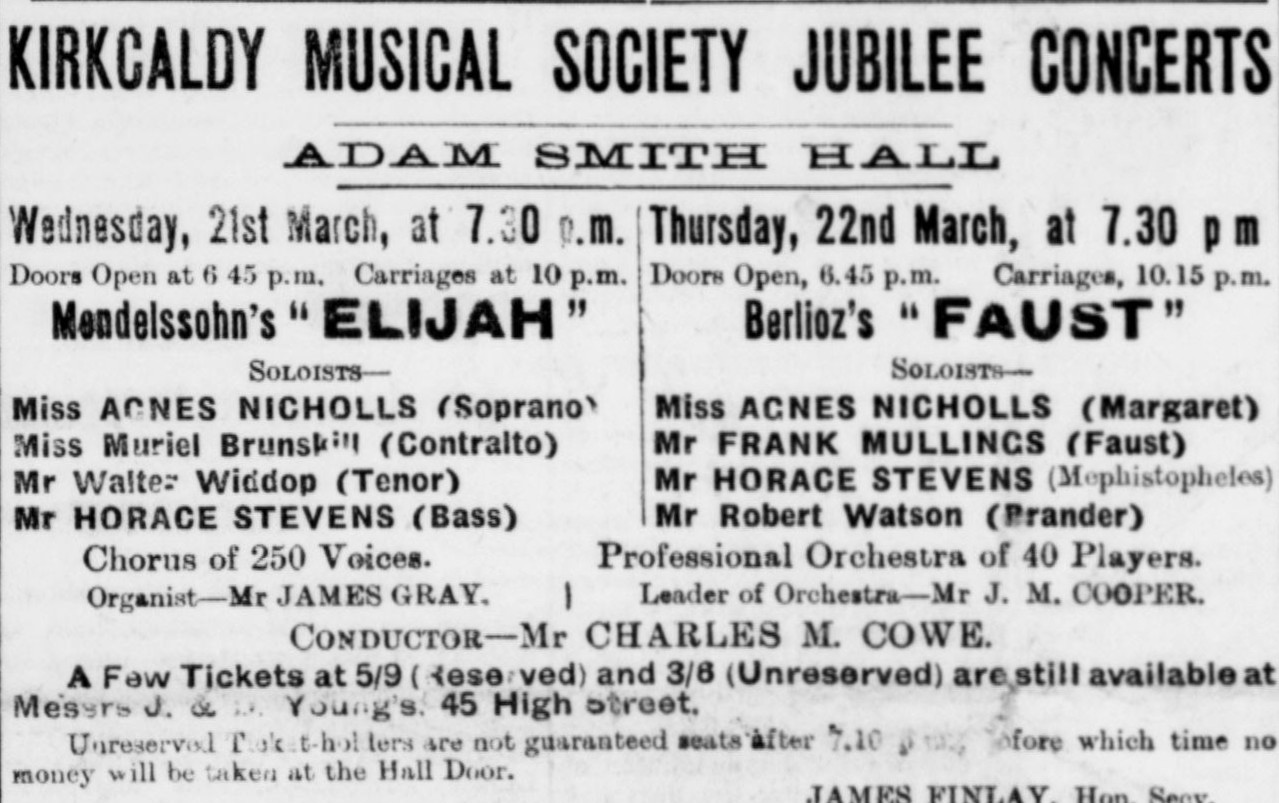 Flintshire Advertiser, 17 March 1923
In March Stevens was back in Scotland, at Kirkcaldy, with the Kirkcaldy Musical Society’s Jubilee. He performed Elijah and Mephistopheles in the Damnation of Faustby Berlioz. “The Prophet’s part upon which everything hangs” wrote the Fife Free Press “was in the capable keeping of Mr Horace Stevens who earned a reputation at the Society’s concert last year. We confess to a little disappointment. It was not a consistent performance, and though the singing of the great ‘It is enough’ was very fine, at other points Mr Stevens did not quite realise the hopes we had for him in this role.”25 Despite featuring such brilliant soloists as Walter Widdop and Muriel Brunskill, as well as Stevens, the Berlioz was dismissed as “possibly blasphemous” and using all the instruments of the orchestra.
Also, in March, Stevens recorded ‘The Wayside Cross’. Composed by American hymn writer, Evelyn Sharpe (1884-1969), it shows off the remarkable Stevens gift for floating high notes, although his over emphasis of the consonants, particularly the rolled ‘r’s sounds almost comical.26 In June 1923 he recorded his superb Messiah arias, ‘Why do the Nations’ (with da capo) and ‘The Trumpet shall sound’ and his first recording of ’Lord God of Abraham’ from Elijah. In July, under the curious assumed name of ‘Stephen Langley’, he recorded his first version of ‘The Drum Major’ by Frederic Weatherly (1848-1929), composed in 1907, and ’The Veterans Song’ with lyrics by Weatherly and composed by Stephen Adams (1841-1913) the nom de composeur of Michael Maybrick, the composer of the perennial favourite ‘The Holy City’.27 Both these were recorded for Aeolian, which was the parent of Vocalion records and after 1924 became Aeolian Vocalion.
In 1923, after a series of legal actions involving the control of the Covent Garden Estate, which had begun in 1916,28 Sir Thomas Beecham staged his final season at Covent Garden until 1931. Australian singers were well represented, with Melba performing Marguerite in Faust, Florence Austral singing the three ‘Ring’ Brünnhilde’s and Aida, Gertrude Johnson as The Queen of the Night, Frederick Collier singing Peter in Hansel and Gretel, Sydney mezzo Leah Myers making a brief sojourn into soprano repertoire as Charpentier’s Louise and Horace Stevens making his theatre debut as Wotan in DieWalküre, second cast to the American bass baritone Robert Parker.29 There is no local review of any of the performances of the second cast, but news arrived back in Australia by July. The London correspondent of The Age wrote “Mr. Horace Stevens, who has done a great amount of concert work in this country, made a still more ambitious first appearance as Wotan, no less, in the Valkyrie. For a stage debut, his performance was remarkable. In particular, he sang Wotan’s music, which suits him well, with admirable taste and skill, and took full advantage of his great chance in the farewell to Brünnhilde in the last act”.30 The correspondent to The Daily Herald of Adelaide listed the Australians Eda Bennie, Florence Austral, Beatrice Miranda, Leah Myers, Elsa Treweek, Frederick Collier (listed as a baritone) and “Horace Stevens, basso, in Wagnerian roles”.31 In December 1923, Stevens was mentioned in a letter to the Sydney Morning Herald from local singing teacher Roland Foster, that the success of Australian singers overseas should lead to a National Opera Company, using these singers as a basis.32 At 47 years of age, Horace Stevens had made a mark in his first operatic performances.
Stevens sang The Damnation of Faust again that November in Nottingham33 and The Dream of Gerontius in September in a double bill with Holst’s Hymn of Jesus that also featured Florence Austral.34 He sang Vaughan Williams’s A Sea Symphony with soprano Muriel Childe in Belfast in October with the Belfast Symphony Orchestra under E. Godfrey-Brown (1874-1955). His performance “added to a previously held, high opinion”. Amongst a raft of encores, he performed ‘Honour and Arms’ from Handel’s Samson, ‘Vision Fugitive’ from Massenet’s Herodiade and Peter Warlock’s ballad ‘Captain Stratton’s Fancy‘(composed only three years earlier).35
In 1924 Stevens was involved once again in the double bill of The Dream of Gerontius and Hymn of Jesus, this time at the Royal Albert Hall with the Royal Choral Society under the direction of Sir Landon Ronald (1873-1938). His colleagues for this occasion were the tenor Arthur Jordan, and the mezzo-soprano Margaret Balfour (1892-1961).36
In February 1924 he also recorded two of his finest sides for Vocalion: the other two Elijah arias, ‘It is enough’ and ‘For the mountains shall depart’, both from the second part.37 The Gramophone reviewer, Herman Klein, considered his version of ‘It is enough’ “an original, rather than a traditional reading. It is too full of sforzandos and staccatos for my taste, but in a large auditorium would doubtless sound well.” This is exactly the reason I love this recording. To achieve these effects, Stevens plays with his exemplary technique, to show the absolute beauty that can be achieved with this aria. In way of contrast, one should listen to the superb Wagnerian, Friedrich Schorr in 192938 which is fairly straight compared to Stevens’s version, and without embellishment. Klein is more supportive of the second aria, remarking upon the successful use of mezza-voce to get across a ‘difficult melody’.39
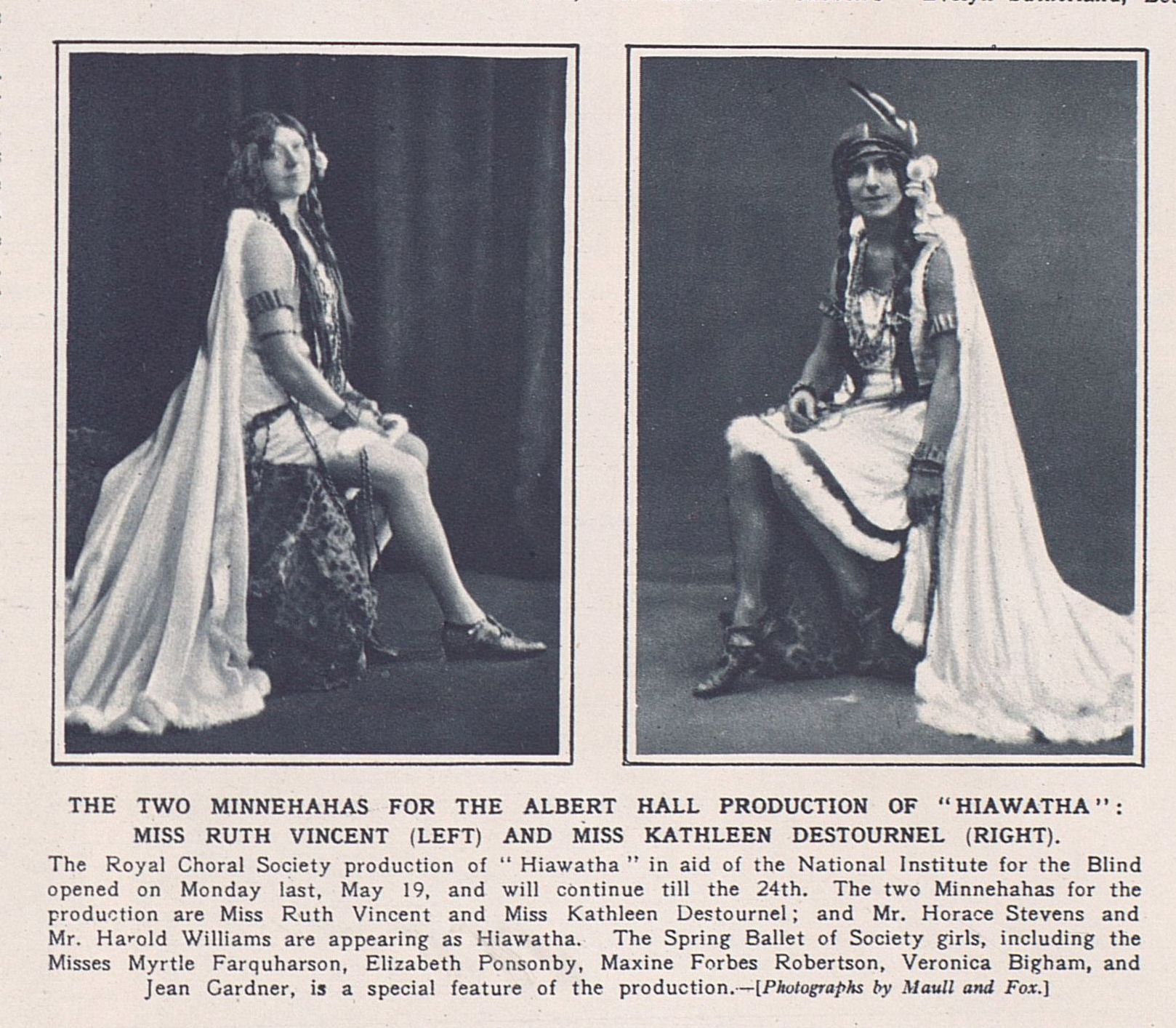 The Sketch (London), 21 May 1924
The British Empire Exhibition ran from 23 April 1924 to 31 October 1925. During this year of celebration, the entrepreneur Thomas Fairbairn was requested by the National Institute for the Blind to organise a charity event, whereby the cantata Hiawatha was staged. It had been performed as a complete, three-part cantata at the Royal Albert Hall on 22 March 1900. The scale of the set was huge. The back cloth was 10,000 square feet, and the production featured a waterfall and a snow storm.40 Because of the number of choristers, ’back-stage’ changing facilities were erected in tents in Hyde Park. The cast included a genuine Mohawk Chief Os-Ke-Non-Ton.41 Of the three casts, the opening night included Horace Stevens, Frank Mullings, Maggie Teyte and Ruth Vincent. Eugene Goossens conducted the orchestra, while Coleridge-Taylor’s son, Hiawatha, conducted the Ballet Music.42 After 1924, Goossens departed for the USA, leaving the performances in the charge of Malcolm Sargent, who wrote lovingly of the music, which he had first conducted in 1919.43 The performances proved so popular that the work was staged “for a fortnight each year from 1924 until 1939”.44
In 1925 Stevens recorded ‘Hiawatha’s Vision’ from part three of the Cantata; Hiawatha’s Departure. It is an edited version, possibly to cater for the limited recording time on the disc, cutting 24 bars from figure 26 to three bars before figure 27.45 This monologue has an extremely high tessitura, so the cut probably makes it easier to sing. Stevens approaches the piece with his usual, faultless diction, and elegant phrasing.46
October 1924 was a busy month, beginning with a performance of Elijah at the Alexandra Palace in North London. “Mr Stevens very cleverly combined subtlety with forceful expression”.47 On the 18 October he was in Norfolk to perform in an ‘all-star’ Yarmouth Festival, attended by King George V and Queen Mary. Dame Ethel Smyth and Ralph Vaughan-Williams conducted their own compositions, Horace performing the baritone solos in Vaughan-Williams’s A Sea Symphony. Under the baton of Sir Henry Wood, he once again sang ‘Wotan’s Farewell’ in a ’Special Wagner Programme’ which featured excerpts from ‘The Ring’, Parsifal and Tristan and Isolde. Other featured soloists included Maggie Teyte, Florence Austral, Malcolm McEachern and Margaret Balfour. The programming of the concert series was concentrated. Stevens sang the A Sea Symphony on Friday morning, the Wagner programme on Friday evening, and Elijah on Wednesday morning.48
By 1925 Stevens was a regular performer on wireless broadcasts. On the 26 January he appeared in an Australia Day broadcast with three compatriots, soprano Gertrude Johnson (1894-1973), a famous Queen of the Night and Micaela for British National Opera,49 tenor (Joseph) Browning Mummery (1888-1974), a famous lyric tenor who performed Rodolfo to Melba’s Mimi in her 1924 Covent Garden Farewell, and pianist and composer Roy Agnew (1891-1944), whose piano works were featured in recitals by Moisewitch and Cortot.50 The conductor for the evening was British, Sir Dan Godfrey (1868-1939), founder of the Bournemouth Symphony Orchestra. The program included the singers and orchestra performing Six Bush Songs by William G James (1892-1977).51
A broadcast on the 8 March by Stevens included the Four Serious Songsof Brahms, plus a set of Oriental Songs by Welsh composer, Bryceson Treharne, (1879-1948) who had previously been composition lecturer in Adelaide.52
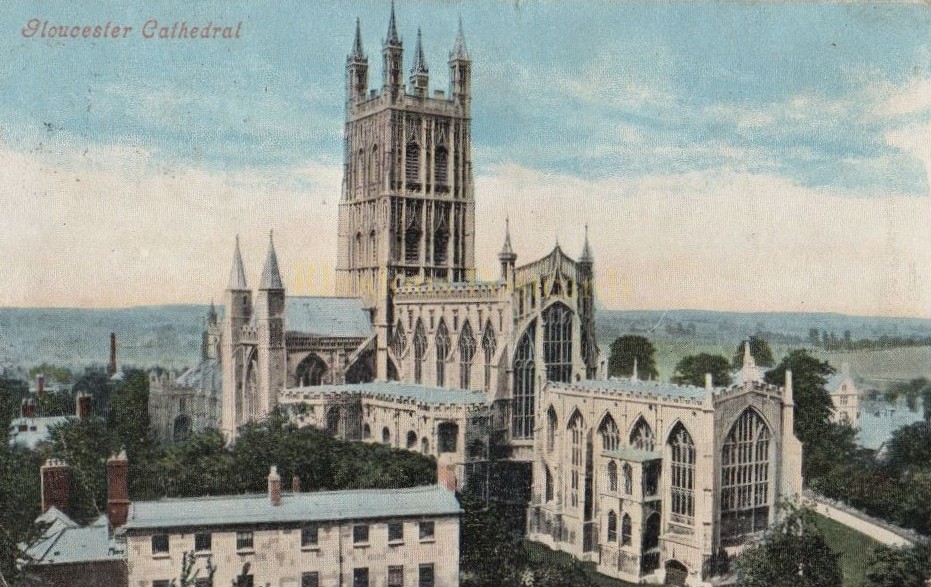
The Three Choirs Festival is one of the oldest musical festivals in the world, dating back to at least 1719 and comprising the choirs of the Cathedrals of the “three counties”, Hereford, Gloucester and Worcester. In 1925 it was the turn of Gloucester Cathedral to host the festival. This was the first year the BBC broadcast a Three Choirs concert. The London Symphony Orchestra was engaged, conducted by Sir Ivor Atkins, excepting the featured works by Dame Ethel Smyth and Ralph Vaughan Williams, which the composers themselves directed.53 In a massive program, Horace performed in Elijah, Sir Hubert Parry’s Job (in the relatively minor role of the Narrator), A Sea Symphony and in the premiere of Dame Ethel Smyth’s Mass in C. His reviews were consistently good, “powerful and impressive”.54 Sir Edward Elgar attended the festival to direct The Apostles but according to an email I received from Diana McVeagh of the Elgar Society, Stevens did not meet him until the following year in Worcester.
The Times headlined their review of Stevens’s performance “A Great Elijah”. Following a musical setting of The Lord’s Prayer, set by Leo Williams, during which the audience stood, “the main business of the day was begun by Mr. Horace Stevens singing the opening recitative of Elijah. The majority of the audience seemed to be armed with vocal scores, and in some of them, at any rate, the names of famous singers of past festivals had been pencilled against favourite arias. No doubt the words “Horace Stevens, 1925” will be added to many of them, and the name will deserve its place beside those of Santley, Ffrangçon-Davies and the rest, for his whole treatment of the part of Elijah is on the great scale. Mr Stevens singing was dramatic in the sense that he makes a musical picture a distinct personality which dominates the whole work, but it is singularly free from that over-assertiveness which sinks into theatricality.”55
Amongst his recordings for 1925 was the song cycle Maud (1898) by Arthur Somervell (1862-1937) to poems by Alfred, Lord Tennyson. The recording was reviewed in The Gramophone. “Somervell’s song cycles exhale the essence and the perfume of the poems which they reflect in music … for the Vocalion Horace Stevens however, has done four songs, all of them absolutely first rate, viz; A voice from the cedar tree (K. 05186) on one side of the disc; and on the other (a) O that ‘twere possible, (b) O let the solid ground, and (c) Go not, happy day.56 I commend first for the composition, as well as the singer’s artistic juxtaposition of energetic emphasis, tenderness , and strong gusts of passion.”57
Endnotes
1. The Argus(Melbourne), 11 June 1920 p.8. Trove. Accessed 19 April 2017.
2. The Argus(Melbourne), 13 August 1920 p.8. Trove. Accessed 21 May 2017.
3. W.A. Carne, A Century of Harmony: The official Centenary History of the Royal Melbourne Philharmonic Society, Royal Melbourne Philharmonic Society, Melbourne, 1954, p.167
4. Table Talk, 19 August 1920, p.25. Trove. Accessed 19 April 2017.
5. The Manchester Guardian. 4 September 1919, p.10. ©The Manchester Guardian Archives, 1901-1959. Accessed 4 August 2017.
6. Barbara & Findlay MacKenzie, Singers of Australia from Melba to Sutherland, Lansdowne Press, 1967, pp.109-111.
7. Thomas Russell, The Proms, Max Parrish & Co. Ltd., 1949, p.58.
8. Sir Henry Wood, My Life in Music, Victor Gollancz. Ltd., 1938, pp.71-72.
9. https://www.bbc.co.uk/proms/events/by/date/1919
10. Decca K527, K528 (mx MA 1464-1, MA 1465-1, MA 1466-3, MA 1467-2)-London, 06.06.1930
11. Truesound Transfers. Horace Stevens 2. TT-303 Copyright 2009 Christian Zwarg. Raschdorffstr.15, D-13409 Berlin
12. The Times, 1 December 1920, p.10. ©Times Newspapers Ltd. Accessed 21 June 2017.
13. ibid, Wood, pp 311-312
14. https://www.bbc.co.uk/proms/events/by/date/1921
15. Leamington Spa Courier, 18 November 1921. British Newspaper Archive. Accessed 4 August. 2017.
16. William Boosey, Fifty Years of Music, Ernest Benn Ltd., London, 1931, pp.102-111.
17. The Observer, 12 March 1922, p.6. The Observer Archives, 1901-2003. Accessed 10 August 2017.
18. http://www.hyperion-records.co.uk/dc.asp?dc=D_CDA67280
19. The Scotsman, 23 March 1922. British Newspaper Archive. Accessed 10 August 2017.
20. Charles Reid, Malcolm Sargent, A biography, Hamish Hamilton, 1968, p.105.
21. ibid, Barbara & Findlay MacKenzie, p.148.
22. James Griffin, Australian Dictionary of Biography, Volume 12, MUP, 1990.Accessed23 July 2017, http://adb.anu.edu.au/biography/stevens-horace-ernest-8653
23. Forfar Dispatch, 18 January 1923. British Newspaper Archive. Accessed 10 August 2017.
24. Grantham Journal, 24 February 1923. British Newspaper Archive. Accessed 10 August 2017.
25. Fife Free Press and Kirkcaldy Guardian, 24 March 1923. British Newspaper Archive. Accessed 10 August 2017.
26. Vocalion R-6109 Mx 03167 London 03 1923
27. Aeolian Aco-G-15247 mx C-58888 London 07 1923
28. Sir Thomas Beecham, A Mingled Chime, Hutchinson and Co., 1944. Reprint White Lion Publishers, 1973, pp.185-190.
29. J.P. Wearing, The London Stage, 1920-1929,Rowan & Littlefield. Accessed online 27 March 2014.
30. The Age (Melbourne), 21 July 1923. Trove. Accessed 26 November 2017.
31. Daily Herald (Adelaide), 23 May 1923, p 3. Trove. Accessed 26 November 2017.
32. The Sydney Morning Herald, 20 December 1923. Trove. Accessed 26 November 2017.
33. Nottingham Journal, 12 November 1923. British Newspaper Archive. Accessed 10 August 2017.
34. Sheffield Daily Telegraph, 29 September 1923. British Newspaper Archive. Accessed 10 August 2017.
35. Northern Whig, 29 October 1923. British Newspaper Archive. Accessed 10 August 2017.
36. The Times, 25 February 1924, p.10. ©Times Newspapers Ltd. Accessed 8 September 2017.
37. Vocalion D 01245 (mx 3474/5) London 02 1924
38. https://www.youtube.com/watch?v=U7jJRHrjOGc
39. William Moran (ed.), Herman Klein and the Gramophone. Being a series of essays on the Bel canto (1923) The Gramophone and the singer (1924-1934) and reviews of new classical vocal recordings (1925-1934) and other writings from the Gramophone by Herman Klein, Amadeus Press, 1990, p.93.
40. The Manchester Guardian, 8 May 1924. p.6. ©The Manchester Guardian. Accessed 8 September 2017.
41. https://www.royalalberthall.com/about-the-hall/news/2012/june/june-story-of-the-month-the-royal-choral-society-and-the-royal-albert-hall/ accessed 8 Sep. 2017
42. ibid, The Manchester Guardian.
43. ibid, Charles Reid, pp.84-85.
44. ibid, Royal Albert Hall website.
45. S. Coleridge-Taylor, Scenes from the Song of Hiawatha, No. 3. Hiawatha’s Departure, Novello and Company Limited, London, Copyright 1900.
46. Aeolian (London) Vocalion K-05176 (mx 03913) London 04. 1925.
47. Daily Telegraph, 13 October 1924, p.5. The Telegraph Historical Archive.Accessed 4 August 2017.
48. Thetford and Watford Times and People’s Weekly Journal, 18 October 1924. British Newspaper Archive. Accessed 26 April 2017.
49. Frank van Straten, National Treasure, the story of Gertrude Johnson and the National Theatre, Victoria Press, 1994.
50. Isabelle Moresby, Australia makes Music, Longman’s, Green and Company, 1948, pp.130-132.
51. 2LO London - 26 January 1925-BBC Genome.
52. The Observer, 8 March 1925, p.15. ©The Observer, 1901-2003. Accessed 3 May 2017.
53. Three Choirs Festival http://www.3choirs.org/ Accessed 5 November 2017.
54. Cheltenham Chronical, 12 September 1925. British Newspaper Archive. Accessed 3 May 2017.
55. The Times, 9 September 1925, p.10. ©Times Newspapers Ltd.Accessed 16 May 2017.
56. Vocalion K05186 (mx 03934X & 039345)
57. ibid, Herman Klein.


