Oswald Stoll
-
Florrie Forde at 150: Melba for the masses (Part 1)
.jpg) Australian-born music hall singer Florrie Forde is better known in England than she is in the country of her birth. ROGER NEILL seeks to make amends by taking an in depth look at the life and career of a woman who was regarded as the ‘world’s greatest chorus singer’.
Many a heart is aching,
If you could read them all;
Many the hopes that have vanished,
After the ballIn my childhood in England in the late 1940s and early 1950s, the golden years of music hall were already long gone. Of course there were vestiges that remained―occasionally on the wireless, more regularly at pantomimes and in ‘variety’ shows at still-functioning end-of-the-pier theatres. These featured former stars of the post-First World War decline. Then at the start of the 1960s came Joan Littlewood’s Oh! What a Lovely War, which debunked the nationalistic patriotism which drove so many young men to sign up and give their lives so unceremoniously. It was packed full of music hall songs, several of them popularised by Florrie Forde.1
 Young Florrie FordeWhile from a young age getting to know so many of Florrie’s songs, I had no idea that she was Australian―although in fact she had featured her origins strongly in her initial years in Britain before the turn of the century. Nor did I realise that she had been such a major star and that she performed continuously between her debut in Sydney in 1892 and her death in Scotland in 1940―just two years short of a half-century on the stage.
Florrie Forde was born Flora Flannagan, probably at 88 (now 122) Gertrude Street in Fitzroy, Melbourne, on 16 August 1875. Her father, (Francis) Lott Flannagan, was previously a stonemason but by then a publican, born in Ireland.2 And in Florrie’s birth certificate, her mother Phoebe Cahill (née Simmons) is said to have been born in the USA. Before Flannagan, whom she married in Melbourne in 1876, Phoebe had been married to Daniel James Cahill (since 1861). With Cahill she had several children, then Lott and Phoebe together had a further nine, only four of whom survived beyond early childhood (Emily b.1868, Francis b.1872, Hannah (Nan) b.1874, Flora b.1875). Flora, the last of the survivors, was named after a sister who had predeceased her.
While her first two husbands were of Irish heritage, Phoebe herself seems to have been Jewish, born in 1846 the daughter of Barnett Simmons and Susan Solomans. Her relationship with Lott Flannagan seems to have been over by the end of the 1870s and in 1883 she married for a third time, declaring herself to be Phoebe Cahill (although Lott Flannagan was still alive―by that time living as a publican in Sydney―and possibly Daniel Cahill too). This time she married a Melbourne-based theatrical and society costumier, Thomas Henry Snelling Ford, who was to take over in 1888 his stepfather’s business (Ford and Son) in Russell Street, Melbourne. Phoebe and Thomas were to have more offspring. While Thomas had a ‘proper job’ in Melbourne, he also moonlighted, playing the banjo in the music halls.3 He also played other stringed instruments―fiddles (which he made) and zithers among them.
That her stepfather played on the halls seems not to have been noticed until recently and it is important in that it will have provided Flora with a practical introduction to the genre. From the start of her performing career, she styled herself Florrie Ford (after her stepfather but initially without an e, which was to be added within six months).
Florrie says that she first went to school at St Peter’s (presumably Eastern Hill), then at St Mary’s Convent (Carlton Gardens). She emphasises that the ‘family’ was as many as nineteen (including all the surviving children of Phoebe’s three marriages) and it has been suggested that several of them (including Flora) were ‘parked out’, so the convent, taking boarders, looks a good bet. And the costumier’s business will have generated the necessary fees.
Florrie will most likely have left school at fourteen―and she writes that she then spent time in her stepfather’s costumier business in Russell Street, where she learned to design dresses―a skill she took into her future performing career.
Clearly, she showed real promise as a singer from childhood. She wrote:
Once I had heard a song I seemed to record the tune in my memory with the precision of a phonograph record.
She described her young voice as contralto, but her mother, having risen in the world, did not see ‘actress’ in her talented daughter’s future. Phoebe insisted that she learn the piano, but Florrie hated it and stopped. ‘Singing made me happy’, she declared.
It is interesting that her first public performances (at 14–15) were to sing for her stepfather’s marionette theatre (another of his talents).
In the latter part of 1891 Florrie left home in Melbourne at just fifteen, travelling to Sydney, intent on a career in the music halls, where she stayed with her older sister Nan (Hannah), recently married to Navy man Alfred Tiltman in Melbourne. Nan and Alfred later transferred to live at the Devonport naval base in southwest England and she and Florrie were to remain close until she died there at 38 in 1912.4
Apprenticeship in Australia
Florrie Forde spent the first five years of her performing life (aged 16 to 21) ―all of it in Australia―fundamentally learning her trade. These years were mainly spent in seasons of three to six months, alternating between Sydney and Melbourne, with one season each in Brisbane and Adelaide, before travelling to try her luck in London. The majority of these engagements were as a music hall singer―one of a list of performers including all sorts of vaudeville entertainers―appreciated by audiences and critics but rarely headlining. Then Florrie extended her experience―as a singing actress in pantomime and musical comedy.
While much of our knowledge of Florrie’s performing career, both in Australia and in Britain, comes from contemporary newspaper reports, she also wrote a series of memoir pieces for publications, the most wide-ranging of them being ‘My Life Story’, told on a weekly basis in seven parts for Thomson’s Weekly News from 16 February 1916. Particularly revealing are the parts dealing with her early performing years in Australia.
While music hall in Britain had grown up in the second half of the nineteenth century in venues principally developed from pubs, in Australia, it had followed suit, but mostly was situated in theatres with proscenium arches. As a consequence, while every town and city in Britain, indeed many suburbs, had a music hall, in Australia it was mostly confined to the major metropolises.5
Many reports on the early performances of Florrie Ford (without the e) have 1 February 1892 as the date of her debut – at the Polytechnic Music Hall underneath the Imperial Arcade in Pitt Street, Sydney―and this was the occasion put out in her lifetime in press reports. Yet by the beginning of February that year, Florrie had already performed (from 9 November 1891) with Arthur Gordon’s Grand Variety Entertainments in the ‘middle of Sydney Harbour’ on the SS Alathea. She was one of twenty ‘artistes’ providing entertainment as they went on a ‘grand trip round the harbour’.
In Sydney, young Florrie was most impressed by the English burlesque actress Billie Barlow, learning to imitate her songs and even her walk. Around the same time, Florrie was introduced to (and auditioned with) the Canadian dancer-impresario, Dan Tracey, who gave her a job as a ‘chair-warmer’, a chorus girl, in Tracey’s company at the School of Arts, Pitt Street. This was to turn into a real solo booking with Tracey some months later.
Florrie’s debut at the Polytechnic was not on 1 February 1892, but in fact six weeks earlier (Saturday 19 December 1891), when she sang a ‘serio-comic’ song, ‘Don’t you believe it’―a ‘great attraction’―and later a duet as the Ford Sisters (‘Florrie and Carrie’), ‘See us dance the polka’.6 Was ‘Carrie’ her sister Nan, who later in England was a dance teacher, or someone else entirely? Someone else, says Florrie, but who?7

Florrie Forde with her sister, Photo by Stewart and Co, Melbourne
State Library Victoria, Melbourne

‘See me dance the polka’
At the supposed Polytechnic debut on Saturday I February, Florrie sang with Amy Olive, together as the Bowery Sisters (no more Ford Sisters, it seems), but in fact she also made another debut on the Sunday―with Steve Adson’s promenade concert at the Port Jackson Pavilion at Chowder Bay.8 For one shilling, the customers were ferried to that bay, together with a brass band on board, the concert itself being free. In order to ward off the wowsers, these Sunday concerts were labelled ‘Sacred and Classical’ and Florrie was to be a featured performer at them through the following months until early June, while continuing on Saturdays, a ‘great favourite’ with the Polytechnic. Again, on Sundays in early June, Florrie sang in the ‘Sacred and Classical Concerts’ at the Centennial Hall in Walker Street, North Sydney.
However, learning of her daughter’s theatrical exploits in Sydney, Florrie’s mother was devastated and sent Florrie’s brother (was this Francis?) up to Sydney to persuade her to cease and desist before bringing the family into disrepute. According to Florrie, mother thought of theatre folk as ‘poor lost souls, not fit for the society of respectable, decent folk.’ Florrie went home immediately to Melbourne in order to try to persuade Phoebe, and ‘[mother] bravely determined to cast aside all her foolish prejudices’, and be proud of her daughter’s success, if that were to come.
At some point that year, Florrie reports, she was approached by the American co-leader of the Montague-Turner Opera Company, impresario and tenor Charles Turner, who had heard Florrie sing and tried to persuade her to abandon the music hall stage and join his opera company. The Montague-Turner company was regularly on tour through Australia and New Zealand, always seeming to be short on resources, human and financial. Florrie turned him down.
While Florrie was back in Sydney, her mother Phoebe died at forty-six at her home with Thomas Ford in Bourke Street.9 Unreported in the Australian press, Florrie performed in a minor role (as a fairy) with Billie Barlow in June 1892 at Her Majesty’s in Sydney in the pantomime-burlesque Randolph the Reckless.10 This was produced by George Rignold, who was to play such a crucial role in Florrie’s development as a singing actor in 1894–95.

The young Florrie Forde
State Library Victoria, Melbourne

Billie Barlow, 1892, photo by Falk/H. Walter Barnett
Pantomime was to become a major factor in Florrie’s career, although in the future always in lead roles. Born in London in 1863, Billie Barlow had made her name in the operettas of Gilbert and Sullivan in London and New York before touring in Australia (in musical comedy, pantomime and music hall) three times―initially in 1891–93. Florrie was so besotted by Barlow that she took care of Billie’s wigs through the run of Randolph and its successors.
Florrie performed at the Gaiety until mid-August. In late June of 1892, Florrie returned to Melbourne to perform, booked to headline at the Gaiety Theatre with Dan Tracey’s company, opening on Monday 27 June.
On 10 September, Florrie was back in Sydney, this time with Dan Tracey’s other Gaiety company (at the School of Arts in Pitt Street). As before, Florrie juggled two employers―performing for Tracey in the week, while on Sundays going to sing at the Coogee Aquarium, an arrangement that continued through to March 1893. At Coogee, Florrie sang with the Alabama Minstrels ‘in her male impersonations and in her original character “Bubbles”’.
Florrie was married on 2 February 1893 to Walter Bew, an English-born water policeman, at the Mariner’s Church on the Rocks in Sydney. In the New South Wales official register of marriages, Florrie gave her name as Flora Flanagan. And the event was reported in the Free Lance newspaper in Melbourne three years later (on 30 April 1896). They seem not to have co-habited for any length of time, if at all, and the marriage was not mentioned in Florrie’s memoirs of 1916.11
There was a special benefit at the Opera House in Sydney (corner King and York Streets) on Friday 3 March 1893 for the manager of the Vaudeville Minstrel and Specialty Company, Alf Hazlewood, featuring some 70+ performers, ‘six shows in one’ according to the advertisement in the Sydney Morning Herald, but in the event, it was Florrie who particularly caught the attention of the Evening News’s reporter:
Miss Florrie Forde sang a witty topical song full of allusions to our late Governor and political situation.
The late Governor of New South Wales was the genial Earl of Jersey, recently returned to London after a somewhat uneventful governorship.
In April Florrie switched to the new vaudeville company at the Alhambra Music Hall (George Street Haymarket), with whom she was to perform over a six-month period until September. Many of the songs she sang at the Alhambra were noted as winners, among them: ‘The Wrong Man’ (sung in England by Marie Lloyd), ‘Oh! Mr Chevalier’, ‘Dear Little Girls’, ‘One of the Light Brigade’ and ‘Life’s Highway’ (sung by Jenny Hill in England).
By October 1893 Florrie was back in Melbourne with the Alhambra Palace of Varieties at the Opera House. The Lorgnette noted: ‘Miss Florrie Forde at the Alhambra is a worthy successor of Miss Billie Barlow on the Melbourne stage.’
On 21 November, The Sportsman, reported on Florrie’s progress in Melbourne:
There may be nothing very elaborate in the music of ‘After the Ball’, but no one can deny that it is ‘catchy’, very catchy. Since Miss Florrie Forde sang it at the Alhambra Theatre all the lads are whistling it―a sure sign of popularity.
The Melbourne public’s response to ‘After the Ball’ was a sign of things to come for Florrie Forde. Composed by Charles K. Harris, it had been published in America the previous year and is said to have sold over a million copies of the sheet music. She was to record it in London forty-one years later (in 1934).

‘After the Ball’

Harry Rickards
Florrie returned to Sydney in January 1894, this time, for the first time, to perform at Harry Rickards’s Tivoli Theatre. Florrie was introduced in publicity in the Sydney Morning Herald as a ‘serio-comic and descriptive singer and impersonator’, terms not so easy to uncode at this distance, but serio-comic was a regular descriptor for singers who were said to combine (as the phrase implies) the weighty with the humorous.
Born in London in 1843, Harry Rickards was initially a comic singer in the London music halls before travelling to perform successfully in Australia for the first time in 1871. He returned to London in 1876, where he built a reputation as a ‘lion comique’. He was back in Australia in 1885, where in 1893 he was to purchase the Garrick Theatre in the Haymarket, renaming it the Tivoli and establishing himself as its impresario. From 1894 until the time Florrie left Australia for London, Rickards was to be a major influence on her career.
Florrie continued with his company at the Tivoli in Sydney until June 1894 and, as they did not open on Sundays, she returned to perform on those days at the Coogee Aquarium. On 30 April the Tivoli company went to the Theatre Royal in Brisbane, giving a one-off benefit there for Florrie. The Brisbane event was some kind of try-out and Florrie was to return to the Theatre Royal there for a season a year later (opening on Monday 1 April 1895).
In August 1894 Florrie moved on from the Rickards company at the Tivoli to open with Harry Barrington’s Variety and Burlesque Company at the School of Arts in Pitt Street, remaining there through September and early October, before returning to Melbourne with the Cogill Brothers company at the Oxford Theatre.
However, in December 1894 Florrie for the first time took a major role as a singing actress ― in a Christmas pantomime at Her Majesty’s Theatre (at that time Sydney’s finest)―George Rignold’s The House that Jack Built with Florrie as Jack (the first of many Principal Boys to come). In the cast was a soprano who was to become a regular performer with Florrie both in Australia and England―Melbourne-born soprano Florence Esdaile (a pupil of Lucy Chambers). The role was a breakthrough for Florrie―treating her for the first time as a star commodity―and complimentary cabinet photos of her in role were offered to patrons. Reviewing the opening night (22 December), the Australian Star wrote:
Miss Florrie Forde sang and acted splendidly as Jack, and when she had anything to say she spoke her lines well. Miss Forde has a powerful voice and every item she rendered during the interpretation of a very severe part was encored.
George Rignold was a Birmingham-born Shakespearean actor who had been involved in the building of Her Majesty’s Theatre in Sydney in 1887―and was the lessee and impresario until 1895. Florrie was able, working with him on theatrical productions, to develop her nascent acting skills. She also befriended the famous English actress Kate Bishop, who was temporarily retired from the stage in order to bring up her talented young daughter Marie Lohr.12 Bishop designed Florrie’s costume as Jack.

George Rignold
State Library Victoria, Melbourne

The young Marie Lohr, 1903, photo by H. Walter Barnett
Following the pantomime, she was retained to perform in a double bill at Her Majesty’s in February 1895: the drama Black Eyed Susan by Douglas Jerrold, followed by a burlesque, Susan with Two Lovely Black Eyes. In the drama George Rignold played the seaman William, a role he had acted extensively in London, while Florrie was to play the same role in the burlesque. The Sydney Morning Herald reported:
Miss Florrie Forde’s confidence and aplomb enabled her to act cheerily and well as William, and she was very properly encored for the rattling song (with chorus), ‘At Four O’Clock in the Morning’.
However, the Herald critic’s praises did not extend to Florrie’s singing: ‘… she must learn to modulate her voice and to sing from the head, as the chest fortissimo throughout an entire piece is apt to become monotonous.’ Was this the first negative feedback for Florrie on her vocal capabilities? And perhaps the last? It was certainly not something she took to heart, her many later recordings being dominated by her distinctive chest voice.
Around February/March 1895 rumours started to circulate (doubtless prompted by her) that Florrie was planning to ‘go home’―to try her luck in London. In the event, two years were to pass before she was to leave, the months filled with more performing work, principally in Sydney and Melbourne, but also taking a season each in Brisbane and Adelaide.
She opened on Monday 1 April 1895 at the Theatre Royal in Brisbane with the Concert Variety and Ballad Company, the season running for some six weeks. One of her colleagues there was a singer with a famous five-octave range (contralto-mezzo-soprano extending up to top F), Ada Colley. Born at Parramatta, and with a career that started in opera but migrated to the music hall, Ada made the journey to England a few months before Florrie, in January 1897.

Ada Colley

Florence Esdaile
State Library Victoria, Melbourne
In May and June 1895 Florrie sang with Frank M. Clark’s Empire Company at the Bijou Theatre in Melbourne, but by the end of June she had returned to Sydney and Harry Rickards’s company at the Tivoli, where a colleague was Florence Esdaile again. In October she moved with Rickards’s Tivoli company to his Melbourne theatre, the Opera House.
That Christmas, Florrie took a major role with Charles B Westmacott’s company at the Theatre Royal in Sydney as a Gaiety Girl in Pat, or the Bells of Rathbeal―not so much a panto, more a musical comedy―the score originating from half a dozen different composers, the play by Harry Monkhouse. This extended her skills as an actress once more and led on to more theatrical work with that company, Florrie taking the role of Jenny Wibbles, a coster girl, in The Work Girl, a melodrama with songs from London, which was followed by The Enemy’s Camp, where she had a smaller role, Clairette. The latter transferred in April to the Theatre Royal in Melbourne. The dancing in both shows was choreographed and led by Beanie Galletly (wife of baritone Hamilton Hill), who was to become a close friend and business associate of Florrie in England.
In the remaining ten months before she embarked for London, Florrie worked continuously in Harry Rickards’s Tivoli companies―in Melbourne, touring in Ballarat, Bendigo and Geelong, then Sydney and then (with Wybert Reeve’s company) at the Theatre Royal in Adelaide. On Tuesday 22 December 1896 there was a Tivoli benefit for Florrie at the Opera House in Melbourne, the star attraction (aside from her) being the ‘White Eyed Kaffir’, G.H. Chirgwin. Born in London in 1854, Chirgwin was a star performer, combining the black-faced minstrel fashion with cockney material. He and Florrie performed on the same Tivoli bill in Melbourne and Sydney through January to early March.

G.H. Chirgwin

SS Gulf of Bothnia
Her apprenticeship complete, it seems that Florrie left Australia (from Sydney or Melbourne?) in the second half of March 1897. She had been encouraged to take this step both by Rickards and by Chirgwin. She tells us that she sailed on the Gulf of Bothnia, mainly a cargo ship with a handful of passengers, arriving in London on 19 May 1897. As Australian poet Victor Daley put it:
They leave us – artists, singers, all―
When London calls aloud,
Commanding to her Festival
The gifted crowd.13What would the future hold for Florrie Forde?
Getting established in Britain (and Ireland)
While the exodus of talented Australians―principally to London, but also to Paris, Leipzig, Vienna and elsewhere in Europe―had been going on for decades, with musicians and singers, artists and writers, the flood increased dramatically after Nellie Melba’s triumph in 1887 in Brussels. Among them were other pupils of Mathilde Marchesi in Paris, including Frances Saville, Amy Sherwin, Ada Crossley, Amy Castles, Florence Young, Frances Alda and Evelyn Scotney; plus pupils of other singing teachers in Paris and London, including Lalla Miranda, Margherita Grandi, Peter Dawson and Walter Kirby; among pianists, the best went to Leschetizky in Vienna, the finest violinists to Ševčík in Prague.
But Australian singers who came to ply their trade in Europe were not solely working in the opera houses and concert halls. Many were clearly destined for the more egalitarian music halls, which were overwhelmingly located in Britain.
The Australians who rose to stardom in British music halls in the first decade of the new century included comic singers Albert Whelan and Billy Williams, the ‘living statue’ La Milo (Pansy Montague), champion swimmer Annette Kellermann, ‘the world’s greatest liar’ Louis de Rougemont and (above them all) Florrie Forde.

La Milo, photo by Bassano, London

Louis de Rougemont, 1898, photo by H. Walter Barnett
But there were also classically-trained Australian singers who, unable to get regular work in classical venues in Britain, turned successfully to the halls, including Alice Hollander, L’Incognita (Violet Mount) and baritone Hamilton Hill, and four others who had performed with Florrie on bills in Australia―Syria Lamonte, Ada Colley, Florence Esdaile and her sister Stella Esdaile, all sopranos. Many of them were to feature in Britain on the same bills as Florrie.14
Florrie carried with her on the voyage to London a letter of introduction to Mr Charles Morton. Morton, often called ‘the father of the halls’ had transformed the Canterbury Arms in Westminster Bridge Road into a music hall in 1852-54, later taking over the Palace Theatre at Cambridge Circus.15 His programs were by earlier pub standards high quality and Morton introduced ballet and opera into his bills.

Charles Morton
Not wasting time, Florrie went to see Morton the Monday after she landed and had an audition with him at the Palace two weeks later. Unusually, performing for an audience of one, Florrie was afflicted with stage-fright. But Morton reassured her and asked her to start again. He liked her but was clear that her style was not suited to his theatres and she should go try her luck with ‘syndicate halls’.
She did just that and was about to audition with Harry Lundy, when Harry Rickards, on one of his regular trips from Australia, met up with Lundy and was surprised to learn that he was about to audition Florrie. ‘Is she any good?’ Lundy wanted to know. Any good? ‘She’s the Marie Lloyd of Australia,’ said Rickards. The outcome was that Florrie was given a contract at £8 a turn, starting with an opening night in London at three different ‘syndicate’ halls on the evening of August Bank Holiday.
Previously published summaries of the performing career of Florrie Forde assert that she made her debut in London on Monday 2 August 1897 (August Bank Holiday) at three different music hall venues in the capital―the South London Palace, the London Pavilion and the Oxford. And this is indeed the case. But not mentioned is that she had performed through the previous month in Britain―first at Oswald Stoll’s Empire Theatre in Cardiff (from 2 July) and then (from 10 July) at the Star Palace of Varieties at Barrow-in-Furness in the far north-west of England.

Oswald Stoll

Harry Lauder
Of her Cardiff debut, the Music Hall and Theatre Review reported that it had been an unusual evening. The audience ‘could not cease applauding … there was more applause on Monday than I have ever heard at Mr Stoll’s splendid hall.’ And he/she went on to note:
Florrie Forde, an Australian vocalist, sang a couple of songs in capital style, they were catchy songs, and the refrains were taken up most enthusiastically.
On the same bill in Cardiff was the celebrated Scottish singer-comedian Harry Lauder. The Era reported more modestly that the audience at Barrow had given Florrie a ‘flattering reception’. Altogether a highly encouraging start to Florrie’s new life in Britain―and with her famous three London debuts in one evening yet to come.
The three London debuts on August Bank Holiday 1897 were: the London Pavilion (on the corner of Shaftesbury Avenue and Coventry Street at Piccadilly Circus) with Dan Leno, James Fawn and Vesta Victoria; the Oxford (corner of Oxford Street and Tottenham Court Road (again with Dan Leno); and the South London Palace (London Road, Lambeth). Two venues in the heart of the West End of London (theatreland) and one in Cockneyland. All went well. The Daily Telegraph reported on her turn at the Oxford:
Miss Florrie Forde from Australia … has a fascinating appearance, good enunciation and a finished style.

The Oxford Music Hall, Oxford Street

The London Pavilion, Piccadilly Circus
An accolade for the still twenty-one-year-old. In reality, Florrie had a cold and was afraid that she would be unable to perform, something that doesn’t happen in Australia, according to her. Anyway, ‘cold or no cold, they gave me a good reception.’ It must have been good enough as Florrie was given a five-year contract with the Moss and Stoll circuits.
She continued at the three London music halls through August and September before opening on the south coast at the Empire Theatre in Brighton, returning to the capital in October, this time to Norton’s Canterbury Theatre, south of the river on Westminster Bridge Road. On the same bill at the Canterbury were G.H. Chirgwin, the White-Eyed Kaffir (who had encouraged her move to London when they performed together in Australia), comedian R.G. Knowles (who will have seen Florrie perform there), Charles Godfrey and the young George Robey. Alongside the Canterbury, Florrie also appeared at the Paragon Theatre in the Mile End Road in the East End of London.
Florrie’s re-acquaintance with R.G. Knowles was fortuitous in that he agitated on her behalf, recommending her for the pantomime he was about to appear in at Birmingham. However, this was not to be―Moss and Stoll held her to her contract with their music halls―so she had to wait a year before making her debut in Britain in pantomime.
Several of the London halls that Florrie had performed in between August and November 1897 were controlled by ‘the syndicate’, managed by George Adney Payne (1846–1907)―the London Pavilion, the Oxford, the South London Palace, the Metropolitan, the Canterbury and the Paragon in the Mile End Road.

George Adney Payne
Well-established by this time in London, Florrie returned to major regional cities, opening first in late November in Liverpool at the New Empire Theatre in Lime Street (owner Edward Moss) with coster comedian Gus Elen, followed by Glasgow (with her Australian colleague Florence Esdaile), Newcastle, Hull, Sheffield and Birmingham.
At the end of January 1898, Florrie came back to London, again appearing at several music halls―the Hammersmith Theatre of Varieties, the London Pavilion (again), the Oxford (again), the Metropolitan (in the Edgware Road, Paddington) with the great Marie Lloyd, and the London Theatre at Shoreditch with Katie Lawrence.

Marie Lloyd

Gatti’s Hungerford Palace of Varieties: Second Turn of Miss Katie Lawrence, Walter Sickert, 1887-88
Art Gallery of New South Wales, Sydney
Altogether Florrie Forde’s first six months in Britain had started with a bang and had steadily built her reputation as a promising top-flight music hall artist, both in London and in several major towns and cities of England and Wales. In a piece that was to foreshadow so much of Florrie Forde’s emerging career, the Echo in London (on 11 March), reviewing her recent appearances, observed:
This week at the Oxford she celebrates on the virtues of the worker’s daughter. The song in question is unambitious, but it boasts of a good chorus. And Miss Florrie sings it with gusto, and in her blue tights makes as gallant a figure as Miss Harriet Vernon.16
In the remaining months of the century―from April 1898―Florrie established a pattern that was to serve her well going forward. She toured outside London for several months, followed by months back in the capital, where she performed nightly at three or even four halls. And over the Christmas season, she was ‘principal boy’ in a major pantomime either in London or in the regions.
In April she made her debut in Scotland at the Empire Palace in Edinburgh (with the famous beauty Lily Langtry, a mistress of the Prince of Wales, also on the bill),17 followed by Empire Theatres at Newcastle and Liverpool (with Langtry again), and Empire Palaces at Sheffield and Birmingham. All of these theatres were part of the burgeoning provincial network run by Edward Moss.
Back in London in May, Florrie made a return south of the Thames to the Canterbury, where a star-studded cast included Dan Leno, Lily Langtry and her Australian compatriot Florence Esdaile. On the same nights she was at the Tivoli (with Leno, Vesta Tilley, Eugene Stratton, George Robey and the ‘Jersey Lily’), and at the Paragon in the Mile End Road and (later) the London in Shoreditch. Of Florrie at the Paragon, the Era reported:
Miss Florrie Forde, looking very handsome in a principal boy’s costume, sang in an interesting fashion of the humble love of a coster, of a girl who is quite good enough for him.
At the turn of the century, the infinite gradations of the British class system were still being rehearsed in East End music halls. Notices in newspapers started to appear regularly stating that Florrie was fully booked until 1900.
In mid-August, Florrie left London again, briefly this time, for more Empire theatres belonging to Moss―at Nottingham and Cardiff (where she had made her UK debut), But in September she was back in London at the three theatres where she had made her London debut: the Oxford, the South London and the London Pavilion. Sharing the bill with her was a galaxy of music hall stars, including Dan Leno, George Robey, Charles Coborn, and two she had previously shared the bill with, in Australia, Billie Barlow and G.H. Chirgwin.
Remaining in London in October, Florrie performed with Marie Lloyd at the Collins, and also at the Metropolitan in Edgware Road, before leaving for the Palace Theatre at Manchester and the Empire Palace at Leeds. Booked for the first time in Britain as principal boy for a major pantomime, Cinderella, at the Shakespeare Theatre in Clapham, she started rehearsals in mid-December, where she was to be ‘sprightly and charming’.

Cinderella at the Shakespeare
The South London Press, 28 January 1899, p.5
However, Cinderella at Clapham was not the bed of roses she might have anticipated. Handed the script, she learned her part as principal boy and was disappointed that it contained only three rather indifferent songs. And she was not thrilled with her costumes. It gradually became apparent to her that both the management of the theatre and her performing colleagues regarded her as an untried beginner―a potential dud―and worked effectively to sideline her. In the event, of course, she was triumphant and over time she was given more and better songs and dialogue.
The last year of the century continued the pattern for Florrie. Cinderella at Clapham closed early in February, followed by a week at the Lyric in Dublin, ‘storming all hearts’, her debut in Ireland. Did she make play of her (part) Irish ancestry there?
Then came four months in London, playing at most of the top music hall venues with the greatest stars of the day. First came the Collins, the Metropolitan and the London at Shoreditch, then the Tivoli, the Canterbury and the Paragon, and finally the London Pavilion, the Oxford and the South London―she was back to where she had started. The Era reported of Florrie at the Pavilion that she ‘proclaims in song her intention of becoming a society lady.’ Some hope! Regular co-performers on her bills were Dan Leno, George Robey, G.H. Chirgwin and Bransby Williams.
And on 9 May 1899 a special performance was given at the Oxford to greet the touring Australian cricketers – with Alma Obrey, Florence Esdaile, Billie Barlow and Florrie all performing.18 The St James’s Gazettereported: ‘… as a mark of honour most of the performers wore the Australian colours―green and old gold.’
From July to early October Florrie returned to a demanding weekly regime through Moss’s northern circuit of Empire Theatres―Edinburgh, Glasgow, Newcastle, South Shields, Leeds, Hull, Bradford, Liverpool, Birmingham, Sheffield and Manchester.
However, in October 1899 the Boer War broke out in South Africa and music hall programs were adapted to reflect patriotic priorities―sometimes with the inclusion of a recitation of Kipling’s specially written poem, ‘The Absent-Minded Beggar’.19 Florrie was now back in London at her usual venues, before starting rehearsal in December for her next pantomime―Cinderella again, but this time at the Grand in Newcastle.
In December, Edward Moss and Oswald Stoll merged their chains of theatres, many of them at that time outside of London, forming a virtual monopoly of regional music halls and its emerging mutation, ‘variety’. Stoll was to run the business, Moss Empires Ltd, which in time expanded its London presence and overall had more than 50 venues.
To be continued...
Endnotes
1. I saw the film when it came out in 1969; Oh! What a Cast: Maggie Smith, Dirk Bogarde, John Gielgud, John Mills, Kenneth More, Laurence Olivier, Jack Hawkins, Corin Redgrave, Michael Redgrave, Vanessa Redgrave, Ralph Richardson, Ian Holm, Nanette Newman, Phyllis Calvert, Edward Fox, Susannah York, John Clements …
2. Lott Flannagan sold his stonemasons business in Williamstown in 1872, taking the United Service Club Hotel in Gertrude Street Fitzroy with its ten rooms; he had been declared insolvent in 1869 and was again in 1882, by which time he was lessee/publican at the United Service Club Hotel at Castlereagh Street in Sydney
3. Table Talk (Melbourne), 12 February 1903, p.14
4. The Royal Australian Navy only became independent from the Royal Navy in 1901 (the year of federation)
5. It has been estimated that in 1875 there were 375 music halls in London and 384 in the rest of England; in 1888 there were 473 in London
6. The managing director at the Polytechnic was John Saville Smith, who had previously been the husband and manager of soprano Frances Saville; she took his name, having been Frances Simonsen
7. A likely candidate is another beginner on the halls, contralto Carrie Ford
8. On the same bill at Chowder Bay was the ‘serio-comic’ singer Alma Obrey (and husband Bob Baxter), who was to reappear frequently with Florrie in Australia and Britain; Obrey had arrived in Melbourne from London in late 1889 and returned to London in 1896
9. Was Phoebe pregnant again?
10. Florrie revealed her role in Randolph the Reckless in a brief memoir in The People’s Journal, 21 March 1914; the epithet was later used to characterise the Australian writer Randolph Bedford
11. Perhaps Florrie suspected that Bew’s former wife Eleanor Jane Rogers from 1882 (Harrison, p.11) was still alive?
12. This writer saw Marie Lohr as Lady Bracknell in Half in Earnest at the Belgrade, Coventry in 1958
13. ‘When London Calls’ by Victor Daley: first published by The Bulletin, 8 December 1900
14. Another Antipodean who appeared in Britain with Florrie was New Zealand-born siffleur (whistler) Borneo Gardiner
15. Currently home to Harry Potter and the Cursed Child
16. Harriet Vernon was a veteran music hall and pantomime artist, famous for her figure in tights
17. Or was she Langtry’s fake music hall double?
18. 1899 was the first cricket tour of England by Australia to include five test matches; the Australian team included Victor Trumper (his test debut), while for England the first test at Trent Bridge saw the last appearance of W.G. Grace and the first of Wilfred Rhodes
19. ‘The Absent-Minded Beggar’ was written by Kipling in October 1899 as a patriotic piece with the specific aim of raising funds for British soldiers and their families.
Bibliography
Alomes, Stephen, When London Calls: The Expatriation of Australian Creative Artists to Britain, Cambridge University Press, Cambridge, 1999
Anderson, Gae, Tivoli King: Life of Harry Rickards Vaudeville Showman, Allambie Press, Sydney, 2009
Bailey, Peter (ed.), Music Hall: The Business of Pleasure, Open University Press, Milton Keynes, 1986
Bratton, JS (ed.), Music Hall: Performance and Style, Open University Press, Milton Keynes, 1986
Brisbane, Katharine (ed.), Entertaining Australia: The Performing Arts as Cultural History, Currency Press, Sydney, 1991
Brownrigg, Jeff, The Shamrock and the Wattle: Florrie Forde The World’s Greatest Chorus Singer, National Film and Sound Archive, Canberra, 1998 (CD booklet)
――, ‘Melba’s Puddin’: Corowa, Mulwala and our Cultural Past’, Papers on Parliament 32, Canberra, 1998
――, Florrie Forde (1875–1940), Australian Dictionary of Biography, Supplement, 2005
Cheshire, D.F., Music Hall in Britain, Farleigh Dickinson University Press, Cranbury NJ, 1974
Colquhoun, Edward and Nethercoate-Bryant, KT, Shoreham-by-Sea: Past and Present, Sutton Publishing, Stroud, 1997
Dawson, Peter, Fifty Years of Song, Hutchinson, London, 1951
Disher, M. Willson, Winkles and Champagne: Comedies and Tragedies of the Music Hall, Batsford, London, 1938
Djubal, Clay, ‘Florrie Forde’, Australian Variety Theatre Archive, forde-florrie-23122012.pdf (ozvta.com), 2012
Felstead, S. Theodore, Stars who made the Halls, T. Werner Laurie, London, 1946
Gaisberg, F.W., Music on Record, Robert Hale, London, 1947
Green, Benny (ed), The Last Empires: A Music Hall Companion, Pavilion/Michael Joseph, London, 1986
Harrison, Keith, Florrie Forde: The World’s Greatest Chorus Singer, The City of London Phonograph and Gramophone Society, London, 2022
Irvin, Eric, Dictionary of the Australian Theatre 1788–1914, Hale & Iremonger, Sydney, 1985
Kilgarriff, Michael, Sing Us One of the Old Songs: A Guide to Popular Song 1860–1920, Oxford University Press, Oxford, 1998
Laver, James, Edwardian Promenade, Edward Hulton, London, 1958
Macqueen-Pope, W., The Melodies Linger On: The Story of Music Hall, W.H. Allen, London, 1950
Mander, Raymond and Mitchenson, Joe, British Music Hall: A Story in Pictures, Studio Vista, London, 1965
Martin-Jones, Tony, ‘Florrie Forde: Her Early Life in Australia’, Florrie Forde: her time in Australia (apex.net.au), 2020
Martland, Peter, Recording History: The British Record Industry 188801931, Scarecrow Press, Plymouth, 2013
Neill, Roger, Melba’s First Recordings, Historic Masters, London, 2008
――, ‘Going on the Halls’, unpublished, part of uncompleted dissertation, Goldsmiths College, London, 2013
――, ‘Re-discovering Syria Lamonte: Pioneering Recording Artist’ (online), Re-discovering Syria Lamonte: Pioneering Recording Artist - Theatre Heritage Australia, 2023
――, The Simonsens of St Kilda: A Family of Singers, Per Diem Projects, King’s Sutton, 2023
Short, Ernest, Fifty Years of Vaudeville, Eyre & Spottiswoode, London, 1946
Upward, Penelope, Florrie Forde: The Girl from Fitzroy (play), unpublished, nd
Van Straten, Frank, Tivoli, Thomas C. Lothian, Melbourne, 2003
――, Florence Young and the Golden Years of Australian Musical Theatre, Beleura, Mornington, 2009
――, ‘Fabulous Florrie Forde’, Stage Whispers, Fabulous Florrie Forde | Stage Whispers, 2013
Wilmut, Roger, Kindly Leave the Stage: The Story of Variety 1919–1960, Methuen, London, 1985
Woollacott, Angela, To Try Her Fortune in London: Australian Women, Colonialism and Modernity, Oxford University Press, New York, 2001
Acknowledgements
Thanks (for help of various kinds) to Christine Davies and colleagues (Templeman Library, University of Kent), Elisabeth Kumm, Tony Locantro, Tony Martin-Jones, Penelope Upward, Sophie Wilson
-
Violet Mount: Becoming L’Incognita
 ROGER NEILL uncovers the life and career of another extraordinary but neglected Australian vocalist―Violet Mount―a Melbourne-born singer with a rich soprano voice who went on to woo the music halls of Britain as the masked singer L'Incognita.
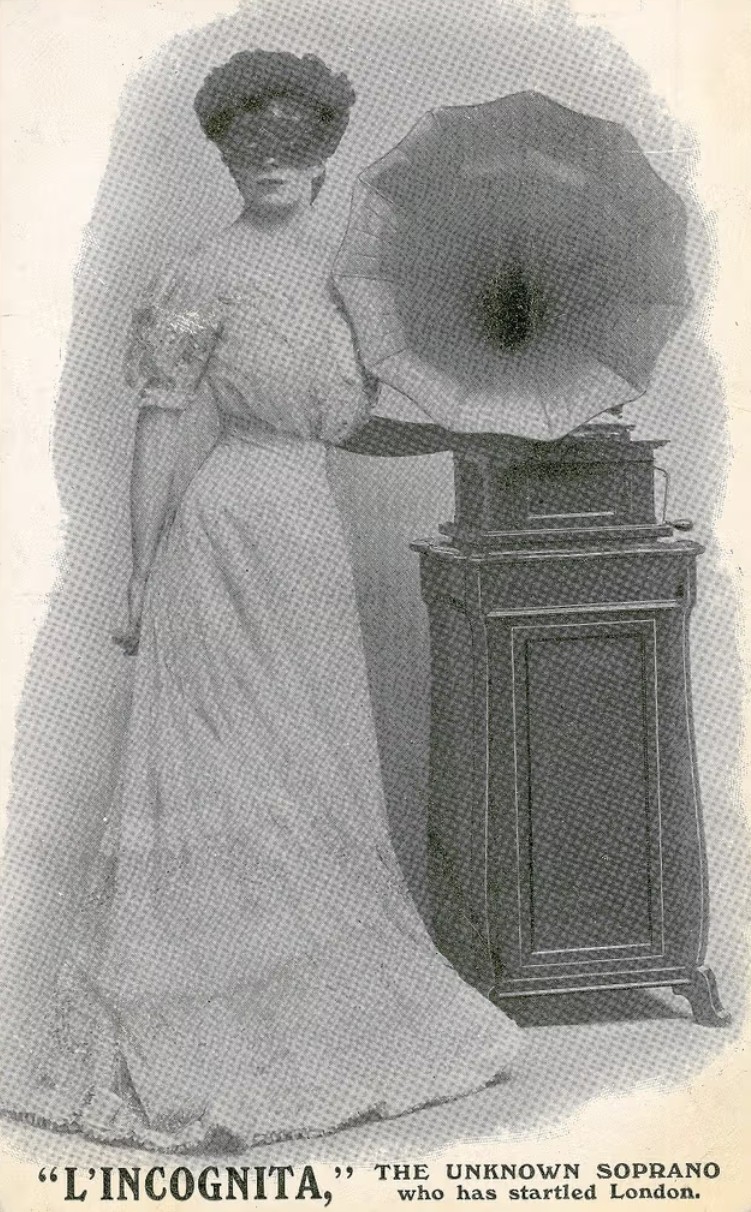 On Wednesday 18 March 1908 at 10.25pm, a masked woman walked for the first time on to the stage of the Alhambra music hall in Leicester Square, London. She was eighth in the pecking order that night, top-of-the-bill being Edouard Garceau, fresh from the chansons of Montmartre. She had been advertised that day as ‘L’Incognita’ and she sang the dazzling ‘Shadow Song’ from Meyerbeer’s Dinorah, taking the high E with ease. She ‘took the house by storm.’1
Violet Mount (aka "L'Incognita") - Meyerbeer: DINORAH, Shadow Song, 1913
But who was she?
Although she has been ignored in all the standard works on singers from Australia and New Zealand, Violet Mount, ‘L’Incognita’, was much admired by K.J. Kutsch and Leo Riemens in what has become the standard international Concise Biographical Dictionary of Singers. They wrote:
Strange rumours about the identity of the singer grew up after the appearance of her records. People conjectured that behind the pseudonym was Luisa Tetrazzini, who had just had great triumphs in England, or Alice Verlet or Yvonne de Tréville. Actually, they were made by the Australian music-hall singer Violet Mount, who was at that time appearing at the Alhambra Music Hall … The records, which appeared under the name L’Incognita and sold in large numbers, presented a lovely coloratura soprano, who possessed a thoroughly trained and virtuoso voice, which would not have been suspected of a music-hall singer.2
Violet Emily Le Breton Mount was born on 15 March 1875 at Caulfield, south-east of Melbourne’s CBD, the house of her paternal grandfather, Dr Mount. For quite differing reasons, her parents were rather extraordinary people.
Her father, Lambton Le Breton Mount, was born in Montreal, Canada, in 1839, the seventh son of Dr Edward Henry Mount and Emily Catherine Le Lièvre Mount (née Le Breton), who had immigrated to Australia from Canada in 1853, settling in gold-rush Ballarat, where Dr Mount practised as a surgeon and general practitioner. It was in Ballarat that Lambton met and befriended Adam Lindsay Gordon, who was to become the ‘father of Australian poetry’. In 1866, Gordon and Mount set up a sheep station at Bunbury in Western Australia. However, there were problems and the venture folded. To the end of his long life, Lambton remembered how he and Gordon ‘rode together’.
The sheep business was to be a portent for a stop-start career that Lambton was to have, much of it as an innovator in the glass manufacturing sector. This was his working life until he retired in his late sixties. However, he was a man of enormous energy, famous for his long-distance running (‘pedestrianism’)―one such being the 285 kilometres from Beechworth to Melbourne. In 1876 he imported forty lacrosse sticks from Canada, establishing that sport in Australia.3 And in 1887-88 he was President of the Victorian Chamber of Manufactures and a commissioner for the Centennial International Exhibition in Melbourne.
But he was also very conscious of his position in Australian society as a ‘gentleman’. And, in the late nineteenth and early twentieth centuries, gentlemen’s daughters led cloistered, lady-like lives and did not take paid work―particularly not on the rackety stage. And this set of beliefs was to affect Violet Mount’s whole life and career.

Lambton Le Breton Mount, c.1878
The Gold Museum, Ballatat

Adam Lindsay Gordon
State Library Victoria, Melbourne
Violet Mount’s mother was Mary Frances Mount (née Glynn), who was born in the St Kilda East suburb of Melbourne on 28 December 1855. Her parents were both immigrants from Cork, Ireland, her father a builder. Mary was a talented pianist and singer, who was to have a profound effect on her daughter’s growth as a musician, playing as her accompanist throughout her early years.
Where (and how) Mary learned that pianistic expertise is not known to me. There are many skills involved in successfully accompanying singers (and other musicians), among them: the ability to sight-read the music; the ability to transpose from one key to another at will; sensitivity both to follow the interpretive wishes of the singer and to provide advice on interpretive matters.
A Melbourne childhood
Violet was Lambton and Mary’s first child, born just nine months after their marriage. And there were five siblings to come, four brothers and a sister Winifred.4 Of these, it appears that only Winnie shared her sister’s musical gift, providing obligato violin to Violet’s singing in early concerts, but not going on to pursue music as a career.
Did Violet (or Winnie) go to school? There is no evidence that they did. So, if not, were they home-schooled by their mother Mary (or by a governess)? Given the later evidence of Lambton’s genteel opposition to Violet having a professional career on the stage, this might well seem to be another part of his beliefs concerning the restricted role of women and girls in the Victorian/Edwardian world.
Nor is there evidence of music teachers being employed by the Mounts—and as a consequence there are no early listings of performances of any kind. They must have been taught their music by Mary and if so, she must have been a remarkable teacher. Perhaps it is no surprise that the three of them first appear in print in Table Talk of 2 December 1892 with products for sale at a church sale of work—Mary offering her ‘fine art’, while Violet (17) and Winnie (15) had made confections.
The next we hear of them is leaving Melbourne on 29 April 1893 on a German steamer, the Karlsruhe,5 whose eventual port will be Bremen, but the Mounts were to disembark at Southampton. The family group consists of ‘Mrs L.L. Mount, Miss Violet Mount, Miss Winnie Mount, Masters Harold and Ray Mount’.6 The boys are the two youngest, with their older male siblings left behind with father Lambton in Melbourne, who was to put their house and furniture up for sale to fund the expedition.7
At the time, it was quite unclear as to why they went on this long voyage. Was it to find music teachers for Violet in Europe? Or just to have a holiday experience? I have yet to discover when they returned to Melbourne but in August 1896, at an ‘At Home’ in Caulfield, Violet sang and her mother Mary both sang and accompanied.
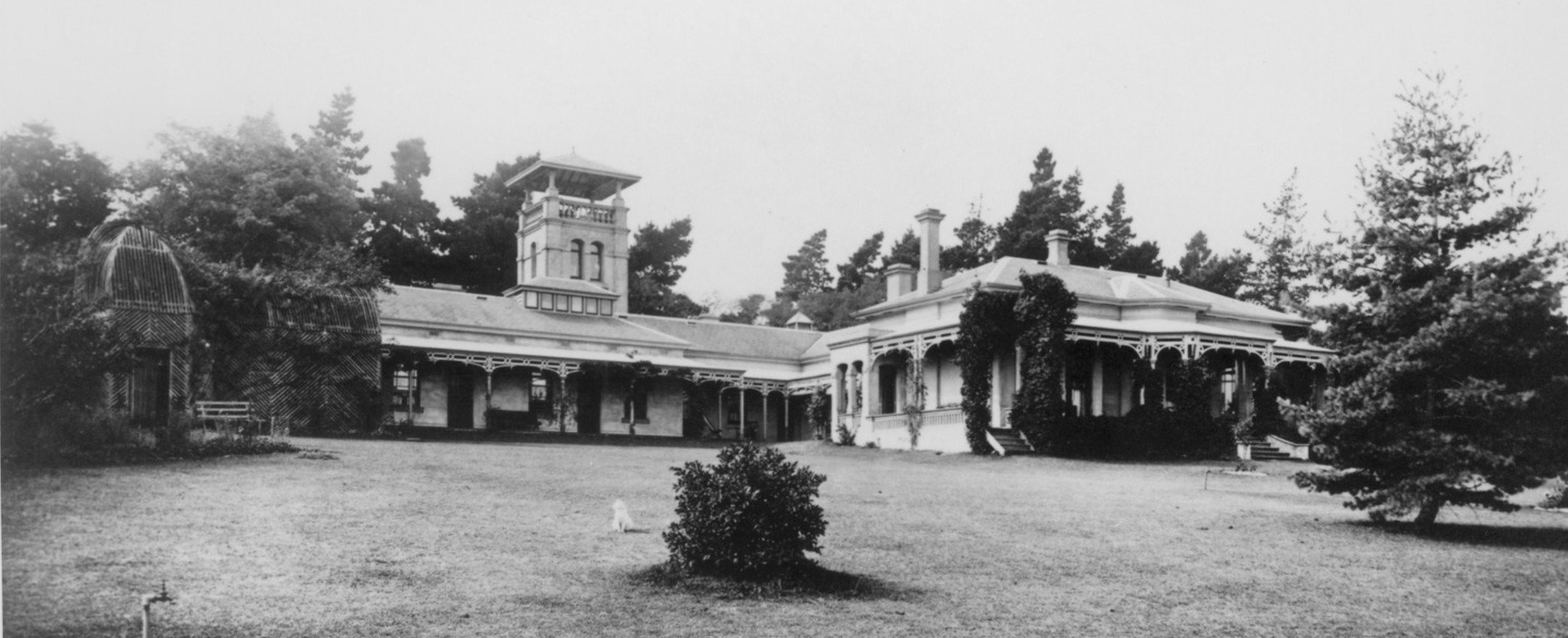 Keroongola—where the Mount family lived during 1896-1898. State Library Victoria, Melbourne.
Returned to Australia, they lived until 1898 at Keroongola in Orrong Road, St Kilda East. And on 28 June 1897 Violet was ‘heard to advantage’ in Marie’s famous aria, ‘Convien partir’, from Donizetti’s bel canto comedy La fille du régiment in a pupil concert for the Howard Conservatoire.8 This conservatoire had been opened in Melbourne the previous year but both the founder, George Howard and its leading singing teacher, the ageing prima donna Fanny Simonsen, died in 1896 and the business was taken forward by Howard’s widow, Mme Houyet-Howard. It offered the full range of musical tuition, singing now being taught by the English tenor William Parkinson and others. Violet was later to disclose that it was Parkinson who was the one who taught her there.
She appeared again in the conservatoire’s second student concert of the year in August, where she gave Agathe’s aria, ‘Softly sighs the breath of evening’ (‘Leise, leise’), from Weber’s Der Freischütz, this time accompanied by a thirty-piece orchestra.9 She was announced to sing a lead role (Plaintiff) in Gilbert and Sullivan’s Trial by Jury in October, a charitable performance.10 And in December Mme Howard gave an ‘At Home’ which featured Violet singing Anton Strelezki’s then-popular ‘Dreams’ with Winnie Mount providing obligato violin.11
To start out on her performing career as an amateur at the age of twenty-two with two showpiece arias shows how confident Violet Mount must have been in her capabilities. In fact, the Weber aria was to have form: it was later sung by Kiri Te Kanawa when she won the Sun Aria competition in Melbourne in 1965 and then by the Finnish soprano Karita Mattila, who sang it when winning the inaugural Cardiff Singer of the World competition in 1983.
It was a promising start and Violet went on the following year to sing at a number of private events in Melbourne, one of them (2 July) including the young baritone Horace Stevens, and another was an ‘At Home’ (7 July) given by her mother at the Mount home in St Kilda East, which included the New Zealand-born tenor Walter Kirby.12 He was to turn out to be a fortunate contact for Violet.13
To New Zealand
In 1899 the Mount family moved from Melbourne to Wellington. It seems that father Lambton was the instigator of the move as his glass manufacturing business was struggling in Australia and …
He came to New Zealand to test the colony’s mineral wealth. He thought Wellington would provide a fine field for glassworks …14
However, the major beneficiary of the migration was undoubtedly Violet, whose singing career simply took off in Wellington with many concert performances that were to be paid for. Did her ‘gentleman’ father approve of the reality that she was becoming a professional?
Violet made her debut in New Zealand on 13 June 1899 in a concert given by the Ladies Musical Society at the Art Gallery in Wellington, conducted by Mrs Alfred Levi. Looking forward to the event, the Evening Post reported:
She is the possessor of a fine soprano voice and has for many years studied at the Howard Conservatoire in Melbourne and in Germany and Paris.15
She sang her aria from La fille du regiment and two songs, ‘creating a favourable impression’. It was a start. Then in July she was in a chamber concert at Choral Hall, where she sang a wider range of arias and songs, accompanied this time by Cyril Towsey, and received fulsome endorsement:
She is gifted with a soprano voice of considerable power and singularly sympathetic timbre, and she sings with ease and displays great intelligence in the management of the words.16
On 29 August, booked by her new friend Walter Kirby, she sang at a concert at the Opera House, attended by the Governor, the Earl and Countess Ranfurly. Again, she sang the Weber aria and Tosti’s ‘Goodbye’.17

NZ Sporting Review, 2 March 1899

Wanganui Chronicle, 12 October 1899
In subsequent months, engagements for Violet came usually twice a month, including: a cantata, Corder’s Margaret; German pianist Albert Friedenthal’s farewell concert (where she sang two of the pianist’s own songs); another concert with Walter Kirby at Wanganui; and in June 1900 she performed in her first opera, Gilbert and Sullivan’s The Grand Duke(as Julia Jellicoe), at the Opera House. She got a mixed review:
Miss Mount’s ability as a singer is well known, but as an actress she is unable, as yet, to give a particularly telling reproduction of a comedienne’s part.18
In November 1900 she sang (perhaps for the first time in public) Henry Bishop’s ‘Lo! Here the gentle lark’,19 accompanied on the flute by Charles Hill, eldest brother of Australasian composer Alfred Hill, with her mother at the piano.20 The song, with its testing coloratura, had already held the stage over many decades, recorded by (among others) Nellie Melba, Galli-Curci, Joan Sutherland, Kiri Te Kanawa―and Violet Mount (as ‘L’Incognita’) with Australasian flautist John Amadio.21 It was to remain in her repertoire throughout.
And the following month she was soloist in Stanford’s Te Deum at a Jubilee event at the Canterbury Hall in Christchurch, among the many speakers prime minister RJ Seddon.22

Alice Hollander, 1900s, by The Biograph Studio
Elisabeth Kumm collection

Jean Gerardy, 1900s, by Falk, Sydney
Elisabeth Kumm collection
Early in the new year, Violet was recruited to ‘assist’ at a concert given by the Australian contralto Alice Hollander at Sydney Street Hall in Wellington. Although she was some seven years younger than Violet, Hollander was already further ahead in her career, which was looking to be in conventional concert halls. Yet it was not long after this meeting that Alice Hollander made an unusual career choice, moving into music halls in Britain:
A good voice is just equivalent to capital, which should be banked where it will draw the best interest … And people who pretend this is not the mainspring of all we do, and talk Art with an exaggerated capital A, are merely ‘foozling’ … The business aspect of the question is that the concert platform is limited to the concert season, whereas the halls are open all year round.23
Hollander implemented this radical strategy in the years before the arrival of Violet Mount in London in 1907. There were few ‘serious’ singers on the halls. Hollander herself would play several music-halls every night, singing just one song at each venue and picking up a handsome fee every time. At some stage, Violet will have recognised the good business sense in Hollander’s working life―and this proposition may well have been put to Violet’s business-oriented father.
Violet was to sing Irish songs, presumably learned in Melbourne at her Irish mother’s knee, at the Opera House in Wellington on St Patrick’s Day 1901―‘Kate O’Shea’, ‘Kathleen Mavourneen’ and ‘The Minstrel Boy’.
However, it was not to be many weeks before the family moved again, this time north to Auckland. And (again) it was father Lambton who instigated the move, having ascertained that there were rich sandstone deposits in the area ideal for glass manufacture.24
That month (May) there was a first Complimentary Farewell Concert for Violet Mount in Wellington, given at the Opera House. She sang ‘Ernani involami’, Chaminade’s ‘L’été’, the trio from The Bohemian Girl, and the grand sextet from Lucia di Lammermoor (with two brothers of Alfred Hill among others).
But before the Mounts left the city, the Wellington Liedertafel with Violet Mount and others gave a concert performance at the Art Gallery of Offenbach’s one-act operetta The Rose of Auvergne.
The New Zealand Free Lance waved farewell to them from Wellington in July 1901:
Miss Violet Mount, the sweet singer from Melbourne, who had practically become a Wellingtonian, left last week to take up her residence with her people in Auckland. Wellington’s loss is Auckland’s gain, for the Mount family is highly musical. Mr Mount, who has successfully floated a glass manufacturing concern in the Queen City of the North, is a sound critic and Mrs Mount is both songstress and pianist. Violet is the flower of the flock and the Mount family simply adore her.25
Her performing life in Auckland picked up immediately, this time with more opera. But first, Violet was hired to assist the Belgian international cellist Jean Gerardy in a series of concerts.26 In October it was announced that Violet would create the lead role in Auckland-based surgeon-composer George de Clive-Lowe’s new comic opera, The LadyTypist. In the event, it does not seem to have got past rehearsals stage.27
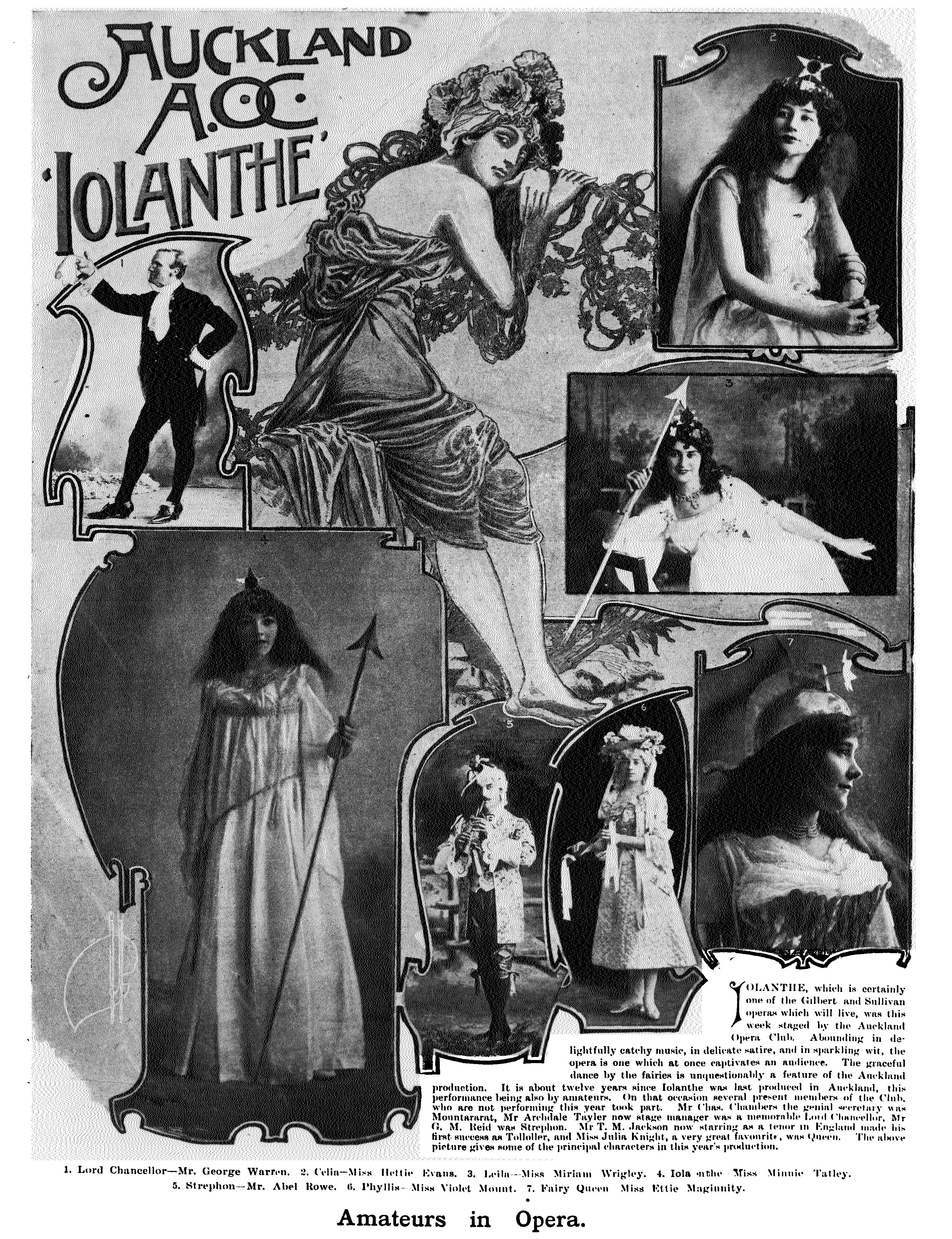 New Zealand Graphic, 26 October 1901
But there was better luck with Gilbert and Sullivan’s Iolanthe, given by the Auckland Amateur Opera Club in November—with Violet as Phyllis: ‘Miss Violet Mount was in delightful voice and unquestionably scored the first honours of the evening.’28
She travelled from Auckland to give concerts in other North Island cities―Hawera in December 1901 and New Plymouth in January; and later that month she again ‘assisted’ contralto Alice Hollander, this time at the Choral Hall in Auckland, singing the cavatina from Verdi’s Ernani.
To Sydney
However, Violet Mount’s sojourn in Auckland was short-lived and, after the obligatory Complimentary Farewell and a performance of Schumann’s Paradise and the Peri, she left for Sydney in May 1902 aboard the Mararoa, the rest of the Mount family remaining in Auckland.29
Violet opened in Sydney with performances on successive days: first, on Monday 14 July, she gave an invitation matinée at Centenary Hall, ‘best heard in Grieg’s Solvieg’s Song’. She must have briefed a local journalist, for in his/her report it was finally disclosed that Violet had studied with singing teachers in Europe in1883: with a Herr Odenwald in Germany (probably Dresden, as disclosed in another interview) and with Mme Caut in Paris. I have (as yet) not been able to identify either of them.30
And on the following day she assisted the Florentine tenor Carlo Dani in his ‘final’ concert in Sydney at the Town Hall. The Watchman was full of admiration for Violet’s performance: she had ‘clear enunciation, sweetness of tone and an expressive style of singing’.31 In the event, she was retained by Dani for his touring company and gave several more performances with him, the ‘Waltz Song’ from Gounod’s Romeo et Juliette being her calling card.

Alfred Hill, 1910, by May and Mina Moore
National Portrait Gallery, Canberra

Roberto Hazon, 1890
National Library of Australia, Canberra
Then in August she sang in a complimentary farewell concert for composer Alfred Hill. Violet had got to know (and had performed with) several of Hill’s brothers in New Zealand. The main event was a performance of Hill’s Maori cantata, Hinemoa, and Violet sang ‘several songs’.32
However, business dropped off in the summer months and Violet felt the need to advertise in the Sydney Morning Herald for work.33 This initiative seems to have borne fruit, as in December she was hired ‘at great expense’ to be the principal soprano in a concert party playing the towns of the Northern Rivers region of New South Wales (Lismore. Byron Bay, Grafton, Ballina, Tweed Heads).34 And she was to repeat the experience with another touring company the following June.
Next came a series of recitals in the Town Hall played by the city’s organist, Arthur Mason. One of these focused on Wagner and Violet sang ‘Elisabeth’s Greeting’ from Tannhäuser.35 In March Violet was appointed soprano soloist for St Patrick’s Church in the Rocks, a role which was to provide her with consistent work. And April brought a Sydney Philharmonic Society performance of Haydn’s The Creation with Violet as soprano soloist. The Italian Roberto Hazon conducted, and Violet was later to claim that he had had a major influence on her singing.36 She must have sung well as the Society booked her again in September for Mendelssohn’s Elijah.
Also in September, Violet sang in the first performance in Sydney of Liza Lehman’s song cycle ‘The Daisy chain’.37 And later that month, Violet was to meet and sing with the visiting Australian contralto Ada Crossley, by now an international concert artist and living in London. Violet’s first encounter with her was at a reception given for Crossley where Violet sang. Then, on 6 November, Mount and Crossley performed together with the Sydney Philharmonic Society in Sydney in Elijah. Both singers received outstanding response from the audience and very generous reviews in the media.38
By this stage in her career, twenty-eight years old Violet Mount had built a strong reputation as a singer―in Wellington, Auckland and Sydney. But her career had quite simply not taken off as other women before her in Australia had managed―among them Nellie Melba, Frances Saville and Ada Crossley. And each of them, in order to take their careers on to a new level, had made the choice to relocate to much bigger markets in Britain or continental Europe.

Violet Mount, 1905, by Appleby, Sydney
State Library of New South Wales, Sydney
This is exactly the advice that Crossley gave to Violet. And some time later Crossley was to write to Violet, ‘asking her to go straight to her [in London] and promising her many engagements.’39 But it was to be a further three and a half years after that Elijah before Violet took the plunge.
The following years, 1904 and 1905, provided Violet with a constant stream of work in Sydney, much of it of the bread-and-butter kind―including oratorios, disaster relief concerts and many farewells for Australian singers and other musicians leaving for the northern hemisphere. There were perhaps two more outstanding events: in April 1904 she sang the role of Elsa in Act One of Wagner’s Lohengrin for the Sydney Philharmonic Society under Roberto Hazon at the Town Hall;40 and June saw the arrival in Sydney of the German pianist Albert Friedenthal, at whose concert she had performed in Wellington four years earlier, again singing the pianist’s own songs.41
It seems likely that father Lambton Mount sailed from Sydney to London on the Rimutakain May 1904.42 In 1905 Violet led the cast as Arline in Balfe’s The BohemianGirl, first at Penrith in May, then at the Palace Theatre in Sydney in September, where her acting was said to be ‘very spirited’.43
More Farewells than …
However, 1905 saw the start of a two-year ‘farewell’ period for Violet as she moved towards leaving Australia and New Zealand, sailing with her mother to London in May 1907.
‘Farewells’ have for so long been synonymous in Australian mythology with Dame Nellie Melba, who very regularly gave performances so named as she approached the end of her illustrious career. But what Violet Mount’s life story shows is that farewells were common currency—for herself and for so many of her musical friends and colleagues.
The planning process for Violet’s farewell from Sydney started in July 1905, leading to the event itself taking place at the Town Hall on 20 September. There were many performers, but Violet’s own main contributions were the ‘Bell Song’ from Delibes’ Lakméand ‘Casta diva’ from Norma, in both of which she ‘sang brilliantly’.44
Then in December Violet returned to Auckland to give a farewell concert ‘before going to Europe’, singing ‘Ah! fors’è lui’ from La traviata, the ‘Bell Song’, ‘Villanelle’ and a Rossini song:
Always a sweet soprano, Miss Mount’s voice has materially increased in power since she was last heard here.45
By February of 1906 Violet was back in her home city of Melbourne, where she opened with an invitation concert at the Pianola Hall in March, followed by Elijah at the Town Hall for the Melbourne Philharmonic Society. While Violet was gratefully received, the star attraction was the Scottish-born baritone Andrew Black, who was touring Australia and was to settle there, perhaps the only leading singer from the ‘Golden Age’ to immigrate.

Andrew Black, 1905
Elisabeth Kumm collection

Melboune Town Hall, c.1906
State Library Victoria, Melbourne
The obligatory Complimentary Farewell Concert for Violet in Melbourne came on 2 May 1906—still twelve months before her actual departure. It was given at the Town Hall, where …
a large audience received the young artist with great enthusiasm … Her voice is a bright, clear, ringing soprano of very wide range—she touched F sharp in alt with exact truth of intonation and perfect sweetness—and she has trained it to an astonishing degree of flexibility … She was accompanied by her mother Mrs Lambton Mount.46
Still marking time, Violet organised in September an operatic event at the Masonic Hall in Melbourne, where she was Marguerite in Acts 3 and 5 of Faust, plus giving arias from Rigoletto, Dinorah and Mignon.47
October saw a return for Violet with Andrew Black, this time in Haydn’s Creation at the Town Hall, a performance they repeated when Violet returned to Sydney in March 1907.48
Her final farewell was, fittingly, given at Her Majesty’s Theatre in Ballarat, the hometown of her father’s family, on 9 May. In ‘Lo! Here the gentle lark’ her obligato flautist was another Amadio, Master Adrian, half-brother of John, and the whole was accompanied by Violet’s mother.49
Violet, ‘Australia’s best soprano’, and her mother finally left Melbourne for London on 24 May 1907 (Empire Day) on the White Star liner Afric.50 She was thirty-one.
What would the future hold?

Mathilde Bauermeister, 1900s
The Newberry, Chicago

L'Incognita, photo by Bassano
The Sketch, 15 April 1908
London: Becoming L’Incognita
When Violet and her mother arrived in London, Violet was quite clear responding to inquisitive reporters: it was to be opera or the concert stage. And strenuous efforts were made in that direction.
In October 1907 she sang at a ‘semi-private’ event where she ‘scored an unequivocal success’.51 Maybe. At that time, she (and presumably her mother) were living with an ‘aunt’ in Queen’s Road Bayswater.52 Was Ada Crossley any help to her? Not much, it seems. Did she go to see Melba, who had helped so many young Australian singers?
In November it was announced that Violet was studying with Mme Bauermeister in London. Born in Hamburg, the mezzo-soprano Mathilde Bauermeister had sung at Covent Garden for thirty-seven years. Melba had organised her Farewell. And in January-February 1908 it was rumoured that Violet had been offered a three-year engagement touring with the Carl Rosa Opera Company—which Violet turned down.53 And she was said to have auditioned unsuccessfully for Covent Garden.
In truth, without causing any stir, from January 1908 Violet had already started, under her own name, to perform in music halls around London—at Putney, Uxbridge, Stoke Newington, Park Lane and Hyde Park.54
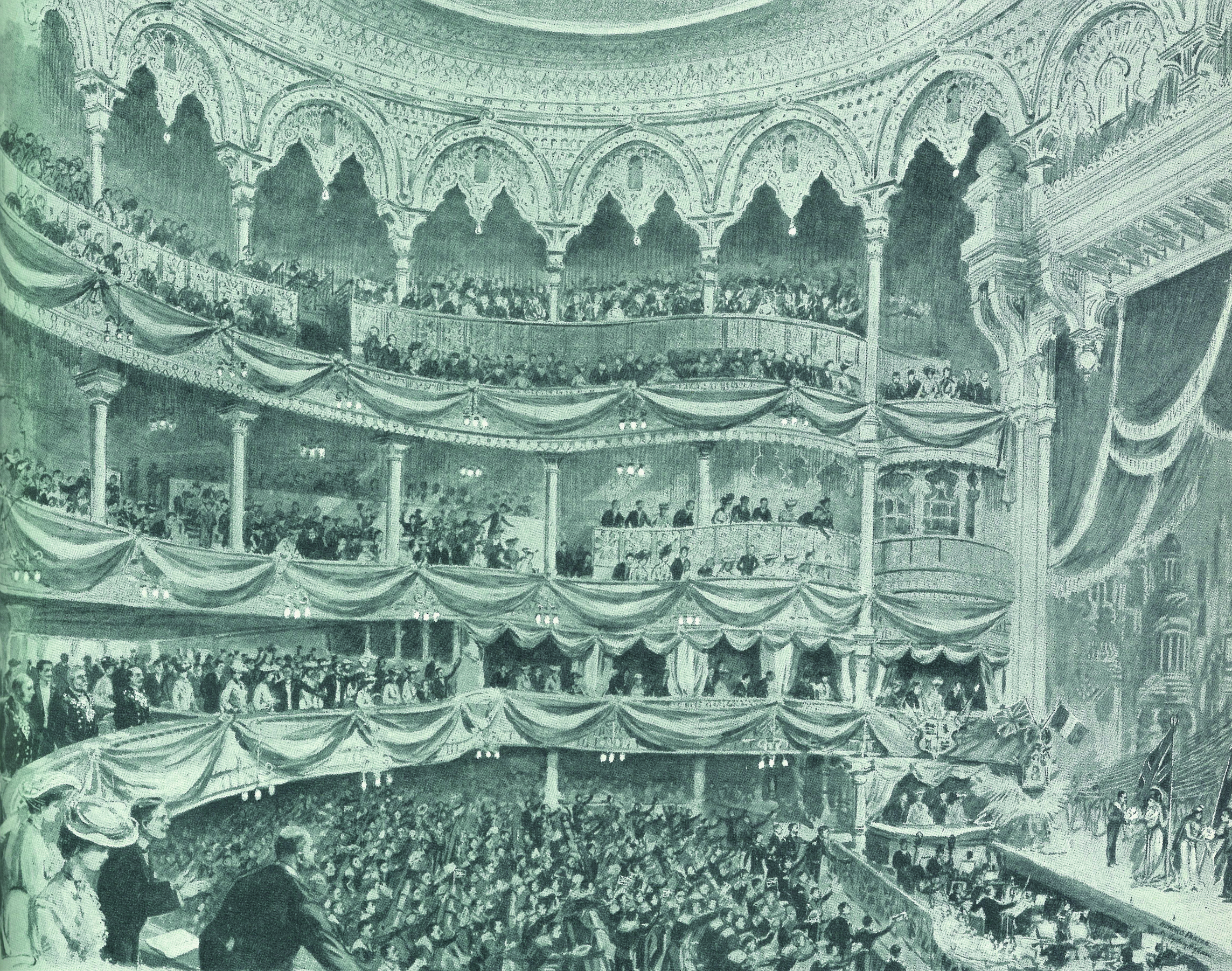 The Alhambra in 1905
It was in March of 1908 that the decisive change in Violet’s fortunes took place. It was reported in these words:
Mystery surrounds the identity of the talented singer, L’Incognita, who created such a sensation at the Alhambra, London, on Thursday evening. A short time ago Mr Alfred Moul, the managing director, received a letter from a firm of solicitors, asking him to give a hearing to a young protegee of theirs. He consented, and the girl, closely veiled, sang before him. Mr Moul discovered that she possessed a voice of remarkable range and purity of tone, and pressed her to appear at the Alhambra, naming a very high fee. She consented to do so for one performance only, on condition that she should not be required to give her name, that no announcement should be made … and that she should be allowed to wear a mask. These were hard conditions but Mr Moul accepted them with the result that the unknown duly made her single appearance and took the house by storm.55
Thus, at thirty-two years old, Violet Mount, L’Incognita, was to embark on a new career, not in opera houses or concert halls, but in the music halls. Immediately following her debut at the Alhambra, she was given a contract of indefinite duration on an exclusive basis to sing nightly.
But who was she? Was she the daughter, as rumoured, of an impoverished nobleman? From the start, she was headlining in the Alhambra’s ubiquitous advertisements. It was in a prime location in London, Leicester Square, the Alhambra being one of the leading halls in the capital with a long line of stars who had performed there.
By the late nineteenth century, music hall was well established in Australia, as in Britain and America. However, there was simply not enough employment for Australian performers in Sydney, Melbourne and the other major cities, and so many came to Britain to find work.

Florrie Forde, 1900s, photo by Foulsham & Banfield
Theatre Heritage Australia

Annette Kellerman, 1910s, by H. Walter Barnett
National Portrait Gallery, London
The majority of the emigrant Australian music hall artists were from working-class backgrounds, performing popular material for primarily working-class audiences, among them the singers Florrie Forde, Albert Whelan and Billy Williams. But there were also successful novelty acts, including the ‘living statue’ La Milo (Pansy Montague), the champion swimmer turned to vaudeville, Annette Kellermann, the ‘world’s greatest liar’, Louis de Rougemont, and the New Zealand-born coloratura ‘siffleur’ (whistler), Borneo Gardiner.
And there was a handful of classically trained Australian-born singers, who, usually unable to break into the opera houses, came to work on the halls in Britain. Among these were contralto Alice Hollander (whose conversion was mentioned earlier), sopranos Syria Lamonte (in 1898 the first woman singer to make gramophone records in Britain), Ada Colley and Florence Esdaile, and baritone Hamilton Hill (who popularised Boer War songs).
Nevertheless, that kind of singer remained the exception rather than the rule in music halls. And an unnamed but a first-rate coloratura soprano in a mask was unique, well appreciated and newsworthy.56
Not to miss the excitement The Times sent along one of their music reporters, who, true to form, sniffily appreciated the performance, while finding fault:
‘L’Incognita’ has a clear and powerful high F, and considerable skill in singing scales and florid passages; it is to be hoped that the money she earns by this engagement will be applied to the continuance of her musical studies, and in particular to the acquirement of better pronunciation both of French and of Italian.57
In mid-April one of the leading illustrated magazines in Britain, The Sketch, carried the by now famous masked singer on its front page, full page, the photograph by the fashionable Bassano.58 And L’Incognita’s first season at the Alhambra went right through to early September, at which point it was suggested that she was to make a tour in Scottish halls and venture abroad to the continent.59

The Phono Trader and Record, April 1908

Was she the sister of the great Luisa Tetrazzini?
Victoria & Albert Museum, London
Within weeks of first appearing at the Alhambra, she was in the studios of the Gramophone Company in London, recording arias for their Zonophone label which featured in her act: ‘Caro nome’ from Rigoletto, ‘Ah! fors’e lui’ from La traviata, the ‘Shadow Song’ from Meyerbeer’s Dinorah and the ‘Mad Scene’ from Lucia diLammermoor.60
The legendary recording producer Fred Gaisberg recalled her entry into the studio wearing her mask: ‘I remember her as a first-class artist with a very pleasing and graceful stage presence.’61
At one of those recording sessions, she was a third persona, Violetta Viamonti—it was issued on HMV. Did she wear her mask for it?62
But, really, who was this L’Incognita? Speculation was rife. If not the daughter of a poor peer, was she perhaps the sister of the great Luisa Tetrazzini? Or was she the real Tetrazzini moonlighting—she was then wowing audiences at Covent Garden in Rigoletto, Lucia di Lammermoor and La traviata.
Her season at the Alhambra completed, in July 1908 L’Incognita appeared at the Grand in Corporation Street, Birmingham, the first of many Stoll-Moss theatres:
Last night every seat in the building was occupied and L’Incognita, who has already achieved considerable distinction in the Metropolis, was given a hearty welcome to this city. She possesses a rich soprano voice. Wearing a black mask, L’Incognita last evening rendered ‘Lo! Here the gentle lark’ and the Polonaise from Mignon in a beautiful clear, rich and telling voice. The applause lasted for several minutes and was led in a hearty manner by the leader of the orchestra.63
Birmingham was followed in August by the Olympia in Liverpool, L’Incognita ‘an artiste of great ability’,64 then the Hippodrome in Coventry. She was to return to London in September—to the Empire at Shepherd’s Bush—then back north to the Stoll-owned Empires in Nottingham and Manchester, where she was introduced as ‘the greatest soprano ever heard on the Vaudeville Stage’.65

The masked singer who is creating quite a sensation at the Alhambra
The Tatler, 10 June 1908

Caricature of Sir Oswald Stoll by Ape
Vanity Fair, 4 January 1911
There was every reason that she would suit Sir Oswald Stoll and his Empire group of theatres. Not only was he Australian born, but he was also committed to presenting music hall as suitable for everyone. And L’Incognita, was fully booked up in Stoll’s theatres in the provincial cities of England and Wales to the end of a year of massive change for her.
This pattern for L’Incognita continued into1909 with her first engagement north of the border at the Empire, Glasgow, her name on the advertisements still in the largest typeface. Then, in February, she made a return to the Alhambra in London for six weeks, before going on to Vienna, where she appeared at the Apollo Theatre.66
After that she returned to the Stoll’s provincial theatres before arriving in July at one of his major London venues, the Hippodrome. From September, for Violet it was back touring in provincial theatres, several of them for a second time around.
L’Incognita’s outstanding, top-of-the-bill career in the music halls of Britain was to sustain itself steadily through the following years. 1910 was fully booked for her, although without a return to London, while 1911 showed a slight slowdown, but included her first performances in Northern Ireland—at the Hippodrome in Belfast. The census of 1911 showed that Violet was living with both her parents at Lauderdale Mansions in Maida Vale.
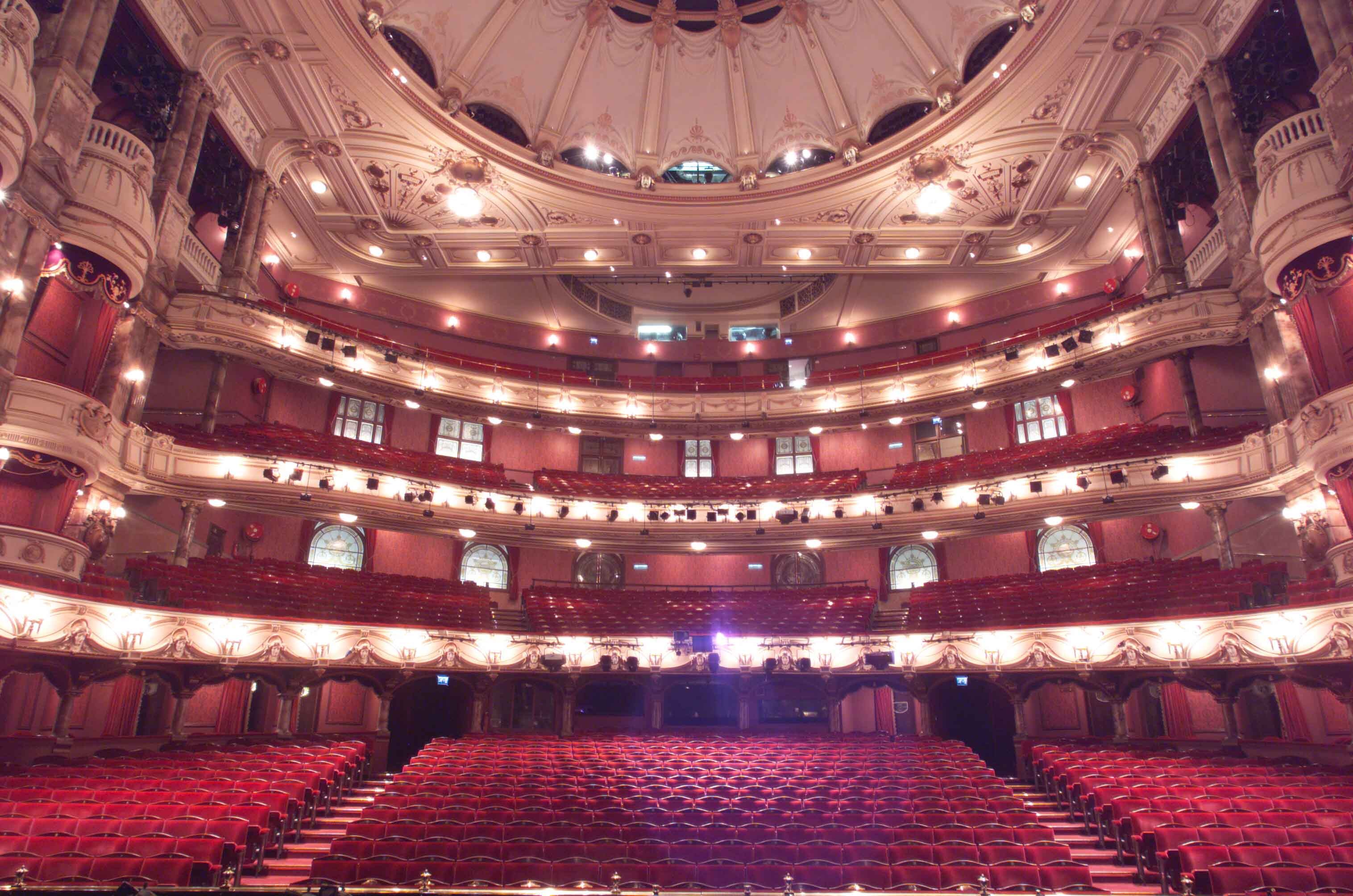 The London Coliseum today, londoncoliseum.org
However, the pace was kept up through 1912-1914, and she made a return to the metropolis in February 1912, singing at the Victoria Palace, then again in April 1913 at Stoll’s top London theatre, the Coliseum, where Albert Chevalier was also on the bill.
And she was to return to the Coliseum in October—in the same week that the legendary French actress, Sarah Bernhardt performed there.
28 July 1914 saw the start of the Great War and, although music hall theatres generally remained open, business contracted substantially, 1915 being a particularly bleak year for music hall performers before a slight revival in 1916. It appears that L’Incognita had only one booking in 1917—at the Hippodrome in Newcastle.
In her innumerable appearances as L’Incognita, what had she sung to her music hall audiences? She would always start with one or two bel canto arias, filled with trills and runs and sustained top notes. A regular starter was the dazzling Polonaise (‘Je suis Titania’ but doubtless sung in English) from Ambroise Thomas’s Mignon, or the Jewel Song from Gounod’s Faust, or ‘Ah! fors’è lui’ from La traviata, or the ‘Shadow Song’ from Dinorah. And she continued to sing Bishops’ ‘Lo! Here the gentle lark’, which she had performed before regularly in New Zealand and Australia and was to go on with in duet with flautist John Amadio.
Then she would end with a popular song of the day – ‘I dreamt I dwelt in marble halls’, or ‘Annie Laurie’, or ‘Killarney’, or ’Home Sweet Home’ (a Melba favourite).
In 1919 and 1920, Violet Mount returned to the studio for Zonophone, recording ten new arias and songs, including: ‘Calm and peaceful’ from Il trovatore, ‘Casta diva’ from Norma, ‘Beauty’s Sleep’ by Arditi and the ‘Doll Song’ from Tales of Hoffmann.

Hamilton Gardens in St John’s Wood, London
www.onthemarket.com
And by 1921 the Mounts had moved home from Maida Vale to live at 7 Hamilton Gardens, St Johns Wood, surrounded by expatriate Australian artists, musicians and other singers (including Ada Crossley).67
Probably the wartime slowdown for L’Incognita was exacerbated by the fact that by 1917 her music hall act was already some nine years old and in need of rejuvenation. And this came along in the shape of partnership on stage with the outstanding New Zealand-born flautist, John Amadio.
L’Incognita and Amadio
One of a dynasty of flautists and other musicians, John Amadio was born in Christchurch in 1886 and brought up in Wellington, before moving aged seventeen to Sydney, then Melbourne. However, initially taught by his stepfather, he started playing with the Wellington Orchestral Society at eleven. In 1911 he was principal flute in Dame Nellie Melba’s touring opera company in Australia.
John moved to London in 1920, where he was to tour with a range of top-flight artists, including Nellie Melba, Luisa Tetrazzini, Emma Calvé, Galli-Curci and his second wife, Florence Austral.

Palace Theatre, Grimsby
Grimsby Local History Library

Royal Hippodrome, Preston
Lancashire City Council
Already a star in his own right, Amadio was to tour in music halls as a duo with L’Incognita from October 1920, and they were given equal billing. To great applause, they opened at the Palace in Grimsby, going on immediately to Liverpool, Darlington and Rochdale, in each place greeted warmly. They were usually advertised as ‘The Phenomenal Soprano and Wizard of the Flute in the Magic of Flute and Voice’.68
The partnership continued touring around UK music halls through to 1924, at which point it came to an abrupt end—the final engagement being at the Royal Hippodrome in Preston in July 1924.69 When Amadio went on to perform in the USA in 1925 with soprano wife Florence Austral, it effectively spelled the end of L’Incognita’s performing career. She was approaching fifty. Violet’s only future appearances on stage came in a touring pantomime in the north of England, ‘Dick Whittington and his Cat’ in 1925 and in a concert at the Star, Tonbridge, in 1928.
But a lasting legacy of her time performing with John Amadio came in the form of three gramophone records made for Zonophone in September 1921—‘La Villanelle’ by dell’Acqua. ‘Lo! Here the gentle lark’ by Bishop and ‘Sweet Bird’ by Handel. Already well-known by the halls’ audiences, they were an ideal catch for Zonophone and the recordings sold very well, and the three pieces were at the centre of their live performances together.
As an aside, it’s curious to note that, although Australian and New Zealand newspapers knew from the start that Violet Mount and L’Incognita were one and the same person, this was never revealed in the British media.

John Amadio with his wife soprano Florence Austral, 1930
National Library of Australia, Canberra
From 1925 onwards, Violet Mount is less easy to find. That year she gave written evidence in the divorce proceedings in Melbourne between John Amadio and his first wife, Leonora Soames Amadio. Violet was now living at Birchington Road, West Hampstead.70
The following year, Violet visited Australia House (which had opened in 1918) with her aged father.71 Lambton Mount died at 95 in London in June 1931, remembered in Australia for his friendship with Adam Lindsay Gordon and for his long-distance foot races.72
That’s all …
But in 2009 I was lucky enough to find Violet’s great-niece Linda Mount, and she sent me this email about the singer’s last years. It gives us a rare glimpse into the more private personality of Violet Mount, the woman:
I remember her well when she was older and retired. She came to live in Weybridge in Surrey to be near her brother Ray and his family, my father being one of his sons, Jack. I don't remember exactly when she died but it was in the mid-60s sometime. She was extremely fit, lived independently and never went to hospital until she was in her 90s when she had a short illness and died.
I remember her being a very feisty old lady who enjoyed debating various topics, particularly with her brother. I am sure she must have been quite a dramatic singer and after a glass of wine at Christmas she would suddenly burst into an aria or two during the lunch! If she had had a good time, she would also sing some opera when she waved one off from her flat! Certainly, as a child it was quite something.
I also remember she had some friends who lived in Weybridge so I think she had quite a happy retirement. I was a teenager when she died and I cannot remember more about her. It is nice to have a couple of old records of her singing and so we can hear how good her voice was. I gather the reason she was called L'Incognita or the Masked Soprano was because her father felt it was unladylike to appear on stage so everyone could see her face—how times have changed!73
In fact, Violet Mount died, not in the mid-1960s, but in September 1972. Living a year longer than her father, she was ninety-six. Sadly, her passing was not noted—neither in Britain, nor in Australia or New Zealand.
But the neglect of Violet Mount since that time seems hard to explain, when her surviving recordings reveal an Australian bel canto soprano only equalled by Nellie Melba and Joan Sutherland.
L’incognita and Violetta Viamonti Recordings
Based on a full discography by David Mason
All of Violet Mount’s recordings, made under the pseudonyms L’Incognita and Violetta Viamonte, were made for the Gramophone Company’s subsidiaries, Zonophone and HMV. In total there were 21 recordings issued under the L’Incognita name, all on Zonophone (plus 4 unissued takes) and just one as Violetta Viamonte on HMV.
The early recordings were from 1908-09 and the later ones from 1919-21. All but one of the L’Incognita records were later reissued, most of them twice over, indicating that the company thought they still would sell.
L’Incognita: issued recordings (all Zonophone)
La traviata, Ah fors’è lui (Verdi), Matrix 8146, recorded April 1908
Dinorah, Shadow Song (Meyerbeer), 8147, April 1908
Mignon, Io son Titania Thomas), 8164, April 1908
Lucia di Lammermoor, Mad Scene (Donizetti), 8196, 1908
Rigoletto, Caro nome (Verdi), 8199, 1908
Hamlet, Mad Scene (Thomas), 21620, 10 June 1919
Rosebuds (Arditi), 21644, June 1919
Il trovatore, Calm and peaceful was the night (Verdi), 21657, 1919
Norma, Gentle Godess (Bellini), 21658, 1919
The Tales of Hoffmann, Doll Song (Offenbach), 21723, 1919
Beauty’s Sleep, (Arditi), 21725, 1919
Mireille, Waltz Song (Gounod), 21920, 1920
The Daughter of the Regiment, None can gainsay (Donizetti), 21922, March 1920
Maritana, Scenes that are brightest (Wallace), 21923, March 1920
Der Freischütz, Softly sighs the voice of even (Weber), 21935, 1920
Tom Jones, Waltz Song (German), 21936, 1920
A Masked Ball, You’d fain be hearing (Saper vorreste) (Verdi), 22111, September 1920
Il trovatore, Silent the sombre wings of night (Verdi), 22126, October 1920
Il pensiero, Sweet Bird (Handel), 493, 23 September 1921 (with John Amadio, orchestra George W. Byng)
Villanelle (dell’Acqua), 494, 23 September 1921 (with John Amadio, orchestra George W. Byng)
Lo! Here the gentle Lark (Bishop), 495, 23 September 1921 (with John Amadio, orchestra George W. Byng)
Note: This ‘Lo! Here the gentle lark’ recording was included in the 4CD set, From Melba to Sutherland: Australian Singers on Record(Decca Eloquence 2016)
Bibliography
Warren Bebbington (ed), Oxford Dictionary of Australian Music, Oxford University Press, Melbourne, 1998
J.S. Bratton (ed), Music Hall: Performance and Style, Open University Press, Milton Keynes, 1986
Doug W. Fox, Lacrosse in Australia: Lambton L. Mount and the Foundation Years, self-published, Melbourne, 2021
Edouard Garceau, The Little Doustes, (translated by Vera A Chappell) Frederick Muller, London, 1935
Victor Glasstone, Victorian and Edwardian Theatres: An Architectural and Social Survey, Thames and Hudson, London, 1975
K.J. Kutsch & Leo Riemens, A Concise Dictionary of Singers: From the Beginning of Recorded Sound to the Present, Chilton Book Company, Philadelphia, 1962/1969
Barbara & Findlay Mackenzie, Singers of Australia: From Melba to Sutherland, Lansdowne, Melbourne, 1967
W. Macqueen-Pope, The Melodies Linger On: The Story of Music Hall, WH Allen, London, 1950
Raymond Mander & Joe Mitchenson, British Music Hall: A Story in Pictures, Studio Vista, London, 1965
Roger Neill, ‘Going on the Halls’, unpublished, part of uncompleted dissertation, Goldsmiths College, London, 2013
―― DIVAS: Mathilde Marchesi and her Pupils, NewSouth (University of New South Wales Press), Sydney, 2016
――, Melba’s Farewell, Decca Eloquence (CD), Sydney, 2017
――, ‘Re-discovering Syria Lamonte: Pioneering Recording Artist, Theatre Heritage Australia (online), Melbourne, 2023
――, The Simonsens of St Kilda: A Family of Singers, Per Diem Projects, King’s Sutton, 2023
――, ‘Florrie Forde at 150: Melba for the Masses’, Theatre Heritage Australia (online in three parts), Melbourne, 2025
Roger Neill & Tony Locantro, From Melba to Sutherland: Australian Singers on Record(4CD set), Decca Eloquence, Sydney, 2016
Adrienne Simpson, Opera’s Farthest Frontier: A History of Professional Opera in New Zealand, Reed, Auckland, 1996
Douglas Sladen (ed), The Poems of Adam Lindsay Gordon, Constable, London, 1912
J.B. Steane, The Grand Tradition: Seventy Years of Singing on Record 1900-1970, Scribner’s, New York, 1974
John Mansfield Thomson, The Oxford History of New Zealand Music, Oxford University Press, Auckland, 1991
Angela Woollacott, To Try Her Fortune in London: Australian Women, Colonialism and Modernity, Oxford University Press, New York, 2001
Endnotes
1. This recording has been transferred from an ancient shellac 78rpm record with all the clicks and buzzes left intact; nevertheless, Mount’s bel canto singing shines through
2. Kutsch and Riemens (1962/1969), p.203
3. The Lambton Mount Lacrosse Club in Melbourne exists to this day
4. Le Breton in 1876, Winifred in 1877, Lambton Le Breton in 1881, Rupert Henry Le Breton in 1886 and Frank Raymond De Tito in 1887
5. This Karlsruhe, a Norddeutscher-Lloyd vessel, was built in Glasgow in 1889
6. Argus, 1 May 1893, p.4
7. Argus, 10 April 1893, p.2
8. La fille du regiment was to become a core role in Joan Sutherland’s career many years later
9. Punch (Melbourne), 26 August 1897, p.18
10. Table Talk, 8 October 1897, p.9; Australasian (Melbourne), 16 October 1897
11. Punch (Melbourne), 9 December 1897, p.16
12. Punch (Melbourne), 7 July 1898, p.16
13. Argus, 8 October 1931; he later annoyed Melba, when he missed the boat to take him from Tasmania to New Zealand in 1903; and, sadly, in 1931 he was imprisoned for 21 days in London, having been accused of ‘an act of indecency’ at Victoria Station
14. New Zealand Free Lance, 11 May 1901
15. Evening Post (Wellington), 10 June 1899
16. Evening Post, 8 July 1899
17 Evening Post, 30 August 1899
18. Evening Post, 21 June 1900
19. The song is frequently, incorrectly, rendered by journalists and others as ‘Lo! Hear the gentle lark’
20. Evening Post, 29 November 1900
21. Flautist remained the spelling used in Australia and New Zealand at that time; more on John Amadio later
22. Evening Post, 18 December 1900
23. Don Ross, ‘The World of Music Hall in 1906’, Call Boy, London, June 1972
24. New Zealand Free Lance, 11 May 1901
25. New Zealand Free Lance, 6 July 1901
26. Auckland Star, 12 August 1901
27. New Zealand Free Lance, 12 October 1901
28. Observer (Auckland), 2 November 1901
29. Otago Witness, 28 May 1902
30. Australian Star, 11 July 1902
31. Watchman (Sydney) 26 July 1902
32. Daily Telegraph (Sydney), 18 August 1902; born in Melbourne in 1869, Alfred Hill was already the leading composer in Australia-New Zealand
33. Sydney Morning Herald, 15 November 1902
34. Northern Star (Lismore), 3 January 1903
35. Sydney Morning Herald, 19 February 1903
36. Daily Telegraph (Sydney), 3 April 1903
37. Sydney Morning Herald, 21 September 1903; words by Alma Tadema and Robert Louis Stevenson
38. Daily Telegraph (Sydney), 7 November 1903
39. Sydney Mail, 5 June 1907
40. Sydney Morning Herald, 11 April 1904
41. Sydney Morning Herald, 6 June 1904
42. New Zealand Times, 12 May 1904
43. Sydney Morning Herald, 9 August 1905
44. Sydney Morning Herald, 21 September 1905
45. Observer (Wellington), 2 December 1905
46. Argus (Melbourne), 3 May 1906
47. Argus (Melbourne), 20 September 1906
48. Sydney Morning Herald, 22 March 1907
49. Ballarat Star, 11 May 1907
50. Punch (Melbourne), 30 May 1907
51. Punch (Melbourne), 24 October 1907
52. Daily Telegraph (Sydney), 31 October 1907; who is the ‘aunt’? I can’t see that mother Mary had sisters, so maybe it was a sister of father Lambton, born in Canada
53. Sydney Morning Herald, 12 February 1908
54. Daily Telegraph (London) and others, 19 March 1908
55. Worcestershire Advertiser, 21 March 1908
56. Curiously, while Australian newspapers joyfully reported that L’Incognita was in fact Violet Mount, British papers never revealed the connection
57. Times (London), 1 April 1908
58. Sketch (London), 15 April 1908
59. Sydney Morning Herald, 9 September 1908
60. Zonophone was a subsidiary of The Gramophone Company in London
61. Gramophone, February 1943
62. David Mason points out that Zonophone recordings by ‘Madame Violetta’, some of them with Ernest Pike, were not by Violet Mount but by English mezzo-soprano Edna Thornton
63. Evening Despatch (Birmingham), 21 July 1908
64. Liverpool Echo, 4 August 1908
65. Manchester Evening News, 14 January 1909
66. Mercury (Clevedon), 20 March 1909
67. In 1939 she lived at 51 Boundary Road, Primrose Hill (Hampstead); they had been at 7 Hamilton Gardens until the mid-1930s; Violet's mother, Mary Mount, died in January 1922 in Marylebone, Herald (Melbourne), 1 February 1922
68. Hampshire Independent, 11 August 1922
69. Lancashire Evening Post, 11 July 1924
70. Telegraph (Brisbane), 26 September 1925
71. Australasian (Melbourne), 25 February 1926
72. Sydney Morning Herald, 15 June 1931
73. Email from Linda Mount to Roger Neill, 26 August 2009
Acknowledgements
With especially grateful thanks to Tony Locantro, who originally introduced me to Violet Mount and several other Australian singers and is a constant editor of my writings. To David Mason for providing a full discography of Violet Mount’s recordings. And to Elisabeth Kumm, publisher and magician with illustrations.
Also, thanks to Jamie and Linda Mount, relations of the subject. And to my wife, Sophie Wilson, who always provides valuable perspective.


