Nutcombe Gould
-
George Alexander and the St James's Theatre (Part 1)

 The St. James's Theatre, King Street, LondonMaking use of the digitised stage photos from the JCW Scene books, NIGEL RIDEOUT documents his distant relation, British actor-manager Sir George Alexander’s tenure at the St. James’s Theatre, London commencing in 1891 in the first of a series of articles.
Sir George Alexander (1858—1918)
An extract from The Illustrated and Dramatic News - Saturday 7th February 1891
The new management of the St. James’s Theatre.
Mr. Alexander is fortunate to have so charming and thoroughly wholesome a production as Sunlight and Shadow, with its attractions unexhausted and ready for transfer intact to a new theatre. The labour and anxiety incident to such a move as that just accomplished by the young manager are quite enough without the added responsibilities of a new play; so, it was much better to defer the rehearsing ‘The Idler’ until after the rest of the work has been carried out. What this work was may be judged from the fact that the St. James’s has been fitted with a new stage by Mr. White, has been lighted throughout with electricity, has been warmed with stoves placed in all parts of the house, and what is by no means less important, has been refurnished and made draught proof by Messrs. Oetzmann. The theatre is thus made as comfortable as it is handsome, and it is altogether a far more pleasant place of entertainment than it has ever been since John Braham, the great tenor, who built it some 55 years ago.
 Auditorium and Proscenium of the St. James's Theatre (1902)
From ‘The Idol of the Ladies’ by W. Macqueen Pope.
The St. James’s Theatre was the ideal setting for Sir George Alexander; it had an atmosphere to house his brilliant and successful management. As he transferred from the Avenue Theatre, his first step was to make the theatre more comfortable, so he installed electric light, which was a great innovation. The seating was re-upholstered, and the walls were repainted in warmer and softer tones. The backstage area was fully carpeted to reduce noise during scene changes and dressing rooms were renovated.
From the very start Mr. Alexander impressed his views, his methods and his personality on his theatre and it became like himself.
The new box office manager became a character too and always wore a top hat while on duty. His assistant was called in true theatrical fashion, De Courcy. Even the tickets were different. They were not of paper but of pasteboard and had something of the appearance of a railway ticket.
The housekeeper, who kept the place like a new pin, knew every patron and their tastes, especially Royalty, for whose visits she kept a special tea service with a solid silver tea and coffee pot. On one occasion, being told that her Royal Highness the Princess Royal (the Duchess of Fife) was coming to a matinee, and that a nice tea should be served, she replied, ‘Rightly speaking, sir, Her Royal Highness does not partake of tea - she prefers coffee.’ That, again, was true St. James’s. In her black dress and gold chains, she pervaded the theatre, and nothing escaped her eagle eye.
The staff that Alexander surrounded himself with stayed with him loyally for his entire 28 years there until his death. Gilbert Miller, the successful American theatre producer, began his career on the staff of the St. James’s Theatre and then took over its management when Alexander died in 1918 casting the future film star Claude Rains in his first production who himself had begun life as a call boy with Herbert Beerbohm Tree at the Haymarket Theatre.
Everything about his time was about politeness and his method of treating his guests the audience is shown in this extract from one of his programmes:
‘Mr. George Alexander would respectfully request those ladies who frequent the St. James’s Theatre intent on viewing the performance to recollect the similar purpose in those who sit behind them. If therefore every large hat was left in the cloakroom (for which there is no charge) the lady so doing would confer a great benefit on her immediate neighbours.’
It is feared that the appeal fell on stony ground. Some ladies, after someone from the pit had yelled out ‘Take that hat off’ were reduced to pinning the hat to the back of the seat in front of them with their hatpins which could be dangerous affairs with silver or gold hilts like daggers. Frequent were the loud squeaks of pain when one of those pins penetrated the back of the occupant in front and profuse the apologies that followed.
Politeness even extended to the refusal of applications for free seats. The manager would not say to Arnold, when handing him a stamped and addressed envelope, 'regret this one' - the usual managerial formula for turning down an application and posting a printed form whereby 'Sir George Alexander regrets that due to public demand, he is unable to comply with your request at the moment.' No, he would say, ‘Send him Box C’. This was polite fiction, because there was no Box C in the theatre.
Arnold understood what to do, But if, because it was near the end of a run, there happened to be room for a bona fide member of the profession, and the request was granted, then you were sent, not the usual ticket stamped ‘Complimentary’ but a special ticket, a paper one, larger in size than the one sold for cash, showing clearly what it was, placing the recipient apart from the cash customers, and carrying instructions to the effect that you must wear evening dress, or you would not be admitted. It stated in large type, impossible to overlook, 'Evening Dress Compulsory’. Alexander was not going to have the tone of his stalls or dress circle let down by a non-paying guest. Nor did he desire to let his paying guests know that some were in ‘on the nod’. But it mattered little, for in Edwardian days nobody would have dreamed of entering the stalls or circle unsuitably attired.
It was probably a desire to inculcate his own good manners into the late arriving stallites, whose noisy entrances so often disturbed the house, which caused Alexander to ‘ring up the curtain’ on The Second Mrs Tanqueray at the odd hour of 8.10pm. If so, it was unsuccessful, for nothing will make some playgoers punctual!
Despite all this politeness and social conformity, Alexander’s management was a highly commercial one. He had many plays written for him and gave many chances to young actors and actresses. He taught them their jobs in the same way that Dame Ellen Terry had coached him on stagecraft throughout his time at the Lyceum under Sir Henry Irving. Much of her guidance had been onstage during performances where she shocked him with improvisations to keep him on his toes and to be sure he was listening intently through every minute. She would drop a handkerchief to see if he could pick it up in character and not miss a beat or change a move to surprise him. A hard set of tasks for a young actor but ones she said he coped with brilliantly.
He was an expert in casting, discovering and risking everything on the then unknown Mrs Patrick Campbell and later the talented Henry Ainley, who was the incarnation of manly beauty.
During his 28 years in management, cut short by his early death from consumption brought on by overwork during the First World War, he presented 82 plays, 7 of which were by Sir Arthur Wing Pinero and two by Oscar Wilde. By then the Victorian and Edwardian age of the actor-manager was coming to an end as the world picked itself up from the horrors of war and a changing population waking up to a new era heralding the 1920’s.

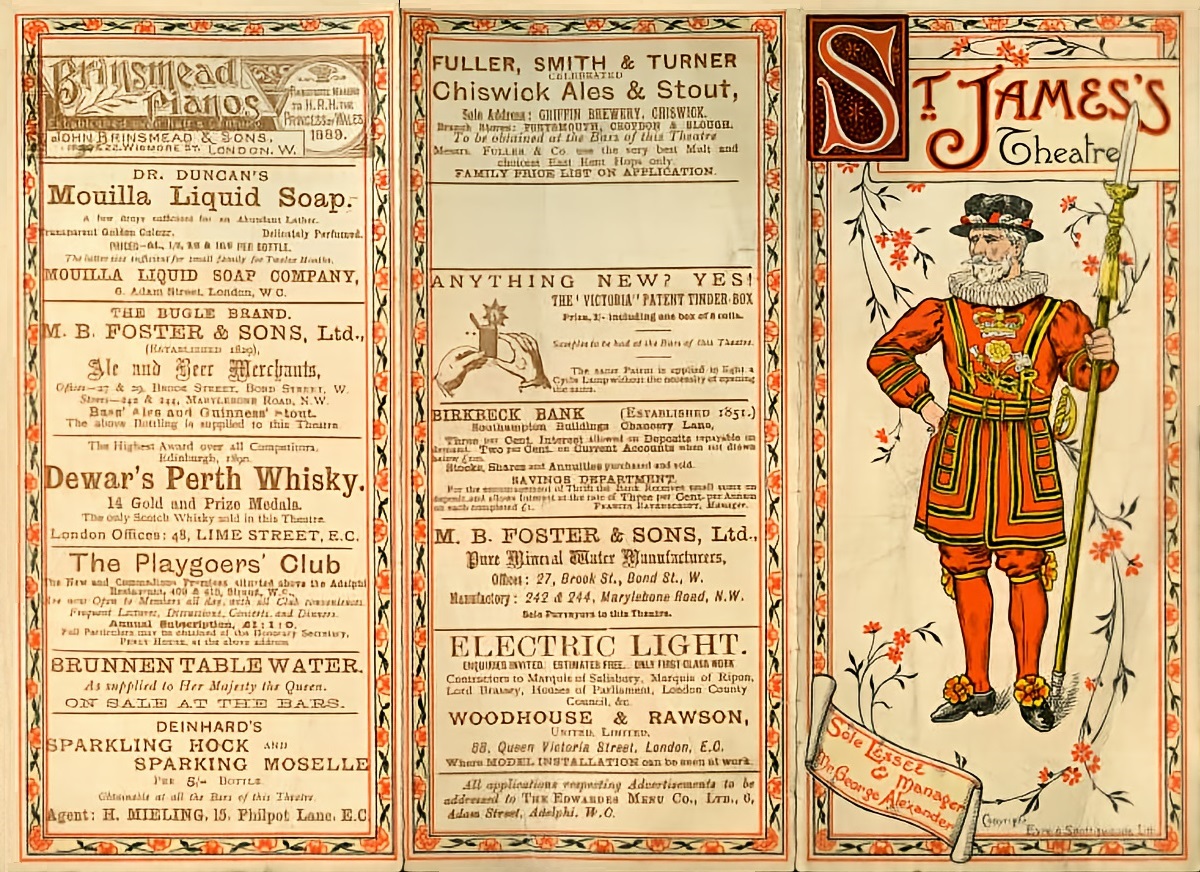
Generic programme cover for the theatre

Business Manager Robert V. Shone (1895)
Hesketh Pearson writes:
The most continuously successful actor-manager on the stage of my time throughout his tenancy of twenty-seven years at the St. James’s Theatre, the most fashionable playhouse in London. The more expensive seats were occupied by Society with a capital ‘S’, the less expensive seats by those who longed to be in Society, the least expensive ones by those who wished to see what Society looked like. In such circumstances it is not to be expected that the drama served up at the St. James’s Theatre was of the most exalted kind.
Most of the plays dealt with life as lived by the upper classes, and peers of the realm were as common onstage as they were in the stalls. Alexander catered for their dramatic taste as much as the Savoy Hotel catered for their gastronomic taste.
In a typical St. James’s play the humorous characters were delightfully playful, the serious characters charmingly sentimental, and the plot savoured of scandal without being too truthful. Adultery was touched on and inevitably touched up; theft was made thrilling and murder romance.
George Alexander himself was ideally suited to the parts that he played and the drama he produced: he was a polished but uninspired actor; he had a perfect sense of what his audiences wanted because it was exactly what he wanted; he was handsome is a rather expressionless way; his voice was genteel and admirably modulated and his movements were as graceful as they were decorous. He was so well dressed that men would often study his clothes before ordering their own. He had an enormous and loyal following and was the perfect matinee idol of his day. If he was not in one of his productions, the box office takings would drop considerably.
 Judy Leech collection
A.E.W. Mason continues:
Mr. George Alexander, who, having tried his hand successfully as a manager at the Avenue Theatre until his box office manager fled to Mexico with £700 of box office takings, now took on the challenge on a larger scale and against far heavier odds at the St. James's Theatre, King Street, St. James’s- a very fashionable side of town but on the outskirts of the main theatre district. He took with him several of his previous casts including Miss Marion Terry, Miss Maud Millett, Mr. Nutcombe Gould and Mr. Ben Webster who then formed the nucleus of a new company—afterwards swelled, as occasion might demand, by the addition of Mrs. Patrick Campbell, Misses Fay Davis, Winifred Emery, Lily Hanbury, Ellis Jeffreys, Gertrude Kingston, Rose Leclercq, Evelyn Millard, Julia Neilson, Juliette Nesville, Amy Roselle, Irene and Violet Vanbrugh ; Messrs. Allan Aynesworth, Arthur Bourchier, H. V. Esmond, James Fernandez, H. B. Irving, Cyril Maude, John Mason, Edward Righton, E. M. Robson, Vane Tempest, Fred Terry and Herbert Waring—which could, in modern comedy, drama or tragedy, hold its own against any in the world. The theatre, too, was thoroughly overhauled. Ironically, aged 16 in 1874, he had performed there in a charity performance for the Royal Hospital for Consumption, an illness he was to die from too early in 1918 from overwork.
However, with great energy for this new adventure he installed electric light, decorated the auditorium with warm tints, and re-upholstered the seating.
It was indeed to a new theatre, rising Phoenix-like out of the ashes of the old, that Mr. Alexander bid his patrons welcome on January 31st, I891, when the following programme was presented:

Elisabeth Kumm collectionDRAMA
ST. JAMES'S THEATRE.
MR. ALEXANDER is fortunate to have so charming and thoroughly wholesome a production as Sunlight and Shadow, with its attractions unexhausted and ready for transfer intact to his new theatre...
Apart from the convenience of the arrangement, the transfer of Mr. Carton's play is quite justified by the degree of favour with which the public continues to regard the piece; for even though its hundredth representation has been reached, there must still be many playgoers anxious to make the acquaintance of so typical and pretty a specimen of the idyllic home-grown English comedy, which smells as it were of lavender, and has all the varying charms of the summer day spent in a country village. One must grant a playwright his choice of plot and subject, or else one would be inclined to quarrel with Mr Carton for the touch of melodrama imported in the introduction of Mark Denzil's outcast wife, and her attempted but abortive theft of the bank notes. One cannot help fancying that it would have been quite safe to leave the existence of the unhappy Janet Felton to the imagination, and would have avoided the one jarring note in the harmony. But this is the only blot, and after all it is a slight one. The general impression produced, whether by the "sunlight" of Maud Latimer's girlish gaiety or by the "shadow" of Helen Latimer's passing sorrow and George Addis's sore trial—this is wholly satisfactory. Not since the time of Two Roses have we listened to brighter and more natural dialogue as spoken between sisters and lovers, and fathers and friends and in his graver moments—as in the really fine scene between Helen and her crippled worshipper—Mr. Carton attains a depth and sincerity of pathos such as were beyond Mr. Albery altogether. Much no doubt this episode owes to its exceptionally beautiful interpretation by Mr. Alexander and especially by Miss Marion Terry. We remember few things upon the stage more touching in absolute truth to woman's nature than Miss Terry's study of the gentle self-sacrificing Helen's distress when, broken-hearted herself, she is asked by her poor deformed friend for the kind of love which she knows she can never really give again, but which she cannot refuse lest the meaning of her refusal should be misunderstood. This is a noble piece of pathetic acting on the part alike of actor and of actress. In admirable contrast with the tender sweetness of the one sister is the sunny brightness of the other as embodied by Miss Maude Millett. The very thoughtlessness of the younger girl seems one of her charms, and the whole impersonation, with its saucy fun and its occasional indications of true albeit superficial credit, shows the popular young actress quite at her best. Mr. Nutcombe Gould perhaps is a shade too refined in speech for the country practitioner, but his Dr. Latimer is none the less a capital sketch of character, whilst the only fault of Mr. Yorke Stephens's Denzil and of Mr. Webster's Bamfield is a slight tendency to drag the action. On the whole Mr. Carton is as fortunate in his interpreters as are they in the matter supplied them for interpretation.
The novelty in the programme is the little piece which brings it to a close. This is a one-act comedy by Mr. A. C. Calmour called The Gay Lothario, and written in the somewhat archaic manner generally affected by this young playwright. The Gay Lothario seems to owe its motive to the Spanish El Desden contre el Desden, best known perhaps on our stage through the medium of the late Dr. Westland Marston's Donna Diana. In this case it is Sir Harry Lovell, an eighteenth century lady killer, who being bent upon asking the hand of the beautiful heiress, Amanda Goldacre, discovers from her maid Letty that she means to play with him disdainfully as might a cat with a mouse, encouraging him at first only to make his final rejection appear the more disastrous. Amanda's reason for this heartless project is her belief that Sir Harry is about to propose for her only in fulfilment of a wager which he has laid in his capacity of deliberate lady killer. She has no chance, however, of carrying through her scheme, inasmuch as Sir Harry's long expected profession proves to be merely one of complete indifference, expressed with as much courtesy as the case will allow. Amanda's enraged indignation grows more and more violent until she learns that her careless courtier does, at any rate, care enough for her to fight a duel about her good name—a duel which, unlike most of those fashionable in Bath in the eighteenth century, is fought, not with swords, but pistols. Sir Harry soon returns uninjured and perfectly ready for the proposed reconciliation. There is not very much in it all, and the lady is allowed too little chance of self-defence. But there is plenty of spirit in the conduct of the dialogue as well as ample chance of distinction for both the chief performers. These are Mr. George Alexander and Miss Maude Millett, who while throwing all possible animation into their simulation of scornful indifference, are both, perhaps, a little too free and easy of bearing to suggest the typical beau and belle of bygone Bath. In this respect, however, the actress is more to blame than the actor, for her tone and method are altogether modern, while his are only fitfully so. In spite of this flaw the performance is an extremely pleasant one, the players took their parts admirably, and careful sketches of the inevitable domestics are supplied by Mr. Webster and Miss Graves. The luck, therefore, of Mr. Calmour in getting his pieces well played follows him as steadily as ever.
The Illustrated Sporting and Dramatic News (London), Saturday, 7 February 1891, p.719
* * * * * * * * * * * * * * * * * * * *

George Alexander as 'George Addis'
Harvard University, Houghton Library

Alexander as 'George Addis' & Marion Terry as 'Helen Latimer'
National Portrait Gallery, London

Maude Millett
Elisabeth Kumm collection
* * * * * * * * * * * * * * * * * * * *
The Idler
(C. Haddon Chambers)
First performance was on 26 February 1891 and ran until 17 July; second season began 30 September and concluded on 4 November 1891 for a total of 173 performances– Scenery by Walter Hann, Walter Johnstone & Joseph Harker – Furniture by Frank Giles and Co. of High St., Kensington
(George Alexander’s first new production as manager of the St. James.)
(Revived in 1895 on 4 until 10 July for 6 performances and 1897 on 30 November for 1 matinee performance.)
(playscript at https://archive.org/details/idlerplayinfoura00cham )

National Library of Australia, Canberra
Charles Haddon Chambers (22 April 1860 - 28 March 1921) - Australian-born playwright
The Idler was a traditional drawing room melodrama of that period including ‘asides’ to the audience plus a ‘trick’ or stage convention to bring down the curtain at the interval. The duel, the bouquet and the fan were all stock pieces of mechanism and Haddon Chambers employed them all. The public received the play enthusiastically but the critics, as one might suspect, were divided.
A London critic, Mr. William Archer scornfully declared that "From the literary point of view, the play ranks no higher than the most ephemeral 'railway reading.' It belongs to the Hugh-Conway-cum-Fergus-Hume, not to the Bret-Harte-cum-Rudyard-Kipling, order of fiction." Archer was a writer of melodrama himself but found it very hard to endure with difficulty melodrama in other writers. Other critics like those of H.D.Traill, Stephen Coleridge, Lady Martin and Edmund Yates, found in its fresh and nervous dialogue, a good deal of human nature and a very moving conclusion. The general consensus was that Alexander had played an extremely difficult part with tact and force. It ran for a total of 173 performances.
Mrs Langtry refused to appear in it and may have regretted her decision. As a result, Mr. George Alexander and Miss Marion Terry suddenly found themselves the toast of the town with a popularity which those artists have never before experienced in London and in the company of such excellence.
* * * * * * * * * * * * * * * * * * * *
An extremely brilliant assembly filled the St. James's Theatre the other night at the debut of "The Idler." Lord Londesborough, with his two daughters, occupied the royal box, and Lady Dorothy Nevill, Miss Hare, and Mr. and Mrs. Arthur Lewis were among the spectators. The evening was also conspicuous as a comprehensive Australian reunion, for all the principal Australian journalists and men of affairs in London were present in full force to witness their compatriot's success. Mr. C. Haddon Chambers, who is singularly boyish-looking for his years, was born in Australia, and during his early life was engaged in commercial pursuits, subsequently forsaking these to go "up the country" as a stock-rider. Some little time after his marriage he came to England, and wrote "Captain Swift," and then "The Idler," which latter was originally entitled "The Bouquet," and expressly designed for Mrs. Langtry. It is said, however, that Mrs. Langtry was unwilling to produce the piece, as she did not consider the part of the heroine sufficiently important.
The Illustrated London News, Saturday, 7 March 1891, p.303
 Mander & Mitchenson Theatre collection, University of Bristol

George Alexander as 'Mark Cross' with Lady Monckton as 'Mrs. Cross'
V&A Museum, London

Alexander as 'Mark Cross' with Herbert Waring as 'Sir John Harding, M.P.'
V&A Museum, London
The Idler
ST. JAMES'S THEATRE. IT is a curious chance that almost simultaneously with Mrs. Langtry's not too promising production of Lady Barter, there should have been scored an unmistakable success with The Idler, a play which Mrs. Langtry had accepted some time ago, and for the non-production of which she paid a substantial penalty. On the face of it, it looks as though the lady had made a mistake in asserting her feminine privilege of changing her mind, and yet she was probably quite right in hesitating over Mr. Haddon Chambers's play, clever though that play undoubtedly is. In the first place the dramatic interest of The Idler which, by the way, was to have been called The Bouquet, in reference to one of its most striking episodes rests almost entirely with its masculine characters, their motives and their actions. In the second place it owes much of what seems likely to prove a most popular triumph to the powerful and admirably balanced acting of players whom Mrs. Langtry had not called in to her assistance. With interpretation a shade less skilful than Mr. Alexander's, the title-part would not only lose sympathy, but would become actually repulsive. The graphic point of the scenes between the three men, Mark Cross, Sir John Harding, and Simeon Strong, in Acts 2 and 4, depends very largely upon the tact and quiet force of the performance in which Mr. Alexander is so admirably seconded by Mr. Waring and Mr. James Mason, the latter an American comedian with a fresh individuality of style which is extremely welcome. It would, however, be in the last degree unfair to the young playwright to suggest that The Idler has little intrinsic merit of its own. The play has, to begin with, the saving virtue and what a virtue it is in these days of dreary moralising on the stage of a strong interesting story, such as makes nine out of ten of its hearers keenly excited concerning each of its coming developments. It has dialogue which, if without any special literary quality, has at least the advantage of being terse and appropriate. It has situations which, although they are in some instances arrived at by familiar methods, are none the less striking when they are reached. In its essentials the play is a melodrama in its manner and surroundings; it is a drawing-room piece. It is none the worse, however, but rather, as it seems to us, the better for this combination of styles, and for following deliberately the track laid down by the late Sir Charles Young in that skilful drama, Jim the Penman, and by its own author in Captain Swift. The only mistake in this connection is the hint of a backwoods duel, without seconds, in a man's Piccadilly chambers, though even this incongruity is overlooked by spectators, who draw their breath quickly as they watch to see whether the wished-for explanation will come before the revolvers go off. Graver artistic defects are perhaps the obvious reminiscences of well-known plays like The School for Scandal, and the perfunctory nature of light comedy "relief," which has the air of being written in to order. Here, again, however, Mr. Chambers's good luck in the matter of interpretation befriends and saves him. Mr. Nutcombe Gould and Miss Gertrude Kingston are, it is true, hardly able to conceal the fact that they are superfluities; the part, indeed, played by the lady—that of a widow scheming for a second marriage might with advantage be excised bodily. But Miss Maude Millett catches with such delightful spirit the humour of her subordinate part that her comic scene with Mr. Mason goes with one long shout of appreciative laughter, though, as a matter of fact, it delays dangerously the very serious interest which it interrupts. The plot of The Idler hinges upon the sudden temptation to an act of almost incredible baseness undergone by a man by no means wholly base but left by the circumstances of a loafing life defenceless against the suggestions of unworthy intrigue. Ingeniously contrived accident, not unassisted by what the author calls “the long arm of coincidence," places Mark Cross in a position to offer Lady Harding her husband's immunity from a menacing peril at the price of her own honour. Now, Mark was in love with Lady Harding before her marriage, but by reason of his own secret and unhappy marriage had gone away without declaring his passion. On his return he finds her the affectionate wife of an honourable man menaced by the terrible punishment of a youthful folly; a drunken frolic out in the Golden Valley, where Sir John shot a mining comrade, whose brother, Simeon Strong, now vows vengeance for a murder which was really only manslaughter. Over Strong Mark Cross has sufficient hold to induce him to stay his avenging hand, and one of the most interesting passages in the play is that in which this hold is exerted. Other powerful episodes are those of the signal given by Lady Harding in the dropping of her bouquet—that she consents to her former lover's terrible terms for saving her husband, and of the evening visit which accordingly she pays to his rooms. The finest sympathetic touches of the drama are those whereby Lady Harding's tender womanly appeal to Mark's better nature induces him to forego his evil purpose, and to let her depart in peace. Here Miss Marion Terry's pure and gentle pathos, tearful, yet not unduly lachrymose, produces a convincing effect, while Mr. Alexander on his side has let us see that Mark, ignoble though he is in reckless passion, might yet be quite conceivably moved by pleading such as Lady Harding's. At this juncture, a new but more conventional turn is given to the romance by making Sir John discover his wife's compromising visit, give way to unreasoning yet not unreasonable jealousy, and propose a duel in outrage with his wife's supposed betrayer. Happily, the dramatic interest is sustained better than the tone of the story; the interruption of the duel by Simeon Strong is contrived in a very telling manner, and the lonely remorse in which the sympathetic villain is left to expiate his base design ends the play with as picturesque effect as need be wished. Altogether, The Idler, if not a perfect, is, at any rate, a very clever piece of work, and its probable success will be thoroughly well deserved. Mr. Alexander has, we think, never acted before with such sustained force and such tactful ease as in the very difficult and risky part of Mark Cross, whilst his winning grace of manner has seldom been of more value. Mr. Mason is a comedian from whose combined sense of fun and of almost tragic earnestness great things may fairly be looked for, and Mr. Waring as Sir John grapples firmly with a not very thankful task. To Miss Terry's charming performance reference has already been made, as also to Miss Millett's bright rendering of a damsel whose pretty impertinences are, so far as the author is concerned, decidedly overdrawn. Lady Monckton gives her wonted distinction and significance to the small part of Mark's mother, and Mr. Nutcombe Gould helps to complete a cast of singularly level excellence. The mounting of the piece is perfect in taste and suitability, being handsome without extravagance, and perfectly natural in its detailed illustration of the dress and furniture and appointments belonging to the fashionable life of to-day.
The Illustrated Sporting and Dramatic News (London), Saturday, 7 March 1891, p.879
* * * * * * * * * * * * * * * * * * * *

Marion Terry as 'Lady Harding' & George Alexander as 'Mark Cross'
Elisabeth Kumm collection

Marion Terry as 'Lady Harding' & John Mason as 'Simeon Strong'
National Portrait Galley, London

Gertrude Kingston as 'Mrs. Glynn-Stanmore'
V&A Museum, London

George Alexander as 'Mark Cross' & Lady Monckton as 'Mrs Cross'
V&A Museum, London
OUR CAPTIOUS CRITIC
"THE IDLER."
The central idea of The Idler is certainly not a new one. It has been utilised by all the great dramatists in turn—Shakespeare, Victor Hugo, Sardou, and—if I remember rightly—Simms and Petit! Measure for Measure, Marion Delorme, La Tosca—to go no further—are variations of the same resource as that upon which Mr. Chambers' play is founded. Indeed, from first to last, the stage owes a great deal to this device of bargaining for the sacrifice of a woman's honour in exchange for a man's life. Nor has the theme been neglected by the writers of unacted fiction. From the old Italian novelists down, almost every tale-teller has given us at least one version; while the historians, too, have found the notion useful, and branded us an Angelo or a Scarpia some politician whom they wished to make wicked indeed. However, notwithstanding the familiarity of the subject of The Idler, the piece has good qualities. The construction, for instance, is, in the main, admirable, and the plot is—as regards the principals, at all events—simple and interesting. It is not so exciting as it might have been had some of those leading personages been a little more thorough. At the critical points—at the climax of incident—the villain abjures his villainy and the avenger foregoes his vengeance all too readily. The author brings about situations which would have had veritable intensity. But exactly where the emotion should have been strongest the edge is taken off. There is not sufficient force—to be on terms with the rest of the piece—in the conditions under which Mark Cross abandons his claim upon Lady Harding and Simeon Strong relinquishes his cherished hope of bringing her husband to the gallows. The result is that the audience, wound up by what has gone before almost to melodramatic pitch, finds itself of a sudden letdown in a lump amidst the simpler methods of comedy. Comedy is an excellent thing in its way, but it comes in at the wrong time when it takes the vigour out of melodrama in this wise. The effect here is that with a decidedly sensational plot there is from first to last no really sensational episode. Nevertheless, the story and the acting, which if not always quite on the lines of the story, take hold of the audience, and full houses testify to the fact that The Idler is at least an entertaining play. The dialogue is not ambitious, but if it gives us little in the sense of epigram, it also avoids extravagance; it is perhaps even too subdued in style, where the passion comes in. The plot is soon told. In the old days Mark Cross, although a married man, has adored Miss Merryweather, and her manner has encouraged him to believe that his regard was reciprocated. He returns from America, Mrs. Cross having died meanwhile, to learn that the heroine whom he hoped to find still free is now the devoted wife of his former comrade, Sir John Harding. It was in the mining regions of the Far West that Cross and Harding were associated, and there in a drunken row the baronet (Gentleman Jack they called him) has shot a man. Cross having, now that it is too late, declared his love to Lady Harding, and she having told him that her former feeling for him was one of liking merely, is filled with a great hatred of her more fortunate husband. Simeon Strong, of the United States, a brother of the miner who was shot, has sworn to bring to justice the man who caused his death. In vain the baronet protests that the shooting was unintentional. Cross first, and afterwards Strong with Cross's corroboration, accuse him of homicide with intent. Sir John, who is now an M.P. with the prospect of an Under-Secretaryship, is threatened with arrest. But he will not disappear, as Cross would wish him to. He will stand his trial, if his accusers do not believe his word.


The danger of her husband's position is communicated to Lady Harding by Cross, and her terror made the most of. Then he proposes the bargain. If she will give herself for Sir John—if she will come to the villain's rooms and stay there—the prosecution shall not go on. The signal that she accepts his offer is to be the dropping of her bouquet at the close of a reception that evening—a device by no means novel. After a struggle Lady Harding at length drops the bouquet, but with the mental reservation that having first saved her husband, she will then save herself. Amongst other things in his eventful past, Mark Cross has rescued Simeon Strong from death. In a scene which is ingenious, but too ingenious to be harmonious in this particular play, the villain utilises this fact to make Strong write a letter renouncing the vengeance of his life. When Lady Harding arrives, Cross has performed his part of the compact, and it is for her to fulfil hers. At first it appears almost as though the villain were sufficiently in earnest to listen to nothing, but the persuasion of the intended victim produces rapidly the desired repentance, and, as it seems to me, in a manner far too unemphatic for so emphatic a situation, the episode is closed. The discovery of Lady Harding in Cross’s rooms by her husband, for whom she has risked so much, and who, refusing to listen to any explanation, repudiates her there and then, brings down the curtain effectively on the third act. It must be remembered in excuse for Sir John that he does not give the same importance that Cross and Lady Harding do to the charge of murder which Strong holds over his head. Perhaps if he did the piece would be all the better; for the audience in such a matter is not likely to feel more anxiety than the person chiefly interested. In the fourth act Sir John enters in a fury with a couple of revolvers, and he and Cross are about to fight a duel muzzle to muzzle when Strong intervenes. The duel goes for little, and the rest is reconciliation. By way of comic relief—all the foregoing is serious—there are in and out of the play an elderly General Merryweather, and his daughter Kate. The General has twice married already, and wishes to marry again. There are passages of no great originality bearing out this idea, between the General and the two widows, the mother of Mark Cross and a Mrs. Glynn-Stanmore—a marrying woman. The General's gushing daughter, Kate, is a marrying girl, and she sets her cap at Simeon Strong, the American millionaire, whose words are few, and whose manner is deliberate. Mr. Mason (his first appearance in London) is excellent in this part; I must wait to know how he would be in another. Miss Maud Millett overacts the character of Kate until some of her tricks become tiresome. Mr. Nutcombe Gould can hardly be blamed for the weakness of the General's part, which is, indeed, rather silly. Miss Gertrude Kingston does well with the slight opportunities afforded by the widow, Stanmore.


Lady Monckton, as Cross's mother, has a stronger character, and gives an excellent performance. In her principal scene—that in which she visits her son in his rooms and tries to elicit the secret of his altered nature—for it seems, although the play does not show it, that he must have been nice at one time—she is a very natural mother. Mr. Herbert Waring as Sir John Harding is consistent. Miss Marion Terry is charming, and—to the height of the situations—forceful and pathetic as Lady Harding. Mr. George Alexander gives, as usual, a finished performance as Mark Cross. But I fear that he wants to be at the same time both a villain and an object of sympathy, and, as it is difficult to serve two masters, I could wish that he might give the villain a little more swing. The scenery and mounting are liberal. The grand old furniture of “the idler's" rooms is, indeed, more than liberal. For a man of no occupation and no prospects he is prodigiously well located. Messrs. Oetzmann could not afford to set up every dramatic villain in so handsome a way.


[Caricatures by Alfred Bryan]
The Illustrated Sporting And Dramatic News, (London), 11 March 1891, p.28
* * * * * * * * * * * * * * * * * * * *
ST. JAMES'S THEATRE.
Fresh from the triumphs of the first tour which he has undertaken as manager Mr. George Alexander returned to the St. James's on Wednesday evening to begin his second season. He brought with him no actual novelty, although Mr. Frith's Molière, which appeared in the programme, had been given only on one previous occasion in town. The pièce de resistance was, of course, The Idler, which, as one of the most interesting drawing-room dramas known to the contemporary stage, may well prove equal to a still further extended run. It is unnecessary again to point out the many marked merits, and the few defects of Mr. Haddon Chambers's capital play. As on the first night, the audience on Wednesday was interested from the moment the story was fairly started, and was kept on the tiptoe of excitement until the very fall of the curtain. Nor is it necessary to repeat our recognition of the extent to which Mr. Alexander's personal share in the performance—his admirable study of a new, thoroughly unstagey type of villain—contributes to the freshness, the force, and the finish of the production. Suffice it to say that Mark Cross remains as plausible and as suggestive a creation as ever, and strikes the keynote of absolute naturalness for the whole piece. Miss Marion Terry, in her delightfully womanly embodiment of Lady Harding, Lady Monckton, with her tactful firmness as Mark's mother, as well as Mr. Waring, Mr. Nutcombe Gould, and Miss Gertrude Kingston, all reappear, whilst Mr. Lackaye again does his best to replace Mr. Mason as the American avenger. The one new impersonation is that of Kate Merryweather, by Miss Lily Hanbury, a promising young actress who has, no doubt, an exceptionally difficult task in following so happily placed a predecessor as Miss Maud Millett. Miss Hanbury's touch is a little heavy for light comedy, and though she gives full significance to her lines, her pertness is rather lacking in that charm of girlishness for which so much is forgiven.
The performance of Molière, which brings the evening to a most successful close, has gained greatly in ease and point since it was last under notice. The play is taken more briskly than before; the death-scene is abbreviated, and Mr. Alexander has gained the weight which formerly seemed wanting in his clever impersonation.
The Illustrated Sporting And Dramatic News, (London), 3 October 1891, p.26
* * * * * * * * * * * * * * * * * * * *
The Scenes
 Act I - At Sir John Harding's Kensington Palace Gardens (scenery by Walter Hann) - JCW Scene Book 10 - Theatre Heritage Australia
 Act II - At Mrs. Cross' (scenery by Walter Johnstone) - JCW Scene Book 10 - Theatre Heritage Australia
 Acts III & IV - Mark Cross' Rooms in Piccadilly (scenery by Joseph Harker) - JCW Scene Book 10 - Theatre Heritage Australia
 SCENE FROM "THE IDLER" AT THE ST. JAMES'S THEATRE - The Illustrated London News, 7 March 1891, p.316
Sources:
W. Macqueen-Pope, Carriages at Eleven: The Story of the Edwardian Theatre [Robert Hale & Company, London: 1947 - reprinted: 1972]
A.E.W. Mason, Sir George Alexander and the St. James' Theatre [Macmillan & Co., London: 1935]
Hesketh Pearson, The Actor Managers [Methuen & Co., London: 1950]
J.P. Wearing, The London Stage 1890-1899 : a calendar of productions, performers, and personnel, 2nd Edition [Lanham : Rowman & Littlefield: 2013]
Acknowledgements:
With grateful thanks to the curator and staff of the University of Bristol Theatre Collection for their assistance in providing the St. James's theatre programmes.
With thanks also to Rob Morrison for his assistance in the preparation of this article.
-
George Alexander and the St James's Theatre (Part 3)
 NIGEL RIDEOUT documents George Alexander's productions of Oscar Wilde's Lady Windermere's Fanand R.C. Carton's Liberty Hall at the St. James's Theatre, London in the third of his series of articles, which make use of the digitised stage photos from the JCW Scene books.
Lady Windermere’s Fan
(Oscar Wilde)
First performance was on 20 February 1892 until 29 July; 2nd season from 31 October until 30 November 1892 for a total of 197 performances – Scenery by H.P. Hall, Walter Hann & William Harford – Furniture by Frank Giles and Co.

Oscar Wilde
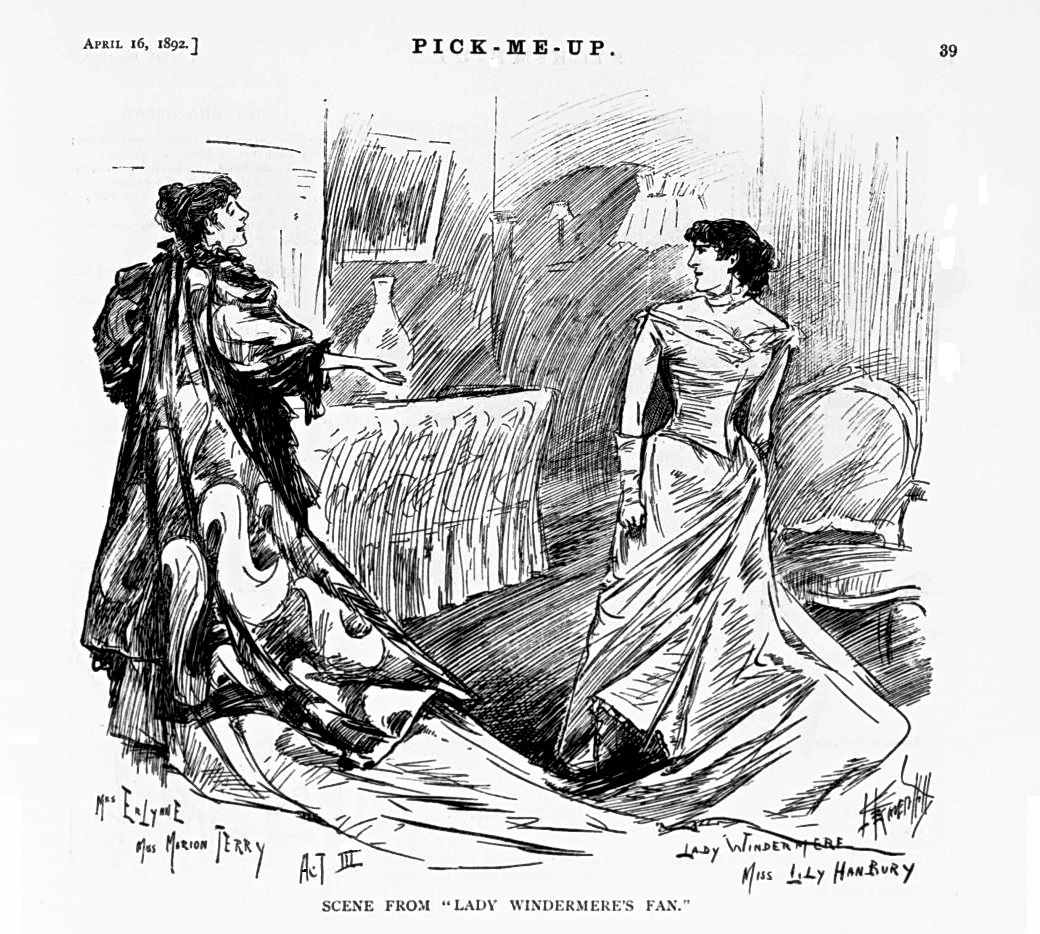
Alexander played Lord Windermere; Marion Terry (Mrs Erlynne); Lily Hanbury (Lady Windermere) and Nutcombe Gould (Lord Darlington.)
In "Lady Windermere's Fan” Mr. Archer said: —"How comes it that, for the past twelve years or so, we have been entertaining a dramatist unawares, when he ought, on the contrary, to have been entertaining us?" And the impression on Mr. A. B. Walkley's mind was such he declared, "I would say 'Lady Windermere's Fan' is an admirable play."
In 1890, Wilde had determined to write a modern comedy, and George Alexander had given him £50 for an option on it. On February 2nd, 1891, Wilde wrote to Alexander: "I am not satisfied with myself or my work. I can’t get a grip on the play or make my people real. Shall I return your £50 and end our agreement or keep it and when the play is written for you have the rights and refusal of it? This will be just as you wish". The play was finished by October. Alexander was so pleased with the play that he offered him an advance of £1,000 for the rights. Wilde, impressed by his confidence, and Alexander’s faith in him, shrewdly opted to take a percentage instead, from which he would earn £7,000 in the first year alone.
Alexander was a meticulous manager and he and Wilde began exhaustive revisions and rehearsals of the play. Both were talented artists with strong ideas about their art. Wilde, for instance, emphasised attention to aesthetic minutiae rather than realism; he resisted Alexander's suggested broad stage movements, quipping that "Details are of no importance in life, but in art details are vital". These continued after the opening night when, at the suggestion of both friends and Alexander, Wilde made changes to reveal Mrs Erlynne's relationship with Lady Windermere gradually throughout the play, rather than reserving the secret for the final act. Despite these artistic differences, both were professional, and their collaboration was a fruitful one.
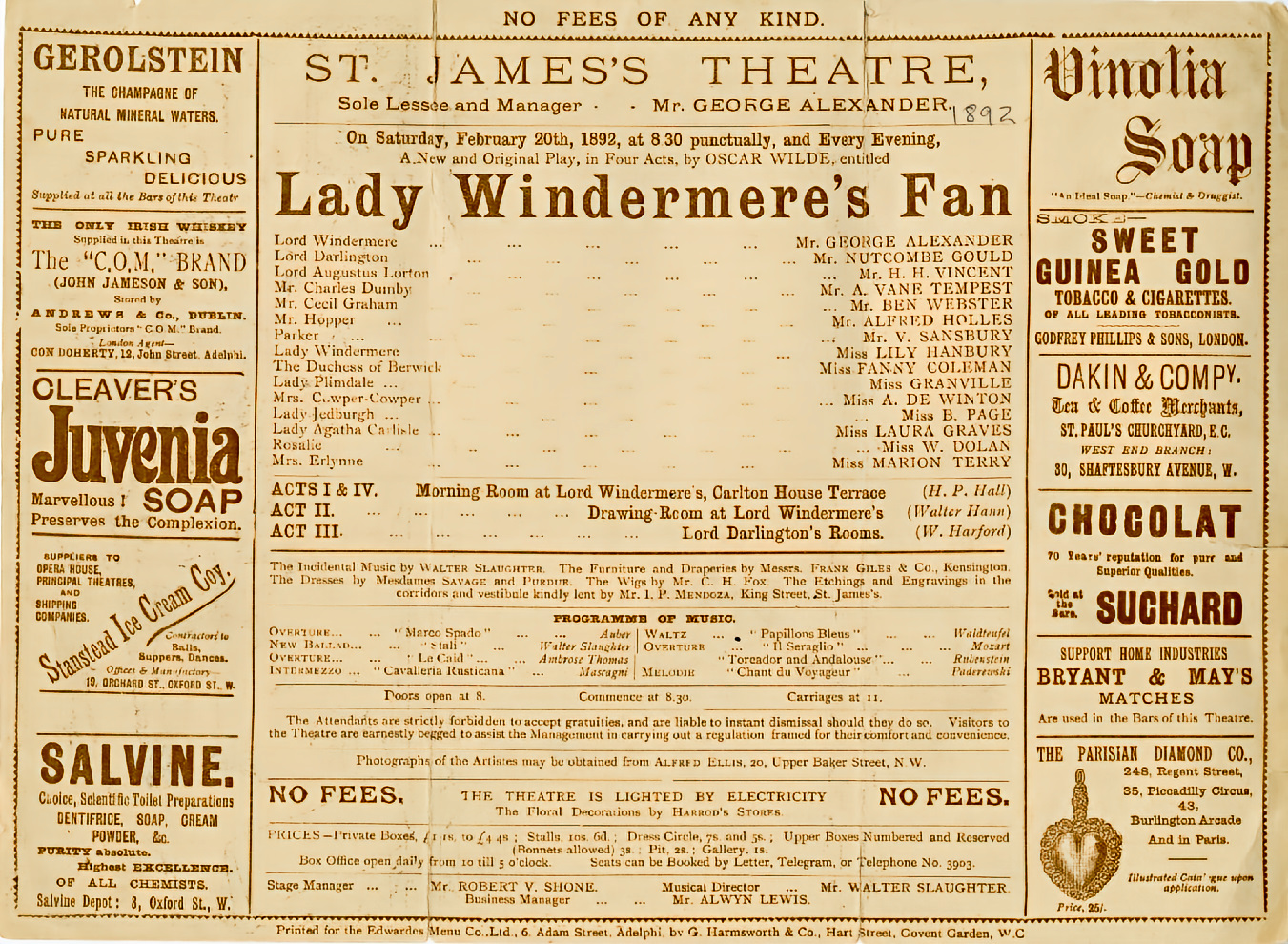 Mander & Mitchenson Theatre Collection, University of Bristol
* * * * * * * * * * * * * * * * * * * *
Lady Windemere's Fan
ST. JAMES'S THEATRE.
MR. OSCAR WILDE, who we know despises convention, artistic and otherwise, and who is nothing if not original, will probably be disappointed to hear that the only very unconventional and original feature of the entertainment provided by him on Saturday night was his own personal exhibition at the end of the regular performance. So it was, however and the new playwright saved his reputation for daring eccentricity chiefly by taking advantage of a call before the curtain to appear there with a big blue buttonhole and a half-smoked cigarette and deliver an unexpected appreciation of his own work. The taste of this display might be doubtful and might be quarrelled with in the case of any one less privileged than Mr. Wilde in the matter of self-advertisement by means of impertinence. But its eccentricity could not, happily, be questioned, and thus the sought-for success was attained. For the rest the St. James's production, which does the highest credit to Mr. Alexander and his company, is, in its dramatic essentials, a rather ordinary play, based upon the kind of secret which has done duty in many dramas, from The Wife's Secret to Odette and furnished with theatrical devices which have done duty in works as diverse as The School for Scandal and The Idler. Its distinguishing feature is the paradoxical wit of its really brilliant dialogue, which constantly makes up in showy effect what it lacks in appropriateness. But there is genuine interest also in the motive, familiar though it is, which is here worked out by the dramatist, though this interest is sadly handicapped by the manner in which the spectator is kept in the dark until nearly the close of the play as to the significance and identity of the chief character. This mistake, which in its obvious trickery seems wholly unworthy an author of Mr. Wilde's intelligence, is one that should be corrected at once by interpolating a sentence—it need only be a line—explaining Mrs. Erlynne's relationship to Lady Windermere, and her consequent hold over her reluctant and scandalised hostess's husband.
It is surely the least aesthetic of art to puzzle an audience over a conundrum when it ought to be concentrating its attention upon the development of character and situation. For our purpose here we may as well explain at once that Mrs. Erlynne, the fast and demi-mondaine widow of whose intimacy with her husband Lady Windermere not unnaturally grows jealous, is in reality her own mother, who is levying blackmail on Lord Windermere as the price of her silence as to her identity. It is not very clear why Mrs. Erlynne, whose object it is to get back into the society which has known nothing of her for twenty years, does not approach her own daughter rather than her son-in-law with a view of making good her footing in the fashionable world under her assumed name. Nor can one understand how it is that so clever a woman, having forced herself into Lady Windermere's drawing-room, should behave in such a manner as to confirm the worst suspicions that her declassé life has aroused. But, although Mrs. Erlynne's proceedings here would be more interesting if they were more intelligible, Lady Windermere's actions excite keen curiosity. Will she, as she has threatened, insult her unwelcome guest by striking her with her fan? Will she listen to the arguments whereby Lord Darlington seeks to make her descend to the level of dishonour to which she believes her husband to have fallen? Her flight to Lord Darlington's rooms works up the spectator's curiosity to a high pitch, especially when she is frantically followed thither by her supposed rival, bent upon saving her from her ruin, though here again the interest would be immensely increased if we were allowed to know the meaning of Mrs. Erlynne's sudden anxiety concerning Lady Windermere's fate. An admirably managed if reminiscent scene at the end of the third act shows how Mrs. Erlynne, by sacrificing her own reputation, succeeds in her mission, while the last act with rare skill brings about the reconciliation of husband and wife without the enlightenment of as to the true motives which have actuated Mrs. Erlynne in her dealings with them. The author's cynical contempt for the platitudes of sentiment here stands him in good stead and serves a really dramatic purpose in giving his play a thoroughly characteristic and consistent end. On the whole the merits of Lady Windemere's Fan—its finesse of treatment, its wit of dialogue, and its neat caricature of certain phases of the society of the day—certainly outweigh the defects to which allusion has been made, and render it pretty sure to take and to hold the fancy of the public to which it specially appeals. Its paradoxical epigrams will be quoted and will bear quotation, even though one may feel the most appropriate of them to be the frank admission that "nowadays to be intelligible is to be found out."
The "actable value," to use Mr. Oscar Wilde's own expression, of Lady Windermere’s Fan is so considerable as to prove that its author is gifted with that dramatic instinct which is so often missing in the litterateurs who play at writing for the stage. This value is upon the whole admirably brought out at the St James's, though in one or two particulars the cast might be improved. Mr. Nutcombe Gould, for example, though excellent in the refinement of his speech and bearing scarcely suggests the blacker hues of Lord Darlington's character, whilst his treatment of a passage of lawless passion is too discreet to be really emotional. Miss L. Hanbury again, though promising in her work, gives far too unsympathetic and tragic a rendering of Lady Windermere. Miss Marion Terry, on the other hand, gives many a welcome touch of human nature to the womanly inconsistencies of Mrs. Erlynne, whilst the Lord Windermere of Mr. Alexander could not be improved. Mr. Ben Webster and Mr. Vane Tempest are especially happy in catching the tone of Mr. Wilde's conversational humour without missing that of the society—with a big S.—in which they are supposed to move. Nearly half of Mr. Wilde's dramatis personæ are titled folk, and with a proper appreciation of what is due to rank, he allots some of his most telling speeches to the Duchess, who takes precedence over the rest. Very comically does Miss Fanny Coleman render these amusing lines, and very usefully do Mr. Vincent, Mr. Holles, and Miss Laura Graves fulfil their minor functions. The play is mounted very handsomely indeed, but the pains that have been spent upon it in this and in other respects seem sure to be repaid in the course of a long career of popularity.
The Illustrated Sporting and Dramatic News (London), Saturday, 27 February 1892, p.805 – 806
* * * * * * * * * * * * * * * * * * * *
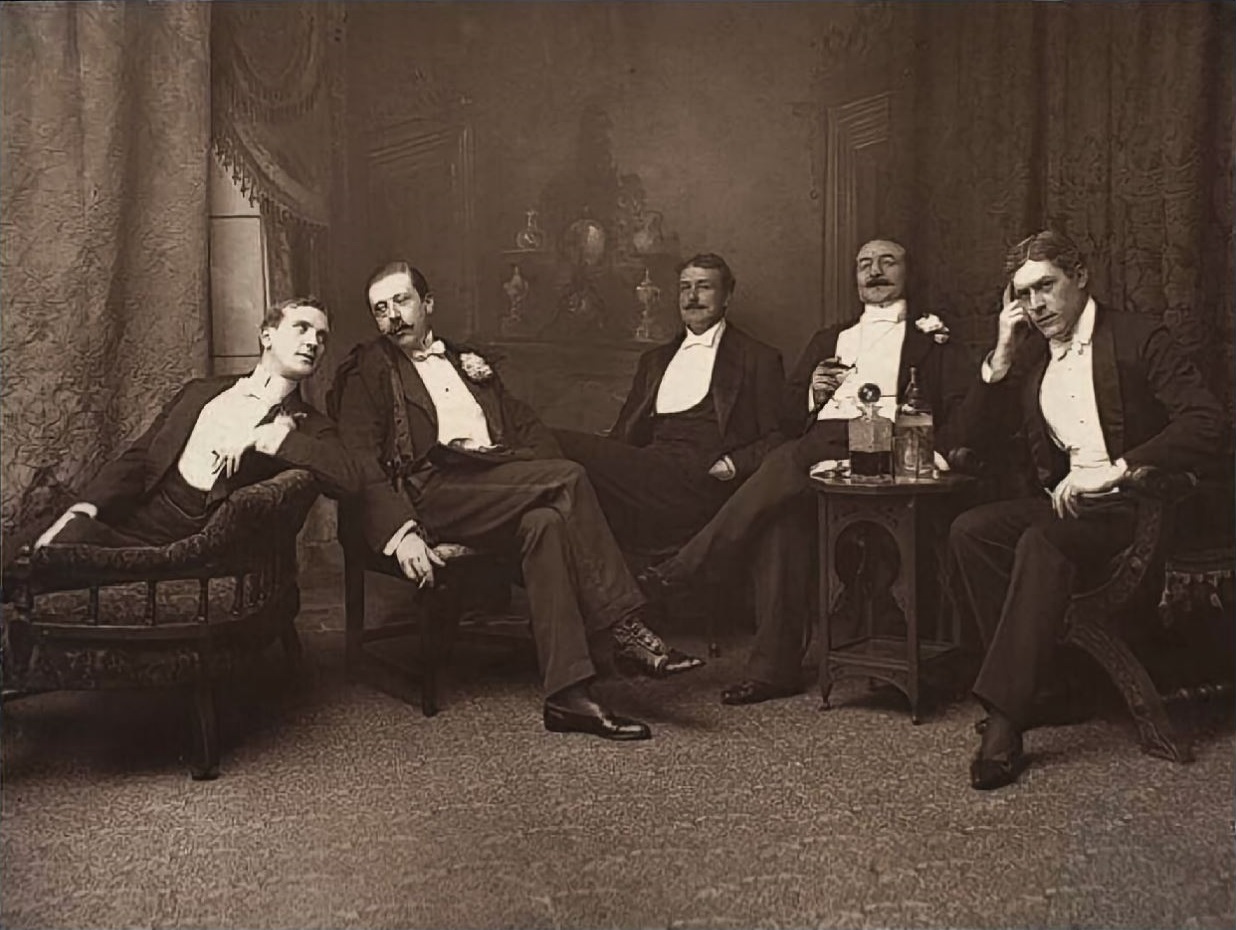 Studio photo of the principal male cast (l to r) Ben Webster, A. Vane Tempest, Nutcombe Gould, H.H. Vincent & George Alexander (V&A Museum, London)
* * * * * * * * * * * * * * * * * * * *
The latest addition to the noble company of playwrights is Mr. Oscar Wilde, whose very successful début in his new role was awaited by many with as much curiosity as interest. Just now, too, all Paris is on the qui vive for his play of “Salomè,” founded on sacred history, and written solely and originally in French by this most versatile of geniuses, though whether or no he is to reap fresh laurels thereby remains to be seen. Mr. Oscar Wilde is, as everyone knows, the younger son of Sir William Wilde, the celebrated Irish oculist; and of his clever wife, whose nom de guerre of "Speranza” will be well remembered by all who have any cognisance or recollection of the Young Ireland movement, but who of late years has turned her attention more to folk-lore than to politics. Mr. Wilde’s career has been a varied and a brilliant succession of tableaux vivants, so to speak, from the commencement, as winner of the Newdigate at Oxford and leader of the then infantile æsthetic craze, to his present semi-public position as lecturer, man of fashion, wit, poet, novelist, essayist, and dramatist all in one. His lecturing tour in America was literally a species of royal progress even "God Save the Queen" being played to mark his entry into a ball-room. Perhaps his most remarkable attribute, after big mastery of paradox and skill in epigram, is the imperturbable and courtly serenity which characterises his every speech and action. Mr. Wilde was married, some eight years ago, to Miss Constance Lloyd, daughter of Mr. Horace Lloyd, and is the father of two very beautiful boys. His house in Tite Street, Chelsea, was decorated by the late Mr. Godwin, and is, with its subtle harmonies of green and blue, its peacock-like charm of colouring, and quaint, old-world furniture, strangely in consonance with the spirit of modern art and its somewhat fin-de-siècle occupier.
A very full and, on the whole, admiring house greeted the production of Mr. Oscar Wilde’s play (“Lady Windermere's Fan”) at the St. James's Theatre the other evening, and never did audience at a première appear less brilliantly attired. It may be that the stage dresses, which certainly were miracles of fine colour and distinction, threw everything else a little into the shade; it may be that the recent sad necessity for mourning garments has pushed aside the instinct for pretty gowns. Certainly, with few exceptions the feminine portion of the assemblage was gowned wisely, maybe, but decidedly not too well. However, there were bright spots here and there. Mrs. Bram Stoker wore a wonderful evening wrap of striped brocade with ''thousand rare encolourings." Mrs. Oscar Wilde looked charming in her pale-blue brocaded gown, made after the fashion of Charles the First's time, with its long tabbed bodice, slashed sleeves, and garniture of old lace and pearls. Mrs. Jopling-Rowe was becomingly arrayed in shrimp-pink, lightly accented with black. Some of the other wearers of pleasing toilettes were Mrs. Pinero, Miss Julia Neilson, and Miss Florence Terry. Among those present were Mrs. Langtry, Mrs. Campbell-Praed, Mr. Bancroft, Mrs. Hare, Mr. Charles Matthews, Mr. Inderwick, Dr. Playfair, Mr. Luke Fildes, Mr. Forbes Robertson. and Mr. Oswald Crawfurd, to say nothing of whole rows of critics and other notabilities of the pen and pencil. Miss Marion Terry's gowns were beautiful beyond words; the ball-dress in the second act was rich white-and-gold brocade of Arabian Nights-iike splendour, but very simply made, with a closely fitting, pointed golden girdle and a cloud of white ostrich and lilies-of-the-valley about the corsage. Her bouquet, in this scene was of marvellous violet and white orchids. The graceful grey corduroy walking-gown which Miss Terry wore in the fourth act was not less becoming to her; like the first, it was of Princess build, but with elaborate garniture of fine steel, flowing in glittering rivulets from shoulder to waist, from waist to hem. The little grey and black bonnet to match is the most espiègle headgear imaginable. Miss Lily Hanbury wears a pale primrose tea-gown of lace and silk, with a Watteau pleat, in the first act; a light-blue satin ball-gown embroidered with gold and spangles in the second and third, and a delightful confection of chestnut-brown velvet and salmon-pink cashmere in the fourth.
The Illustrated London News, 27 February 1892, p. 262
* * * * * * * * * * * * * * * * * * * *

Lily Hanbury as Lady Windermere
(Elisabeth Kumm collection)

Marion Terry as Mrs. Erlynne & George Alexander as Lord Winderemere
(V&A Museum, London)
* * * * * * * * * * * * * * * * * * * *
ST. JAMES’S THEATRE.
MR. OSCAR WILDE’S PLAY.
Mr. Oscar Wilde has done many clever and original things in his time, but he has, perhaps, never shown himself cleverer than he did last night, when, amid the applause which was being showered upon him for his play, “Lady Windermere‘s Fan” he came forward and surprised his audience with a speech which sent them away in thorough good humour. Mr. Wilde always manages to give people plenty to talk about, and the novelty of an author slyly expressing his own appreciation of his own play, may probably make “Lady Windermere‘s Fan” the talk of the town for the moment—in the intervals of discussing the Local Government Bill and the tragedy at Cannes.
But “Lady Windermere’s Fan” is clever and interesting enough to justify attention on its merits, and though by no means a perfect or unconventional play as far as the development of character and incident goes, it has a showy story which interests, and it is brilliantly written. Mr. Wilde has the gift of writing witty and memorable dialogue, full of paradoxical surprises, and pregnant with the wisdom of the boudoir and the cynicism of the club smoking-room , while under all this there frequently lurk deeper truths of a wider range . One of his characters says, “I think life far too important a thing ever to talk seriously about it,” and this is the keynote of much of the cynicism of this play, in which the author has attempted to depict a certain phase of life, but has not taken it quite seriously. This is, perhaps, no great drawback, for as one of the characters says, “to be intelligible is to be found out,” and that is a catastrophe which Mr. Wilde would be scarcely likely to court. Therefore, he keeps his audience as perplexed as possible without actually mystifying them. He carefully preserves his “secret” till the last act, and he makes at least one of his characters something of a psychological puzzle. But let us tell the story.
Lady Windermere is a young wife who loves her husband and believes in him. She has been brought up by an aunt of severely strict principles, and has imbibed ideas of morality which are positively Puritanical. The mother she has never known she regards as her ideal of all virtue, and she has no pardon for wrong-doing, nor sympathy for moral irregularity. Indeed, she lives her life encased in virtue, and the happiness she feels in her husband’s love preserves her illusions . But a change gradually comes over the spirit of her dream, shadows of suspicion and scandal begin to lower upon her life. First, Lord Darlington, a young man who affects that kind of paradoxical cynicism of which Mr. Oscar Wilde is himself so fond, makes love to her, and hints that her husband is not all that he should be. Then a garrulous dowager duchess tells her that her husband is scandalously entangled with a certain Mrs. Erlynne, an attractive but disreputable woman, who has suddenly turned up from heaven knows where, and is now living elegantly and extravagantly at Lord Windemere’s expense, and making the scandal much worse by dressing so well. Of course Lady Windermere does not believe this, but when her husband comes home she promptly questions him about Mrs. Erlynne, and he makes matters worse by asking his wife to send that lady a card for their “small and early” dance that night. This request Lady Windermere considers an outrage, and of course refuses, whereupon Lord Windermere says he will send the invitation himself in her name. The young wife is now furious, and threatens that if Mrs. Erlynne dares to come she will strike her before all their guests with the fan her husband had that day given her as a birthday souvenir. He warns her that she would regret such an act, but she is obdurate. The evening arrives, and among the guests who assemble at Lady Windermere’s comes Mrs. Erlynne, to the amazement of all the men and the scandal of the women. Everybody has been talking about a liason between Windermere and this woman, therefore, when she is seen at his wife’s party, Lady Windermere at once regarded with a sort of contemptuous pity, for at the critical moment she had not found the courage to publicly insult her rival as she had threatened. But her feelings are outraged, and she actually listens to Lord Darlington‘s renewed declarations of love, though her Puritanical principles will not permit her to accept his invitation to run away with him. Mrs. Erlynne has made quite a sensation, and some of the men have been obliged to introduce her to their women-folk, to whom she has made herself aggressively agreeable . She plays her cards well, and dangles many men on her hook, but one vain, silly person actually proposes marriage to her, and she promises him an answer in the morning, at the same time that she tells Windermere she must see him late that night to discuss the question of his making her a handsome settlement before she accepts Lord Augustus’s offer. Lady Windermere sees all this going on, and can stand it no longer, so before Mrs. Erlynne has left the house, she writes her husband a letter telling him she has gone away—where do you think? —not to her aunt, as one might have expected such a rigid moralist to do, but actually to Lord Darlington’s rooms!
Mrs. Erlynne intercepts this letter, and after making her devoted Lord Augustus promise to take Windermere to the club and never leave him, she hastens to Lord Darlington‘s. There she finds the runaway, who has already regretted her rash step, and is hoping her husband will come to fetch her. But when Lady Windermere sees Mrs. Erlynne she is filled with rage, and determines to wait for Darlington, who has not anticipated her taking the road to the Divorce Court at his entreaty, and so has not hurried home. But Mrs. Erlynne will not be rebuffed. She has come there to save Lady Windermere, and she uses every argument to persuade her to return home. Of course she paints the consequences of not doing so in very distressing colours, admitting that she does so from actual experience, and then she appeals to the mother, when the indignant runaway wife cannot be moved, and eventually she succeeds, and Lady Windermere agrees to return. But there is a drawback. Lord Darlington and a party of men are heard coming up the stairs, and among them Lord Windermere. What can be done? The curtains, of course. They have done duty before, why not now? So Lady Windermere hides there, and Mrs. Erlynne conceals herself in the inner room. Then the men come in and talk scandal and moralise cynically and wittily about life, and men and woman . Of course, Mrs. Erlynne is one of their topics, and Darlington confesses he is in love with a good woman who is not for him. But as there was a convenient curtain, why should there not be a lady‘s fan left about? We know that fan as we know those curtains. Of course, it is Lady Windermere’s birthday fan, and one of the men finds it, and accuses Darlington of having a woman in his rooms. They always jump to conclusions. The fan is shown to Windermere, he recognises it as his wife’s and demands an explanation, when Mrs. Erlynne reveals herself. Poor Lady Windermere possibly thinks she is going to expose her, but no, Mrs. Erlynne is only making a diversion to enable her to slip out, which she does. But this piece of magnanimity costs her—for the time, at all events—her prospects of marriage with Lord Augustus, and the regard of Lord Windermere.
The next morning Lady Windemere is as full of gratitude to Mrs. Erlynne as her husband is as full of disgust. She wants to confess her escapade to him, but Mrs. Erlynne is announced, and although her husband protests, she insists on seeing and thanking her preserver. All suspicions of her husband are gone, and she asks no questions about the sums of money he has been in the habit of giving to Mrs. Erlynne . She accepts that lady’s statement that Windermere’s apparent intrigue was all for love of his wife, to save her from shame, and she has no further curiosity about the matter. But we in the audience are not of the same mind. We want to know. And at last, just before curtain-fall, we pluck out the heart of the mystery. Mrs. Erlynne is Lady Windermere’s mother. Twenty years ago she left her husband and her baby, was divorced, and has led a disreputable life ever since. But learning that her daughter has married a rich man, she was seized with a craving, not to see her daughter, but to get back into Society. So she threatens to bring disgrace on Windermere and his wife unless they help her back to her old position. She has no desire that her daughter should ever know who she is, for, as she says, how could she play the mother to a daughter of twenty-one when she herself has never owned to more than twenty-nine, or thirty at most—“twenty-nine when there are pink shades, thirty when there are not.”
But would not the play have been much more dramatically effective if we had been let into this secret from the first? Had we known that Lady Windermere was standing in her drawing-room waiting to insult her own mother as an infamous woman, would there not have been an intenser interest? But we are only led to suppose that Windermere has an intrigue with an improper woman, whom he insists on inviting as the guest ot his wife. Mr. Wilde can be brilliantly cynical, but when he handles sentiment, he seems to lack the essential of sympathy . He can be thoroughly interesting though, and brilliant, and these are qualities which go far towards making “Lady Windermere’s Fan” a success. To develop character in action is surely the highest aim of dramatic writing . And Mr. Wilde attempts this at least with the women of his play, but his developments do not always seem true. The character of Lady Windermere is decidedly perplexing, according to the logic of ordinary life—though women are often extraordinary creatures. The man are not conspicuous successes as characters, though they all talk interestingly and amusingly, except Lord Windermere. He says nothing amusing, and he is very serious. And this is the character Mr. Alexander has elected to play. He has only to be earnest, and Mr. Alexander’s earnestness is one of his most valued artistic gifts.
Of course the best acting part in the play, as it is the best drawn character, is that of Mrs. Erlynne, the divorcée, who talks of having lost an illusion when she finds she has a heart, and regrets it as being unsuitable to modern costume and her complexion. Miss Marion Terry makes this woman live, and she acts with beautiful art, whether she is playing the fascinating hypocrite in the ballroom, or passionately pleading to her daughter to return home to her husband, or taking herself out of the life of this daughter she has suddenly learnt to love. Miss Lily Hanbury revealed unexpected dramatic power and charm of expression in the character of Lady Windermere. This is the most exacting part this clever and beautiful young actress has yet attempted, and last night she rose to the occasion. Miss Fanny Coleman as the garrulous duchess has many amusing things to say, and says them amusingly. To Mr. Ben Webster also fall some of Mr. Wilde’s best lines, and he speaks them admirably. Mr. Vincent as Lord Augustus (a clever bit of character), Mr. Vane Tempest as a young Society man, and Mr. Holles as a silly young Australian, all render useful service to the author’s scheme, but that excellent actor, Mr. Nutcombe Gould, as Lord Darlington, seems out of his element. It is difficult to believe in his sincerity even in his impassioned moments.
SPEECH BY THE AUTHOR.
At the close of the performance there was a loud call for the Author, to which Mr. Oscar Wilde responded and bowed his acknowledgement . On his retirement there was a further call, when he again appeared before the curtain, now smoking a cigarette. The applause continued, and, amidst the cheers, was heard a demand for a speech. Mr. Wilde seemed for a moment to suffer from indecision, which encouraged those who desired to hear his sentiments to renew their demands for an oration. Yielding to their solicitations, he at length addressed them to the following effect:—
“Ladies and Gentlemen,—I believe it is the privilege of an author to allow his words to be reproduced by others while he himself remains silent. But, as you seem to wish to hear me speak, I accept the honour you are kind enough to confer upon me. The more especially am I pleased to do this as your goodness gives me the opportunity of thanking all who have been instrumental in securing the success that has crowned this evening‘s entertainment. My acknowledgements are due, in the first instance, to Mr. George Alexander, who has placed my play upon the stage with the admirable completeness that has characterised all the productions at the St. James’s Theatre during the time it has been under his management. If I praised all I wished to praise in the interpretation of the piece I would have to read to you the entire cast as it appears upon the programme. But I have to thank the company, not only for repeating the words I have set down for them to speak, but also for entering, as it were, into the atmosphere of the world I have endeavoured to reproduce before you. I have to thank them, one and all, for the infinite care they have taken to fill in every detail until the sketch has become a finished picture. I think that you have enjoyed the performance as much as I have, and I am pleased to believe that you like the piece almost as much as I do myself.
Mr. Wilde, still smoking his cigarette, then retired amidst loud applause, which was repeated when the curtain was again raised to show the entire strength of the company.
The Sunday Times (London), 21 February 1892, p.5
* * * * * * * * * * * * * * * * * * * *
In order that "our Oscar" may not be supposed to be indebted to such vulgar people as critics, it was "officially" announced last night that an arrangement had been entered into between Mr. George Alexander and Mr. Wilde that the attitude of the audience on Saturday night should decide the question whether the mystery in the plot ought or ought not to be disclosed in the first act. Mr. Alexander was for publicity. Of course Mr. Alexander was right. Not to mislead an audience is among the very first rules which are laid down "for the guidance of young playwrights," and the disregard of it has wrecked better plays than "Lady Windermere's Fan." The novel reader likes the mystery to be kept up to the end, but the play-goer is apt to regard it as a kind of practical joke when the supposed adventuress turns out, wholly unexpectedly and in the last scene, to be the heroine's long-lost mother. Mysterious allusions and by-play, which, if the secret is known, are part of the entertainment and add a touch of Sophoclean "irony," are simply so many puzzles if the secret is unknown. Of course Mr. Wilde knew a great deal better about these things than those whose business it is to know, but it is something that he should have shown himself amenable to the advice even of an audience where "a work of art" is concerned.
PaIl MaIl Gazette(London), 23 February 1892, p.2
* * * * * * * * * * * * * * * * * * * *
OUR CAPTIOUS CRITIC.
"LADY WINDERMERE'S FAN."
MR. ALEXANDER would, appear to have a success in Lady Windermere's Fan. But for all that Mr. Oscar Wilde should promise himself that he will try to do better next time. It is well enough for once, this kind of piece, which— like the big sunflower of other days—one does not know whether to take as chaff or seriously. But in the long run the public expects to be able to tell what a dramatic author is driving at. I have not yet found out either the literary or social purpose of this four-act puzzle at the St. James's Theatre. The one thing clear about it is that every character in the cast bursts with epigram and bubbles over with paradox of that not very subtle kind which prevails where Bohemians foregather. It is like an evening at the Savage Club, where the members who have been saving up good things all the week fire them off at one another on Saturdays—after dinner. They would work out very contradictory, these "smart "utterances, could they be collected afterwards and put in a row, but being "clever" they have to be spoken or the author of them would crack. The dialogue of Lady Windermere's Fan is from first to last at this sort of literary-club tension—all the personages are showing off. It is amusing enough, some of it, but the difficulty is that one cannot reconcile the things they say with the things they do. The course of the plot refuses to agree with the arguments of the dialogue, and one wonders whether it is the talk of the characters or their actions which must be taken to heart. Where is the joke? —is it the dialogue or the story? —that is what the audience asks itself, and, while asking, believes not too implicitly in either—although the plot, conventional as it is, might have passed for emotional at intervals but for the cheap cynicism which sterilises the characters and obfuscates their motives. It is a plot, however, which is more allied to the traditions of farce than to those of serious comedy. This husband, who is suspected by his wife because he pays the bills of his mother-in-law; this wife, who runs away in a temper and leaves her fan about in a naughty gentleman's chambers, are very old friends indeed in the Palais Royal sense. With the same curtains and side doors which we have at the St. James's they would have gone far towards a funny piece—at least they have done so before. And I am not at all sure that had the incidents been carried out—on the stage—with a view to making them comic, instead of trying to make them serious, Lady Windermere's Fan would have acted as at all a bad farce. Certainly the dialogue would have blended better with the story in such a reading; I suggest that Mr. Alexander and his company should essay the two styles, on alternate evenings.

Oscar Wilde

Lady Windermere
Lady Windermere, the heroine—as far as I can gather amid the dazzle of Mr. Oscar Wilde's smart writing—is a good young woman who loves her husband and has very pronounced views about morality. Lord Darlington, who adores her, passes much time in her society. She sees no harm in this, however, because since he poses as a wicked man there is more reason, she holds, to believe him a virtuous one. Then the Duchess of Berwick drops in and tells her that everybody is talking of the suspicious friendship of Lord Windermere and an adventuress, Mrs. Erlynne. Lady Windermere at first refuses to believe that anything is wrong, but after breaking into her husband's pass-book finds that he has been paying large sums to the strange lady. The wife calls upon the husband to explain this. He declines, however, and, what is worse, insists that at a dance that evening Mrs. Erlynne shall be received. Lady Windermere thereupon threatens that if the adventuress comes she herself will go. But Lord Windermere is still silent, because—it is Mr. Wilde's because, not mine—Mrs. Erlynne is Lady Windermere's own mother, who has run away years ago, and her daughter must never know what a bad mother she has got. The motive for concealment is very weak, much too weak for a strong play, or to risk wrecking the happiness of two lives upon. Equally weak is the manner of Lady Windermere's running away. Really, for a woman with so lofty an ideal of purity as hers, there is absolute absurdity in her placid reception of Lord Darlington's professions, and her quick resolve to fly to him. In fact Mr. Wilde has not made Lord Darlington a very eloquent lover, and, judging Lady Windermere by herself, the incident of her flight is sadly lacking in dramatic justification. However, it is certain that she does run away, leaving a letter to say where she has gone. Mrs. Erlynne very improperly opens that letter and follows her daughter to the chambers of Darlington, who fortunately happens to be out. Lady Windermere, alone, has already half repented her hasty step, and is almost decided to return, when Mrs. Erlynne appears. The sight of the adventuress, however, upsets her good resolves, and it is only after a great deal of argument that the fugitive is again, brought back to reason—by being reminded that she has a little girl at home—à la Porte Saint Martin. As the pair are about to go male voices are heard on the stairs. Lord Darlington has brought with him from "the Club" a number of friends, including Lord Windermere. Mrs. Erlynne thrusts Lady Windermere behind a curtain and herself hides in a closet. A conversation among the visitors, now clever, now personal and impertinent, follows, and then somebody finds on a table a lady's fan. Lord Windermere recognises it as his wife's and fiercely demands an explanation from Darlington. During the altercation Lady Windermere glides off unobserved, and to end the quarrel Mrs. Erlynne comes from her concealment and announces that it was she herself who brought Lady Windermere's fan by mistake. The mother has thus sacrificed herself to save her daughter, because, of course, Mrs. Erlynne has no more right in Lord Darlington's rooms than Lady Windermere had. The last act is devoted to the reconciliation of husband and wife and the departure for the Continent of Mrs. Erlynne. The dénouement is carried out with some ingenuity and as much pathos as Mr. Wilde allows himself—the points being that the mother's identity is still kept from the daughter, and that the husband never knows how nearly he has lost his wife. May they live happy in their ignorance until somebody tells; for, alas! Lady Windermere's flight, visit to Lord Darlington's, and return home at dead of night, must have been known to quite a number of servants who let her out and in.

Mrs Erlynne

Lord Windermere
The part of Lady Windermere is acted with charm and intelligence by Miss L. Hanbury, and with what power is possible where there is so little coherence. Mrs. Erlynne, the mother of thirty-five, who is supposed to be a rival by her daughter of twenty—a supposition more effective for farce than in comedy—is represented very cleverly by Miss M. Terry. Miss Terry is especially good in the third and fourth acts—when she appeals to Lady Windermere to return to her husband, and also when, to convince Lord Windermere of her story of the fan, she is compelled to affect that frivolity of which he believed that she had repented. Mr. Alexander has not a very strong part as Lord Windermere, but makes the most of it. The Lord Darlington of Mr. Nutcombe Gould is fair, but has not much dash of the devil. Miss Fanny Coleman makes an excellent gossipy Duchess of Berwick, and Miss Laura Graves as her repressed unmarried daughter, the Lady Agatha, is duly silent. Lord Augustus Lorton, an elderly beau, the butt of the young men whose society he affects, and the credulous admirer of Mrs. Erlynne, is played by Mr. H.H. Vincent creditably if without much of newness; and the two young men—who are impertinent to Lorton, and who fire off epigrams about themselves—are satisfactorily placed with Messrs. Vane Tempest and Ben Webster. The piece is capitally mounted. I note from the programme that photographs of any of the artists can be obtained from Mr. Alfred Ellis of Upper Baker-street—what do you think of that for vanity.

Lord Darlington

Lord Augustus Lorton

Mr Cecil Graham
[Caricatures by Alfred Bryan]
The Illustrated Sporting and Dramatic News (London), Saturday, 9 April 1892, p.150
* * * * * * * * * * * * * * * * * * * *
The Scenes
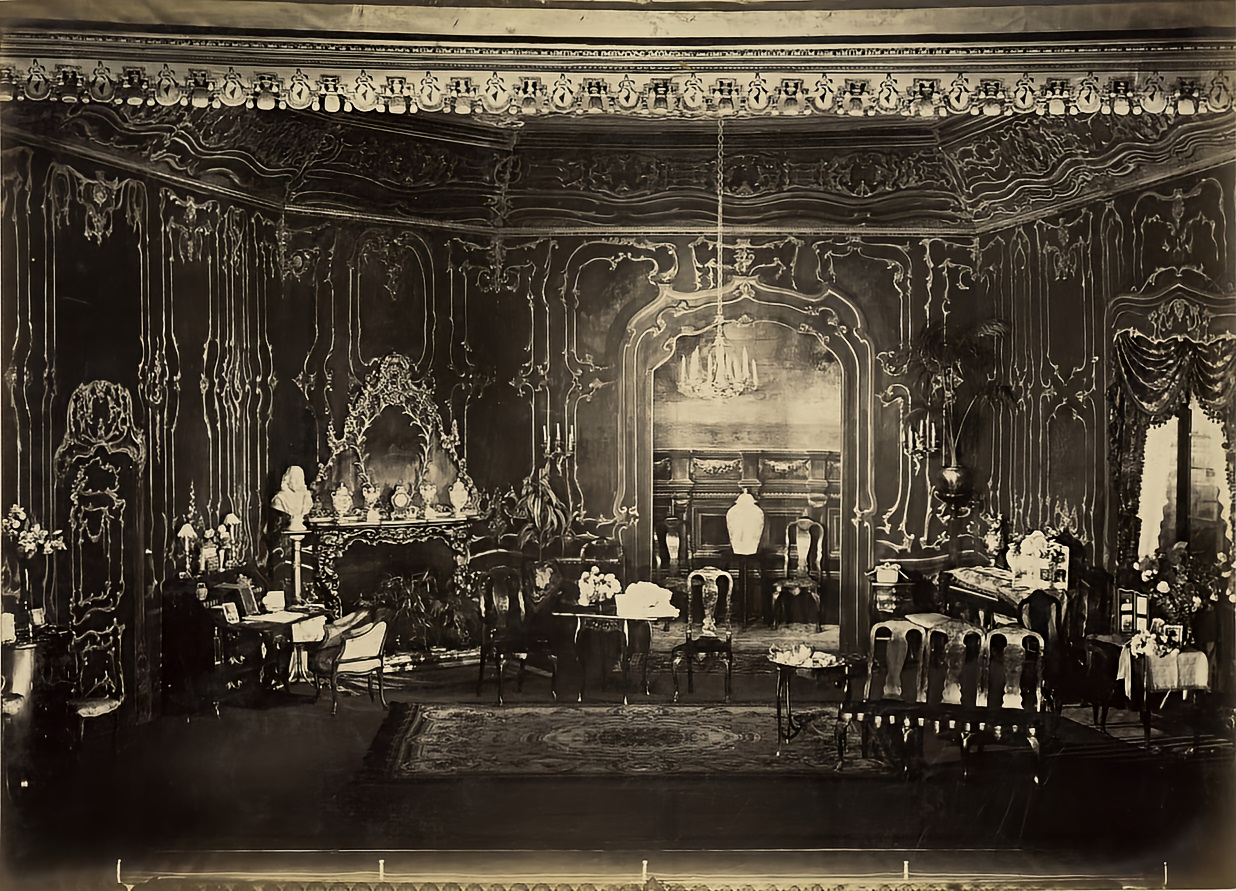 Act I & IV - Morning Room at Lord Windermere's, Carlton House Terrace (scenery by H.P. Hall) - JCW Scene Book 10 - Theatre Heritage Australia)
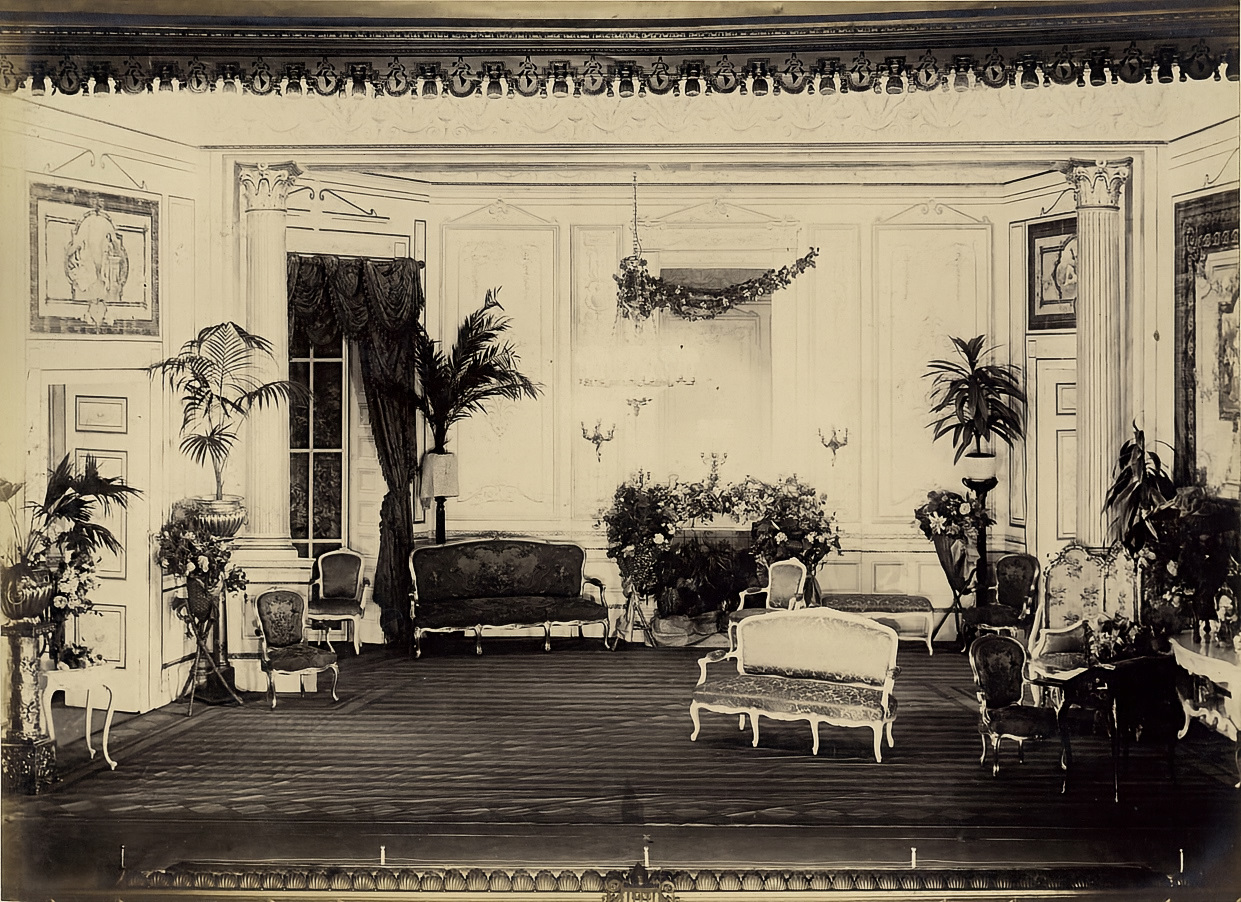 Act II - Drawing-Room at Lord Windermere's (scenery by Walter Hann) - JCW Scene Book 10 - Theatre Heritage Australia
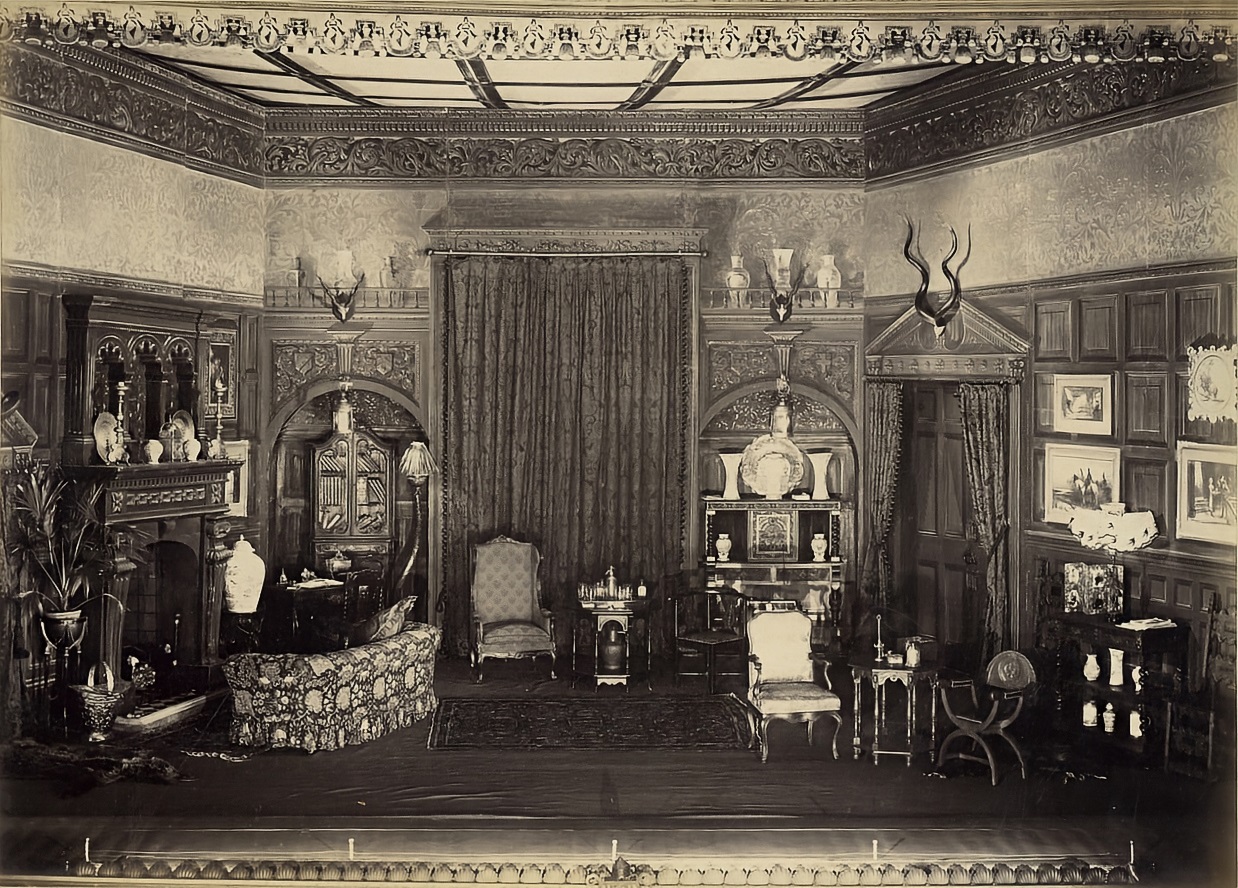 Act III - Lord Darlington's Rooms (scenery by William Harford) - JCW Scene Book 10 - Theatre Heritage Australia
* * * * * * * * * * * * * * * * * * * *
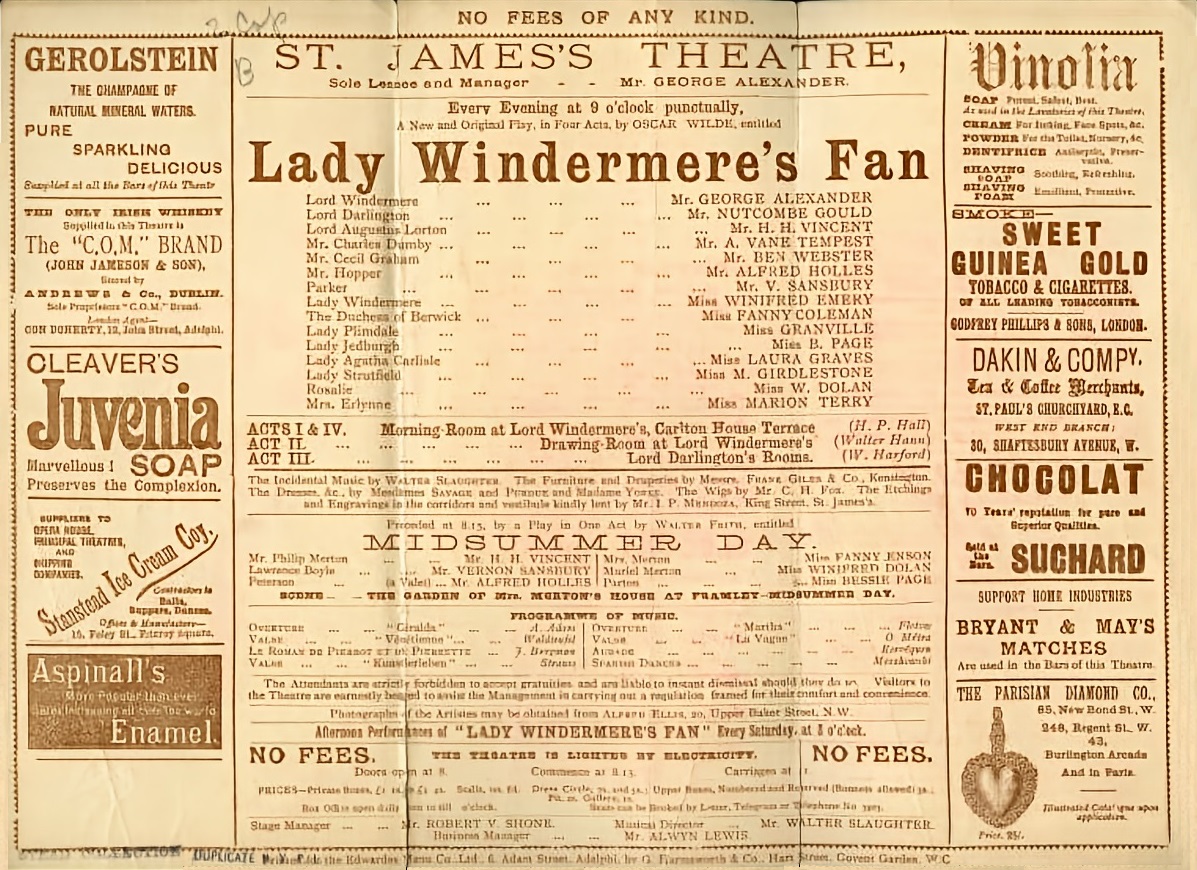
The role of Lady Windermere was subsequently taken over by Winifred Emery from 9 May 1892.

Miss Winifred Emery as Lady Windermere
(V&A Museum, London)

Winifred Emery as Lady Windermere & George Alexander as Lord Windermere
(V&A Museum, London)
* * * * * * * * * * * * * * * * * * * *
ST. JAMES'S THEATRE.
A pretty little play by Mr. Walter Frith, called Midsummer-day was acted last night at the St. James's before the principal piece of the evening, which is, and promises to be for a long time to come, Lady Windermere’s Fan. The novelty contains a tolerably fresh idea, the reconciliation after a long parting of a husband and wife who have quarrelled, for no adequate reason, and agreed to separate. Mr. and Mrs. Merton, who have not met for eleven years, live alternately for periods of six months in their house at Framley. Mrs. Merton and her daughter Muriel are about to take their departure—it is Midsummer-day—in order that Mr. Merton may resume possession for his half-year; but he has mistaken the date and arrives a day before he is due. Muriel and her lover, Lawrence Boyle, have been discussing the possibility of reuniting the estranged pair, but such a result seems hardly probable, as Mr. Merton, on grasping the condition of affairs, orders his servants to take rooms at the inn. The father, however, sees his child, her lover’s signal to her—a curlew's whistle—brings back memories of the past, and when husband and wife presently meet in the garden, where the action passes, a reconciliation takes place. There is nothing remarkable in the dialogue of Midsummer-day and the character of Mr. Merton is somewhat crude and indistinct as represented by Mr. H. H. Vincent. He is brusque and overbearing in a very half-hearted sort of way, but is, at the same time, readily moved to gushes of sentimentality. The part of Muriel was very naturally and gracefully filled by Miss Winifred Dolan; Miss Fanny Euson played with tenderness as the wife, Mr. Vernon Salisbury was the Lawrence, and Mr. Holles a valet.
London Evening Standard, 31 March 1892, p.3
* * * * * * * * * * * * * * * * * * * *
Kit Marlowe
a play in 1 Act by J.L. Courtney. First performed on 31st October 1892.
"KIT MARLOWE" AT THE ST. JAMES'S THEATRE.
Mr. GEORGE ALEXANDER produced, for the first time in London, last week at the St. James’s Theatre, a small play which precedes Lady Windermere's Fan, called Kit Marlowe by W. L. Courtenay. Our artist has selected for his sketches Mr. George Alexander as Kit Marlowe (a poet and dramatist) reciting to his friends one of his own plays. He also portrays the tragic end of Kit Marlowe—who is stabbed by an innkeeper for making love, and successfully too, to his housekeeper—with whom he himself is in love. Miss Edith Chester is shown as Nan (the innkeeper's housekeeper). Mr. George Alexander and Miss Chester are supported by Mr. H. H. Vincent as Archer the Innkeeper, and Mr. V. Salisbury, Mr. Holles, and Mr. Vane Tempest, Kit Marlowe's companions.
The Illustrated Sporting and Dramatic News (London), Saturday, 12 November 1892, p.18
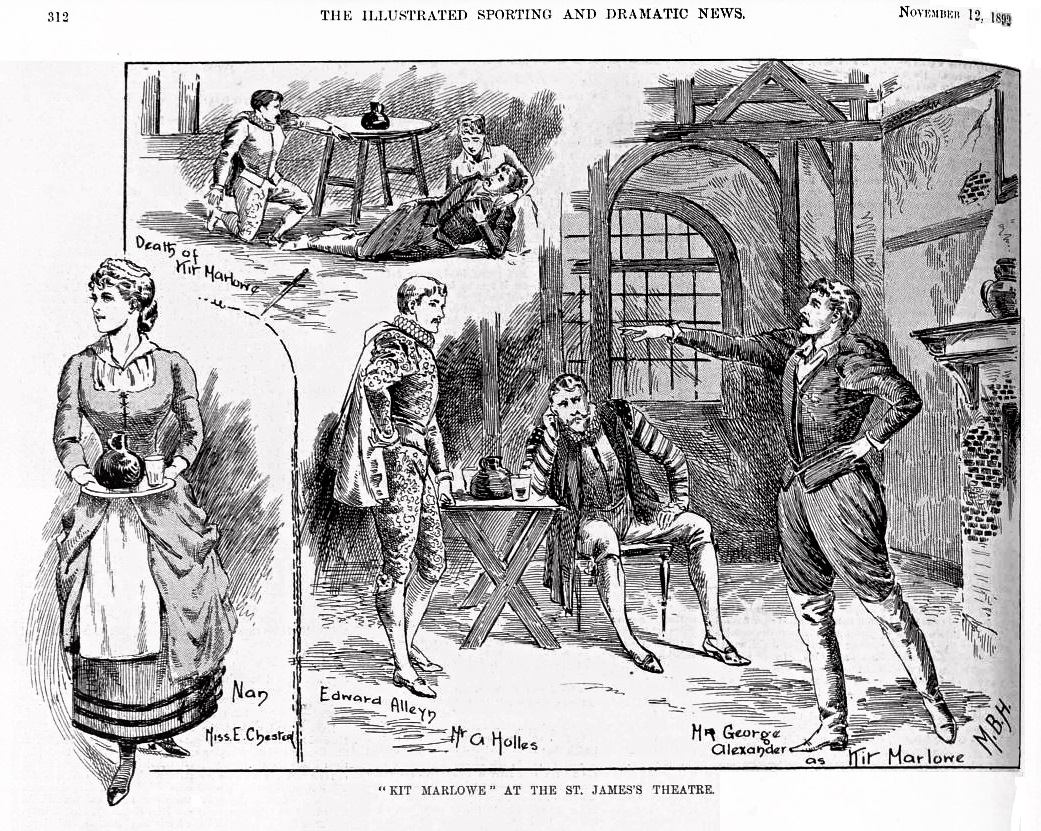
* * * * * * * * * * * * * * * * * * * *
Liberty Hall
(“R.C. Carton” pseud. Richard Claude Critchett)
First performance was on 3 December 1892 until 20 May 1893 for 182 performances – Scenery by H.P. Hall – Furniture by Frank Giles and Co.
(Revived in 1894 for 1 matinee performance on 1 March 1895 on 7 until 21 November for 16 performances and 1899 on 8 June for 1 matinee performance.)
(Revived in 1901 for 16 matinee performances between 26 December until 29 January 1902)

R.C. Carton
On December 3rd, 1892, Mr. Carton's comedy, 'Liberty Hall," was placed in the bills. The wit of the dialogue and the humours of the low comedy parts, equally with the beautiful acting of Miss Marion Terry, Mr. George Alexander, Mr. Edward Righton—whose quaint pathetic and picturesque sketch of Todman brought the stuffiness of musty volumes across the footlights—ensured it a long career. George Alexander (Mr Owen); Marion Terry (Blanche Chilworth) Ben Webster (Hon. Gerald Haringay).
Extracts from a letter received after the first night in December 1892.
89, Ladbroke Road, Notting Hill Gate. Sunday
My dear Alexander.
The cheque reached me in perfect safety, and my pleasure at the amount! was not entirely selfish.
May I take the opportunity of giving my personal and written adhesion to the opinion of those who ascribe a very large proportion of our joint success to the perfection of the acting and the excellence of the ‘tout ensemble’.
No dramatic author was ever more fortunate in his company – and his manager.
I am so happy and so proud about all. In the sincerity of my gratitude, and my regard!
Always yours,
R.C. Carton.
The play caught on and ran for 24 weeks and earned on its London run more money than ‘Lady Windermere’s Fan’. Two years later it was performed in front of Queen Victoria at Balmoral in Scotland.
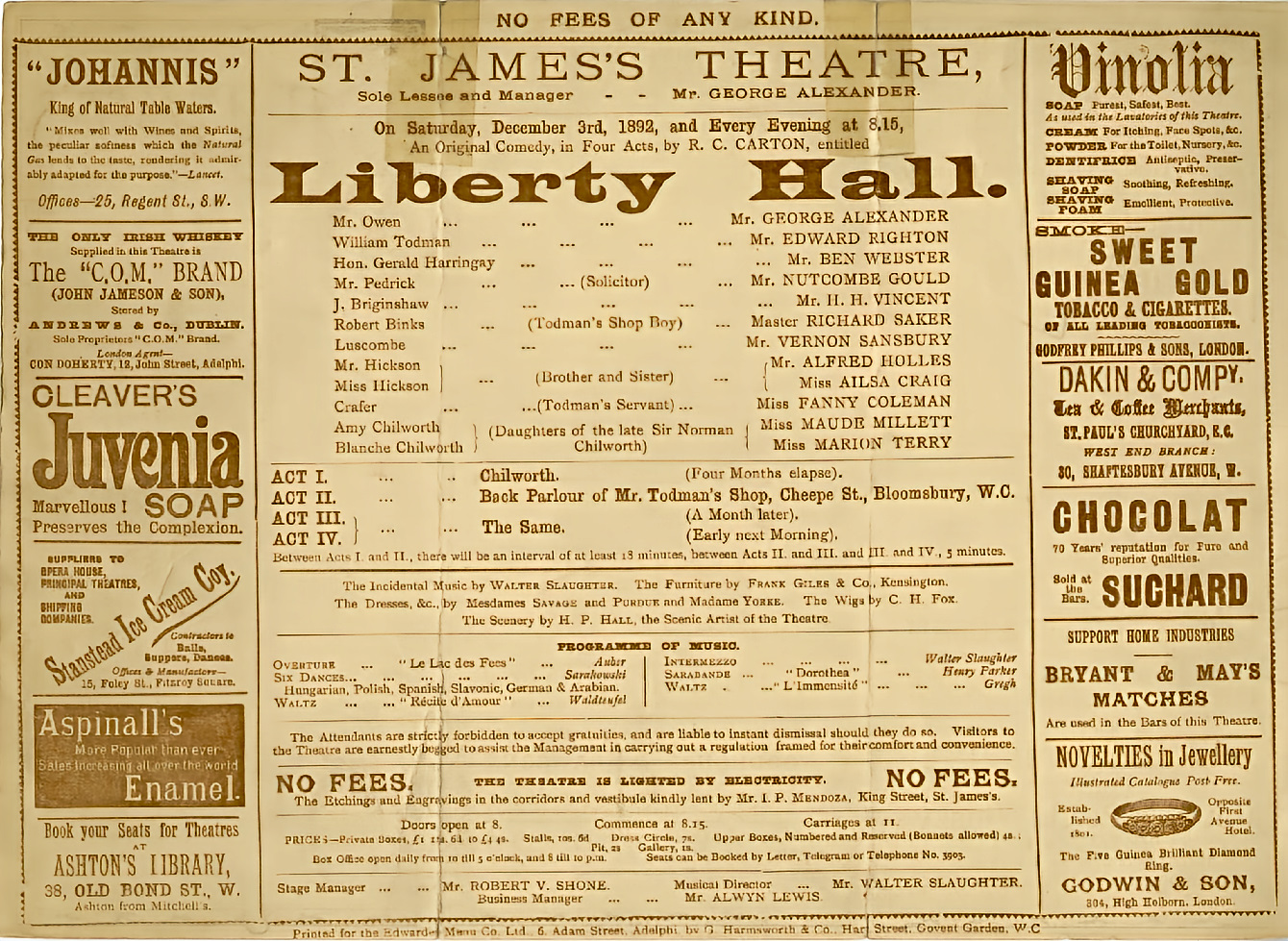 Mander & Mitchenson Theatre Collection, University of Bristol

George Alexander as Mr Owen & Marion Terry as Blanche Chilworth
(V&A Museum, London)

George Alexander & Marion Terry (ditto)
(V&A Museum, London)
"LIBERTY HALL," THE NEW PLAY AT THE ST. JAMES'S THEATRE.
The old playgoer who visits the St. James’s Theatre will find Mr. Carton’s comedy many pleasant reminiscences. Indeed, he may rub his eyes and wonder whether the geni who whisked away the gentleman in the Arabian tale and left him at the gates of Damascus has not transported the theatrical world hack to the heydey of Dickens and the atmosphere of romance. As you follow the story of Liberty Hall it is difficult to believe that such a being as Ibsen ever existed, or that any school of playwrights has grown discontented with the fairies of the drama's childhood, and has striven to replace them with beings whose motives and actions are supposed to resemble those of ordinary mortals. I have a weakness for a fairy tale, and can never withstand the graces of Prince Charming, when he disguises himself like so many romantic heroes, from Haroun Al Raschid to John Harmon in "Our Mutual Friend," and then plays the part of guardian angel, dispensing blessings and penalties, the blessings generally proceeding from an expansive cheque-book and the penalties taking the form of ironical politeness to the discomfited villain of the piece. So when Mr. George Alexander, instead of assuming the rights and title of the heir to the Chilworth baronetcy, called himself Owen, passed as a commercial traveller, and lived on the second-floor back of a shop in Bloomsbury, solely for the pleasure of making love to one cousin and saving another from an injudicious elopement with a sprig of the aristocracy, I thoroughly enjoyed the expectation that in Act four the fairy prince would bring out his cheque-book and dazzle the family party with his surprising signature. It was nothing whatever to me that Miss Blanche Chilworth left her ancestral home on the very shadowy pretext that she could not accept the charity of her kinsman, who wrote her an extremely civil letter from the Himalayas, and asked her to remain under the old roof. I reflected for an instant that ladies do not fly to the homes of second-hand booksellers who happen to be their uncles, when their fathers die, leaving them nothing to live upon, and when cousins who inherit the family estates send perfectly courteous messages which show that they are not ogres. Mais que voulez vous? The fairy play has to be written, and so Miss Chilworth carries off her sister Amy, who, though she is supposed to be a mere child with no sense, has the very practical notion that they ought to stay where they are. Miss Chilworth knows no more about her uncle the bookseller than she knows about her other kinsman, and if she were to decline the uncle's hospitality and accept her cousin's, she would abate not a jot of the family pride which looks down upon her from a portrait over the mantelpiece, bearing a remarkable likeness to Mr. Alexander. But here I am reasoning again, and it is indispensable to the perfectly genuine enjoyment of this play that you should forget the habit of two and two to make four, or any other prosaic combination of a similar kind.

George Alexander

H.H. Vincent & Marion Terry

Mr. Carton is greatly indebted to Dickens, and he is honestly proud of the obligation. The household in Bloomsbury positively reeks of Dickens. Mr. Todman, the little book-seller, reads Dickens, talks Dickens, and acts like some of the favourite creations of that great master. "Mr. Charles Dickens has been a good friend to me," exclaims Mr. Todman, and, indeed, without the aid of the novelist whose bust and whose books and whose characteristic turns of thought and phrase pervade the play I do not know how Mr. Todman and his shop-boy Robert and his servant Crafer could have come into existence. Mr. Todman says his wife, who is deceased, has gone “out of print,” and when he is much worried by a creditor who threatens to sell him up, and who will presently be extinguished by Prince Charming's cheque-book, he talks of his leaves getting loose, and says it is high time that he were taken out of his binding. All this, it may be said, is a little overdone, and the demon of realism whispers in your ear that second-hand booksellers do not reconstruct themselves in metaphors of their trade. You are not deeply disturbed when Mr. Ben Webster, with most excellent intent, tries to carry off Miss Maude Millett, and when the frustration of this project exposes Mr. Alexander to the injurious suspicions of Miss Marion Terry, who finds him soothing Miss Millett after Mr. Webster's discomfiture. Here the texture of the plot is perilously thin, but the danger is held at bay by the excellence of the acting; and the somewhat extravagant humours prompted by the bust of Dickens become life-like under the dexterous touch of comedians like Mr. Edward Righton, Mr. Vincent, and Miss Fanny Coleman. Miss Marion Terry would make a much more incredible personage than Miss Blanche Chilworth delightfully sympathetic, and Mr. Alexander convinces me that the fairy prince is one of the most companionable illusions of my acquaintance. Whether he jests in season or out of season, or delivers discourses on human life which do not correspond to my observation of that puzzle, the disguised baronet is always interesting. I have not yet decided to ascribe this to the special influence of an ancestral baronetcy or to the romance which is, happily, incurable in my disposition. But at all events I am no discontented visitor to "Liberty Hall." F. D.

The Back Parlour
[Sketches by Dudley Hardy]
The Illustrated London News, 10 December 1892, p.740

George Alexander(Mr Owen), Marion Terry(Blanche Chilworth), Maude Millet (Amy Chilworth) & Edward Righton(William Todman)
(V&A Museum, London)

Maud Millet as Amy Chilworth
(Elisabeth Kumm collection)

H.H. Vincent as J. Briginshaw
* * * * * * * * * * * * * * * * * * * *
OUR CAPTIOUS CRITIC.
"LIBERTY HALL."
THE play-going public is very indulgent. We see it time after time, in the goodness of its heart, giving success to performances which tax its endurance even, while certainly it is ever ready to welcome with enthusiasm any production of more than average claims—I mean, of course, average claims measured by the present standard, which is not a very high one. No one will deny, I fancy, that although we now have Mr. Pinero, Mr. Grundy, Mr. Jones; and Mr. Buchanan, the drama was stronger with Boucicault, Tom Taylor, Charles Reade, Robertson, and Byron, and that on the whole, notwithstanding occasional good things, there has been a great falling off within the last fifteen or twenty years. As a matter of fact, especially in the region of comedy, we have been kept just alive, in that condition which borders on starvation, until, like all hungry people, we are ready to regard a half meal as a veritable banquet. It is to this position of affairs that I should be inclined to ascribe the undoubted run upon Liberty Hall, Mr. Carton's latest effort at Mr. Alexander's theatre. It is not a great work, but, on the other hand, it is not a bad one, and so the public, eager for an excuse seizes rapturously upon the chance.

Mr Owen

Mrs Crafer
The plot of Mr. Carton's play is of the penny serial type. It deals with persons of family, but it does so in the family story way. As it develops somewhat slowly—for there is rather a lack of incident—we seem to know in advance pretty nearly all about it. Fortunately, however, the characters are less humdrum than the plot, and a couple of them are like Dickens. Dickens, who looked far and wide for his personages, and whom we called a caricaturist because we knew no better, has done more for the drama than if he had written more plays. One can scarcely read a chapter in any of his novels without finding a suggestion of character which, properly treated, would be capable of lifting any ordinary plot out of the everyday level. It is so in the case of Liberty Hall. We are at once taken away from the groove by the poor old bookdealer and his masterful housekeeper, who recall so much of Mr. Snagsby and Mrs. MacStinger. With these two away the rest would, except for some fair dialogue here and there, be scarcely worth making a fuss about. I do not see the logic of the heroine's conduct. She refuses with pride the help of her cousin, who, as next of kin, inherits her father's estate, and in a measure owes her assistance; and yet accepts the charity of an uncle by marriage who, as she ought quickly to find out, is himself almost in financial extremis. The cousin, adopting an alias, takes lodgings with this struggling uncle, a dealer in old books somewhere in Bloomsbury, and pretends to be a traveller in soap. He believes that if the haughty girl can be induced to love him in that capacity she will love him beyond anything. It is, of course, a tradition from ancient times that there is something dreadfully bourgeois in the sale of soap, but surely Mr. Carton might have found some idea more modern, and one not like this, involving a falsehood, in order that the heroine's pride might be humbled. It is humbled in due course, and she ultimately confesses that she loves her cousin—even though he may be in soap. I think too that Mr. Carton might have touched with a more delicate hand the transition on her part from pride to humility. With no other reason for her conduct than a little sermon from the hero she changes from snubbing her cousin to adoring him. In the fall of her pride she speaks of herself with an amount of depreciation which, since he is a lover and not a prig, one wonders that he allows. It is, however, the lot of Mr. Alexander, as the baronet incognito, to have enough good things to say to atone for any little defects of his character, and to have good things to do as well. In fact, the author has not neglected the actor-manager, who not only restores the elder daughter of the Chilworths to her lost home but saves the younger one from a faux pas, and their kind old uncle from bankruptcy. Perhaps it is only fair to say that Mr. George Alexander makes the most of his opportunities, and I have never liked his acting better for variety and spirit. It is a lighter part than he sometimes plays, and I think him better in it than in heavier ones.

Amy Chilworth

Hon. Gerald Harringay
Miss M. Terry is sympathetic as the heroine, almost too sympathetic, since at the beginning she might, I think, with advantage give a little more emphasis to the almost aggressive family pride of the character as drawn. The uncle—Todman—the dealer in old books, who married—I do not know how he contrived an alliance with such great folk—an aunt of the Chilworths, is a marked success for Mr. Righton. Even more like Mr. Snagsby than the author is, Mr. Righton fills with the influence of Dickens the three acts which pass in that dingy room behind the bookstall in Bloomsbury. Over-acting and over-deliberate at first, Mr. Righton soon settles down into a quaint, pathetic, and picturesque sketch of old-world character. His house keeper and tyrant, Mrs. Crafer, who, as I have said, more than reminds me of Mrs. MacStinger, is vigorously played by Miss Fanny Coleman. There is an Hon. Gerald Harringay, who has been a friend of Blanche Chilworth from her childhood. When she becomes poor he proposes that she should run away with him. The hero counter-plots and Harringay finds him instead of Blanche waiting for him in the darkened parlour when he enters in travelling clothes at dead of night. A scene between the two men, in which Mr. Alexander looks good and Mr. Webster, as the culprit, looks small, is effective. The latter gentleman acts as well as may be but the author, leaving it somewhat doubtful whether Harringay would ruin Blanche or marry her, neither this character nor Blanche's, acted with as much distinctness as it allows by Miss Maude Millett, comes out very well. There is a solicitor, a Mr. Pedrick, whom Mr. Nutcombe Gould represents; I do not like him at all in this part; I particularly was not struck by the jerky—missing word—manner in which he communicated to the supposed heiress the fact that she was a beggar. Mr. H. H. Vincent is the Baginshaw, a vulgar draper who has financed Todman, and on the strength of his money wants to marry his niece. Mr. Vincent, who opened somewhat at a tension in an affected voice, was all that could be wished for when he got further into the part. Master Richard Saker has a self-acting part, as an office-boy of fourteen in love from a great distance with the younger sister Blanche. The scenery is good. The first set at Chilworth is an effective baronial interior, and the book vendor's quarters—"Liberty Hall" as he calls them—are quaintly realistic. Parodying an old saying as to Mr. Pinero, one may give credit to Mr. Hall for bringing the stuffiness of musty volumes across the footlights. From present indications the St. James's piece is likely to be a great success, as much, I think, from its Dickensian associations as from anything else.

J. Briginshaw

Robert Binks

Blanche Chilworth & William Todman
[Caricatures by Alfred Bryan]
The Illustrated Sporting and Dramatic News (london), Saturday, 17 December 1892
* * * * * * * * * * * * * * * * * * * *
The Scenes
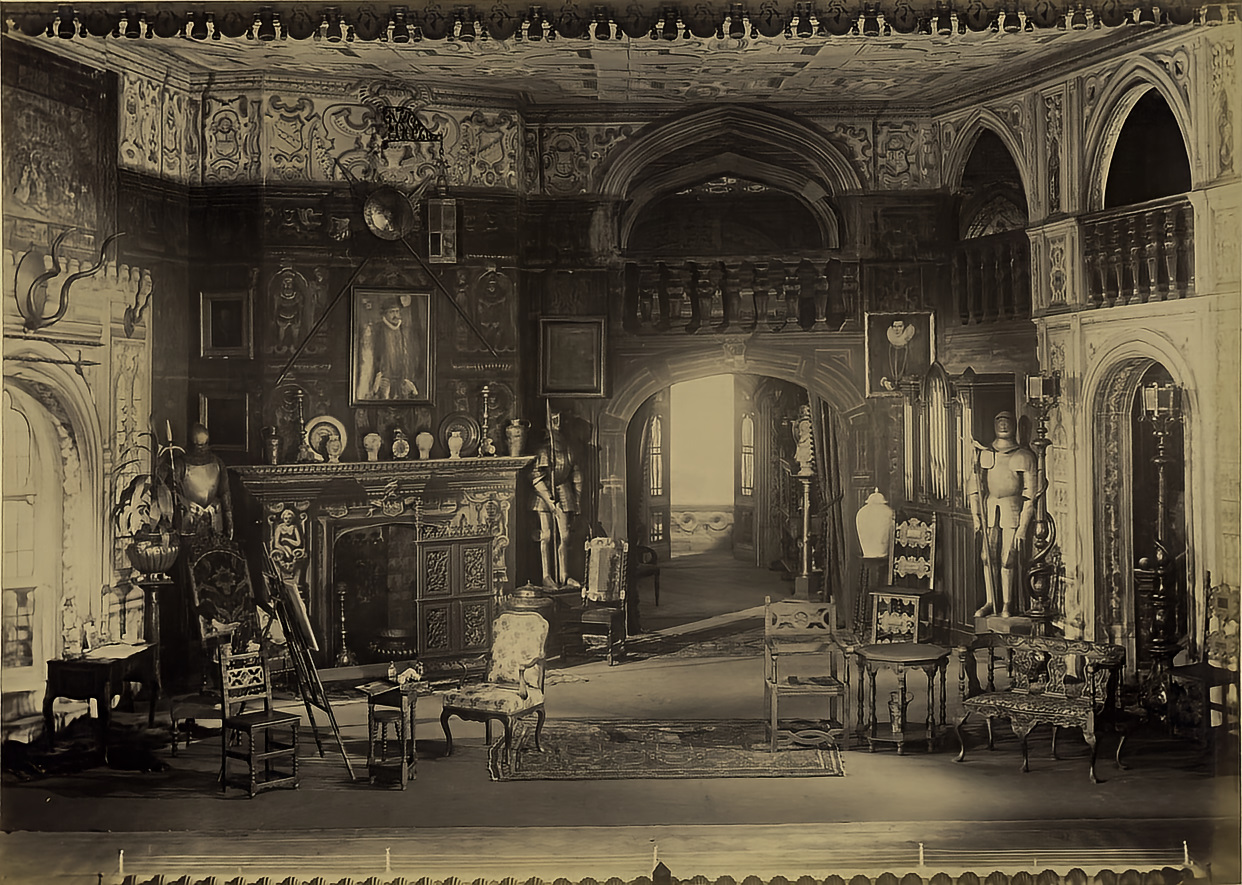 Act I - Chilworth (front view) (scenery by H.P. Hall) - JCW Scene Book 10 - Theatre Heritage Australia
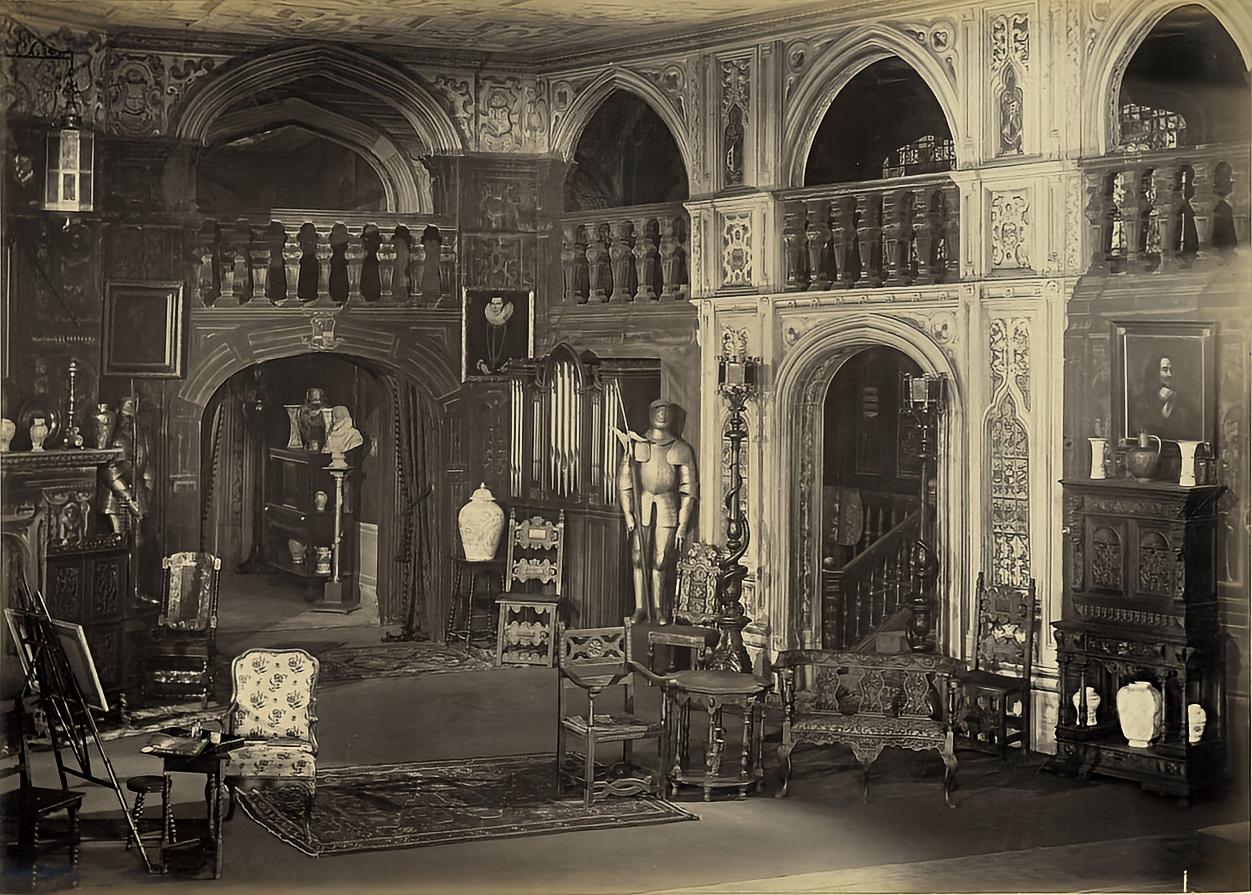 Act I - Chilworth (stage-left view) (scenery by H.P. Hall) - JCW Scene Book 10 - Theatre Heritage Australia
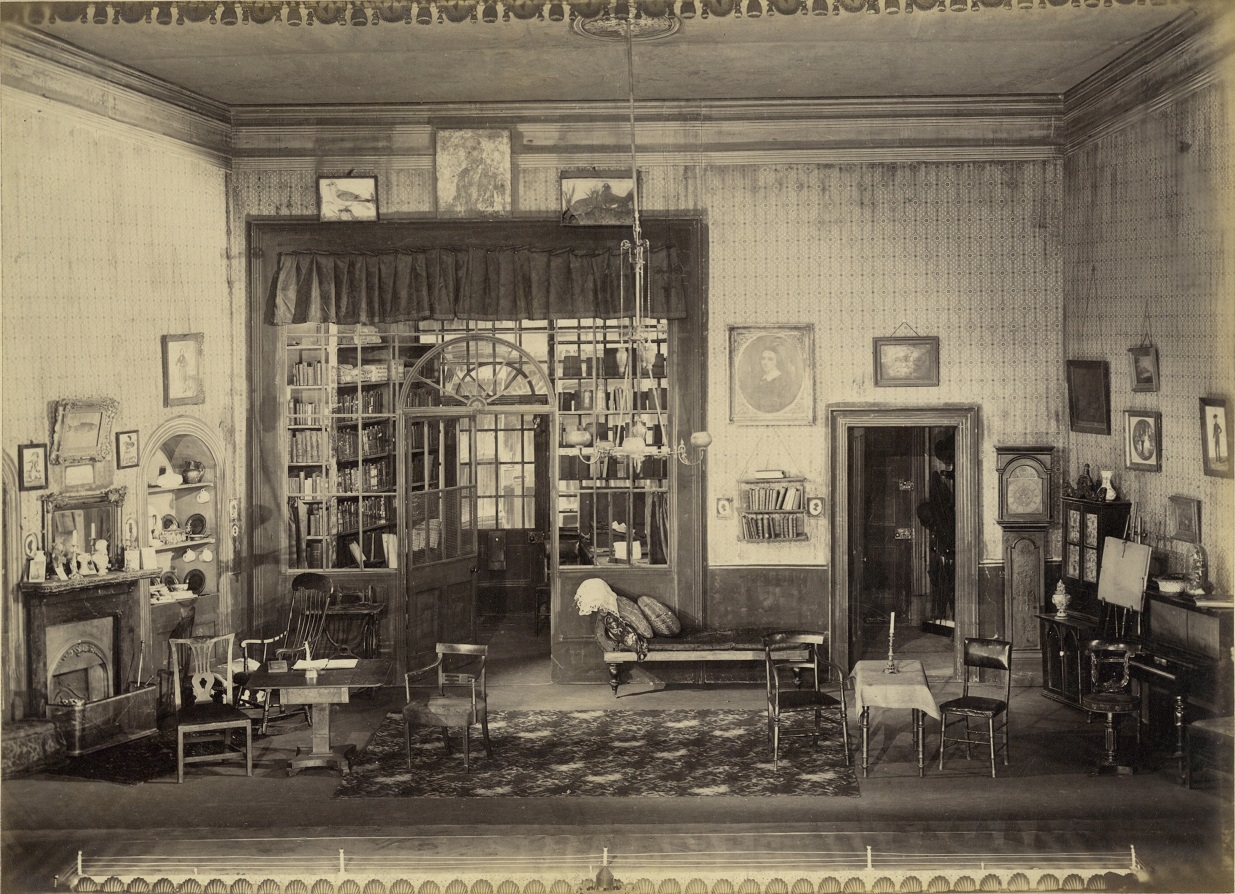 Act II, III & IV - Back Parlour of Mr. Todman's Shop, Cheepe St.., Bloomsbury, W.C. (scenery by H.P. Hall) - JCW Scene Book 10 - Theatre Heritage Australia
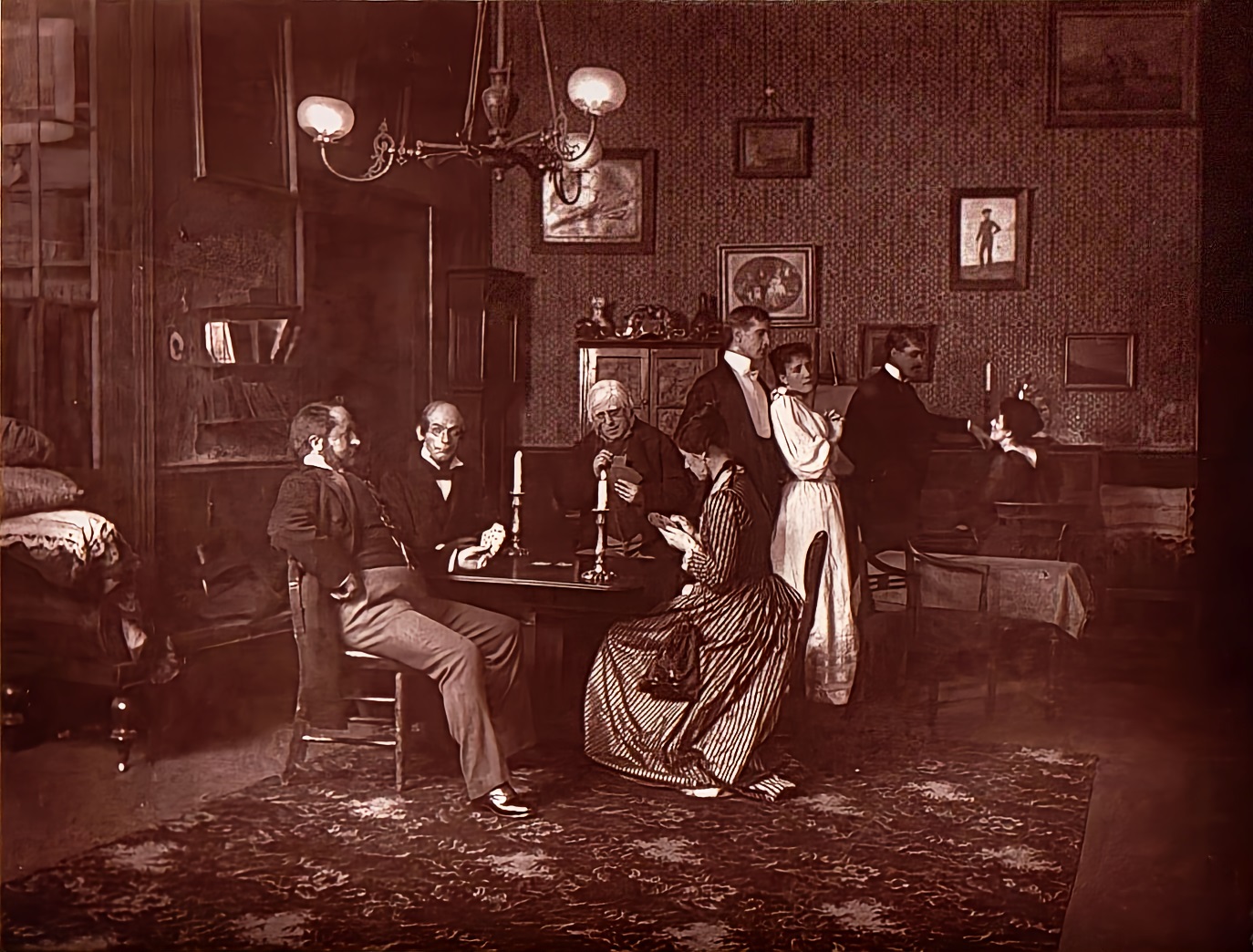
Scene in Mr. Todman's Back Parlour (photo by Alfred Ellis) - "The Theatre", February 1893 (Elisabeth Kumm collection)Sources:
A.E.W. Mason, Sir George Alexander and the St. James' Theatre [Macmillan & Co., London: 1935]
J.P. Wearing, The London Stage 1890-1899 : a calendar of productions, performers, and personnel, 2nd Edition [Lanham : Rowman & Littlefield: 2013]
Acknowledgements:
With grateful thanks to the curator and staff of the University of Bristol Theatre Collection for their assistance in providing the St. James's theatre programmes.
With thanks also to Rob Morrison for his assistance in the preparation of this article.


