Noel Murray
-
Women Photographers - 1900-1975 – but where is Jean?

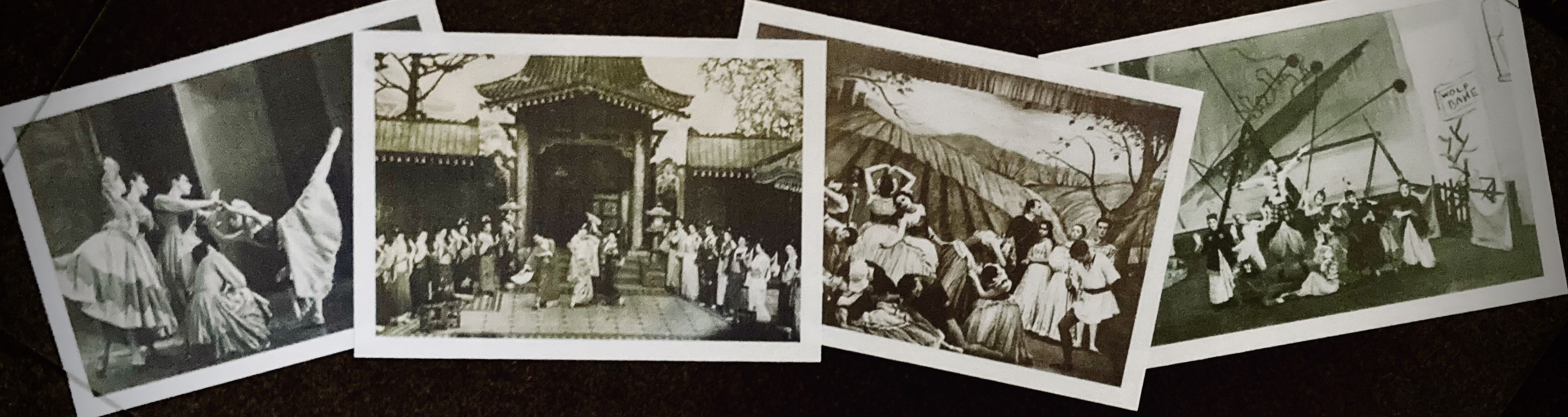 A radiologist by training, Jean Stewart was a passionate photographer of theatre and ballet in Melbourne from the 1940s. Her vast archive is now in the State Library Victoria, but her achievements are largely unrecognised. JUDY LEECH takes a look at the life and career of a remarkable woman who deserves to be remembered alongside Alice Mills and Olive Cotton.
There occurred earlier this year at the National Gallery of Victoria an exhibition entitled A Legacy of Light, which presented the diverse photographic practices of over eighty 20th century women artists—but where was Jean Stewart? The Moore sisters were featured, May and Mina, Ruth Hollick and Alice Mills, Olive Cotton, Sue Ford and Ponch Hawkes, plus a host of others, both national and international, but not a sign of Jean’s enormous contribution to our performing arts, now held in collections and published in numerous books and journals, here in Australia and in the UK. So—just who was this Jean Margaret Stewart … ?
The following I learnt from conversations with Jean over her last three years, during which we sorted, assembled and generally prepared a huge collection of her work for its journey to the State Library Victoria.
A victim of World War 1 mustard gas, Jean’s father was extremely strict about certain matters in the family—for example there was to be no talking at mealtimes—although reading was permitted—his wife and daughter were not to cut their hair—hair must be kept long … Jean remembered how he and a male friend laughed at the time and effort she regularly spent on her homework …
Jean was at school with one Avonna James, firstly at St. Michael’s in St. Kilda but was later transferred to St. Catherine’s in South Yarra at the wish of her grandparents, where it was hoped she would become ‘more lady-like, less tomboyish’. Through these grandparents, and inspired by their example, Jean and her mother began to regularly attend Gilbert and Sullivan performances at His Majesty’s Theatre in Exhibition Street. Her grandfather, Herbert Hooke, was a composer and director of amateur G&S in the late 1890s. (Piano scores for three of the operas, owned by him, plus some of his own musical compositions and newspaper cuttings from the 1890s have found their way into the SLV.)

G&S notebook relating to numbering of negatives
Author’s collection

G&S Opera Co.: Program, 1942
Author’s collection
After leaving school at eighteen, just before the outbreak of the 2nd World War, Jean applied and was accepted to work in the Melbourne Radiological Clinic in Collins Street. At the same time she took night classes in radiography and photography at RMIT, ending up as dux of both courses. Around this time, she had begun to print full-stage pictures—no doubt as part of her commitment to these courses and her now passionate interest in G&S. She had applied for permission to photograph the productions from her seat in the auditorium, she and her mother paying their way always. London’s G&S Opera Company had had a 6 month season here in 1940—in February 1942 they had returned. Jean, through her keenness and dedication, became acquainted with Claude Kingston, Garnett Carroll and the Tait families and was allowed backstage where she met many of the cast, including Viola Wilson—now Viola Tait—and Max Oldaker, Ivan Menzies, among others.

G&S Opera Co.: The Mikado
Jean Stewart collection

G&S Opera Co.: HMS Pinafore
Jean Stewart collection
Her old friend Avonna James had always studied ballet and was now a member of the newly formed Borovansky Ballet Company (she later joined the Ballet Guild). Through Avonna, Jean met and was accepted by Edouard Borovansky—he was happy to have her photograph his company—she made sure she never let him see any images revealing sickled feet or unacceptable arabesques! In the mid to late 40s and in addition to Borovansky’s seasons of ballet, his dancers performed in several light operettas, including Marinka, Gay Rosalinda and The Dancing Years.

Borovansky Ballet: Edna Busse in Coppelia, 1947
Jean Stewart collection

Borovansky Ballet: Edna Busse, Jonet Wilkie, Valda Jack, Mara North and Noel Murray in Capriccio Italien, 1946
Jean Stewart collection
A most notable member of his company was the dancer, choreographer and teacher Laurel Martyn. In 1940 she had joined the company after teaching for Jennie Brenan and when she was approached by the Melbourne Ballet Club in 1946 to establish a small local ballet company she left Borovansky and formed her own company—which would soon come to be known as Ballet Guild. Jean had become an enthusiastic follower and was appointed Stage Manager for the first ten years of the company’s existence. This was in addition to her ‘day job’: while she worked in Collins Street she would process and develop her films—of both ballet companies—after hours—on the quiet—and then rush them down to The Age at Newspaper House (also in Collins Street) and have the prints dried and glazed on their equipment. Frank Poole, ‘Pooley’, was a photo-retoucher with the paper and also a member of the Ballet Guild’s stage staff. He devised scrapbook after scrapbook which he, and later Jean, filled with photos, magazine articles and newspaper cuttings—right up until the 1970s. One of the first was of the Ballets Russes tours in the late 30s and early 40s.

Ballet Guild: Giselle, St. Patrick’s Hall, 1950
Jean Stewart collection

Ballet Guild: Marie Cumisky in Mathinna, 1954
Jean Stewart collection
The Guild’s original permanent home was St. Patrick’s Hall, the old Assembly Hall for the first Legislative Council in the mid-19th century. Situated at 470 Bourke Street, in 1957 the building was demolished and the company (and now also school) moved down the hill towards Elizabeth Street into a tall, narrow and not very accommodating building. St. Pat’s had ‘boasted’ a stage and quite adequate seating. There had been a studio at the rear and upstairs a teacher of ‘tap’, one Claire Miller. Many performances were given at St Pat’s – also at the Palais (‘Ballet at the Palais’ I can still hear Jean) in St. Kilda (in-between screening of movies), Melbourne University Union Theatre and Melbourne Little Theatre—now St. Martin’s. But the company’s first performance —four new ballets, Ballade,Contes Heraldiques,Dithyramb and Ruritaniana, all choreographed by Laurel Martyn—was at the Arrow Theatre in Middle Park, run/managed by Frank Thring Junior.

Jean Stewart (1940s)—helping with studio renovations
Author’s collection

Jean's notebook—Ballet Guild performances—1940s to 1950s
The Guild’s new venue in 1957 was far too small, quite unsuitable for performances, but by 1963 ‘new’ premises were found in Bouverie Street, Carlton, where the company remained until its demise in 1976.
But returning to 1947—when Australia was host to the UK’s Ballet Rambert tours, here for a matter of a few months—but which turned into fifteen. … Jean was there from the start—October 1947 at the Princess in Spring Street, and a year later at His Majesty’s, Exhibition Street, where she covered all the ballets and met, of course, all the members, some of whom were originally from Australia. Other members, Margaret Scott, Sally Gilmour and Joyce Graeme, etc. remained in Australia and went on to form or to join other companies—for example the National Theatre Ballet Company grew out of Ballet Rambert’s sojourn here, and also many years later, the Australian Ballet School under Margaret Scott, later Dame Margaret. (Ballet Rambert’s founder and director, Marie Rambert, was heard to refer to Jean as “that little gel from the Colonies” …)

Ballet Rambert: Peter and the Wolf, 1947
Jean Stewart collection

Ballet Rambert: Sally Gilmour and Walter Gore in Giselle, Act 1, 1947
Jean Stewart collection
Jean’s photos from these tours are now housed in the Ballet Rambert Archives in London. The archivist, Jane Pritchard, formerly dance curator at the Victoria & Albert, kept in touch with Jean for years.
In 1948, when Jean was 27, her father died, followed—a fortnight later—by the death of her maternal grandfather, Herbert Hooke. He and his wife Ethel had lived in Williams Road, Toorak, in a house called Merriool (Meryule?)—the original name of the Stewart family’s home in nearby Mathoura Road. This had been built in the ‘kitchen garden’ of No. 60—a big house now demolished—of a wealthy Jewish family. The wooden stables had been rebuilt by Jean’s father in brick and ultimately became a garage, workshop (later darkroom) and a shed for storing wood. The garden, maintained by a regular gardener, was referred to as ‘an absolute oasis’ by a close friend of Jean’s.
Meanwhile Jean continued to work full-time as a radiographer—shortly after the War she had worked out at Highett in aeronautical radiography. Then she was transferred to Heidelberg Repatriation, where she remained for 30 years. In 1986, at 65 years, she was obliged to retire. Her mother, with whom she had shared many interests and experiences, had died two months before Ash Wednesday in 1983, when their property by the sea—Eastern View—had perished. It did not take long for Jean to have the house rebuilt.

Jean’s camera
State Library Victoria, Melbourne

A fraction of Jean’s archives!
Jean never used a flash—she relied on the available lighting on stage. Photos were of actual performances or dress rehearsals, from the auditorium and from the wings. She favoured two cameras, a Leica and an Olympus. Film—120 or 35mm. The lighting at Melbourne Little Theatre became problematic and it was around this time, late 1950s, that Jean ceased to photograph quite as much or as often. She was processing and developing in her home darkroom by this time and in 1956 spent a year in the UK and Europe. On her return she continued her photo ‘hobby’—her subjects now landscapes, botanical studies, portraits and groups, and for decades and well into the 2000s, student and graduation photographs of the Australian Ballet School, an institution to which she left in her will, one and a half million dollars. Through this ‘social photography’ of hers she was the recipient of a huge collection of letters from grateful ‘sitters’ or subjects—from the likes of John Lanchbery, Tamara Tchinarova, Irina Baronova, Noel Pelly, Laurel Martyn and Viola Tait—to mention only a very, very few. All photographs and their negatives were meticulously recorded and labelled, boxed, filed and stored. She never missed a season of ballet or the opportunity to link up with like-minded balletomanes (or with dog-walkers and their ‘doggies in the park’!).
—Jean Stewart died on the 18August 2017, at the age of 95. The service to celebrate her life was held on the 7September in St. John’s Anglican Church in Toorak, a short walk from both her family home in Mathoura Road and that of her grandparents’ in Williams Road.

Jean Margaret Stewart, earlier this century
Sources
State Library Victoria—Jean Stewart video with narration by David McAllister
State Library Victoria—Jean Stewart collections of G&S, Borovansky, Ballet Guild and Ballet Rambert photos
State Library Victoria—Jean Stewart’s ballet photography (2016) by Susan Long (blog)
Australian Performing Arts Collection at Arts Centre Melbourne—scrapbooks and photos
Author’s collection of Jean’s photos, notebooks, correspondence and programmes
The Big Picture, 18 | October | 2017 | Blazenka Brysha


