Jerry Hart
-
Book Review: 'Jerry' Hart: Sex & Drugs & Gilbert & Sullivan

'Jerry' Hart Sex & Drugs & Gilbert & Sullivan: A Biography,by Brendan Kelly, Gaelforce Promotions, 236pp., ISBN 9780994624840, pb, $34.95
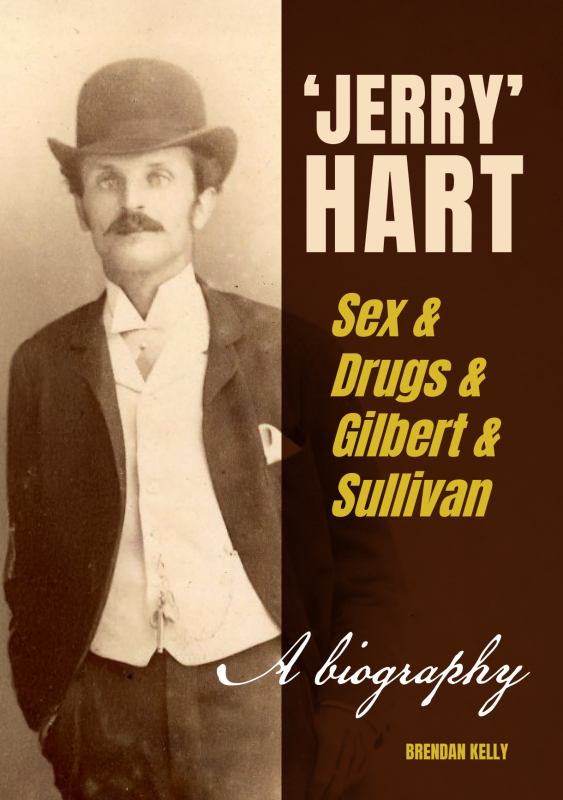
Every family has one—the relative who appears at every gathering, not invited yet never quite unwelcome. The aunty who talks with her mouth full and leaves a trail of crumbs behind her. The uncle who arrives with a hip flask and departs with mysteriously bulging pockets. The quiet cousin who becomes the roaring life of the party after a drink. Or the guest who thinks nothing of loudly farting in church or belching through the speeches. Now imagine all of these personalities rolled into one unconventional, loud, defiant and proud man, and you begin to approximate Francis Jerome Ernest ‘Jerry’ Hart. Hart occupies a distinctive place in Australia’s theatrical story. He is not a household name, yet Hart remains as one of those indispensable figures whose energy, adaptability and sheer persistence helped shape the theatrical landscape through the later decades of the nineteenth century.
One of the early paradoxes Kelly draws attention to is the divide between performing and being a performer. Performing, in the nineteenth century imagination, was a social accomplishment, evidence of refinement, education, and cultural fluency. It belonged to drawing rooms, salons, and polite society, a curated display of classical knowledge, musical ability, and conversational agility. Performing signalled one’s place within the upper tiers of respectability.
A performer, however, lived in an entirely different social category. Kelly’s description of them as “vagabonds, adventurers, effete types, stage door Johnnies, loose women and wobbly men” (p.20) captures the suspicion and fascination that surrounded theatre professionals admired for their daring but distrusted for their instability. They were destined to be treated as perpetual outsiders. Where performing was genteel, performers were itinerant, morally suspect, and economically precarious. This tension, society celebrating the art while rejecting the artist, echoes throughout Hart’s life, and Kelly emphasises it further through two adjunct chapters in which May Gibbs and George Anderson briefly share the stage with the Hart family, illustrating the porous boundaries between respectability and theatrical bohemia.
Hart arrived in Australia in 1878 expecting to be the master at Perth Boys High School, only to become the apprentice, quickly taking up a role with the Fremantle Herald. He drew on his classical education and social connections to pen articles that others avoided, and he used his freemasonry to open doors that his Jewish background might otherwise have kept closed. These networks fed his theatrical ambitions and gave him access to circles where performance was both a profession and a social currency. Yet his ego was never far from the surface, and Kelly does not shy away from Hart’s frequent brushes with the law or the moments where his appetite for life exceeded the boundaries of polite behaviour.
Throughout the 1880s Hart’s theatrical endeavours were broad and relentless. In 1884 he was elected Secretary of the Geraldton Musical Union, whose purpose was “the cultivation and improvement of musical taste” (p.49). Around the same time, a similarly talented Lilian Mitchell entered Hart’s orbit, sharing the stage and eventually marrying him in 1885. A daughter followed in 1886, adding the role of family man to Hart’s already crowded repertoire.
By 1888 the three Harts had outgrown Geraldton and were ready to take Perth by storm. Both ‘Jerry’ and Lilian quickly found work writing various columns. ‘Jerry’ also emerged as a tireless self‑promoter and patron of the arts, working across genres and formats, moving between actor, director, musician, and playwright, to name a few, but never settling into just one role. He was an energetic organiser and a born opportunist. No salon, amateur society, troupe, company or gathering was complete without Hart’s involvement, and he rarely missed a chance to place himself at the centre of the action.
The Fremantle Philharmonic Society’s inaugural performance in 1889 was conducted by none other than Hart. Never content, he wrote a steady stream of works, including Mixed Marriages (or A Matrimonial Muddle), which played in both Perth and Fremantle. His theatrical orbit widened further when he aligned himself with Mr P. B. Roachock’s troupe of Athletes and Gladiators, Boxers and Wrestlers, appearing in their shows as well as in benefit performances for the inmates of the Fremantle Lunatic Asylum and members of the Royal Perth Yacht Club. Within a few short years his name appeared on playbills for Boccaccio, Iolanthe, The Gondoliers, and The Magistrate. All evidence of a man determined to be everywhere at once, and usually succeeding.
By early 1894 Hart’s influence was at its peak. Governor William Robinson had invited a who’s who of Perth’s elite to the premier of The Handsome Ransom. Naturally Hart was not in attendance as audience; he was the librettist and lead actor. Kelly notes that once again Hart’s newspaper connections ensured favourable reviews, even if critics were less impressed. But with gold fever sweeping the colony, Hart’s attention drifted. His family and theatrical career became secondary to business interests. As quickly as the gold money arrived, it departed. Self‑medicating on life, alcohol, and other pharmaceuticals, Hart’s personal chaos became increasingly public. While Hart escaped Perth for London, his wife and daughter were left impoverished, creditors circling and investors fretting.
In London, Hart, relatively unknown but still unmistakable, acted as an unofficial emissary for Western Australia, often identified by his larrikin behaviour (p. 184). His family eventually joined him in an attempt at reconciliation. As in Perth, he dabbled with the theatre in between the next big thing. What had previously been shady behaviour was now simply criminal, an unredeemed decline in the Falstaff mould. Yet Hart returned to writing, the craft that had first given him purpose, before fading from public memory.
Kelly’s biography is the first consolidated attempt to capture Hart’s sprawling, unruly life. Scholars may find the referencing style and lack of an index frustrating. The reliance on contemporaneous newspaper reporting requires caution—salacious headlines were not always matched by rigorous research or independence, given some reporting came from Hart's own press connections. Kelly acknowledges these gaps, and given the nature of Hart’s larger-than-life personality some omissions are inevitable.
The book’s structure, comprised of short vignettes, reflects incidents or periods rather than a strict chronological narrative. Combined with Kelly’s accessible writing style, this makes the book highly readable. It is a gallant first effort to define the highs and lows of a personality who refused to live quietly. For scholars of early Australian theatre, particularly in Western Australia, it will be an invaluable reference. For those with a particular interest in Francis Jerome Ernest ‘Jerry’ Hart, it is essential reading.