Elsie Wiggins
-
Miss Elsie Wiggins: An Amazing Life (Part 1)
 This is the story of Elsie May Wiggins, stage name Grace Elton, married name Mrs Robert Harper; born in Riverstone NSW in 1882, and whose career in entertainment, theatre and moving pictures spanned some forty years in both Australia and overseas. In this two-part article, ROSEMARY PHILLIS and LES TOD shed light on a woman whose career is virtually forgotten.
Born in 1882, Elsie had a musical ability at an early age. Her family were not wealthy, but when she was only ten years old, Elsie attended Miss Maude Grace’s Private School. The name of her teacher would later become important in her musical career, for she would take this name as her stage name, Grace Elton. At a vocal and dance entertainment in 1892, when she was only ten years old, it was reported she opened the program with a pianoforte duet.1 What would become a lifelong love of music was underway, but much more was to come.
In 1897, at a concert and dance at the Oddfellow’s Hall in Riverstone when she was only 15, Elsie Wiggins played the overture as well as a pianoforte duet.2As early as 1898, Elsie had sat for music examinations and received Intermediate Honours in pianoforte with an Intermediate Pass in violin. In her later theatrical career, she would play up to 17 instruments, including cowbells, as well as sing. But her talents would not end there.

Elsie Wiggins, possibly around age 12
Wiggins Family photo

Elsie Wiggins, c.1901, aged around 19
Wiggins Family photo
In April 1899, a concert was held in Riverstone and said to be “The best local concert held here for some time past was under the efficient management of Miss Elsie Wiggins and was brought to a successful issue last Saturday night in the Oddfellow’s Hall.” 3 Her organisational abilities were now coming to the fore as well.
In August 1899 it was reported, “Miss Elsie Wiggins with her brother and Miss Sargent, attended the Oddfellow’s Ball on Wednesday night in Windsor and had a very enjoyable time. Miss Wiggins was attired in fancy costume, representing Home Rule and if the daughters of Old Erin only looked half as charming as the fair young dancer, there would be no fear of their not being instantly granted Home Rule in the Emerald Isle.” Which was quite a compliment to Elsie, who was only 17 at the time.4
The following month, the Windsor and Richmond Gazette reported on the establishment of the Riverstone Juvenile Variety Company by Elsie herself:
One of Riverstone’s most popular young ladies, Miss Elsie Wiggins, has organised a band of minstrels, with the object of giving periodical entertainments for the purpose of raising funds to assist those whom Fortune has dealt harshly with, or who have received rebuffs from the fickle goddess Fate.... Charity is an attribute that is not in every person’s nature, … charity is a jewel rare and precious. Miss Wiggins and her company of juveniles are to be commended for the work they have taken up. Their first entertainment was given in the Riverstone Temperance Hall on the 19th ultimo, and notwithstanding that the weather was very unpropitious, success attended the efforts of the promoters. The concert was certainly one of the best ever given there by juveniles … well staged and the characters admirably sustained … We must not forget to mention that Miss Elsie Wiggins was the musical director and proved herself an accomplished pianist …5
In October 1899, the Company gave a concert, and the Gazette reported: “Riverstone Juvenile Variety Company. The performance given in the School of Arts, Windsor, on Wednesday night by the Riverstone Juvenile Variety Company in aid of Mrs Chisholm of Windsor, was a decided success. Throughout the program was bright and original, everyone sustaining their different roles most creditably. We must not forget to compliment Miss Elsie Wiggins on the clever and business-like way she accompanied the vocalists on the piano.” 6 Elsie was now becoming known outside of her home town, Windsor being the most important town in the Hawkesbury district of far western Sydney.
A grand benefit entertainment was held in aid of Mr George Reece by the Juvenile Variety Co on Saturday January 6, 1900. Elsie Wiggins was reported to be the promoter and was to direct the musical arrangements at the concert. Not only was she garnering recognition for her musical abilities, but as the organiser as well.7
In September 1900 it was announced that Elsie had been appointed organist to St Paul’s Church in Riverstone. In her later years she would play the organ at this church, the parishioners probably unaware of her earlier career.8
It is remarkable that a formal presentation was given to Elsie Wiggins at Riverstone when she was only 19 years of age. An inscribed gold watch and an illuminated address were given in recognition of her charitable work for the district. The Gazette reported:
Some short time ago, a concert was organised by the residents of Riverstone for the purpose of raising funds to make a presentation to Miss Elsie Wiggins, in recognition of her untiring work in all cases of need in the district. For all the worry and the work this talented young lady has done since her school days in the cause of charity, she would never accept fee or reward, always doing the work as a labour of love. On some occasions known to the writer she has had only a few weeks to prepare ten or twelve juveniles for concerts, yet with her skill and indefatigable efforts she was always equal to the occasion, and has provided not only some of the most successful, but also some of the most enjoyable concerts ever held in Riverstone. The nett proceeds of the concert were ten guineas, which were presented to Miss Wiggins on Saturday night last in the form of a gold watch and chain and an illuminated address. On the inner case were inscribed the words: “Presented to Miss Wiggins by the residents of Riverstone”, and on the outer case the initials of the fair recipient were engraved. The presentation was made at a social evening which took place in the Oddfellow’s Hall, at which a program of enjoyable dances was gone through …
Mr J.H. Cragg, JP, who performed the ceremony, said that Miss Wiggins was a native of Riverstone, and had lived in the one house with her parents since they came to the district, which showed the family were not of a roaming disposition. Miss Wiggins got her education at Riverstone, and ever since she left school her time has been devoted to educating the younger ones in the musical world. He intimated that the presentation was scarcely enough to pay off the amount of gratitude they owed Miss Wiggins, but hoped she would receive the present from the residents of Riverstone as a token of their esteem and regard for her kindness …
Miss Wiggins responded gracefully and said “Mr Chairman, ladies and gentlemen, I beg most respectfully to thank you most sincerely for the kind words that you have spoken of me, and also for the gold watch and chain and illuminated address which you have so kindly presented me with. Whatever I have done for charitable causes, it has always been a pleasure to me to be able to do so. In conclusion I again thank you.”
The address, which was executed in a most artistic manner by Mr Davis, was as follows:
“Dear Miss Wiggins—We, the undersigned, on behalf of the residents of Riverstone and district, who have so frequently experienced your kindness and generosity in the organising and conducting of charitable concerts, desire to express our recognition of your kindly disposition and musical abilities. As a small token of our esteem and regard, we present you with the accompanying gold watch and chain and beg to assure you that your welfare will ever be an object of solicitude to us, and that you may enjoy many years of health and happiness in the fervent wish of yours sincerely—A.W. Studdy, J. Cragg, M.W. Grigor, Committee: I. McCarthy, E. Cragg, E.C. Bray, E. Leury, E. Morrison, L.A. McCarthy, M. Johnston, V.A. Vidler, E. McCutcheon.” 9
This type of presentation was normally only given to a person in their senior years, and that it was given to a 19-year-old woman is a testament to the esteem in which she was held. In hindsight, the remark that the family “were not of a roaming disposition” is amusing, for Elsie herself was about to prove that comment very wrong.
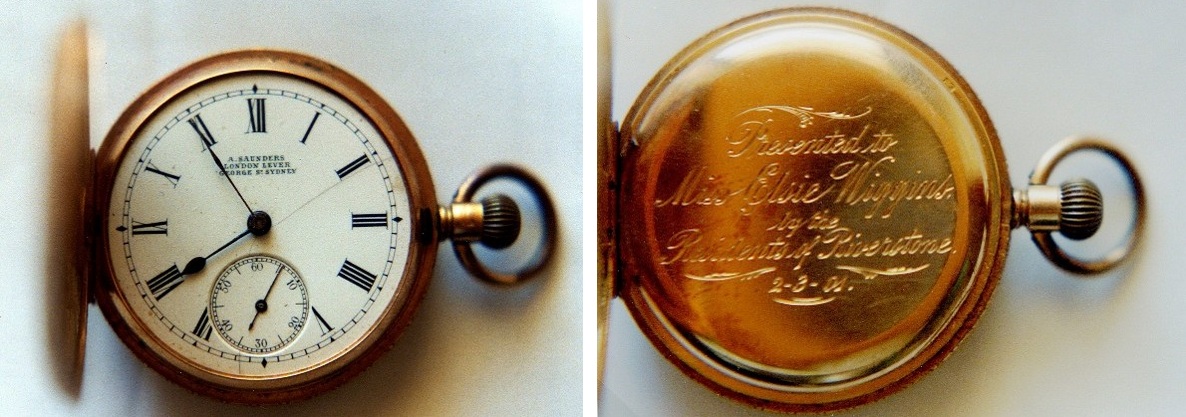 The gold watch presented to Elsie Wiggins in 1901. Photos by Clarrie Neal, Riverstone and District Historical Society.
In January 1904 the Riverstone Juveniles were at the Oddfellow’s Hall for the purpose of assisting the Riverstone Junior Cricket Club to raise funds to purchase equipment. “Miss Elsie Wiggins has prepared the little troupe for the entertainment and viewing this from former entertainments given by the juvenile under Miss Wiggins’ direction, it should be well worthy going miles to hear.”10
In April 1904 Elsie took her juvenile troupe on a picnic to Eastern Creek, then a bushland area: “There were a large number of children present and everything was studied for their enjoyment.” Elsie was always looking after others, an aspect of her character which would never change.11
That same year it was reported: “A grand juvenile entertainment is to be given in the Oddfellows Hall tomorrow evening. Miss Elsie Wiggins is the promoter and has an excellent program arranged. It is hoped there will be a bumper attendance.”12
Elsie, as Grace Elton, began touring country areas in June 1905. Whether the theatrical company sought out Elsie because of her reputation in the local newspapers is not known. She was now 23 years old and must have found the prospect of interstate and overseas travel enticing and exciting. Her parents must have recognised her talents to allow her such freedom, unusual for a single young woman of those times. All her life, Elsie would remain close to her family.
“Miss Elsie Wiggins has gone on a three-month tour to Queensland with a theatrical company. We wish the young lady success,”reported the Gazette in June 1905.13 Elsie had joined the Elton Comedy Company, a small touring theatrical and comedy group. It is unclear if the principal, Fred Elton, was actually her uncle or her cousin. It is doubtful that her family would have allowed her to go on such a venture with a man who was not a relative.
Also in June 1905, it was advertised that Elsie and Fred Elton were at the School of Arts, Casino, as part of Berkeley and Elton’s Dramatic and Comedy Co, with Elsie, now known as Grace Elton, as contralto. Why she took the stage name is not known. Perhaps it sounded more professional, or it was to stop tongues wagging about a single young woman touring with an older man.14
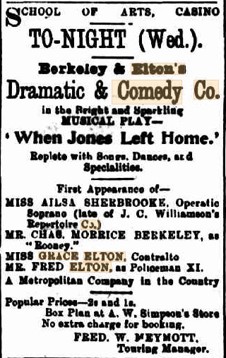 Casino and Kyogle Courier, Wednesday 14 June 1905
In July 1905 Grace and Fred were still part of the Berkeley and Eltons Dramatic and Comedy Co, performing at the Mechanics Institute, Maclean for two nights. They followed that with performances at Lawrence and Harwood, near Grafton.15


In August 1905 the company were at the Theatre Royal in Kempsey, again as Berkeley and Elton’s Musical Comedy Co.16 That same month it was reported that Grace was at the Raleigh Hall, to be followed by performances at Nambucca Heads and Bellingen.17 The company was certainly moving around the far north coast of NSW.
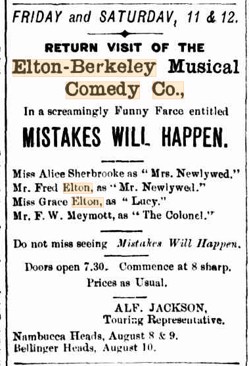 Raleigh Sun, Friday 4 August 1905
In September 1905 the Gazette commented “Miss Elsie Wiggins, who went away a few months ago as a pianiste to a travelling troupe of theatricals, returned home on Saturday. During her travels, Miss Wiggins visited Brisbane and all the important towns on the northern rivers.”18
Only a few months later, the Elton Comedy Company was playing Aberdeen, Scone and Muswellbrook, but not re-playing at Barraba, due to excessive rental charges there. (!)19 In June 1906 the company was in south-east Queensland at the School of Arts, Boonah.20
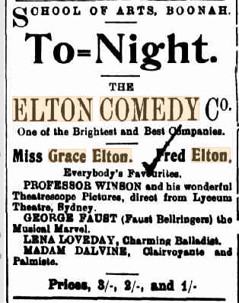 Fassifern Guardian, Saturday 23 June 1906
In 1906 it was commented that Fred Elton and his “merry little quintette, billed as the Elton Comedy Company, is marching north to Cairns and will play all North Queensland towns, returning to Sydney, and thence to New Zealand for a Christmas date. The latest and smallest addition to the company is Bertie Elton, aged four and a half years, a ‘comedian and dancer’, who is said to be a very clever little chap.”21 Another report states that the company was playing at Esk, Allora, Clifton and “other towns along the line to Sydney. The company includes Miss Elton, sketch artists, violinist, pianist and dancer.”22 These were places Elsie had probably never heard of, let alone thought she would play in.
December 1906 saw Elsie spending a short holiday with her parents, while her theatrical company rested in the city. She had started with the Maurice Berkley and Elton Company of Theatricals for the Philippine Islands some five months earlier and toured the whole of the Philippines, returning to Sydney the week before. “She speaks in glowing terms of the Islands, and of the treatment meted out to the members of the company during their visit there, and greatly enjoyed the trip. She expects to sail for New Zealand next week. Miss Wiggins brought home many curios from the islands.”22
In September 1907 it was reported that “The Fred Elton Comedy Co which has been doing good business in the Whangani district, are now doing the suburban halls around Auckland City”.23
In January 1908 Fred Elton’s Comedy Co and Bellringers featuring Grace Elton, “the most charming of actresses and player of 17 instruments”, were at Katoomba, Mt Victoria, Blackheath, Penrith, Windsor and Richmond.24 The last named three towns were very close to her home town of Riverstone.
Elsie took a step upwards when she was performing at the prestigious Melbourne Opera House for Harry Rickards’ New Tivoli Company in March 1908.25 Harry Rickards operated a vast vaudeville circuit, considered one of the best in Australia, and the Melbourne Opera House was one of the most important in that city.
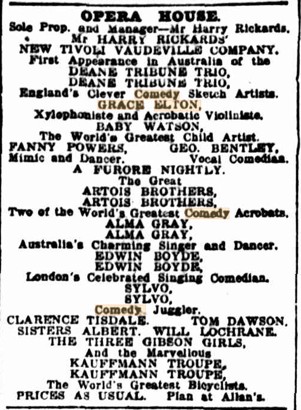 The Herald, Saturday 28 March 1908
Among Harry Rickards’ new artists for next Saturday is Miss Grace Elton, of the Fred Elton Comedy Co, who is aptly called “The Versatile”, for she is balladist, serio, comedy and dramatic sketch artists,“cap and gown” for cornet, violin and piano, besides playing nine other instruments. Her first turn at the Opera House is a musical one, playing eleven pieces of kauri wood, called a home made Xylophone, bellringing on ordinary cowbells, and a wonderful acrobatic violin performance, playing not only in the first, second and third positions, but also in ten others. Fred Elton (one time manager of Princess’ Theatre) went to Europe per SS Bremen last Tuesday in search of theatrical novelties for his new comedy company.26
Elsie was still performing there in April 1908.27

Rickards’ Opera House, Melbourne, where Elsie performed in 1908. The Melbourne Opera House was one of the city’s major theatres. It would later be known as the Tivoli.
Les Tod Collection
In August 1908 saw Fred and Elsie give a concert in the Oddfellow’s Hall in Riverstone. Fred must have returned from his overseas trip. The Gazette reported:
Miss Elsie Wiggins’ (Grace Elton) Concert. The arrival of the American Fleet and the departure of over 150 people from Riverstone last Saturday to view the celebrations seemed to have little effect on the size of the audience at the above concert, for the Oddfellow’s Hall was almost full, and from 8 till 10.30pm they were highly entertained by a unique comedy program and surprised beyond words to find it staged by two people only—Grace and Fred Elton... The program presented by these two versatile artists was a splendid one in song and story, jest and dance … The Riverstone lady is indeed a credit to her town—as an actress and singer, good; as a serio soubrette, excellent; and as a musician and player of 13 different instruments—including bells, xylophones etc—really wonderful, and in her acrobatic violin playing the audience were almost carried away with enthusiasm and vociferous applause greeted her every new move. Miss Wiggins should indeed have a great future before her, and with the humorous Fred Elton, already seems able to satisfy big audiences in big theatres in big towns. We wish them a successful New Zealand tour, which they have undertaken shortly for a second time, their first being almost a triumph.28
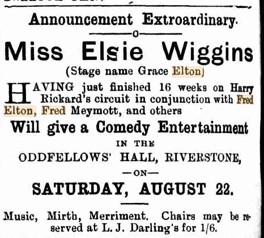 Windsor and Richmond Gazette, Saturday 15 August 1908
Moving Pictures were being shown by Elsie Wiggins and her brothers in Riverstone from around 1909, according to theatre historian, the late Kevin J. Cork. Elsie now had experience in show business as a member of Mr Elton’s travelling show, which featured both live performers and pictures. There is a reference in the Gazette, 17 April 1909, for the Grace Elton Comedy Company [Miss Elsie Wiggins] appearing at the Windsor School of Arts. 29
Kevin Cork wrote that the hall seated about 150, was of weatherboard construction and had a galvanised iron roof. Its interior was unlined and there was a supper room attached to one side of the building. This room became the engine room where a French De Dion motor chugged away to generate power for the hand projector and the hall lights. The projector was housed in an operating box which the Wiggins family built above the front entrance door, on the inside of the hall. Elsie Wiggins accompanied the silent films on the piano whilst Alf, Bert and Bill Wiggins, at various times, cranked the projector. A person was employed to walk the streets, ring a bell and shout ”Pictures Tonight” The films came by train from Sydney and as Bert Wiggins recalled in 1981, westerns were extremely popular.30
January 1909 saw Elsie back in New Zealand where it was commented that “Fred Elton was doing remarkably well in Maoriland, and that Grace Elton, actress, serio, dancer, musician and balladist is proving a draw.”31 Elsie was proving so much of a draw that the name of the company was now Grace Elton’s Comedy Co.
In October 1909, the Grace Elton Comedy Co were performing at Taylor’s Hall in Queenstown, Tasmania [formerly the Academy of Music, but little more than a wooden shed]. This was followed by Gormanston, Linda, Strahan, Zeehan.32
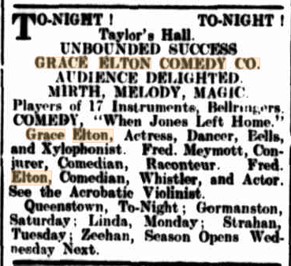 Zeehan and Dundas Herald, Friday 29 October 1909
It was around this time while touring in Tasmania, that the Eltons encountered Frank Thring, a young man starting out as an exhibitor of travelling silent pictures, using the title “World’s Pictures”. Sometimes he used the title “Will’s Pictures” (his middle name). Thring and the Eltons joined forces to provide moving pictures as part of the Eltons’ variety act, and this continued to Launceston later that month. We don’t know how long Thring and the Eltons were together—it may have been only a few months. Frank Thring would later become more than an exhibitor—he helped to establish the massive Hoyts Theatre company and build a chain of magnificent Regent Theatres in capital cities. He then resigned from Hoyts and began making his own independent films in the 1930s until his death in 1936.
There can be no doubt that the Eltons’ experience with Frank Thring and his films influenced them into introducing silent biograph films into their act, and in late 1910, even opening a cinema in Launceston. This experience would also later influence the astute Elsie into purchasing land in Riverstone on which she would later build a picture theatre, the Olympia.
In November 1909, The Eltons were performing at Zeehan’s large Gaiety Theatre, along with The World’s Pictures, provided by Frank Thring. 33
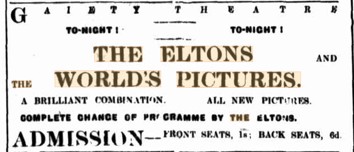 Zeehan and Dundas Herald, Friday 5 November 1909, p.1
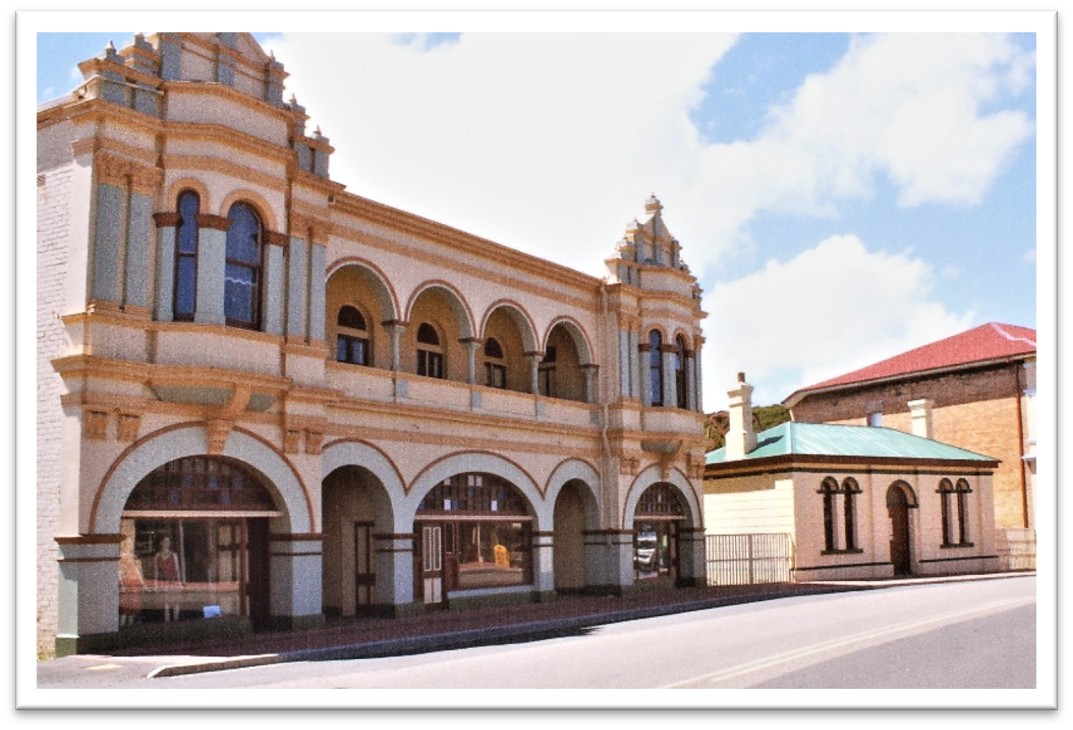 The huge Gaiety Theatre at Zeehan was built during the gold rush days, and included a hotel at the upper front section. The theatre has been restored and is still in use today. Image: courtesy Mike Trickett, Cinema and Theatre Historical Society Inc.
After Zeehan, Elsie and Fred were performing at the Empire Theatre in Launceston in November 1909, with Elsie billed as the Musical Marvel. 34 They were still at the Empire in January 1910.35
The Eltons finished their tour of Tasmania in February 1910 at the Empire Theatre, and returned to Sydney in March, but only for a few months respite before returning again to Tasmania.
“Miss Elsie Wiggins, of Riverstone, returned from Tasmania on Saturday after a very successful tour with her company. Miss Wiggins announces in this issue that she will open a skating rink in Riverstone at 10.30am on Monday.”36 The rink was actually in the Oddfellow’s Hall, and advertised three sessions daily. Skating was enjoying a resurgence in popularity and Elsie obviously decided to expand her interests, as she would some years later when moving pictures became more popular.
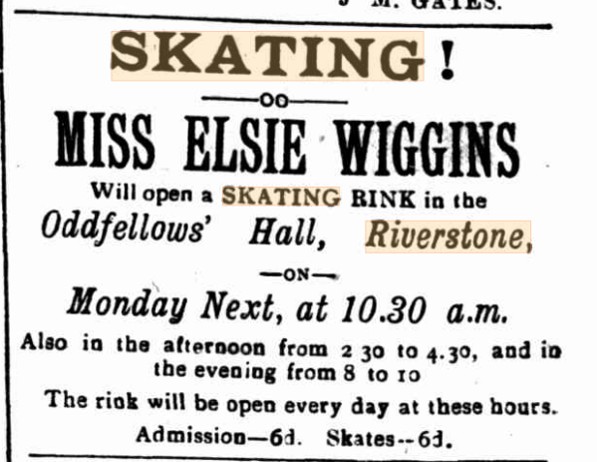 Windsor and Richmond Gazette, Saturday 19 March 1910
In August 1910 she and Fred were running their circuit back in Tasmania, including Ulverstone, Latrobe, Devonport, with New Pictures and Specialties Weekly. Tasmania would have been cold, even freezing, with snow at that time of year.
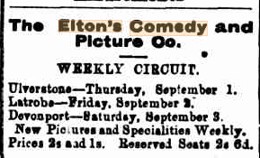 North West Post, Wednesday 31 August 1910
By September 1910 she was still touring the little towns of Tasmania as the “Marvellous Elton’s” accompanied by Elton’s flickerless Peerless Pictures and Graceful Grace Elton, musical marvel. The towns included Devonport, Penguin, Burnie, Wynyard, Stanley and Smithtown.37 Note that the show now included moving pictures, something which would take Elsie’s attention more and more as its popularity increased.
In September 1910 it was remarked “The Elton Comedy Co is shaking Tasmania to its previous foundations. The company, which includes Fred and Grace Elton, and some moving pictures, is cruising from town to town in two motor cars.”38
On Tuesday, 4 October 1910, the Eltons opened their own open air theatre, called Elton’s Garden Theatre, in Launceston’s Cameron Street park.39Probably influenced by Frank Thring and his World Pictures, they were now moving into the moving picture field but retaining vaudeville as well. It was stated there would be a constant change of vaudeville and the latest pictures:
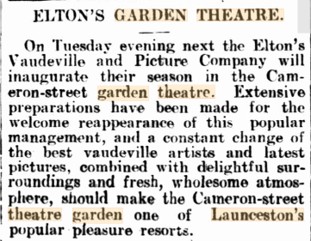 Daily Telegraph, Saturday 1 October 1910, p.4
In October 1910 at the Garden Theatre, vaudeville was still the main attraction, although Elton’s Pictures were also on the program. It was stated that “Miss Grace Elton was, as usual, heartily encored for her performances on a great variety of musical instruments.” It added that there was an excellent attendance at the matinee—this is peculiar, as films in those days could not be shown in daylight. Perhaps they were using a marquee.40
In January 1911 Messrs Elton and Sculthorpe filmed scenes of Launceston, and these were shown at the Garden Theatre a few nights later. Some 1,000 people attended, probably wanting to see the novelty of themselves or others on the screen.41 This was a common novelty of picture show proprietors in order to boost attendances at their shows. The Garden Theatre at Launceston may have been doing good business, but the approach of the colder months would mean as an open air venue, it would have to close.
Elsie was performing with Fred at the Elton’s Garden Theatre, with the slogan “Elton Means Excellence” in mid-January 1911.42 They were still at that venue at the end of the month.43
In March 1911, Fred Elton was back in Sydney, managing the Standard Theatre in Castlereagh Street. One of the acts was “The Eltons in comedy, ‘Jones and Son’”. Elsie had usually been part of that comedy. At the end of the advertisement it states “Invitation to all poor children, with card from school-master or clergy, Deaf and Dumb Asylum, and Sobraon Boys.” Presumably this was for free admission.
By August 1911 Elsie was performing at Hatte’s Picture Palace, with a continuous show and a musical program by Grace Elton. The advertisement allowed admission by half price.45 Hatte’s Picture Palace was an unsuccessful venture in Hatte’s Arcade in King Street, Newtown, poorly patronised and poorly located, which would explain the admission by half price. It was used both for silent pictures and live performance but only had a short life.
On the move again, in September 1911, Grace was in Bathurst, at the School of Arts, now advertising as “her company”, giving a benefit to her cousin, Claude O’Dea. Why Mr O’Dea needed a benefit is not known.46 Her brother Oswald was also performing. It was stated that Mr O’Dea had been bedridden for a long time and the proceeds would help purchase a wheel bed so that he might be able to inhale the fresh air and bask in the sunshine.47
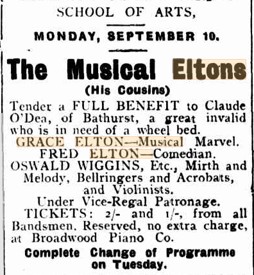 National Advocate, Friday 15 September 1911
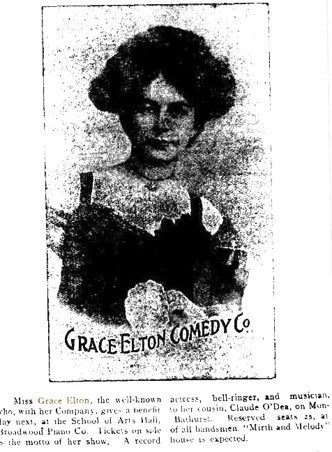 National Advocate, Saturday, 16 September 1911
In June 1912, the Eltons were in Wellington, New Zealand: “Fred Elton writes from Wellington (New Zealand) in connection with the Grace Elton Comedy Company: “We are returning to Sydney from New Zealand after a successful tour of eight months. We go to South Australia and Broken Hill. We have now played before three Governors, so are under vice-regal patronage.”48
The following month finds Grace and Fred at Wellington NSW in the Oddfellows Hall:
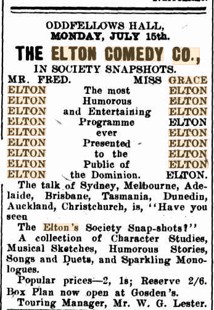 Wellington Times, Thursday 11 July 1912
A few weeks later, they were at the Stadium Picture Theatre in Cobar, far western NSW:
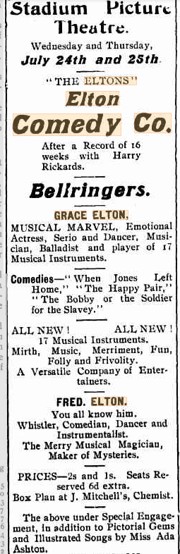 Cobar Herald, Tuesday 23 July 1912
In August 1912 Elsie performed at the Protestant Hall in Dubbo: “Startling Theatrical News! Grace Elton Comedy Co … Grace Elton, the most beautiful and versatile of all the actresses, player of 17 instruments.”49 The Protestant Hall in Dubbo later became the Roxy Theatre and the building still stands, albeit as retail and offices.
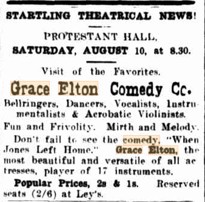 Dubbo Liberal, Friday 9 August 1912
In September that year, it was reported that a six-room house was being built at 31 Mill Street, Riverstone, for Miss E. Wiggins. Elsie may have been travelling, but obviously believed that she needed to have a home of her own and that it would be in Riverstone. Her business acumen has to be admired. 50
In November 1912 the Gazette reported that Elsie was opening a picture show in Riverstone: “The Elton Company are starting a picture show in Riverstone, commencing this Saturday night. They will show regularly in the old Temperance Hall, which has been renovated and enlarged.”51
In February 1913 the Grace Elton Comedy Co, with Grace Elton, “the most beautiful and versatile actress”, were at the Centennial Hall at Moss Vale.52
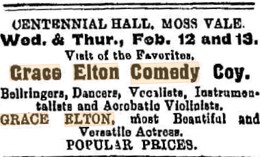 Scrutineer and Berrima District Press, Saturday 8 February 1913
By July 1913 Grace and Fred were back on the road, this time at the Walhalla Hall in Toowoomba. The advertisement is somewhat of a puzzle:
The Eltons at Walhalla Hall. Many old playgoers will remember the late Billy Elton, leading comedian with J.C. Williamson for over 10 years, and his nephew and niece (Fred and Grace) with the above company, carry on his humour with, it is said, just as much vivacity and mirth. A Comedy Company—dancers, vocalists, players of 17 instruments, Bellringers, Comedians and Acrobatic Violinists—they are indeed a versatile combination. In conjunction with Cook’s Pictures, they appear next Saturday and Monday …53
Grace [Elsie] is said to have been Billy Elton’s niece. This raises the question of just who Fred Elton was—possibly her cousin? Her uncle? Her maiden name was Wiggins but she took the stage name of Elton, possibly to ensure there were no whispers concerning her respectability.
In July 1913 Elsie was performing in Dalby, Qld, with “The Elton Comedy Concert Co, featuring Grace Elton, Musical Marvel, Player of 17 Instruments. Lady Champion Xylophonist and Fred Elton, Actor, Whistler, Dancer, Comedian and Female Impersonator. Surprisingly, also on the program was Ossie Wiggin, “Silvery Voiced Tenor”. Ossie was Elsie’s brother.54
August 1913 finds the company at Cook’s New Palace Theatre in Fortitude Valley, Brisbane, advertised as the first appearance of the Elton Comedy Co and featuring Grace Elton and Ossie Wiggins.55
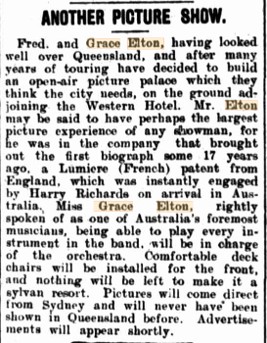 Toowoomba Chronicle, Saturday 20 September 1913, p.6
In September 1913 it was reported that Fred and Grace had opened their own picture palace in Toowoomba, known as Elton’s Variety and Pictures. The theatre—an open air show—opened on Saturday 18 October 1913. The Chronicle reported “Elton’s Variety and Pictures. A Bright Entertainment. Elton’s Elite Picture Gardens, which received such an instantaneous success on Saturday night, was again patronised by a large audience last evening. … Miss Grace Elton, who has already established herself a firm favourite with her refined musical act, supported by Mr Fred Elton (who supplies the comic element) proved the gem of the evening …” 56
Of the opening night, it was reported:
Eltons’ Variety and Pictures—a Packed House. It is something novel for local pleasure seekers to be able to sit in the open air and witness an entertainment such as was afforded them on opening on Saturday night of Elton’s Elite Variety and Picture Garden. It must have been most gratifying to the management, who have spared neither expense nor efforts for the consideration of the comfort for patrons, who responded most liberally. The audience was a very large one, in which the gentler sex were much in evidence, and despite the extensive seating accommodation, comprising 100 deck or verandah chairs (overshadowing ordinary seating for comfort) 200 American tip up chairs and a gallery with a seating capacity for 450, standing room was only available. A special feature which appealed to all was the clear and unobstructed view of the stage obtainable from any part of the structure. On entering the first thing that strikes one is the excellent appointments, the fine stage, with its pleasing garden effects, palms of variety … The musical arrangements are under the direction of Miss Grace Elton, whose wide knowledge of music enables every justice to be done to this most important part of the program. The moving picture machine is of the latest and most modern type … In the variety party of the program a number of artists appeared. These were headed by Miss Grace Elton, whose musical ability acted as a most pleasing tome to the large audience. This talented lady plays almost any instrument, which are altogether too numerous to describe, and the number of difficult positions in which she plays the piano is really amazing. At the end of every item Miss Elton was loudly applauded, and deservedly so, as hers was the star feature of the evening… 57
A few weeks later, in October,
A new bill is presented at the above garden theatre tonight. A half brother, or double one (“Carl”) a bicycle equilibrist, makes his appearance tonight … Grace Elton appears in new turns, and Bert Edwardes in new comicalities … In these prosaic times one can hardly imagine a pleasanter way of spending an evening than in a deck chair, a pipe well underway, in gorgeous surroundings, taking the Elton’s first class entertainment in style and comfort. The management desire it known that they are always willing to give benefit performances, for any local charity in need of funds, and from their sacred concerts held on Sundays, will donate a percentage to the hospital. The Garden Theatre is commended to all playgoers. 58
Grace [Elsie] was also prepared to earn some money on the side by teaching music:
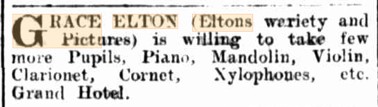 Toowoomba Chronicle, Tuesday 28 October 1913, p.1
The Windsor and Richmond Gazette often followed Elsie’s career as she moved around Australia and New Zealand. In January 1914 it reported:
No doubt the Riverstone public will be pleased to hear that Mr Fred Elton is recovering after a serious operation, which has incapacitated him for some weeks in the Dalby Hospital, Queensland. Miss Elsie Wiggins, better known in the theatrical world as Grace Elton, has been leading the orchestra at the Elite Picture Gardens, Toowoomba, which Mr Elton started on their Queensland tour. Mr Elton and Miss Wiggins for some time past have had their passages booked for England … they expect to sail on February 11… Miss Wiggins and Mr Elton are to start on the Moss and Stoll tour of England and we feel sure that Miss Wiggins, with her great talents, will make a big name for herself. 59
Moss and Stoll was a major British theatrical company, much like J.C. Williamson’s in Australia.
In May 1914 the Gazette reported “From Cairo, Egypt, we have received a mail message from Mr Fred Elton and Grace Elton (Miss Elsie Wiggins). They have been appearing at the Casino de Paris, and were billed as the Australian Eltons, musical artists, and have met with much success.” 60 In those times, because of the lengthy sea voyages, it was quite normal for theatrical companies to spend a few days in Cairo, and performing there.
By October 1915 Elsie was back in her home town:“Miss Elsie Wiggins, after a lengthy tour of many parts of the world, arrived home by HMS Osterley a few weeks ago. Miss Wiggins (piano) and Miss Elvie Rothsay (violiniste of Sydney] will play at the Elect Pictures every three nights.” 61The Elect Pictures were in a local hall at Riverstone.
In 1916 some locals were startled when it was reported that “Miss Elsie Wiggins has bought from Mrs Aird, that block of land next door to Skinner’s Shop and intends building a very up to date picture theatre. The land has a frontage to the main business street of 45 feet with a depth of 180 ft.” 62
Again, Elsie’s business acumen comes to the fore. She had already built a house in Mill Street, and now acquired land in the main street of Riverstone for a theatre. No doubt she had been influenced by what she had seen in the rising popularity of moving pictures and her association with Frank Thring. But Elsie did not actually build her new theatre until 1920, after her marriage to Robert Harper.
In May 1916, the death of Fred Elton was reported:
Many Riverstone people will be sorry to hear of the death of Mr Fred Elton, the well known comedian, which took place in Allasio on the 24th February last. The remains were cremated in Genoa (Italy). Mr Elton and Miss Elsie Wiggins practically toured the world as theatricals, and were travelling round for ten years. The late Mr Elton was a great helper in charity, and in every boat trip he and Miss Wiggins gave a concert for the Seamen’s Orphanage Fund, and up to the last concert, on the way to England, the total proceeds amounted to the respectable sum of £425/6s 6d. The deceased was 51 years of age, and had suffered ill health for many years. 63
Fred’s death explains why Elsie [Grace] was performing and living in Toowoomba by herself for the next few years. But why he had chosen to go to Italy is not known.
To be continued...
Endnotes
1. Windsor and Richmond Gazette, Saturday 17 December 1892
2. Ibid. Saturday 28 August 1897
3. Ibid. Saturday 22 April 1899
4. Ibid. Saturday 5 August 1899
5. Ibid. Saturday 2 September 1899
6. Ibid. Saturday 28 October 1899
7. Ibid. Saturday 30 December 1899
8. Ibid. Saturday 8 September 1900
9. Ibid. Saturday 9 March 1901
10. Ibid. Saturday 9 January 1904
11. Ibid. Saturday 16 April 1904
12. Hawkesbury Herald, Friday 29 April 1904
13.Windsor and Richmond Gazette, Saturday 24 June 1905
14. Casino and Kyogle Courier, Wednesday 14 June 1905
15. Clarence River Advocate, Tuesday 4 July 1905
16. Macleay Chronicle, Thursday 3 August 1905
17. Raleigh Sun, Friday 4 August 1905
18. Windsor and Richmond Gazette, Saturday 2 September 1905
19. The Sydney Morning Herald, Saturday 18 November 1905
20. Fassifern Guardian, Saturday 23 June 1906
21. Brisbane Courier, Saturday 4 August 1906
22. Windsor and Richmond Gazette, Saturday 15 December 1906
23. The Theatre, Vol. 5, No .10, 2 September 1907
24.The Sydney Morning Herald, Saturday 25 January 1908
25.The Herald, Saturday 28 March 1908
26. Punch, Thursday 26 March 1908
27. Ibid. Thursday 2 April 1908
28. Windsor and Richmond Gazette, Saturday 29 August 1908
29. Kevin J. Cork, “Riverstone Picture Shows, Part 1”, Blacktown and District Historical Society Journal, Summer 1995, Vol. 15, No. 1.
30. Ibid.
31. Referee, Wednesday 20 January 1909, p.12
32. Zeehan and Dundas Herald, Friday 29 October 1909
33. Ibid. Friday 5 November 1909 p1. See also “Movie Mogul Thring: The Early Years, Part 2” by David Coles, article in CinemaRecord, September 2025, No 127. Journal of the Cinema and Theatre Historical Society, Inc.
34. Launceston Examiner, Saturday 20 November 1909
35.Ibid. Monday 10 January 1910
36. Windsor and Richmond Gazette, Saturday 19 March 1910
37. North West Advocate, Saturday 10 September 1910
38. Punch, Thursday 29 September 1910
39. Daily Telegraph, Saturday 1 October 1910
40. The Examiner, Monday 24 October 1910
41. Daily Telegraph, Thursday 12 January 1911
42. The Examiner, Friday 13 January 1911
43. Ibid. Wednesday 25 January 1911
44. Daily Telegraph, Saturday 11 March 1911
45. Ibid. Wednesday 9 November 1911
46. National Advocate, Saturday 16 September 1911
47. Ibid. Wednesday 13 September 1911 p2
48. Referee, Wednesday 26 June 1912
49. Dubbo Liberal, Friday 9 August 1912
50. Windsor and Richmond Gazette, Saturday 28 September 1912
51. Ibid. Saturday 9 November 1912
52. Scrutineer and Berrima District Press, Saturday 8 February 1913
53. Toowoomba Chronicle, Friday 18 July 1913
54. Dalby Herald, Wednesday 23 July 1913
55. Daily Standard, Friday 15 August 1913
56. Toowoomba Chronicle, Tuesday 21 October 1913, p.6
57. Ibid. Monday 20 October 1913
58. Ibid. Wednesday 22 October 1913
59. Windsor and Richmond Gazette, Friday 30 January 1914
60. Ibid. Friday 8 May 1914
61. Ibid. Friday 22 October 1915
62. Ibid. Friday 21 April 1916
63. Ibid. Friday 5 May 1916
Acknowledgements
Trove newspapers of the National Library, which enables researchers to follow a person’s career through newspapers; Riverstone and District Historical Society, Clarrie Neal and Alan Strachan, The Wiggins Family of Riverstone; the late Kevin J Cork; “Movie Mogul Thring: The Early Years, Part 2” by David Coles, article in CinemaRecord, journal of the Cinema and Theatre Historical Society, Inc; Mr John Hanna; State Archives of NSW, divorce papers and Probate records; National Archives of Australia; and The Les Tod Theatre Collection.
Rosemary Phillis is the Secretary of the Riverstone and District Historical Society, and Les Tod OAM is a theatre researcher and author of several books on Australian theatre and cinema history.
-
Miss Elsie Wiggins: An Amazing Life (Part 2)
 In Part 2, ROSEMARY PHILLIS and LES TOD conclude their look at the life and career of Elsie May Wiggins, stage name Grace Elton, married name Mrs Robert Harper, whose career in entertainment, theatre and moving pictures spanned some forty years in both Australia and overseas.
In July 1916, Grace Elton was back performing at the Elite Theatre in Toowoomba.1
By August the following month, Grace [Elsie] is at the prestigious Strand Theatre in Toowoomba, which was under the direction of the famous [or infamous] Senora Spencer, where it was advertised “Special Engagement of Miss Grace Elton as Musical Directress”.2 Elsie was now associated with yet another famous theatre entrepreneur and lady projectionist, Senora Spencer, and there is little doubt that she learnt from the good Senora, as she had done with Harry Rickards and Frank Thring.
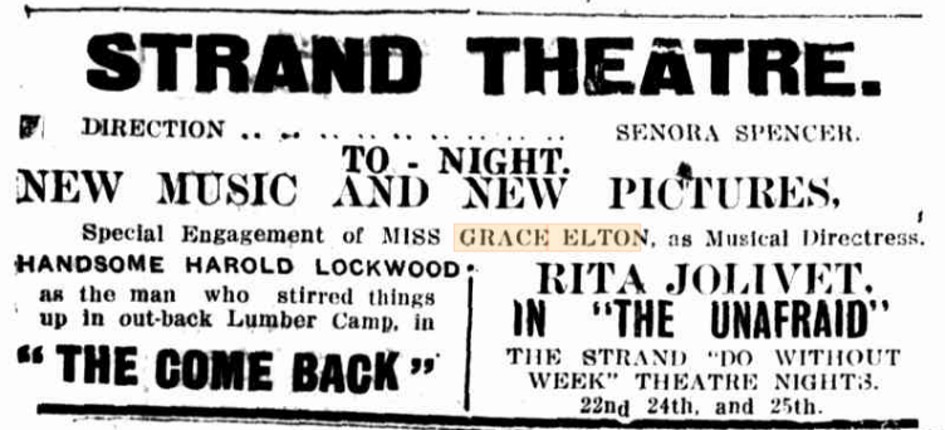 Darling Downs Gazette, 22 August 1916
A musical directress would be a person responsible for selecting the type of appropriate music to be played with the silent pictures. Most theatres of that era had only a pianist, but the bigger shows had small orchestras, even in country towns. Elsie would have been perfect in the role of selecting the music and the instruments to be used, scene by scene.
Senora Spencer—real name Mary Stuart Huntly, had married one of Australia’s first cinema moguls, Cosens Spencer. He took a lease of Sydney’s Lyceum Theatre and his wife became well known as Australia’s first female projectionist, being an attraction in herself. Cosens established a touring picture circuit, known as Spencer’s Pictures, which was extremely profitable as the popularity of moving pictures soared. Senora went on to control three Strand Theatres—Newcastle, Brisbane and Toowoomba, and her exotic sounding name always meant added publicity. After a court case involving their theatres, the Spencers moved to Canada where they bought a ranch around 1923. After shooting his foreman dead and injuring another, Cosens Spencer then drowned himself in a lake. At this point his wife, Senora Spencer aka Mary Stuart Huntly, disappears from theatre history.3
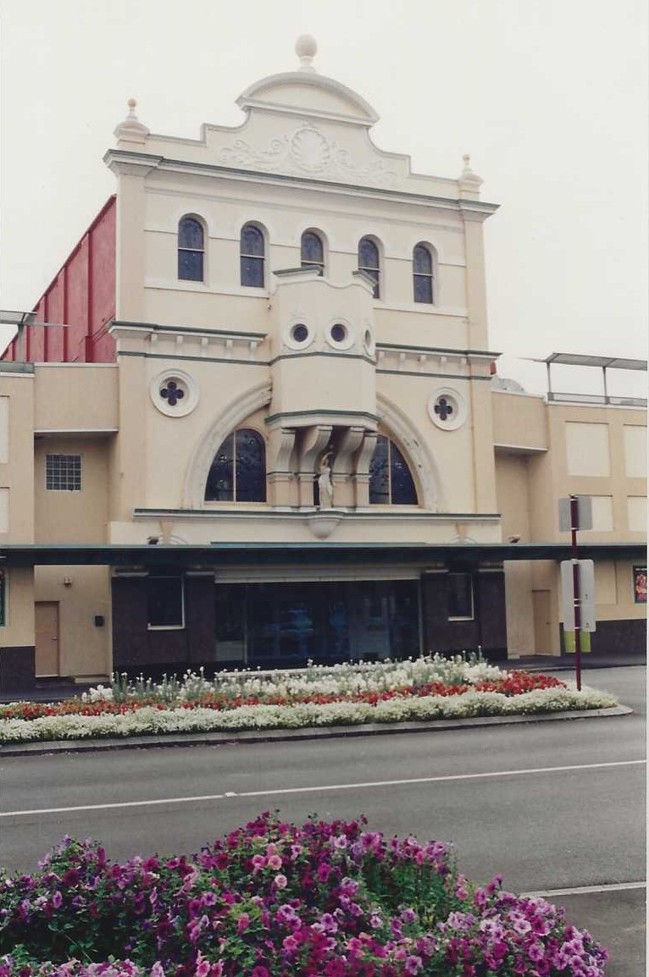 Toowoomba’s Strand Theatre, opened in 1916 and still operating as a five screen cinema. Photo: Les Tod, 1997
In February 1917 “Miss Grace Elton’s many friends will regret to learn that her brother passed away in Sydney during the weekend. Miss Elton is fairly well known in Toowoomba and is the pianist for the Strand Theatre orchestra. Much sympathy will be extended to her in her loss.” 4 The article does not say which brother.
The following month, it was reported “Miss Grace Elton (pianiste) and Miss V. Coghlan (violinist) need no introduction to the Toowoomba public, and it is with great pleasure that the management of the Min Min Tea Rooms, Margaret Street, announce that these gifted young ladies will afford their patrons a musical treat every Thursday afternoon, commencing tomorrow. Ensure your thorough enjoyment of afternoon tea by attending these dainty tea rooms on that afternoon.”5
Grace was never far from the news. In March it was remarked “The Strand Ladies Orchestra (Miss Grace Elton and Miss Vonnie Coghlan) contributed divine music.”6
Also in March 1917, Elsie had taken a job at Nicholson’s, a shop that sold sheet music, instruments and recordings. “Miss Elton will play it for you, so you hear it first.” 7One can imagine many of her fans, both male and female, lining up to seek her assistance in selecting music.
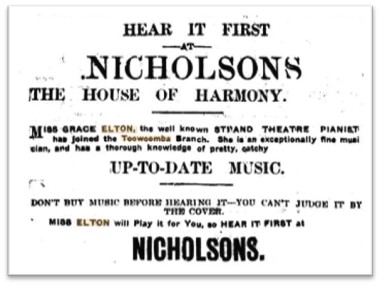 Toowoomba Chronicle, 24 March 1917
Finally, in June 1917, Grace departed Toowoomba:
Miss Grace Elton, who has been pianist at the Strand Theatre for some time, leaves on Monday for Brisbane. It is now some time since Miss Elton and her father (since deceased) came to Toowoomba at the time of the opening of the Elite Theatre, where Miss Elton made a reputation for herself as a brilliant and capable pianist, and one whose good taste and judgement in the selection of her music was always to be relied on. Her ability in this respect was recognised by Messrs Nicholson and Coy, when they decided to utilise her services for trying over music for the benefit of intending purchasers. Miss Elton’s many friends will wish her every success in her new sphere.8
Fred Elton was not Grace Elton’s father. Elsie’s maiden name was Wiggins. Fred and Grace were said to be the niece and nephew of the famous Billy Elton, a performer of the 1890s. If this is true—and there is some doubt—Elsie was travelling with her cousin Fred, not her father. When Fred died, aged, 51, Elsie was only 34. She may have taken his name to stop the tongues wagging and ensure her respectability.
By the end of the year, Elsie was back in Riverstone.
In an unusual notice in November 1917, Mr and Mrs J Posselt of nearby Schofields placed a Thank You in the Windsor and Richmond Gazette of November 1917 “to express their sincerest thanks to Miss Elsie Wiggins of Schofields, for her brave act in saving their daughter from being run over by the train.”9 But this is not Elsie Wiggins of Riverstone. This is Elsie Wiggins of Schofields. In an incredible coincidence, there were two Wiggins families living only 3km apart, but said to be not related. One lived at Schofields, with an Elsie Wiggins in the family, while the subject of this story, Elsie Wiggins, lived at Riverstone. The Elsie Wiggins who rescued the child was a different person to the Elsie in our story, which only highlights the complexities of research.
May 1919 finds Elsie in Bundaberg, where an advertisement states she has been the pianist at the Olympia Theatre but is relinquishing her position.10 A large advertisement states she is giving a farewell concert, using her vast repertoire, at the Austral Hall:
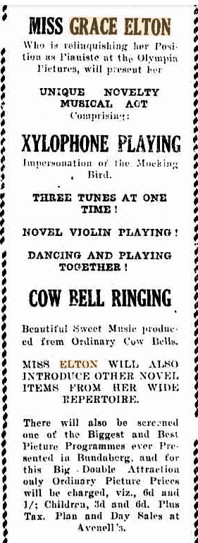 Bundaberg Mail, Saturday 31 May 1919
Elsie had a very good reason for relinquishing her position at the Olympia in Bundaberg. She returned to Riverstone to prepare for her wedding to Robert Harper.11
Elsie was married to Robert Harper in Riverstone, on 19 August 1919:
At St. Paul’s Church, Riverstone, on the 19th instant, a military wedding was celebrated, when Miss Elsie May Wiggins, eldest daughter of Mr and Mrs Geo. [George] Wiggins of Riverstone, was married to Lieutenant Robert Lindsay Harper, 9th Battalion, AIF. The bride, who was given away by her father, was attired in a gown of bridal satin and georgette bodice, beautifully trimmed with pearl and beaded embroidery and beaded tassels. The square court train of satin was lined with pale pink crepe-de-chine, and trimmed with dainty scroll and hanging roses of pink and white. An embroidered tulle veil which was worn over the face, finished with sprays of orange blossoms, completed the bride’s charming toilette, and she carried a shower bouquet of sweet peas and fern, and wore a gold pendant, the gift of the bridegroom …12
Robert Lindsay Harper, a professional singer, was now Elsie Wiggins’ husband. He came to Australia from England as part of the quintette of Kings College Boys, and later played with the Royal Comics, then for four years toured with the AIF’s.13 The Royal Comics were probably the Royal Comic Opera Company, which toured Australia as part of J.C. Williamson’s circuit in capital cities in the early 1920s. If he was part of the Kings College Boys, this group came to Australia around 1913 and also toured New Zealand. They had appeared before the King and Queen of England and were trained by Westminster Cathedral Choral Society. They toured Queensland extensively in 1913 and it was in Brisbane where he and Elsie met, while she was working as a pianiste at a Birch and Carroll picture theatre.14
The official description of Robert was that he had three small marks on his left arm, was aged 29 and 8 months, with dark brown hair and hazel eyes. He was born in Newcastle-on-Tyne and gave his profession as a singer. He was in Queensland when he enlisted with the Australian armed forces on 27 August 1915, in Brisbane. In Army records in 1917 he gave his address as “Mill Street, Riverstone”. His next of kin was John Harper of the Crown Hotel in Railway Street, Newcastle-on-Tyne, also at 125 Pine Street, Newcastle-on-Tyne, who was Robert’s brother. He was signed into the 9th Battalion, 22nd Reinforcements, and left Brisbane on board HMAS Marathon on 27 October 1916. After arriving in Plymouth, England, he was assigned to the Durrington Camp for training, where he was hospitalised several times, once for influenza, which was then quite deadly. In July 1918 he was arrested but for what reason is not recorded. Instead he was released from detention in August 1918 but was informed of the Army’s “grave displeasure” at whatever he had done. He was sent to service in Havre, Belgium. At war’s end he returned to Australia on the SS “Aenead” in 1919. His official file states in May 1918 “has done very good work and has ability and is very capable. Possibly has rather overestimated his own importance and powers, but is distinctly above the average.” 15
He returned to Australia in May 1919, a few months prior to his marriage to Elsie. When they were married Elsie was 36 and Robert around 33 years of age.
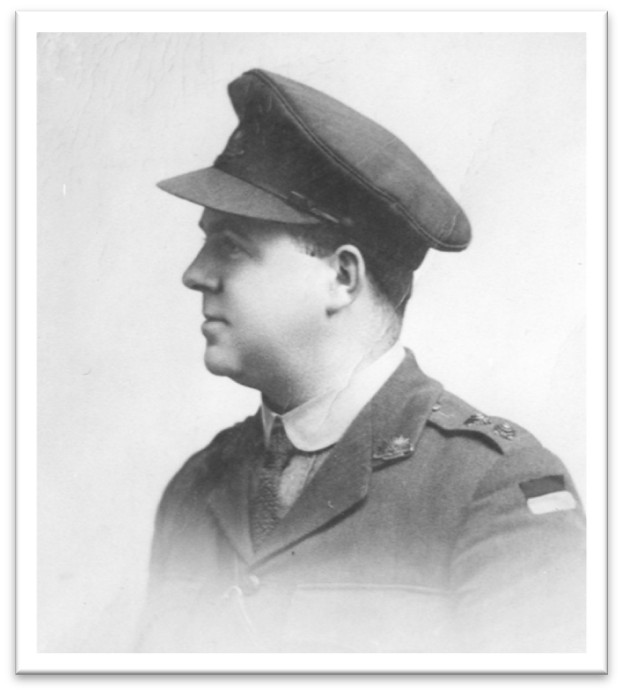 Robert Lindsay Harper in uniform. Wiggins Family Collection.
In March 1920 it was announced that Elsie would be returning to Riverstone to settle and build her theatre: “Mr and Mrs Harper [nee Elsie Wiggins] returned after a six months tour of New Zealand. They were to make final arrangements for the erection of an up to date picture theatre.”16
Robert also involved himself in many local activities and became well known and popular in the town. In May 1920 he sang a solo in St Paul’s Church of England to celebrate Mother’s Day.17
On 30 July 1920 it was finally announced that Riverstone was to get its picture theatre:
It will be pleasing to the residents of Riverstone and district to learn that we are to be favoured by the erection in our midst of an up to date theatre. We learn that Mr and Mrs Harper, a little while ago, received the plans of the proposed theatre from Mr F.H. Faircloth (architect) who has had considerable experience in this class of work. It is intended to get the building operations in hand right away. The theatre will have overall dimensions of 76 feet length, and 36 ft width, with a gallery or circle right across the building of a depth of 18 feet, giving accommodation for some 150 people, while the body of the downstairs portion of the theatre will seat from 500 to 600. The screen will be 16 x 12 ft framed so that in projecting the picture it will be thrown into a complete frame. There will be a roomy vestibule or lobby, inside of which will be the ticket office … The floor will be of special hardwood, to form an ideal dancing floor. It is the intention of the proprietors to allow it to be used for the purpose of dancing etc, during the nights it is not being used for picture production, or concerts, etc. It reflects great credit on Mr and Mrs Harper and shows commendable enterprise …18
In November 1920 it was reported
Through the courtesy of Mr R.L. Harper, the enterprising manager of the new Olympia picture theatre, a Gazette reporter had an opportunity on Wednesday of inspecting the up to date building that is now nearing completion in Riverstone. The theatre is a credit to Riverstone and shows commendable enterprise on the part of the proprietors. Indeed, it is considered to be one of the best country theatres in the State. A feature of the structure is the gallery, or circle which extends right across the back of the building. The operating box situated at the back of the circle, is fitted out with the most modern equipment, and absolutely fireproof. The theatre also contains a roomy vestibule or lobby … The engine is in perfect condition, and Mr Harper asserts that he has not had a second’s stoppage during the last eight months …
This last comment implies that the engine was screening films during the past eight months—would that have been in the Temperance Hall? If so, it was the machine that Elsie bought when she started up her Elton Elect Pictures there some years before.19
The theatre opened on Saturday 20 November, with Catherine Calvert in Marriage, and featuring latest selections by the Orchestra, with screenings every Wednesday and Saturday. This was to be followed by a Grand Ball, plain and fancy dress, on Friday 26 November.20 The authorities did not catch up and license the new theatre until 14 January 1921.21
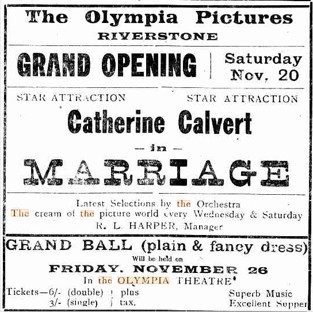 Windsor and Richmond Gazette, 12 November 1920. Robert is mentioned as the manager; there is no mention of Elsie. She may have been involved in the “superb music”.
A description of the building provided by the Chief Secretary’s Department Architect stated that It had a frontage of 44 feet, was constructed of timber and fibrous cement, roofed with iron, and contained an entrance lobby, office, ticket box, stairs leading to a gallery and an auditorium that measured 67 feet by 18 feet to the top of the walls. There was an unenclosed stage that measured 19 ft by 5 feet 6 ins … a timber gallery, which had a depth of 18 feet was located over the entrance lobby. At the rear of the gallery was a projection box, which protruded from the façade over the front awning … the four feet wide stairs leading from the lobby to the gallery meant that the gallery could only be licensed for 50 people, [and not the 150 as claimed in the newspaper].22
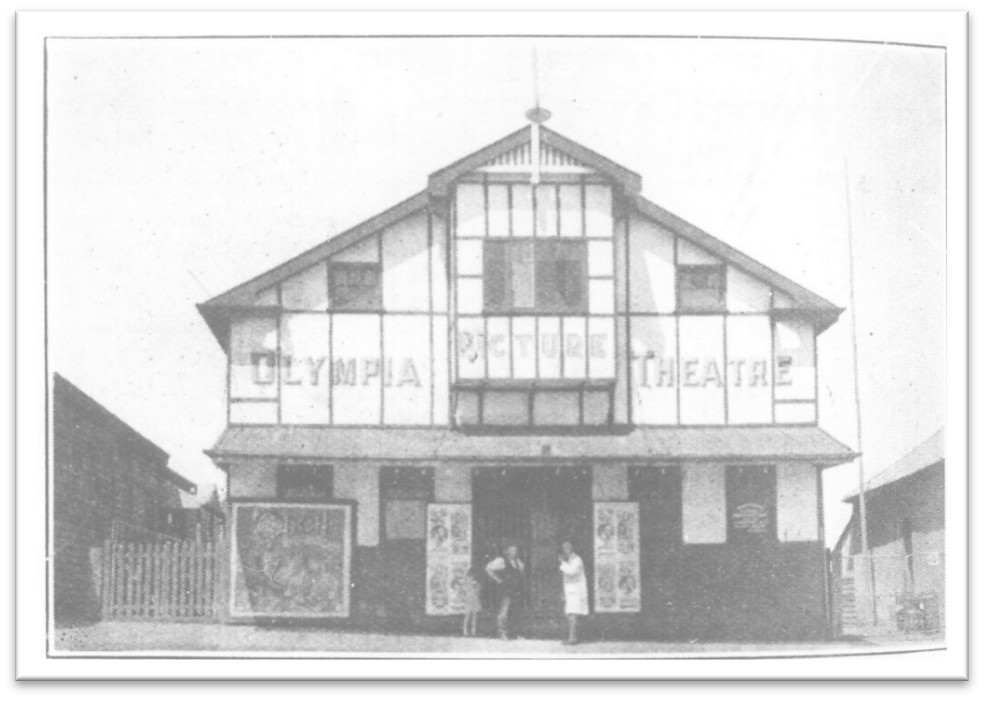 Riverstone Olympia, c.1925. Les Tod Collection.
Theatre historian Kevin Cork wrote of the building:
… its framework was of hardwood and fibro was used to line the interior, the exterior being unclad. The street façade was clad with weatherboard to about four feet high and fibro was used above this. Above the street awning, the projection box jutted out from the façade. The box itself was small and equipped with a Motograph projector which was date stamped in the metal “1911”. Because of its smallness, no rewinding of films could be done in the projection box and had to be done downstairs in the vestibule.
In later years, the rewinding of films anywhere in the theatre except in the actual rewind room was an offence. The comment regarding the projector being a 1911 model would correlate with Elsie Harper [nee Wiggins] starting pictures in the Temperance Hall in 1912.23
Kevin Cork also wrote:
The dress circle was very small. It was reached by a single set of stairs from the small vestibule and the seats were cast iron backed chairs. The street door for many years was a single, solid wood, sliding type. The décor of the auditorium was Spartan. Seating was primitive—the downstairs seats were wooden benches. Moveable seats were necessary as the theatre was used for dancing for many years. The picture screen was fixed onto an island type stage, surrounded by fixed blue curtains and pelmet. Single light globes hung on their cords from the unlined roof of the auditorium.24
Everyone’s, a trade journal, reported in November 1921:
Mr Harper of the Olympia Pictures is doing excellent business, from all accounts, screening Fox and Australasian Films. He makes it a weekly practice of visiting the city, and thus is enabled to keep his patrons in touch with the most up to date releases. The Olympia is one of the best picture theatres on the line, and is most efficiently managed.25
There was no mention of Elsie.
It was reported in 1922:
Fine pictures are being regularly screened at the Olympia Theatre, and Mr Harper is to be congratulated on his judgement and his correct gauging of the public taste. Some of the star pictures he has shown lately came to Riverstone immediately on their release from Sydney, and local picture patrons can see quite as good pictures at home as in the city—in one of the most comfortable country theatres, with cool and pleasant surroundings and bright music. The people also remember that Mr Harper was a digger who did his bit for the Empire, and that it was he who placed the filming of pictures on a high pedestal in Riverstone. His spacious and well ventilated hall is well appointed and well lighted with his own electric plant.26
Again, no mention of Elsie.
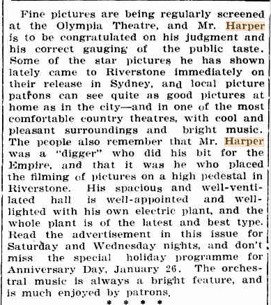 Windsor and Richmond Gazette, Friday 20 January 1922
The above comments gave credit to Robert for putting pictures “on a high pedestal” in Riverstone, for his judgement and also for his well appointed theatre. There was no mention of the person who bought the land some years later with that very intention and also built the theatre.
In 1922 Everyone’s noted that “Bob Harper, of Olympia Pictures, is an operatic tenor of considerable experience and when not busy with his picture show, fulfils many lucrative engagements with various musical societies.”27
It was a classic case of “A Star Is Born”. Robert’s career was on the rise, and Elsie was now Mrs Robert Harper, living in his shadow. That is the way it was for women in those times; few broke through the barrier. But she may have been content with that.
Robert was not always at the helm of the Olympia. In July 1922 he sang in a production of Verdi’s Aidaat the Sydney Town Hall. 28 Everyone’s remarked:
Exhibitor Harper, who for some years, was prominent in vaudeville and comic opera, has been running his show in this town for some considerable time. Recently he decided to introduce a vaudeville act into the bill on Wednesday night and arranged a continuity of bookings from a well known Sydney agent. The acts leaving Sydney in the late afternoon arrive in time to present their act and catch a train back, thus getting into the city by about 11pm.29
In July 1924 Robert appeared at a concert at Windsor School of Arts. It was a wild success. The Gazette reported:
When the services of Mr Robert Harper, the eminent tenor, were secured for this concert, its success was assured. Many Windsor people were anxious to hear Mr Harper and he certainly gave them something for their money. He commands a big fee in Sydney, but he graciously gave his services free on this occasion on account of the cause … Some of those present came long distances specially to hear him. They had heard a good deal about him and had read complimentary and flattering reports in the press of his singing and were much gratified at the opportunity of hearing him at a local concert. As a lyrical tenor Mr Harper is certainly entitled to the adjective “eminent”. He sang in both parts of the programme and was re-called again and again. Some of his classical items were indeed a treat, and he selected some lighter items which were also enjoyed immensely. His wonderful bell-like notes roused the audience to a high pitch of enthusiasm and enraptured them...
At the very end of the lengthy report on the concert it stated that the accompaniment was provided by Miss Norris, Miss May and Mrs Harper.30
This was the same hall in which Elsie had appeared some twenty-five years earlier to similar acclaim. This time she was only given credit for the accompaniment.
The following month, in August 1924, it was reported Mr Harper was donating a scholarship valued at Six Guineas to be contested by his juvenile patrons. Alderman Lawson applauded the fine spirit of citizenship displayed by Mr Harper, who in responding said he was trusting that eventually the State Scholarship … would be won by a Riverstone girl or boy.31
In September 1924 Robert gave another very successful concert at the Windsor School of Arts. It was stated that people attended in “droves” and the hall was packed. Mrs Harper once again provided musical accompaniment.32
When the new Riverstone Methodist Church Hall was opened in Riverstone in February 1925, Robert Harper was the soloist at the evening service. 33
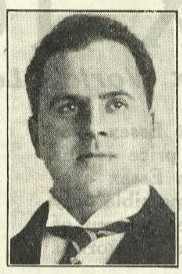 Photograph of Robert Harper, from The Bulletin, 5 November 1925
In 1923 Mr Murrell had begun screenings as the Royal Pictures in the Riverstone Oddfellow’s Hall in direct competition against the Olympia. What made him open a second theatre in a small town like Riverstone when there was already a purpose built theatre there is not known. But he was very personable and popular and quickly made inroads into the attendances at the Olympia, so much so, that in 1926 he purchased the latter and closed his Royal Pictures. What Elsie thought of losing her theatre and the land she had purchased is not known, but one would think she could not have been happy. 34
Oddly, the sale of the theatre to Mr Murrell resulted in him taking out a mortgage to the National Bank—and also to Elsie herself, because the initial land purchase was in her name. The mortgage to Elsie was not discharged until 1950.35
By 1926 Robert would have been finding Riverstone a small pond anyway, and he had other ambitions which would lead him to Sydney, and eventually to New York. His career in Sydney appeared to be soaring, and he was not only teaching, but performing more frequently in classical opera and concerts. After selling the Olympia both he and Elsie moved from Riverstone in 1926 and were now residing in the city. The Gazette reported:
We are about to suffer a loss we can ill afford in the early departure of Mr and Mrs R.L. Harper, who are taking up permanent residence in Sydney, where Mr Harper has commenced practice as a professional vocalist. Already Mr Harper has accepted a number of early operatic and concert engagements and has also established a studio at Adyar House. 36
In January 1926, Elsie Harper was a passenger and suffered a fractured arm when two buses collided in Oxford Street, near Wentworth Avenue in the city. She was taken by ambulance to Sydney Hospital for treatment. 37
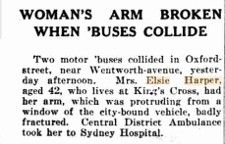 Evening News, 30 January 1926
A few days later, the Gazette reported “Travelling in the city last Saturday, Mrs R.L. Harper sustained a fractured arm. In regard to the many anxious inquiries of friends, they will be relieved to hear that Mrs Harper is making slow but substantial progress.” 38
The Gazette reported in February 1927 :
We continue to hear of the professional success of Mr R.L. Harper, late of this town. Following his departure, he soon attained the repute of being one of Sydney’s leading tenors. He has just fulfilled a contract with the Columbia Phonograph Proprietary. The records proved exceptionally clear, manifesting the artist’s skill to good advantage. We accordingly congratulate Mr Harper, and anticipate to hear of his future success, which undoubtedly, he deservedly merits. 39
In April 1927 he was not only performing, but arranging concerts: “Mr Robert Harper, formerly of Riverstone, arranged the programme which was presented at Burdekin House, Sydney, on Tuesday afternoon, at a concert in aid of the funds of the Royal Prince Alfred Hospital.”40
In May 1927 the Gazette remarked:
Although not now residing in Riverstone, Mr R.L. Harper is still heard by many who avail themselves whenever possible of being present at his appearances on the metropolitan concern platform. Last week he was heard to good advantage in “Dawn of the Capital”, a new song composed in commemoration of the opening of Canberra.41
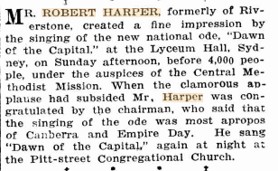 Daily Telegraph, 23 May 1927
A few weeks later, the Gazette added:
Mr Robert Harper, formerly of Riverstone, created a fine impression by the singing of the new national ode, “Dawn of the Capital”, at the Lyceum Hall, Sydney, on Sunday afternoon, before 4,000 people, under the auspices of the Central Methodist Mission. When the clamorous applause had subsided Mr Harper was congratulated by the chairman, who said that the singing of the ode was most apropos of Canberra and Empire Day. He sang “Dawn of the Capital” again at the Pitt Street Congregational Church.42
This is a slight exaggeration, as the Lyceum Hall never seated 4,000 people, more like 2,000.
A few months later it was reported “We continue to hear of the professional success of Mr Robert Harper, late of this town. His vocal recital announced shortly to take place at the State Conservatorium, is held in musical circles to be one of the noteworthy events of the season.”43
The following month, it was reported that “Dame Nellie Melba recently gave a private audition to Mr Robert Harper, the well known tenor, formerly of Riverstone. The following embraces her opinion: “Robert Harper is the possessor of a beautiful voice—one which unfortunately cannot often be utilised in Australia. Here is an all-round tenor within our gates, who can be called upon for opera, oratorios and the concert platform.”44
No doubt her comments would have contributed to Robert’s forthcoming decision to leave Australia. To have a private audition with Madame Melba would have been a great honour, but to be told his voice “cannot often be utilised in Australia” would have been food for thought. Whether Elsie was present at the audition is not known.
The following recordings on 78 rpm records were made by “Robert L. Harper, tenor” at Columbia’s Homebush recording studios:
0583—“Take a Pair of Sparkling Eyes” (The Gondoliers - Gilbert & Sullivan") Matrix R 259 (late Jan or 1 Feb 1927) “Queen of My Heart” (Dorothy - Stevenson & Cellier) Matrix R 260 (ditto)
0643—“For You Alone” (O’Reilly & Geehl) Matrix R 258 (ditto)
Dawn of the Capital” (Marks & Bulmer) Matrix T 109 (late April 1927)
0682—“The Little Girl From Hanley”. Matrix R 261 (late Jan or 1 Feb 1927)
“My Girl and I”. Matrix T 110 (late April 1927)
0802—“Scotland Yet” (Riddle & McLeod) Matrix T 387 (October 1927)
“Scots Wha Hae Wi’ Wallace Bled” (Burns) Matrix T 388 (ditto)45
Amazingly, Robert L. Harper can still be heard today singing “Song of the Soul”, recorded in 1927, almost 100 years ago, on the website of the National Film and Sound Archives in Canberra. [Google National Film and Sound Archives, then to Collections, then search Robert Harper].
In 1927 and 1928 Robert Harper was also tutoring students. In November 1927 it was reported that “an excellent programme was provided by students of Mr Robert Harper at the Conservatorium Hall on Saturday night”.46
The opening of Sydney’s huge and ornate Hoyts Regent Theatre took place on 9 March 1928. Seating 2,200, it featured an opening programme of live performance and film. The first half included a scene from the play Faust: “The curtains rose on the Prison Scene, enacted on the stage by Signora Gilda Pattini, as Marguerite, Signor Allesandra Barbares as Mephistopheles, and Mr Robert Harper as Faust.”47
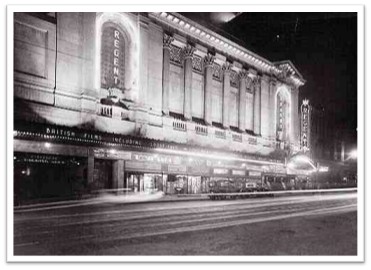 For Robert Harper to be one of the performers at the opening of the prestigious Regent in 1928 must have been a real feather in his cap. The Regent was controversially demolished in 1990. Les Tod Theatre Collection.
Robert’s pupils gave a concert at the King’s Hall in Sydney in November 1928.48 The following month it was mentioned that “Mr Robert Harper of Adyar House, Bligh Street, Sydney, has been selected as tenor soloist at two performances of The Messiah by the Welsh Choral Society and also by Melbourne Philharmonic Society.”49 It was to be one of his last appearances in Sydney.
Robert’s career in Sydney was coming to an end. In 1929 Robert and Elsie Harper left Australia for New York. The Gazette reported:
Mr Robert Harper, the well known tenor and former resident of Riverstone, has decided to leave for New York, where he will reside and practice his profession. Mr Harper will go with testimonials from Dame Nellie Melba, Evelyn Scotney and other artists, and though he much regrets leaving Sydney he feels that in American there is much greater scope. Sincerity in expression, intellectualisms, and versatility have been characteristics that have made Mr Harper’s singing always interesting and his services have been availed of for grand opera, oratorio, concert work and broadcasting.50
Robert gave a Farewell Concert at the Sydney Town Hall on 22 May 1929. It is noteworthy that Elsie was not listed amongst those musicians supporting him.51
Elsie accompanied Robert to New York. Surprisingly, he did not enter the theatre world, notwithstanding Melba’s high praise for his talents, but that of radio broadcasting, stating that it paid better. Radio was much more popular than theatre or opera and its popularity was increasing.
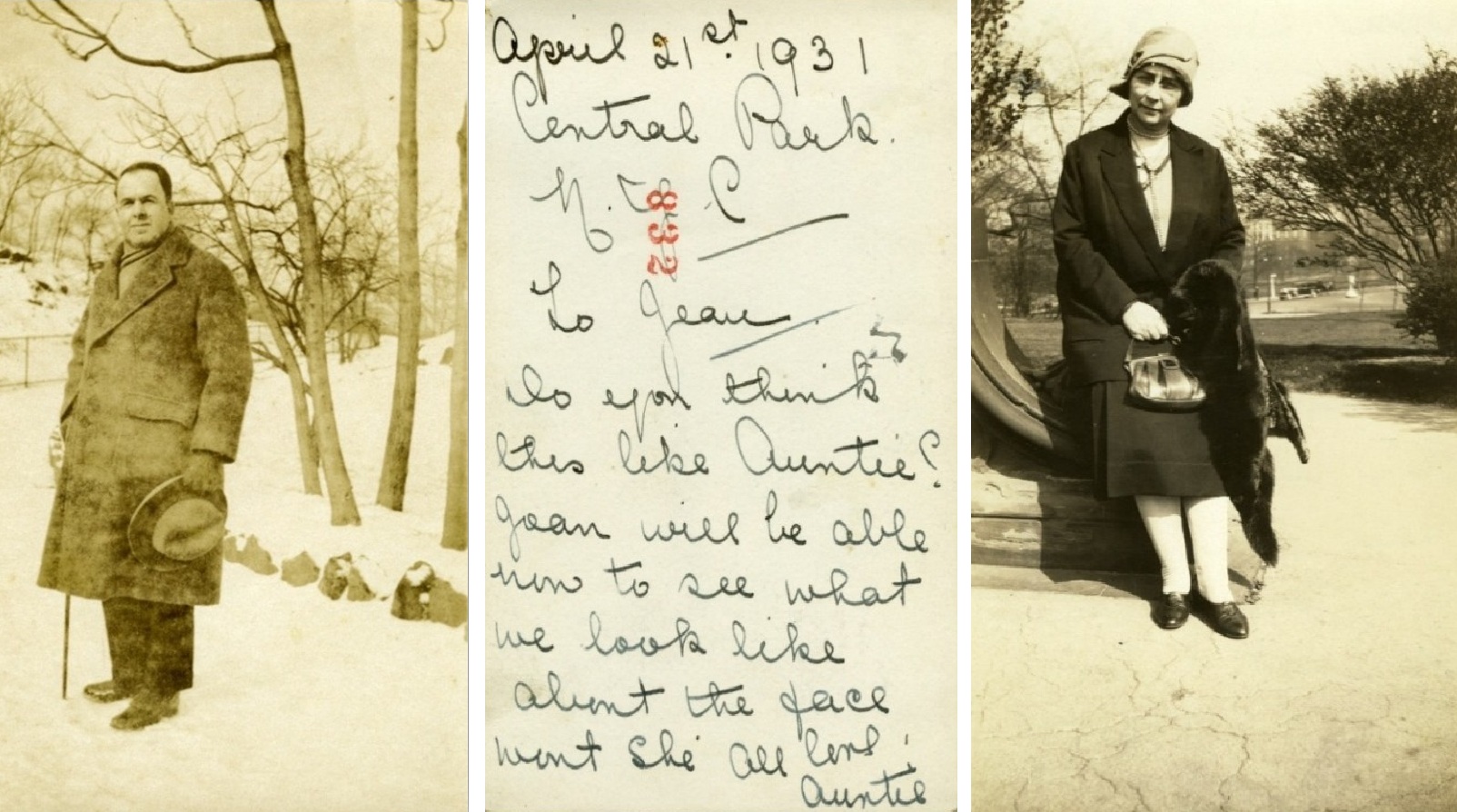 Left: Robert Harper in New York, possibly 1929/30. Photo: Back of postcard is written: “Dec 24th, 1929. Xmas Eve. New York. Pretty scene.” Right: In 1931 Elsie sent a postcard from Central Park, New York City, “To Jean. Do you think this like Auntie? Joan will be able now to see what we look like about the face won’t she. All love, Auntie.” Joan and Jean were her nieces.
When Elsie went to New York in 1929, she must have realised her career was over. Vaudeville was in decline because of talking pictures, with theatres everywhere putting off musicians, orchestras, and vaudeville support acts. It was also the time of The Great Depression, and even big “live” theatres like the Theatre Royal and His Majesty’s in Sydney switched over to movies, because they were cheaper to run, thus putting even more performers and theatre staff off work. The talkies and the depression were a double edged sword for entertainers.
In 1932 Elsie returned home to Riverstone to see her ailing mother. She never went back to New York and Robert never returned to Sydney. The marriage was over. It must have been heartbreaking for her to see her Olympia Theatre now owned by someone else. In 1934 Elsie returned to the Olympia, to perform an overture in classical style for the crowning of the Riverstone Queen, Nancy Strachan.52
Back in Riverstone and now without her husband, Elsie Harper nee Wiggins formerly Grace Elton, appears to have settled down to a life of quiet obscurity, apart from being involved in local events. She had no children of her own, but was still surrounded by the extended Wiggins family. In 1935, when she was 53, she played at the St Paul’s Church 50th Jubilee Year.
The Gazette reported:
Mrs Harper played the opening overture in her customary finished style. Mr Os Wiggins powerful tenor voice was heard to advantage … Little Carita Wiggins quite captured the hearts of the audience with her clever recitations … A pianoforte duet was played by Misses Stella and Audrey Shoular. The accompaniments were sympathetically played by Mrs Harper.53
In October 1939 a concert was held at the Olympia Theatre in Riverstone. The Gazette reported:
The Margaret Wiggins Concert held in the Olympia Theatre on Friday night in aid of the CWA Patriotic Fund drew a large audience, which showed its full appreciation of a beautiful programme, judging by the numerous encores the artists received, and Riverstone people look forward to the day when such a clever little girl as Margaret Wiggins will be on the “top of the tree” in the music world. Mrs Robert Harper, who arranged the concert, received many congratulations upon the high standard of music presented, and for her kind thought in donating the proceeds for the war funds of the CWA. Many large boxes of sweets, floral baskets and posies were received by Miss Margaret Wiggins (who is the second daughter of Mr and Mrs N. Wiggins, of George Street, Riverstone) and Miss Nellie Ravens, the assisting artist from Sydney.54
Margaret is believed to have been around ten years old at the time.
This article does not mention that Mrs Robert Harper was actually Elsie Wiggins, and it is likely that Margaret Wiggins was her niece. Note also that Elsie is identified by her married name, even though the marriage was over and her husband was now in the United States. And the concert was held in the Olympia, the theatre that Elsie and her husband had built. The comment about the high standard of music was all due to the experience and expertise of Elsie, aka Grace Elton.
In July 1940 it was reported:
The Margaret Wiggins concert recital which is so favorably remembered by patrons some months ago was repeated at the School of Arts, Blacktown, on Tuesday night, at the request of the committee of the Shire Patriotic Fund. A packed house greeted this clever young pianist, while the warmest congratulations were offered by the Shire President, Cr J. Stone, to Mrs Robert Harper, of Mill Street, Riverstone, who arranged the recital. 55
No actual credit is given to Elsie Wiggins, which is rather sad, as Robert Harper had long left Riverstone (and Australia) and made no contribution to the event, except for the use of his name. Elsie would now have been 58 years of age.
The 1940 US Census shows Robert Lindsay Parker as 46 years of age, born c.1894, lodging at Mr Vernon, Westchester, New York, and described as “White, Male, American ethnicity, Born England.”56
In March 1943 Jean Parry married Neville Alcorn, and Mrs Robert Harper played the Wedding March. During the signing of the register, Mr Os Wiggins, uncle of the bride [which means Elsie was her aunt] sang.57
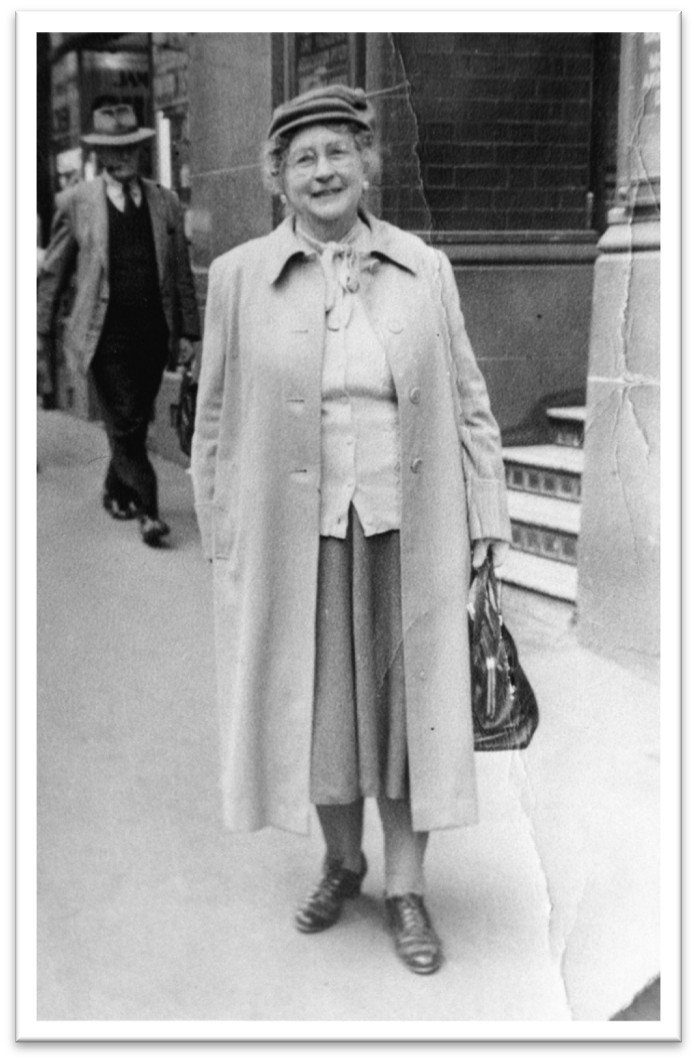 Elsie Wiggins, c.1955. Photo probably taken by a street photographer. What stories she could have told us of Frank Thring, Harry Rickards and Senora Spencer! Wiggins Family Collection.
It is believed that Robert Harper passed away in May 1959. He is buried in Ferncliff Cemetery, Hartsdale, Westchester, NY.58 We do not know if he made a successful career in the US.
Elsie Wiggins had a remarkable career. Its peak seems to have been from around 1905 to 1920, and this was followed by the building of the Olympia Theatre at Riverstone, and running it from 1920 to 1926, when it was sold. She had met people who would later become famous in the Australian entertainment industry: Harry Rickards, Frank Thring, Senora Spencer and Fred Elton. She had a theatrical company in her name, ie, Grace Elton Comedy Co.
At a time when women were expected to be in the kitchen, Elsie Wiggins had carved a career through the entertainment industry, running at least four theatres, one of which she built with her husband on land she had herself purchased. She had performed in vaudeville and seen the rise in popularity of roller skating but more so, of the new moving pictures, which played such an important role in her later career. She had travelled extensively through Australia and New Zealand as well as New York, Egypt and England.
After the sale of the Olympia, Robert’s career seems to have been on the rise, while hers was in decline. When they sold the Olympia in 1926, she was 44. They had no children, and the chances now of having children were remote.
Elsie never remarried. In the early 1950s she finally began divorce proceedings against Robert Harper, the decree absolute being given on 26 November 1956. She continued to live in the house she had built in Mill Street, Riverstone. She cared there for her ageing and invalid mother. Her brother Albert and his wife Emily lived in the house also.59 One would think she felt a tinge of sadness every time she walked past the Olympia, the theatre she and Robert had built on the land she had purchased. In her final years local people recall her sitting on her verandah and waving happily to passers-by.
She is also remembered for giving piano lessons in her front room and for her kindness towards the students.60
Elsie’s story ends quietly in Riverstone on 1 March 1960.61 At her request, her obituary did not mention her incredible career, the places she performed, and theatres she built and performed in, nor the famous people she had met. Nor did it mention her age, nor Robert Harper or even her place of death, in accordance with her final wishes:
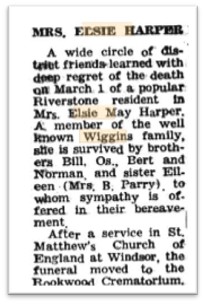 Windsor and Richmond Gazette, Wednesday 16 March 1960

Elsie’s house at 31 Mill Street, Riverstone
Photo courtesy Rosemary Phillis, Riverstone and District Historical Society

St Paul’s Church at Riverstone
Photo courtesy Rosemary Phillis, Riverstone and District Historical Society
Under the terms of Elsie’s will, the house and its contents were left to her brother Albert and her sister-in-law, Emily Maude Wiggins. As would be expected, the contents included an old Sponagel brand piano, valued at only ten pounds.62
The Olympia Theatre closed on 26 June 1971, its final film being the undistinguished Hot Millions. The theatre was used for storage and then left to literally fall apart. It was completely demolished in April 1978.63
Similarly, Elsie’s home at 31 Mill Street, Riverstone, has also now been demolished.
Elsie’s career is now all but forgotten, and until recently the writers knew only of her involvement in the Olympia, but that was all. A comment in a theatre journal alerted them to the fact there was a lot more to the story than the Olympia. Her musical abilities were in themselves outstanding, her business acumen also. It is hoped this article brings to the fore the life and amazing career of Elsie May Wiggins of Riverstone.
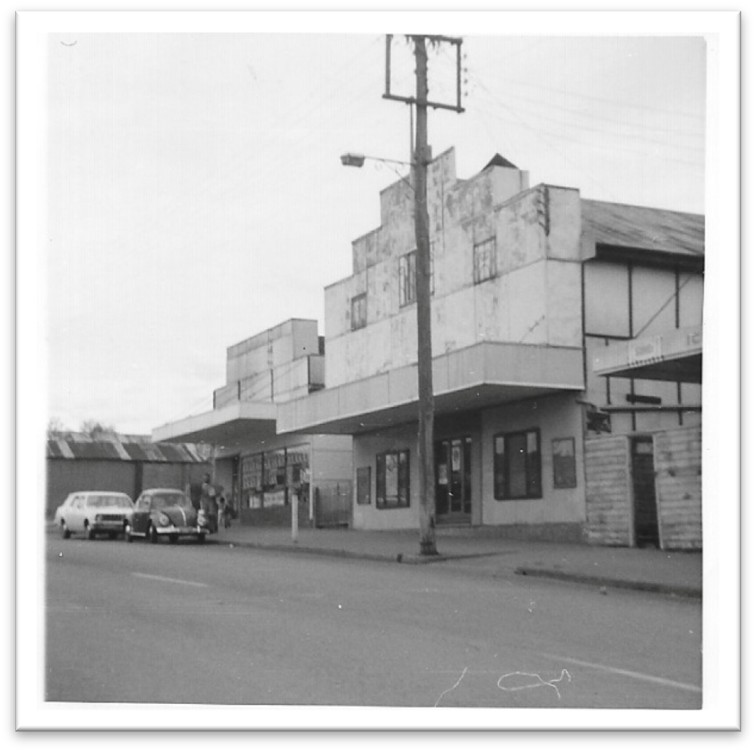 Riverstone Olympia, c.1975. Photo: Les Tod.
Copyright 2026, Les Tod, OAM and Rosemary Phillis.
Postcript
Elsie Wiggins’ career associated her with many entrepreneurs, acts and vaudevillians of that era. The most prominent of these which would certainly have influenced her thinking and outlook were Frank Thring, Harry Rickards and Senora Spencer.

Frank Thring Senior
Les Tod Collection

Harry Rickards
Les Tod Collection
Frank Thring Senior began his career as a travelling showman and met Elsie while travelling in Tasmania. He began his career in moving pictures by screening early films, later graduating to becoming the managing director of J.C. Williamson’s, probably Australia’s biggest theatrical company. He was instrumental in establishing the Hoyts Theatres group by merging Williamson’s and other interests to establish in 1926 what was a small operation into one of Australia’s two major cinema circuits. In the early 1930s he left Hoyts after helping it to build a chain of huge and architecturally stunning Regent Theatres in most capital cities, probably around the time the company was sold to 20th Century-Fox. He established Efftee Films and set about producing his own films, some of which were made in His Majesty’s Theatre in Melbourne. He died of cancer in 1936. His son, Frank Thring jnr, was a well known and outstanding stage and film actor in his own right.
Harry Rickards was a vaudeville performer, born in England, who toured the USA and came to Australia where he quickly established his own vaudeville circuit which toured all cities and many country areas. He purchased the Garrick Theatre in Sydney and renamed it the Tivoli. In Melbourne he took over the Opera House and it too became a Tivoli. The Tivoli circuit was as well known as J.C. Williamson’s. To be selected as a performer on the Rickards circuit was a great privilege. He died in 1911.
 Senora Spencer. Les Tod Collection.
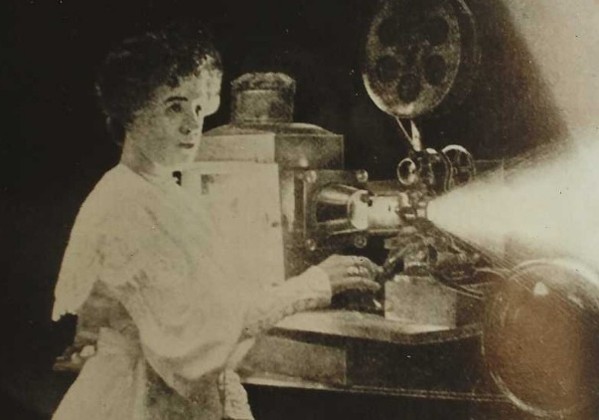
Senora Spencer, aka Mary Huntly, was the wife of Cosens Spencer. He took a lease on the large Lyceum Theatre in Sydney in 1905 and established a company which specialised in distributing moving pictures. As a gimmick -and a very popular one at that—he installed his wife as the first lady projectionist, screening in the open from the balcony where everyone could see her, with the exotic name of Senora and arranged extensive media coverage. His company became popular as Spencer’s Pictures and his films were screened in all states. He became embroiled in several financial issues when his company was merged into the new Union Theatres combine [later to become Greater Union].
Senora Spencer opened three theatres, reputedly of her own, at Toowoomba, Newcastle and Brisbane, although some people were certain her husband was behind them. Elsie Wiggins worked for Senora at the Toowoomba Strand. The Spencers eventually left for Canada and purchased a ranch, where he shot dead one of his employees and wounded another. A search party found Cosen’s body in a lake some days later.
References
1. Darling Downs Gazette, 29 July 1916
2. Ibid. 22 August 1916
3. The Les Tod Theatre Collection [private]
4. Toowoomba Chronicle, 20 February 1917
5. Ibid. Wednesday 7 March 1917
6. Ibid. Monday 12 March 1917
7. Ibid. Saturday 24 March 1917
8. Darling Downs Gazette, Saturday 24 March 1917
9. Windsor and Richmond Gazette, Friday 2 November 1917. Information provided by Moira Bayliss to Rosemary Phillis, Riverstone and District Historical Society, April 2026.
10. Bundaberg Mail, Saturday 31 May 1919
11. Windsor and Richmond Gazette, Friday 22 August 1919
12. Riverstone and District Historical Society website. Accessed November 2025. See also Windsor and Richmond Gazette, 22 August 1919
13. The Bulletin, 5 November 1925
14. Harper Divorce Papers, State Archives of NSW. NRS 13495-21-275-2820/1952
15. Australian War Memorial and National Archives of Australia, World War 1 records.
16. Windsor and Richmond Gazette, Friday 19 March 1920
17. Ibid. Friday 14 May 1920
18. Ibid. Friday 30 July 1920
19. Ibid. Friday 19 November 1920
20. Ibid. Opening Advertisement, 12 November 1920
21. Chief Secretary’s Department, licensing lists. [Les Tod Theatre Collection and State Library of NSW]
22. Kevin J. Cork, op cit.
23. Ibid.
24. Ibid.
25. Everyone’s, Vol. 2, No. 89, 16 November 1921
26. Windsor and Richmond Gazette, Friday 20 January 1922
27. Everyone’s, Vol. 3, No. 109, 5 April 1922
28. Ibid. Vol. 13, No. 124, 19 July 1922
29. Ibid. Vol. 3, No. 168, 23 May 1923
30. Windsor and Richmond Gazette, Friday 25 July 1924
31. Ibid. Friday 22 August 1924
32. Ibid. Friday 5 September 1924
33. Ibid. Friday 20 February 1925
34. Ibid. Friday 26 February 1926
35. NSW Land Titles Records.
36. Windsor and Richmond Gazette, Friday 19 February 1926
37. Sunday Times, Sunday 31 January 1926
38. Windsor and Richmond Gazette, Friday 5 February 1926
39. Ibid. Friday 18 February 1927
40. Ibid. Friday 1 April 1927
41. Ibid. Friday 6 May 1927
42. Ibid. Friday 27 May 1927
43. Ibid. Friday 2 September 1927
44. Ibid. Friday 7 October 1927
45. Listings provided by Mr John Hanna to Riverstone and District Historical Society, 2025
46. Daily Telegraph, Monday 21 November 1927
47. Everyone’s, Vol., No. 419, 14 March 1928
48. The Sydney Morning Herald, Saturday 3 November 1928
49. Commonwealth Home, Vol 35 No 977, 1 December 1928
50. Windsor and Richmond Gazette, Friday 12 April 1929
51. The Sydney Morning Herald, Saturday 27 April 1922?
52. Windsor and Richmond Gazette, Friday 20 June 1934
53. Ibid. Friday 15 March 1935
54. Ibid. Friday 27 October 1939
55. Ibid. Friday 19 July 1940
56. United States of America, census, 1940 [Riverstone and District Historical Society]
57. Windsor and Richmond Gazette, Wednesday 24 March 1943
58. Find a Grave website, accessed 2025
59. Harper Divorce Papers, op cit.
60. Heather Smith nee Watson, information provided to Riverstone and District Historical Society, 2025
61. Windsor and Richmond Gazette, Wednesday 16 March 1960
62. NSW State Archives. Probate records, NRS-13660-39-157980 Series 4, 506333.
63. The Les Tod Theatre Collection, op cit.
Acknowledgements
Trove newspapers of the National Library, which enables researchers to follow a person’s career through newspapers; Riverstone and District Historical Society, Clarrie Neal and Alan Strachan, The Wiggins Family of Riverstone; the late Kevin J. Cork; Movie Mogul Thring: The Early Years, Part 2 by David Coles, article in CinemaRecord, journal of the Cinema and Theatre Historical Society, Inc; Mr John Hanna; State Archives of NSW, divorce papers and Probate records; National Archives of Australia; and The Les Tod Theatre Collection.
Rosemary Phillis is the Secretary of the Riverstone and District Historical Society, and Les Tod OAM is a theatre researcher and author of several books on Australian theatre and cinema history.


