Alfred Hill
-
Varney Monk—Ours for Us

 The following profile and interview with Varney Monk was first published in Jean Devanny’s book Bird of Paradise in 1945.
“I COULD have such a pleasant happy life with my husband and family if I did not possess this urge to fight for justice for Australian compositions.”
 Varney Monk in 1951. Photo by Eric Francis. National Library of Australia, Canberra.So spoke Varney Monk as she threw open a window encasement at her delightful home at Mosman, and gestured towards the dusky harbour view. I, however, found the interiors behind me much more interesting than the conventional forested slopes of the low foreground, the steel shield of the bay, the jewel-studded bow of Sydney’s Eastern suburbs beyond it. So, with a perfunctory glance downwards over the red-tipped gums climbing down to Little Sirius Cove, I turned back into the lounge rooms behind me.
The house seemed to be nearly all lounge. And indubitably Varney Monk’s home. The home of a composer, with its soft richness of colour, its dimness, and quiet in which the vibrations of the music she had been playing when I interrupted her, still lingered.
The red wood panelling of the walls was hung with paintings and etchings and old prints, framed in mahogany and bird’s-eye maple. Nothing anywhere was new. The long, fabric-covered sofa, with its sinuous, flowery, curved supports, cried shame on modern “divans.” The chairs, the occasional tables, the built-in and cupboard-like bookcases, all were old-Australia farmhouse or were brought out to Australia by the first pioneering families.
One corner was filled with a long, lovely, red mahogany harpsichord. “I’ve always had an instinct for real Australian things about me,” said Varney, as she lifted the lid of the instrument to show me its dusty inside. “This came from the South Coast, from Jamberoo. It was brought out from Scotland by the Waugh family, Scottish pioneers, who were among the first settlers. I’ve got old Miss Waugh's bed, too.
“The harpsichord must be at least 150 years old. I dug up some old documents about the Waugh family in Edinburgh and the time of their departure for the colony.”
The soul of the instrument had departed. It had died of old age, its tinkling treble gone to join the spirits of the frail old ladies whose fingers had danced modestly upon its keys. Varney’s piano was old, too. A Lipp. She would like a Bechstein, now. A piano was something a pianist and composer could not afford to be sentimental about.
“For years I have been collecting,” she continued. “See. This is a gentleman's piece, as they call it.” She pulled out a drop table and opened it out. “But most of the things are old farmhouse. If Cyril had been as interested as I we could have got a fine collection together. He calls it junk.” She laughed.
Yes, she was part of it herself. Part of the Australian tradition; homely, practical, unspectacular and persistent. Quietly building around herself a frame-work of Australia-made, Australia-worn, as a background for the music of Australia she spun from the mystery of her mind.
* * * * * * * * * *
I was not surprised to hear that Varney Monk was born in Victoria, at Bacchus Marsh, near Melbourne.1 She looks much more “Melbourne” than “Sydney” even now, though most of her life has been spent in the N.S.W. metropolis.2 Her heritage of talent for music she got from both her parents.
At twelve years of age she composed her first song. A dreadful bit of work, she confided. Paling’s published it under the name When Roses Fall.A glorified little girl took home a bundle of the printed sheets clasped to her breast, her mind filled with ecstatic dreams of a future apotheosised. Varney clasped her hands.
“I seem to have spent all my life bounding along to Paling’s in the hope of achieving fame, but nothing ever happened. From time to time I had things published with the publishers hoping for success, but not until I did Collits’ Innand The Cedar Treewas I well known to the ordinary public.
“Twenty years ago I won a competition prize of a hundred pounds with The Old Bush Track.But in the end I had to publish it myself. It was recorded only the other day.3 I won the Broken Hill Jubilee song competition with the song Broken Hill,which is not printed yet. I won the first radio Eisteddfod song competition, also writing my own lyric.
“My volume called Songs of the Southwas rejected by the publishers on the ground that Australia lacked romance. No one would buy it, they thought. My book of Baby Ballads,however, is used in the State schools.”
In her teens she had been filled with radiant enthusiasm and did a lot of work. One or two things she did then just missed out on being a real success. After her marriage, at twenty-one years of age, to Cyril Monk, the violinist,4 she set music to some of Adam Lindsay Gordon’s poems. These were first sung in public as an accompaniment to a lecture on Gordon delivered by the late A.G. Stephens.
“I first heard the name of Adam Lindsay Gordon,” she told me, “when as a child of eight I was taken by my godfather, Dr. Wisewold, and my mother to the spot where Gordon shot himself. My elders were quite unaware of the deep impression that visit made upon me.5 My mother’s wedding gift to my father was a copy of Gordon’s poems. I treasure it most of all my first edition copies of the Australian poets. ‘To my beloved’ is inscribed upon the flyleaf.”
Later, Varney set music to many Kendall and Lawson lyrics, among them being Kendall’s Rose Lorraine, Bell Birds, September in Australia, The Muse of Australia, Names Upon a Stoneand The Song of the Cattle Hunters.

Henry Lawson
State Library of Queensland, Brisbane

Henry Kendall (1839–1882). Photo by May Moore.
National Library of Australia, Canberra
From Lawson's lyrics she selected The Sliprails and the Spur, On the Night Train, Kiss in the Ringand When the World is Wide.In 1943, the first-named of the Lawson group was broadcast by the B.B.C.6
“Lawson,” said Varney, “was a great admirer of Henry Kendall. Once, when visiting Kendall’s Rock, he told a friend not to mention him in the same breath as Kendall for he was not fitted to tie his shoelaces. Lawson also expressed a wish to be buried near Kendall.”
Varney lists her Kendall songs among her best work. “I feel that no one could have under-lined Kendall better than I did,” she said simply. “I made no attempt to gild the lily. The melodies I wrote to his lyrics but widened the poet’s horizons. My favourite Kendall song is Names Upon a Stone.On the sixtieth anniversary of the death of the poet when a pilgrimage was made to his grave and the children laid wattle upon it, Roderick Quinn read that lyric to the company. He also considers it to be Kendall’s finest poem.
“I don’t suppose many Australians are aware of the impulse that stirred Kendall to write it. It was the outcome of an excursion with George Fagan, one of the family that befriended him so conspicuously.
 George Fagan’s home “Cooranbeen” where Kendall stayed, now known as Henry Kendall Cottage. National Trust.
“In 1870, Kendall walked from Sydney to Newcastle, arriving there destitute and ill. George Fagan met him in an hotel and took him to his home and cared for him. For many years thereafter Kendall lived with the Fagans. On Christmas Day, 1874, George Fagan and Kendall walked out from Gosford and upon the rock now known as Kendall’s Rock, the poet carved their initials. There followed the poem, which was dedicated to George Fagan.
“It was George Fagan that Kendall sent for when he was dying. George brought him in from the country to Sydney and arranged to have him admitted to the St. Vincent’s Hospital. Kendall was unhappy there, however, so George took him to Redfern, where the Fagan family then resided. Kendall died there on August 1st, 1882.
“When I heard that John Joseph Fagan, the last of the family, was on his death-bed at Gosford I went up to see him. On the Pacific Highway I passed the Rock and the obelisk that was subsequently erected nearby and saw that the verses carved upon the latter were the very ones from the poem Names Upon a Stonewhich I had selected for my song.
“When I introduced myself to Joseph Fagan and told him I had come to take the hand of a man who had known Kendall he was terribly pleased. He told me he had loved Kendall like a brother and spoke at length about his fine character and sweet disposition.”

Obelisk marking location of Kendall’s Rock
Central Coast Bushwalks

Joseph Fagan posing next to Kendall’s Rock
Point Clare Cemetery
In that period Varney conceived the idea of writing an operetta around the life of Kendall and to that end she visited the Mitchell Library to gather any available material about him. Maybe, she thought, some of his contemporaries were still living. She found two books on Kendall, both written by Mrs. Hamilton-Grey.7 One was inscribed with the author’s address. Circumstances decided her to relinquish the idea of the play, but there remained with her an indeterminate desire to contact Mrs. Hamilton-Grey, should she be still alive. Then it happened that she received a letter from a former acquaintance, a Miss Black, and the address upon the letter was that written in the biography of Kendall, care of Mrs. Hamilton-Grey.
Varney immediately called upon Mrs. Hamilton-Grey and made herself known to her. The old lady received her with pleasure, told her a great deal about herself and her interest in Kendall and gave her copies of her books. Varney placed the books beside her bed and at intervals, before going to sleep, would dip into them.
One night she read Mrs. Hamilton-Grey's account of how Sir Henry Parkes had followed “the remains” of Kendall's mother to the grave. “One of the few.” The following morning, while breakfasting, she read in the paper the notice of Mrs. Hamilton-Grey’s death and of her interment that very morning, within an hour or two.8
It was a dreadful day. The rain poured down. Varney hurriedly slipped into a mackintosh, pulled an armful of purple flowers from the garden, hurried to the mortuary and asked to see a relative. Mrs. Hamilton-Grey’s agent came forward and informed her that there were no relatives present. He himself and the clergyman were the only people in attendance. Varney followed the hearse with them in their car, one solitary car. It drew up close beside the grave. The agent held an umbrella over the clergyman's head while he read the burial service. Varney’s were the only flowers and she dropped them upon the coffin as it was lowered, a tribute to the lonely forgotten woman who had given such loving service to the recording of Kendall’s life.
* * * * * * * * * *
Most of Varney Monk’s Kendall, Lawson and Gordon songs remain unpublished.
“We Australian composers and musicians cannot be entirely absolved from responsibility for the general indifference on the part of the public to our compositions,” she stated.
“We have lacked the dynamic to organise competition with overseas productions.
“At the same time we have received little encouragement from the theatrical producers and broadcasting stations. And this despite that there has never been a failure with an Australia-written production! Possum Paddock, On Our Selection,and others, have all been successful, yet the producers will not put on our shows. I know there are several good musicals in existence to-day, written by Australians, and they cannot get the chance to make good.
“The whole outlook of our commercial producers has been wrong in the past. They have under-rated Australia, they have under-estimated the patriotism of the people, they have failed to understand the needs of the great mass of the common people, who in the long run are the life-blood of the theatre. They complain of having lost money on their shows and so long as they persist in thrusting upon us entertainment that appeals only to a section they should expect to continue to lose money. They catered for the small minority whose roots are not embedded in the land and the fundamental life of the people, and then grumbled because they were let down. Taken as a whole, I think the judgement of the mass of our people is very good. Australians have always been ready to acclaim anything really good.
“The Australian audience are descendants of the old pioneers. They are interested in the life of their ancestors and the present events that sprung from it. If they are not consciously interested they are potentially so. We need entrepreneurs and producers out of the people, men who will combine education with national pride and culture with entertainment. And they in their turn should have Government support.
“Our present playwrights of importance are awake to the needs of our people; just as our present novelists are. They are producing plays with their roots in the soil. All that is required is a chance of good presentation in well-equipped theatres, the kind of production that would bring in an income to the playwrights and composers and enable them to devote their full time to their art.
“And if ever there was an opportunity to boost our productions it is now! The theatres are over-crowded. The towns are full of Americans anxious to realise Australia. I say it is a crime to neglect such a chance.
“The Labor Government gave our producers a lead when they decreed, in 1941, that two and a half per cent of all music that goes over the air must be written by Australians. My musical plays Collits’ Innand The Cedar Treewere broadcast at the time of their production but nothing more of mine was accepted by the broadcasting stations till after that measure was passed. The result of the Government’s action proved that all we need is a chance, for immediately there came a steady outflow of work from our composers. The music that had lain by for so long is now being played. I find now a continuous demand for my songs from our singers. The Australian Broadcasting Commission has recently performed my Kendall, Lawson and Gordon songs. They have also done Collits’ Innagain.9
* * * * * * * * * *
Both Varney and Cyril Monk spoke feelingly and appreciatively of their country’s most distinguished composer, Alfred Hill. “Hill is not only high-brow,” said Cyril. “His chamber music gives him a distinction far beyond and above all other Australian composers, but in addition his output includes work that makes him one with the people.”
Carefully and thoughtfully Cyril essayed an estimate of his wife's distinctive place in the register of Australia-created music.
“No other composer,” he said, "expressed so clearly and so long ago, the crying need for a peculiarly national musical expression. Varney’s music has been unswervingly and successfully Australian. She may claim to be the most Australian composer, though others may be more gifted. Just as Moussorgsky is more truly Russian than Tschaikowsky, whose appeal is more universal. Varney may define herself as an amateur, perhaps, but she is an amateur with something to say of significance and importance in the life of the people. She has given wholesale attention to our poets, as against the slightness of her colleagues’ contribution in that field.... At any rate, in the past.”


* * * * * * * * * *
Varney Monk believes that she was inspired to the production of Collits’ Innby some subtle spiritual imperative. She regards it, as one might say, as her star of the southern cross. The seeds of the idea were dropped into her mind during her honeymoon days, though years went by before they broke ground, flourished and bore fruit. The seeds were the play of her mind around a story she heard from the lips of a venerable old man, a story that links with old colonial days.
 J.W. Berghofer (1843–1927)—Mt. York obelisk. Blue Mountains Library.
The old man, a unique, a wonderful old man, to Varney’s way of it, was a German-born, naturalised Australian named J.W. Berghofer, featured in early twentieth-century literature as the Father of the Centenary Movement. Berghofer organised the centenary of the first crossing of the Blue Mountains by Blaxland, Lawson and Wentworth. His was the initiative in raising the obelisk at Mt. York, commemorating the work of the explorers. His own spirited contributions to community-welfare are perpetuated in the giving of his name to the pass running from Mt. Victoria to Little Hartley.
To allow pioneers like Berghofer to fade into oblivion would be, in Varney’s opinion, unforgivable. She feels terribly ashamed to think that during World War I, the old man, who had arrived in Australia at the age of sixteen, was persecuted for the accident of his birth. Few native-born Australians are as interested in Australian history as he was. He came to love the land of his adoption.
Berghofer was for fifty years manager of the Kinimbla Station in the Hartley Valley. In 1905 he retired from that position and established himself and his wife in an inn near Mt Victoria, an inn dating back to 1837. Its name, Vittoria Inn, he changed to Rosenthal, in later years to be modified to Rosedale.
To that inn went Varney and Cyril Monk to spend a part of their honeymoon, which was concluded at Norfolk Island. And so enamoured did they become of the splendid old couple who kept it and the gracious and lovely surroundings that they returned there to holiday again and again. It was during one of those trips, seated one night round the fire, that Berghofer told them the story of Collits’ Inn.
“He was full of tales of early Australian history,” Varney told me. “He had a wealth of local colour stories. He made Hartley Valley come alive before one.”
On this particular night he led up to the Collits from reminiscing about the original road made over the mountains, the road made by William Cox with convict labour in six months. That road ran past Collits’ Inn. But its steepness had decided Sir William Thomas Mitchell, in 1832, to build another road, one that deviated from Collits’. Pierce Collits had been a convict. Varney believes that probably he was one of the four convicts who accompanied Blaxland and his companions on their original Crossing. The names of those four were never recorded. But a Mrs. George Nash, at the time of writing still living with her husband at the back of Collits’ Inn, told Varney that during the Centenary of the Crossing she had seen a bracelet inscribed with a legend linking the name Collits with Blaxland.
However that may be, Collits was assigned to his wife on her farm on the Nepean River. Later he received a grant of land west of the mountains, at the foot of Mt. York, and there he built his inn.
In a shack on the Kinimbla property, Berghofer’s story ran, a widowed, aged woman named Mrs. Skene had lived. One day she had visited the Berghofer home and asked for the loan of some foodstuffs to make provision for an unexpected visitor. Knowing her for a recluse Berghofer had expressed surprise and in explanation the old lady had told him her story.
She was Amelia, daughter of Pierce Collits, and had grown from childhood to womanhood at Collits’ Inn. She had fallen in love with a young Ensign in charge of a road gang and Pierce, hating the Redcoats with all the vehemence of an ex-convict, had forbidden their marriage and driven the Ensign away. In the fury of frustration Amelia had sworn to marry the first man who entered the inn after that. One Skene, a foreman on Mitchell’s new road, had been the first man to enter and Amelia had fulfilled her vow.
Her visitor was the one-time Ensign, now a widower. He had returned to the valley to ask Amelia to redeem their love of the past by marriage in their old age. She refused to marry him, however. She told Berghofer that she felt it was now too late for her to change her mode of living.
That story stuck in Varney Monk’s mind.
 Vittoria Inn, Hartley (1887) later known as Rosenthal and then Rosedale. Blue Mountains Library.
Berghofer eventually disposed of Rosedale and went to live at Mt. Victoria, so the Monks had to seek some other place in which to holiday. And the place they decided upon was the old Collits’ Inn, for many years past known as Mt. York Farm, but still a guesthouse and wayside teashop.
There in the old inn, Varney’s mind was filled anew with the young Amelia’s tragedy. She felt as though a wind blew up from the valley to stir the strings of the harp of her talent. Roaming about the valley she got the feel of it. She felt as though she were linked with the pines, beneath which, in a tiny graveyard, lay the crumbling headstone of Amelia Collits’ grave. She became hyper-sensitive to the pathos of the sighing and the rustling of the pines, to the drifting down of their needles. She felt herself part of the symbolism of the place, of the hush of the valley, the pathos and the sighing and the drifting. The valley became for her like a voice from the past urging her to do something about it, to bring the past before the present, the love and the sorrow and the beauty of her country’s colonial days.
* * * * * * * * * *


Playwright and author, T. Stuart Gurr
Some years later, Nathalie Rosenwax, a teacher of singing who conducted a Music Club at Post Office Chambers, George St., Sydney, instituted a competition for an Australian musical play and Varney saw in it the invitation to bring her dream to life. Stuart Gurr, her neighbour, agreed to write the play. Varney herself wrote most of the lyrics. Howard Carr, judge of the competition, awarded it second prize. He saw its possibilities and offered himself to orchestrate the music and conduct it when presented. A cast and orchestra were assembled from volunteers who gave their services freely. It was performed in the Savoy Theatre in Bligh Street and so deep was the impression made on the public that Carr went down to Melbourne for the purpose of interesting the entrepreneur, F.W. Thring, in the possibilities of professional production. Thring, a wealthy man who was devoting himself to furthering Australian talent, gave the music an audition and decided to produce the play.
“My friend Phillipa Alston sang the numbers,” said Varney. “She sang them gloriously. She really sold the play to Thring. When she had finished he walked over to me with his face all smiles, took both my hands and said he would do the show at all costs.
“I felt absolutely sure of success, but the cast themselves were at first pessimistic. Then one day I interviewed a certain paper and revealed that the play was based on Australian history. It was something right out of the manure heap at home.
“That changed the whole outlook, stimulated the interest of players, press and public. Stuart Gurr had written an original play but he had been as interested as I was in the historical colour, and that could not help but orientate it.
“Collits’ Innplayed to packed houses for seven months, the longest run of any musical show in Australia since the advent of the Talkies. With White Horse Innit holds the record. Gladys Moncrieff, George Wallace and the rest of the cast gave it their best. One of the numbers, Australia,sung by Robert Chisholm, was put forward by the press as fitting for a national anthem.10


“As a tribute to the success of the operetta the name of the inn, Mt. York Farm, was discarded in favour of the old name, Collits’.
“If things had gone well from that time on, the play’s success would have meant the beginning of a new era in Australian theatrical enterprise,” continued Varney.
“Our musical composers were roused to an immediate response. But Thring died and after that nothing was done to help Australian composers and playwrights till the Labor Government moved in the matter.
“We went through ten years in the doldrums.
“Thring’s loss to Australian music was inestimable. He recognised that we Australians only need encouragement and opportunity to produce original plays and operas equal to the best the world has to offer. He believed in the national integrity of our people.
“He spared no expense in the presentation of Collits’ Inn....A revolving stage was used, especially constructed for the operetta. He intended to film the play but his death disposed of that project. And also of the dreams of the Australian composers who had seen in his enterprise the fulfilment of their theatrical aspirations.”
However, as I write, a request has come from Howard Carr, now in England, for a copy of the script to be forwarded to him with a view to presentation there.


* * * * * * * * * *
A whole chain of coincidences has linked Varney Monk’s life with Collits’ Inn. As a girl, en route to Kelso, near Bathurst, her grandmother stayed at Rosedale, then Vittoria Inn. She sang in the choir of the little church at Kelso, the church in which Amelia Collits was married to Skene, the first marriage to be solemnised there.
Governor Darling once stayed at Collits’. The Darlings were friends of Varney’s great-great aunt, Mrs. Richard Jones, who named her home at the top of William Street, Sydney, “Darlinghurst,” after them. Later the name was bestowed upon that whole area.
Varney’s life-long friend, Mrs. Henderson, on whose advice she and Cyril Monk had first chosen to visit Rosedale, when residing at Manly found that she had as neighbour a man named Skene, who proved to be one of Amelia Collits’ ten children.
Again, Nathalie Rosenwax’s Music Club, in which she had made her decision to hold the competition, had been part of the old Sydney Barracks, from which the young Ensign must have gone to take charge of the road gang and thus meet Amelia Collits.
Nathalie told Varney that she pondered long on the advisability of running that competition. Again and again she thrust it out of her mind, to have it continually recur. She said the idea was like a gong note struck here, then another struck there, till finally one note sounded so loudly that she felt impelled to take the plunge, though at the time she had no idea where the prize money would come from.
Even yet Varney feels that she has not seen the last of her work for Collits’ Inn.The late George Reeve sent her a sheaf of letters bearing upon the history of the Collits. She envisages a book around the family, a book that would follow the links in the chain connecting them with Blaxland and his fellow explorers.
* * * * * * * * * *
 “Stay While the Stars Are Shining”—Robert Chisholm and Gladys Moncrieff in mid-song—John Frith caricature for The Bulletin,4 July 1934, p.18.
Collits’ Inndid well for everybody concerned with its production. It gave Varney new I hope and enthusiasm. She felt full of ideas, her mind was prolific. But then came a setback.
In collaboration with Edmund Barclay and Helene Barclay she got to work on another operetta, The Cedar Tree.F.W. Thring produced it. It did not go so well as Collits’ Innin Melbourne, but in Sydney it was even more popular and was playing to crowded houses when some personal circumstance compelled Thring to disband his company.11
“The Cedar Tree,” said Varney, “has yet to come into its own.”
Both Collits’ Innand The Cedar Treeremained unpublished. In 1943 Chapell and Co. printed some of the numbers of the first-named. In 1942 Columbia recorded a song from Collits’. 12 The songs Varney wrote during the year succeeding the production of the plays also lie unpublished.
Then came the war! Her strong patriotic desire to link her work with her country inspired her to write When the War is Over,both words and music. It was published on completion and did very well.13 When the enemy were coming very close to Australian shores and people were looking anxious and “blue,” Varney wrote music to the words: There's Going to be Good News,which was also a success, and collaborated in We’re So Glad to be Homeand Homeward.
* * * * * * * * * *
“Of course I can only speak authoritatively from the angle of good light music,” she told me finally. “I am only competent to speak about that. But, no matter how it came about, or whether it should be, good light music is closest of all music to the heart of my people; it is woven most closely into our traditions.
“In the post-war period I think it should be the duty of our leaders to educate the people in the appreciation of ever better music. Particularly by means of the radio. Not to dodge their responsibilities behind the shibboleth: ‘the people get what they want.’ The task of leadership is to guide the people ever upwards, in all spheres.
“I think a lot of fine poetry will come out of this war, which will doubtless inspire our song-writers and composers to do better work. Most music is invoked by the stirring of the emotions by great deeds, by sorrows and tribulations. The horrors and sorrows of this war should stimulate all our creative work, to their weaving into music and song.
“In relation to music we should not argue from the angle: Is Australian music as good or better than the music we get from overseas? The point is: Our country must produce its own fair and just proportion of the world's music. The value of our music lies in its difference to that of other countries.
“I frankly admit that I desire personal success. Why not? Personal success is a weapon that gives one authority to further one's ideals for the good of humanity.
“I was born a fighter. I have never laid down my arms. I never will lay them down. I will fight for Australian compositions till I die and I look to the post-war era to give them a break in a national way.
“Collective effort is what we composers and musicians have neglected in the past. That is the dynamic we have lacked. It is the group that gives power and strength to advance, that is able to compel recognition of just claims. I feel that the new era for which our boys are dying in this war will enable collective effort in music as in every other sphere. Not ‘me for mine’ but ‘ours for us!’ That is the slogan, I feel sure, that we musicians and composers must inscribe upon our banners.”
Published in BIRD OF PARADISEby Jean Devanny [Frank Johnson; Sydney & Melbourne: 1945] as Chapter XXVIII(pp.256-267)
Endnotes
Compiled by Robert Morrison
1. The Victorian Registry of Births, Deaths and Marriages notes that Isabel Varney Desmond Peterson was born to parents Miriam Jane and Ernest Jonathon Peterson in 1892, and that her place of birth was recorded as the inner-city Melbourne suburb of Brunswick. (Registration no. 373/1892)
However Varney Monk’s belief that she had been born in Bacchus Marsh is evident from the following letter giving details of her life published in the Bacchus Marsh Expresson Saturday, 10 March 1934, p.3:
BACCHUS MARSH HER BIRTHPLACE.
Writing to “The Express” from her home, 37 Raglan street, Mosman, Sydney, Mrs. Varney Monk, composer of the musical score for the successful all-Australian play, “Collits’ Inn,” states:
 Varney Monk in 1934. Photo by Broothorn.“My name was Peterson before my marriage, and my father was a solicitor in Bacchus Marsh. The doctor who attended my mother at my birth was Dr. Wisewold, who was my Godfather. We left in 1892 when I was 10 days old and went to Tasmania. My mother died when I was 11 years old; and my father, five years ago. My mother was a woman of character and sweet disposition. What I remember of her and all my childhood memories are ones of her being very unhappy. I have not thought much about her (as children forget so quickly) until the past few years, and, strangely, she has been constantly in my thoughts. If I have accomplished anything it is to her I owe most, as she left me (under great sacrifice) sufficient money, for my musical education, and if I have justified in part all she went through, that is the greatest happiness that the success of ‘Collit's Inn’ has brought to me.”
“If there is anyone in Bacchus Marsh who remembers my mother I should love to get in touch with them. When I was in Melbourne I was so busy, and then when my family arrived they always seemed to have some outing planned, and although many times we intended going to Bacchus Marsh, it never eventuated.”
“The poem by ‘Den’ in ‘The Express’ has made me long to see it all for myself. As I expect to be in Melbourne again before long I shall never leave without a visit to Bacchus Marsh.”
“My husband Is Mr, Cyril Monk, violinist, of the N.S.W. Conservatorium. We have a son 18 years old, and a daughter, 16 years. The former commences his medical course this month. He has a strong literary and musical gift, and has written several plays.”
“I hope I may accomplish next time something better than what I’ve done, and the interest Bacchus Marsh people have taken is most stimulating and creates the desire to do something in gratitude for ‘Bacchus Marsh Concentrated Milk’—for saving my life, I’m told. I am sure Bacchus Marsh has the spirit and atmosphere to produce much talent and ability.”
“I am asked for details of my career. I won the £100 competition some years ago for an Australian song, ‘Down The Old Bush Track;’ and later the best song in the Australian Radio Competition; and last year the Broken Hill Jubilee Song Competition. With Lady Bavin I collaborated in a book of children’s songs, ‘Baby Ballads,’ now used in New South Wales schools. ‘Collits’ Inn’ was also a prize-winner in a competition.
2. A profile of Varney Monk published in Smith’s Weekly on Saturday, 22 December 1945 (p.13) noted that: Owing to the death of her mother while she was still only a girl. she lived with Mrs. Violet Henderson, of Manly, becoming in fact a member of the Henderson family, an association of pleasant memories and musical result, since it was Mrs. Henderson who first introduced her to the beautiful valley of Hartley, on the Western side of the Blue Mountains. (Ref.: http://nla.gov.au/nla.news-article234639812)
3.Having performed the song in his concert repertoire for a number of years, the Australian bass-baritone Raymond Beatty recorded Varney Monk’s The Old Bush Track for Columbia at the Sydney studios at Homebush on 3 June 1943, with piano accompaniment by Idwal Jenkins. It was issued with catalogue number: Columbia DO-2591
4.Isabel Varney Peterson (who had been a piano-accompanist to her husband-to-be on the concert platform for a number of years previously) married Cyril Monk at St. Phillip’s Anglican Church, Sydney on Monday, 22 December 1913. (Ref: https://trove.nla.gov.au/newspaper/article/229345172 )
5.Poet, Adam Lindsay Gordon (who was born in the small English village of Charlton Kings near Cheltenham in 1833) committed suicide with a rifle shot to the head on Brighton Beach, Victoria on 24 June 1870 at age 38; an action motivated by his depression resulting from mounting debts. He was buried in Brighton General Cemetery (see https://brightoncemetery.com/adam-lindsay-gordon-1833-70)
6.Australian baritone, Harold Williams sang Varney Monk’s musical settings of The Sliprails and the Spur, On the Night Trainand Kiss in the Ringas part of a program marking the 75th anniversary of Henry Lawson’s birth broadcast by the ABC on Wednesday, 17 June 1942 from 8 p.m.
7.Mrs. A.M. Hamilton-Grey’s books on the life of Kendall included: Facts and fancies about our “son of the woods” Henry Clarence Kendall and his poetry[John Sands, Sydney:1920], Poet Kendall, his romantic history (from the cradle to the Hymeneal altar) [John Sands, Sydney:1926], and Kendall, our “God-made chief”, “a singer of the dawn”: a continuation of Poet Kendall, making a complete history from cradle to grave[John Sands, Sydney:1929].
These became the subject of a court case in March of 1938 wherein the Chief Judge in Equity was asked to determine whether a direction contained in the will of Mrs. Hamilton-Grey, in which she left the sum of £2,490 for the republication and distribution of her books on Henry Kendall following her death, constituted a valid charitable trust. Various parties (including the poet’s surviving son, librarians and a biographer) testified that her books were full of inaccuracies, both biographical and topographical, and in parts gave purely inferential narratives of Kendall’s life and work. It was further claimed that errors and unwarranted assertions were numerous and, from a purely literary point of view, the books were practically negligible, and as criticism were of no value. The judge, during argument, said that he was inclined to think that Mrs. Hamilton-Grey’s will was intended to gratify her own vanity rather than to do service to literature. (Ref:https://trove.nla.gov.au/newspaper/article/167881482) In the event, only her first book was republished by the Sydney firm of Publicity Press in 1940.
8.The Funeral Notices on page 9 of the Sydney Morning Herald for Friday, 12 February 1937 noted that: “HAMILTON-GREY.—The Remains of the late Mrs. AGNES MARIA HAMILTON-GREY will leave our Funeral Home, corner Miller and Falcon streets, North Sydney. THIS (Friday) MORNING. at 10 o'clock for the Presbyterian Cemetery. Northern Suburbs. WOOD COFFILL LIMITED.”
9.The ABC broadcast a 45 minute radio adaptation of Collits’ Inn on Saturday, 16 October 1943 via the National Network on relay from 2FC Sydney with the Sydney Symphony Orchestra, conducted by J. Farnsworth Hall, in a production by Lawrence H. Cecil. No cast details for the performance were listed in radio guides and newspaper program listings of the period.
10. The professional premiere of Collits’ Innwas staged at the Princess Theatre, Melbourne on 23 December 1933, where it played for a 15 week season, concluding on Saturday, 7 April 1934. Its subsequent Sydney season opened at the Tivoli Theatre on 22 June 1934, where it ran for a further 9 weeks (see Collits’ Inn Revisited by Peter Pinne at https://www.theatreheritage.org.au/on-stage-magazine/flashback/item/997-collits-inn-revisited )
11.The Australian premiere of The Cedar Tree was given at the Princess Theatre, Melbourne on Saturday, 22 December 1934, where it had a run of 8 weeks concluding on Saturday, 16 February 1935. F.W. Thring then leased the Criterion Theatre in Sydney from J.C. Williamson Ltd. for six weeks and opened his season of productions there with the English comic opera Jolly Roger (by V.C. Clinton-Baddeley, with music by Walter Leigh) on 23 February 1935, starring Gladys Moncrieff, Scott Russell, Alan Priora, Alfred Frith, Bryl Walkley and Claude Flemming (who also directed the show). This was followed by The Cedar Tree with the same principal cast (and director), which opened at the Criterion with the matinee on Saturday, 16 March for a two week season concluding on Saturday, 30 March 1935. Despite a favourable reception by the newspaper critics and “crowded houses” during its run, its brief season was attributed in newspaper adverts at the time to Gladys Moncrieff’s “early departure for London.”
12. “Last Year” from the score of Collits’ Inn was recorded by The Melody Men at the Homebush, Sydney studios of Columbia on 14 May 1943 and was issued on the Regal-Zonophone label with catalogue number: G24752.
13. “When the War is Over” was recorded by Harold Williams (with piano accompaniment by Horace Keats) at the Homebush studios of Columbia on 20 April 1942 and was issued with catalogue number: Columbia DO-2414. It may be heard on YouTube at https://www.youtube.com/watch?v=SkOMpAY8uPM
Postscript

The Cedar Tree
Forthcoming Australian Musical Romance
MR. F.W. THRING’S forthcoming production 'The Cedar Tree' (an Australian musical romance by Edmund Barclay, for which Helene Barclay has written the lyrics and Varney Monk has composed the music), takes one back to the Windsor of 1840. This setting was chosen for the play as being richer in early historical association than almost any other part of the colony.
In 1789 Governor Phillip sailed up the Hawkesbury as far as Green Hills (Windsor), and the first settlers in the district arrived in 1794. As the ‘Granary of Young Australia’ the Hawkesbury furnished for years the raw material needed for the main settlement, and on the banks of the river shipbuilding was extensively carried out, and trading done with places as far away as New Zealand and Tasmania. In those days the cedar forests flourished and the sawyers felled and floated the timber down the numerous creeks. The onslaughts made on the cedar may be gauged by the fact that Macquarie in 1814 issued a proclamation forbidding its destruction without permission.
Now only a few isolated trees are to be found, and the accompanying photograph was taken in the grounds of Claremont when the writer had the pleasure of calling there. Claremont is the oldest house in Windsor, and is now the home of J.M. Macnally, the well-known artist. Beneath these trees many famous personages of early history may have had confidential chats, for among the occupiers of Claremont one finds such well known personages as Andrew Thompson (the so-called ‘Founder of Windsor’), Governor Bligh, and William Cox. Governor Macquarie (who had a partiality for Windsor) often visited his friend Cox to discuss his great project, the building of the road to the west.

IN ‘The Cedar Tree’ the character of ‘the Flying Pieman’ has been drawn from life. He was a well-known figure in and around Sydney, and was famous for his remarkable pedestrian feats, Carrying a boy. sheep, or goat on his back he would undertake to beat the coach from Windsor to Sydney—and win his wager! This eccentric of the eccentrics came of a respectable family, his father being Francis King, paymaster at the Treasury, Whitehall. As a youth his absorbing love of field sports unfitted him for any sedate occupation. In 1839 King sailed for New South Wales, bringing excellent testimonials which obtained for him a schoolmastership at Sutton Forest, and afterwards a tutorship in a private family; but his restless spirit finding this monotonous, he hired himself as a barman at the Hope and Anchor, at the corner of Pitt and King streets. Finally he threw up this job, too, to follow the ‘profession’ of a hot pieman. With his tall hat decorated with ribbons, streamers, and business signs, and wheeling his bright tin cans and glowing furnace of charcoal, he was a well-known sight on the streets of Sydney, Parramatta, and Windsor. He died in the Liverpool asylum for the destitute in 1874.
IT was Archibald Bell of Windsor who found an alternative route over the Blue Mountains, known as Bell’s Line. The first two Australian-born poets came from Windsor, and Barrington, the famous pick-pocket, died at his farm here. Another link with the play is the Royal Hotel of to-day, once the home of the Fitzgeralds and later used as mess-rooms for the military officers. Windsor, as a garrison town, must have presented a lively and a very social air in those days.
—Varney Monk.
The Sydney Mail (NSW), Wednesday 13 March 1935, p.28, http://nla.gov.au/nla.news-article166111256
* * * * * * * * * * * * * * * * *

He Wrote the Cedar Tree
A New Australian Music-Comedy
CEDAR TREE, the new Australian musical comedy, began at the Melbourne Princess Theatre on Saturday, December 22, and is to be broadcast next Saturday, December 29. The stars are Gladys Moncrieff, Alan Priora, Claude Flemming, and Alfred Frith. The comedy part was written for George Wallace, but he is making films, so they got Mr. Frith to make a come-back.
The author of the book-of-words is Mr. Edmund Barclay, well known to all listeners for his innumerable radio sketches and revues broadcast from the Sydney stations and Mr. Barclay said: “Following the success of ‘Colitts’ Inn,’ Mrs. Varney Monk asked if I would collaborate with her in writing a second show. Mrs. Monk had a melody which for some inexplicable reason suggested to her an old and friendly cedar tree. From this melody, now the theme of the production, we conceived the idea of a cedar tree playing a benevolent part in the lives of a family of pioneers. The first step was to change this melody into a song. My wife and Varney Monk got at the piano together, and while Varney Monk played Mrs. Barclay took down the melody on the typewriter in a musical shorthand of her own invention. Once the musical balance had been attained the actual lyric was written. Then we looked around for a background. I considered the bare outlines, and finally decided on Windsor, because it had been the centre of the cedar-cutting industry in the old days.
“So up we went to Windsor. We saw the oldest inhabitant, Mr. J. Masters, aged 92; a son of Sir William Cox’s butler. We found him sitting on the back verandah of his son’s house, and went boldly forward to question him. At the first word of greeting we discovered he was practically stone deaf.
“I retired to the background, and Mrs. Monk did the shouting.
THE FLYING PIEMAN.
“He told us that the only voice he had heard distinctly for some years was Charles Moses describing the Test cricket. Then he gave us very many amusing stories of the early days at Windsor. Most were about convicts. Also he told some very good anecdotes concerning ‘The Flying Pieman,’ whom he remembered only dimly, but whose reputation for eccentricity lingered in the district for many years.
“Having by this time got the feel of the thing, we set to work. My task was comparatively simple. I went right ahead with the play, and when a certain situation called for a certain type of song the composer and lyric writer went to work and got them written. I found the experience I had gained in pulling about ten musical comedies to pieces and reassembling them for the [Australian Broadcasting] Commission to broadcast very useful when it came to writing a book of my own.
“As to the story: It is set in Windsor, about 1830, and deals with the cedar and shipbuilding industry. Gladys Moncrieff’s part is of a woman carrying on her deceased father’s belief in ships built of Australian cedar. The story is not historical, but original, and worked out against a historical background. The ‘Australian atmosphere’ is not thrust at the audience in large chunks, and there are no kangaroos hopping across the stage, and, unless the producer decides otherwise, there will not be one single solitary pair of whiskers. The comedy part is of ‘The Flying Pieman’, a well-known identity of the Hawkesbury Road, who caused a great deal of comment. He used to think nothing of carrying a live goat on his shoulders frorn Parramatta to Windsor for a trifling wager. We have endeavored to make the comedy an integral part of the plot, and not just put in as an afterthought. The ‘Flying Pieman’ is woven into the general pattern of the play, and Mr. Frith should do very well with it.
“The action concerns two men and a girl. The only novelty is that there is no villain. The young brother of the heroine is spoiled and dissipated. He bails up one of his sister’s lovers on the highway to get money to pay debts. The young lover seeks to save him from prison, and returns the money while disguised as a notorious bushranger. But just at the wrong moment the ‘Flying Pieman’ arrives, thinks him a real bushranger, and there is a scuffle, during which he is unmasked. He has to get out of the district in a hurry to avoid being drummed out of his regiment and executed. The young brother, in a fit of remorse, writes a confession of his part in the business, and puts it in a hole in the old cedar tree, where he and his sister used to play when they were children. But the confession remains there undiscovered, and the discovery, years later, forms the climax of the piece.”
Wireless Weekly (Sydney), 28 December 1934, p.11
* * * ** * * * * * * * * * * * *

Helene and Edmund Barclay with their son, Peter and dog, DahVarney Monk Discography
(10”, 78 rpm)
Night ‘Neath The Stars—Gil Dech and His Syncopators (5 June 1930)
Columbia DO-110
Bridge Of Our Dreams Come True—Len Maurice (25 August 1930)
Columbia DO-166
The Old Bush Track—Newton Goodson (Late 1937)
Macquarie 588
When The War Is Over—Harold Williams (20 April 1942)
Columbia DO-2414
There’s Going To Be Good News—Eileen Boyd (21 May 1942)
Regal Zonophone—G-24598
Last Year—The Melody Men (from Collits’ Inn) (14 May 1943)
Regal Zonophone—G-24752
The Old Bush Track—Raymond Beatty (3 June 1943)
Columbia – DO-2591
Some Distant Day—Clement Q. Williams (8 November 1946)
Columbia DO-2946
Homeward—Barbara & Reg: (Barbara James, vocal; Reg Lewis, piano) (25 September 1945)
Regal Zonophone—G24975
Macquarie Place / The Man In The Cabbage Tree Hat—Norman Barnes, with Varney Monk at the piano (1952)
Columbia Process Recording PR-1570 [custom pressing by EMI (Australia) Pty. Ltd.]
Stay While The Stars Are Shining (from Collits’ Inn)
Gladys Moncrieff—Sings Musical Comedy and Operetta
(2×LP, Compilation, Mono, Gatefold)—issued 1987
EMI—EME 430062
Radio discs
During the second world war (and into the 1950s) Humphrey Bishop produced many musical shows for radio. These were recorded in the Sydney studios of AWA on 16-inch transcription discs. The following Varney Monk compositions were included in these musical broadcasts:
There’s Going To Be Good News—Walter Kingsley
We Are Glad To Be Home—Joyce West & Varney Monk
Last Year (from Collits’ Inn)—Monda Lenz
I’d Like To Be A Statue In The Park (from The Cedar Tree)—George Brown
The Cedar Cutter (from The Cedar Tree)—Male chorus
There’s Going To Be Good News—Noel Easton
When The World Was Wide—Walter Kingsley
The ABC also recorded a number of Varney Monk’s compositions on 78 rpm discs for use in its broadcasts of Australian composers. These included:
In Martin Place—Rosina Raisbeck (1946)
“Australian Composition” record reference number: AC 6
The Sliprails And The Spur—Frank Lisle (1952)
AC 148
When The World Was Wide—Frank Lisle (1953)
Kiss In The Ring – Frank Lisle (1953)
AC 160
What Look Hath She—Clement Q. Williams (1955)
AC 231
12-inch LP disc, ABC catalogue number PRX-4197, described as “An Australian Song Cycle” includes three songs by Varney Monk:
Coo-Ee; Names Upon A Stone; and The Cedar Tree. The singers are Stewart Harvey, Joyce Simmons, and Noel Melvin
The National Film and Sound Archive collection also includes the following Varney Monk recordings:
Prestophone (16-inch acetate) Australian Singers At Home With Australian Composers—3 November 1944
Side 1 Varney Monk Compositions interpreted by Eric and Marion Gormley, with the composer at the piano.
one track, Cedar Tree. Drinking
Side 2 No 2 Henry Lawson’s Lyrics, Set to music by Varney Monk.
Blank label (7-inch 78rpm acetate) All I Ask (both sides) written and composed by Varney Monk. No artist credit.
Prestophone (12-inch 78rpm acetate) I Had A Dream (words & music Varney Monk) — Newton Goodson, with Strings (dubbed from disc made in 1938)
Prestophone (12-inch 78rpm acetate) Coo-Ee (Varney Monk) from The Cedar Tree / Australia (How I Love You) (Varney Monk) No artist credit either side. Both sides “Dub from 16-inch disc”.
Prestophone (7-inch 33rpm acetate) He’s Here / The Bells of Bathurst (words & music by Varney Monk )—Eric Gormley, with piano
(Additional Discographical information provided by Peter Burgis)
Picture Sources
- Les Dixon caricature from Smith's Weekly, Saturday, 22 December 1945, p.13
- Cyril Monk and Alfred Hill photos by Harold Cazneaux included in a 1920s advertisement for the Beale “Maestro” Player Piano digitised by the State Library of New South Wales
- Nathalie Rosenwax photo from The Sydney Morning Herald, Thursday, 7 June 1934, p.9
- Stuart Gurr photo from the Melbourne Princess Theatre Collits’ Inn souvenir theatre program.
- Gladys Moncrieff, George Wallace, Claude Flemming and Robert Chisholm portraits from the Princess Theatre Collits’ Inn 100th Performance souvenir folder (presented to “every lady in the audience” on Tuesday, 20 March 1934), courtesy of Marriner Theatre Archive.
- Robert Chisholm and Gladys Moncrieff performance photo reproduced in Collits’ Inn playscript [Currency Press in association with Australasian Drama Studies, Sydney: 1990]
- Varney Monk 1934 portrait by Broothorn published in The Bulletin for 10 January 1934, p.37
- TheCedar Tree photos (by Dickinson-Monteath) published in The Australasian on 19 January 1935 p. iii from State Library Victoria, Melbourne
-
Violet Mount: Becoming L’Incognita
 ROGER NEILL uncovers the life and career of another extraordinary but neglected Australian vocalist―Violet Mount―a Melbourne-born singer with a rich soprano voice who went on to woo the music halls of Britain as the masked singer L'Incognita.
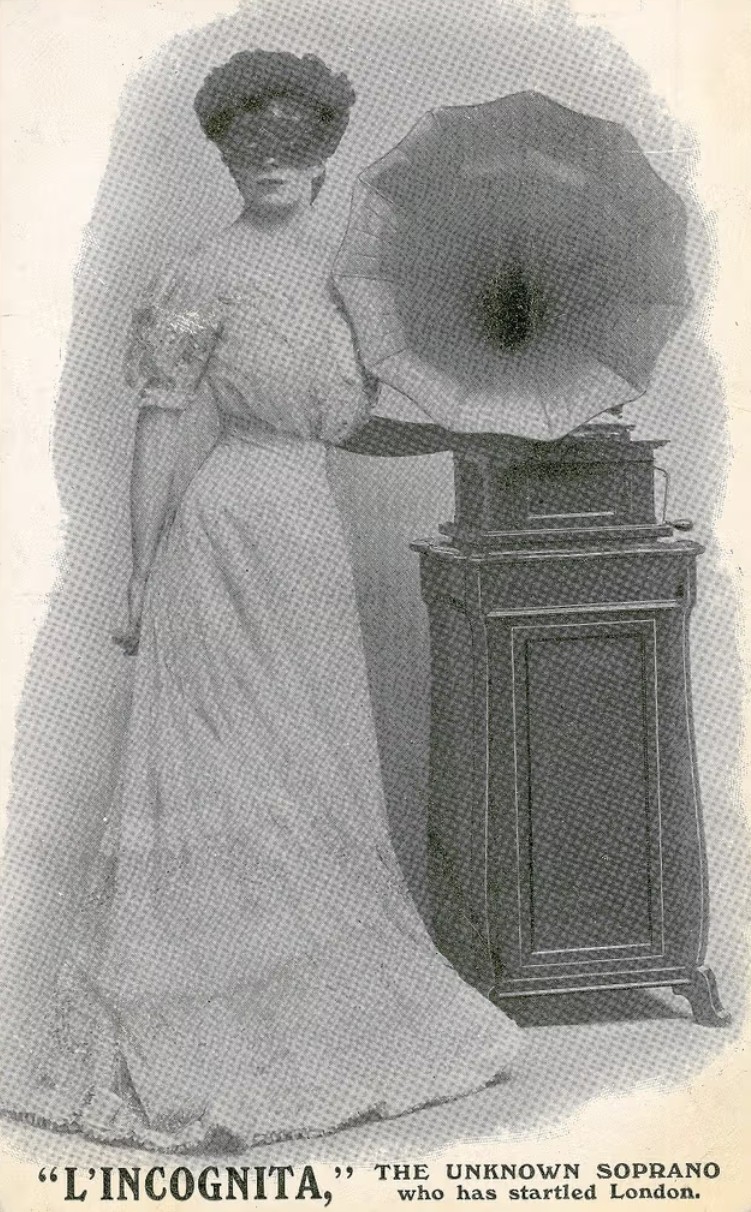 On Wednesday 18 March 1908 at 10.25pm, a masked woman walked for the first time on to the stage of the Alhambra music hall in Leicester Square, London. She was eighth in the pecking order that night, top-of-the-bill being Edouard Garceau, fresh from the chansons of Montmartre. She had been advertised that day as ‘L’Incognita’ and she sang the dazzling ‘Shadow Song’ from Meyerbeer’s Dinorah, taking the high E with ease. She ‘took the house by storm.’1
Violet Mount (aka "L'Incognita") - Meyerbeer: DINORAH, Shadow Song, 1913
But who was she?
Although she has been ignored in all the standard works on singers from Australia and New Zealand, Violet Mount, ‘L’Incognita’, was much admired by K.J. Kutsch and Leo Riemens in what has become the standard international Concise Biographical Dictionary of Singers. They wrote:
Strange rumours about the identity of the singer grew up after the appearance of her records. People conjectured that behind the pseudonym was Luisa Tetrazzini, who had just had great triumphs in England, or Alice Verlet or Yvonne de Tréville. Actually, they were made by the Australian music-hall singer Violet Mount, who was at that time appearing at the Alhambra Music Hall … The records, which appeared under the name L’Incognita and sold in large numbers, presented a lovely coloratura soprano, who possessed a thoroughly trained and virtuoso voice, which would not have been suspected of a music-hall singer.2
Violet Emily Le Breton Mount was born on 15 March 1875 at Caulfield, south-east of Melbourne’s CBD, the house of her paternal grandfather, Dr Mount. For quite differing reasons, her parents were rather extraordinary people.
Her father, Lambton Le Breton Mount, was born in Montreal, Canada, in 1839, the seventh son of Dr Edward Henry Mount and Emily Catherine Le Lièvre Mount (née Le Breton), who had immigrated to Australia from Canada in 1853, settling in gold-rush Ballarat, where Dr Mount practised as a surgeon and general practitioner. It was in Ballarat that Lambton met and befriended Adam Lindsay Gordon, who was to become the ‘father of Australian poetry’. In 1866, Gordon and Mount set up a sheep station at Bunbury in Western Australia. However, there were problems and the venture folded. To the end of his long life, Lambton remembered how he and Gordon ‘rode together’.
The sheep business was to be a portent for a stop-start career that Lambton was to have, much of it as an innovator in the glass manufacturing sector. This was his working life until he retired in his late sixties. However, he was a man of enormous energy, famous for his long-distance running (‘pedestrianism’)―one such being the 285 kilometres from Beechworth to Melbourne. In 1876 he imported forty lacrosse sticks from Canada, establishing that sport in Australia.3 And in 1887-88 he was President of the Victorian Chamber of Manufactures and a commissioner for the Centennial International Exhibition in Melbourne.
But he was also very conscious of his position in Australian society as a ‘gentleman’. And, in the late nineteenth and early twentieth centuries, gentlemen’s daughters led cloistered, lady-like lives and did not take paid work―particularly not on the rackety stage. And this set of beliefs was to affect Violet Mount’s whole life and career.

Lambton Le Breton Mount, c.1878
The Gold Museum, Ballatat

Adam Lindsay Gordon
State Library Victoria, Melbourne
Violet Mount’s mother was Mary Frances Mount (née Glynn), who was born in the St Kilda East suburb of Melbourne on 28 December 1855. Her parents were both immigrants from Cork, Ireland, her father a builder. Mary was a talented pianist and singer, who was to have a profound effect on her daughter’s growth as a musician, playing as her accompanist throughout her early years.
Where (and how) Mary learned that pianistic expertise is not known to me. There are many skills involved in successfully accompanying singers (and other musicians), among them: the ability to sight-read the music; the ability to transpose from one key to another at will; sensitivity both to follow the interpretive wishes of the singer and to provide advice on interpretive matters.
A Melbourne childhood
Violet was Lambton and Mary’s first child, born just nine months after their marriage. And there were five siblings to come, four brothers and a sister Winifred.4 Of these, it appears that only Winnie shared her sister’s musical gift, providing obligato violin to Violet’s singing in early concerts, but not going on to pursue music as a career.
Did Violet (or Winnie) go to school? There is no evidence that they did. So, if not, were they home-schooled by their mother Mary (or by a governess)? Given the later evidence of Lambton’s genteel opposition to Violet having a professional career on the stage, this might well seem to be another part of his beliefs concerning the restricted role of women and girls in the Victorian/Edwardian world.
Nor is there evidence of music teachers being employed by the Mounts—and as a consequence there are no early listings of performances of any kind. They must have been taught their music by Mary and if so, she must have been a remarkable teacher. Perhaps it is no surprise that the three of them first appear in print in Table Talk of 2 December 1892 with products for sale at a church sale of work—Mary offering her ‘fine art’, while Violet (17) and Winnie (15) had made confections.
The next we hear of them is leaving Melbourne on 29 April 1893 on a German steamer, the Karlsruhe,5 whose eventual port will be Bremen, but the Mounts were to disembark at Southampton. The family group consists of ‘Mrs L.L. Mount, Miss Violet Mount, Miss Winnie Mount, Masters Harold and Ray Mount’.6 The boys are the two youngest, with their older male siblings left behind with father Lambton in Melbourne, who was to put their house and furniture up for sale to fund the expedition.7
At the time, it was quite unclear as to why they went on this long voyage. Was it to find music teachers for Violet in Europe? Or just to have a holiday experience? I have yet to discover when they returned to Melbourne but in August 1896, at an ‘At Home’ in Caulfield, Violet sang and her mother Mary both sang and accompanied.
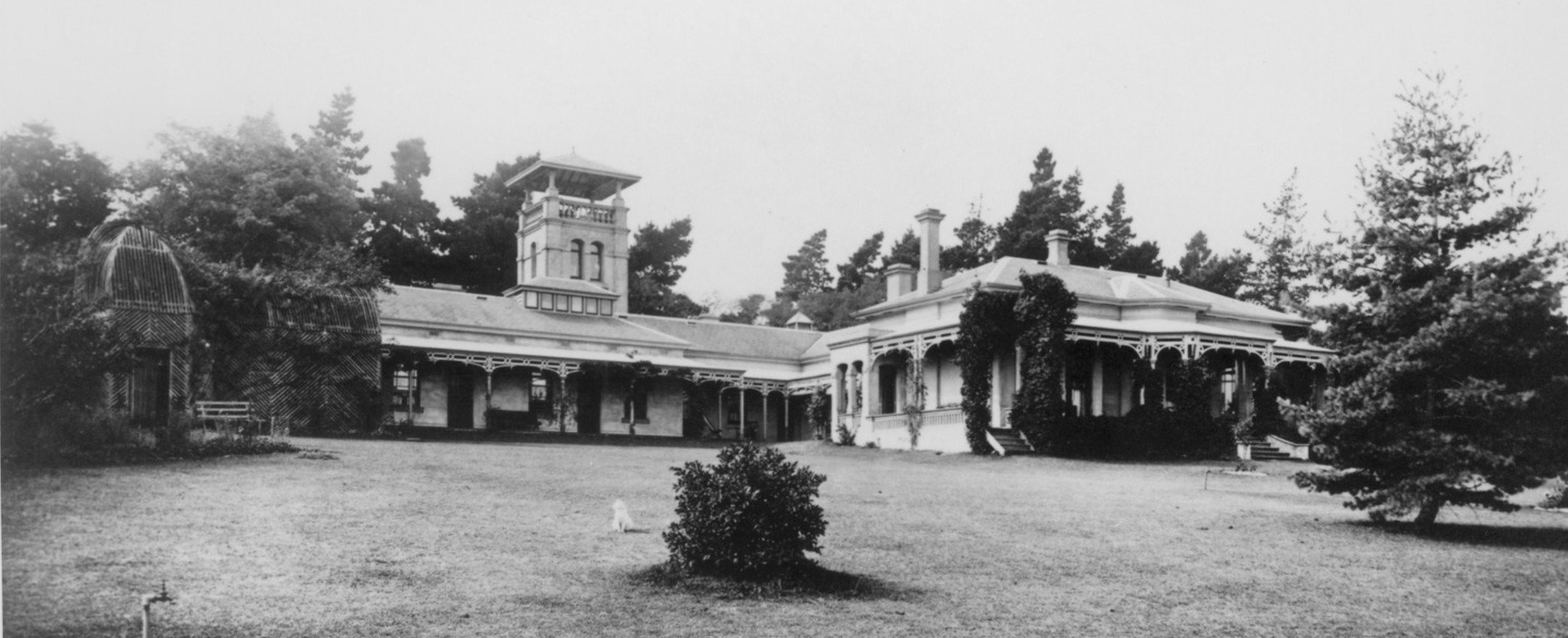 Keroongola—where the Mount family lived during 1896-1898. State Library Victoria, Melbourne.
Returned to Australia, they lived until 1898 at Keroongola in Orrong Road, St Kilda East. And on 28 June 1897 Violet was ‘heard to advantage’ in Marie’s famous aria, ‘Convien partir’, from Donizetti’s bel canto comedy La fille du régiment in a pupil concert for the Howard Conservatoire.8 This conservatoire had been opened in Melbourne the previous year but both the founder, George Howard and its leading singing teacher, the ageing prima donna Fanny Simonsen, died in 1896 and the business was taken forward by Howard’s widow, Mme Houyet-Howard. It offered the full range of musical tuition, singing now being taught by the English tenor William Parkinson and others. Violet was later to disclose that it was Parkinson who was the one who taught her there.
She appeared again in the conservatoire’s second student concert of the year in August, where she gave Agathe’s aria, ‘Softly sighs the breath of evening’ (‘Leise, leise’), from Weber’s Der Freischütz, this time accompanied by a thirty-piece orchestra.9 She was announced to sing a lead role (Plaintiff) in Gilbert and Sullivan’s Trial by Jury in October, a charitable performance.10 And in December Mme Howard gave an ‘At Home’ which featured Violet singing Anton Strelezki’s then-popular ‘Dreams’ with Winnie Mount providing obligato violin.11
To start out on her performing career as an amateur at the age of twenty-two with two showpiece arias shows how confident Violet Mount must have been in her capabilities. In fact, the Weber aria was to have form: it was later sung by Kiri Te Kanawa when she won the Sun Aria competition in Melbourne in 1965 and then by the Finnish soprano Karita Mattila, who sang it when winning the inaugural Cardiff Singer of the World competition in 1983.
It was a promising start and Violet went on the following year to sing at a number of private events in Melbourne, one of them (2 July) including the young baritone Horace Stevens, and another was an ‘At Home’ (7 July) given by her mother at the Mount home in St Kilda East, which included the New Zealand-born tenor Walter Kirby.12 He was to turn out to be a fortunate contact for Violet.13
To New Zealand
In 1899 the Mount family moved from Melbourne to Wellington. It seems that father Lambton was the instigator of the move as his glass manufacturing business was struggling in Australia and …
He came to New Zealand to test the colony’s mineral wealth. He thought Wellington would provide a fine field for glassworks …14
However, the major beneficiary of the migration was undoubtedly Violet, whose singing career simply took off in Wellington with many concert performances that were to be paid for. Did her ‘gentleman’ father approve of the reality that she was becoming a professional?
Violet made her debut in New Zealand on 13 June 1899 in a concert given by the Ladies Musical Society at the Art Gallery in Wellington, conducted by Mrs Alfred Levi. Looking forward to the event, the Evening Post reported:
She is the possessor of a fine soprano voice and has for many years studied at the Howard Conservatoire in Melbourne and in Germany and Paris.15
She sang her aria from La fille du regiment and two songs, ‘creating a favourable impression’. It was a start. Then in July she was in a chamber concert at Choral Hall, where she sang a wider range of arias and songs, accompanied this time by Cyril Towsey, and received fulsome endorsement:
She is gifted with a soprano voice of considerable power and singularly sympathetic timbre, and she sings with ease and displays great intelligence in the management of the words.16
On 29 August, booked by her new friend Walter Kirby, she sang at a concert at the Opera House, attended by the Governor, the Earl and Countess Ranfurly. Again, she sang the Weber aria and Tosti’s ‘Goodbye’.17

NZ Sporting Review, 2 March 1899

Wanganui Chronicle, 12 October 1899
In subsequent months, engagements for Violet came usually twice a month, including: a cantata, Corder’s Margaret; German pianist Albert Friedenthal’s farewell concert (where she sang two of the pianist’s own songs); another concert with Walter Kirby at Wanganui; and in June 1900 she performed in her first opera, Gilbert and Sullivan’s The Grand Duke(as Julia Jellicoe), at the Opera House. She got a mixed review:
Miss Mount’s ability as a singer is well known, but as an actress she is unable, as yet, to give a particularly telling reproduction of a comedienne’s part.18
In November 1900 she sang (perhaps for the first time in public) Henry Bishop’s ‘Lo! Here the gentle lark’,19 accompanied on the flute by Charles Hill, eldest brother of Australasian composer Alfred Hill, with her mother at the piano.20 The song, with its testing coloratura, had already held the stage over many decades, recorded by (among others) Nellie Melba, Galli-Curci, Joan Sutherland, Kiri Te Kanawa―and Violet Mount (as ‘L’Incognita’) with Australasian flautist John Amadio.21 It was to remain in her repertoire throughout.
And the following month she was soloist in Stanford’s Te Deum at a Jubilee event at the Canterbury Hall in Christchurch, among the many speakers prime minister RJ Seddon.22

Alice Hollander, 1900s, by The Biograph Studio
Elisabeth Kumm collection

Jean Gerardy, 1900s, by Falk, Sydney
Elisabeth Kumm collection
Early in the new year, Violet was recruited to ‘assist’ at a concert given by the Australian contralto Alice Hollander at Sydney Street Hall in Wellington. Although she was some seven years younger than Violet, Hollander was already further ahead in her career, which was looking to be in conventional concert halls. Yet it was not long after this meeting that Alice Hollander made an unusual career choice, moving into music halls in Britain:
A good voice is just equivalent to capital, which should be banked where it will draw the best interest … And people who pretend this is not the mainspring of all we do, and talk Art with an exaggerated capital A, are merely ‘foozling’ … The business aspect of the question is that the concert platform is limited to the concert season, whereas the halls are open all year round.23
Hollander implemented this radical strategy in the years before the arrival of Violet Mount in London in 1907. There were few ‘serious’ singers on the halls. Hollander herself would play several music-halls every night, singing just one song at each venue and picking up a handsome fee every time. At some stage, Violet will have recognised the good business sense in Hollander’s working life―and this proposition may well have been put to Violet’s business-oriented father.
Violet was to sing Irish songs, presumably learned in Melbourne at her Irish mother’s knee, at the Opera House in Wellington on St Patrick’s Day 1901―‘Kate O’Shea’, ‘Kathleen Mavourneen’ and ‘The Minstrel Boy’.
However, it was not to be many weeks before the family moved again, this time north to Auckland. And (again) it was father Lambton who instigated the move, having ascertained that there were rich sandstone deposits in the area ideal for glass manufacture.24
That month (May) there was a first Complimentary Farewell Concert for Violet Mount in Wellington, given at the Opera House. She sang ‘Ernani involami’, Chaminade’s ‘L’été’, the trio from The Bohemian Girl, and the grand sextet from Lucia di Lammermoor (with two brothers of Alfred Hill among others).
But before the Mounts left the city, the Wellington Liedertafel with Violet Mount and others gave a concert performance at the Art Gallery of Offenbach’s one-act operetta The Rose of Auvergne.
The New Zealand Free Lance waved farewell to them from Wellington in July 1901:
Miss Violet Mount, the sweet singer from Melbourne, who had practically become a Wellingtonian, left last week to take up her residence with her people in Auckland. Wellington’s loss is Auckland’s gain, for the Mount family is highly musical. Mr Mount, who has successfully floated a glass manufacturing concern in the Queen City of the North, is a sound critic and Mrs Mount is both songstress and pianist. Violet is the flower of the flock and the Mount family simply adore her.25
Her performing life in Auckland picked up immediately, this time with more opera. But first, Violet was hired to assist the Belgian international cellist Jean Gerardy in a series of concerts.26 In October it was announced that Violet would create the lead role in Auckland-based surgeon-composer George de Clive-Lowe’s new comic opera, The LadyTypist. In the event, it does not seem to have got past rehearsals stage.27
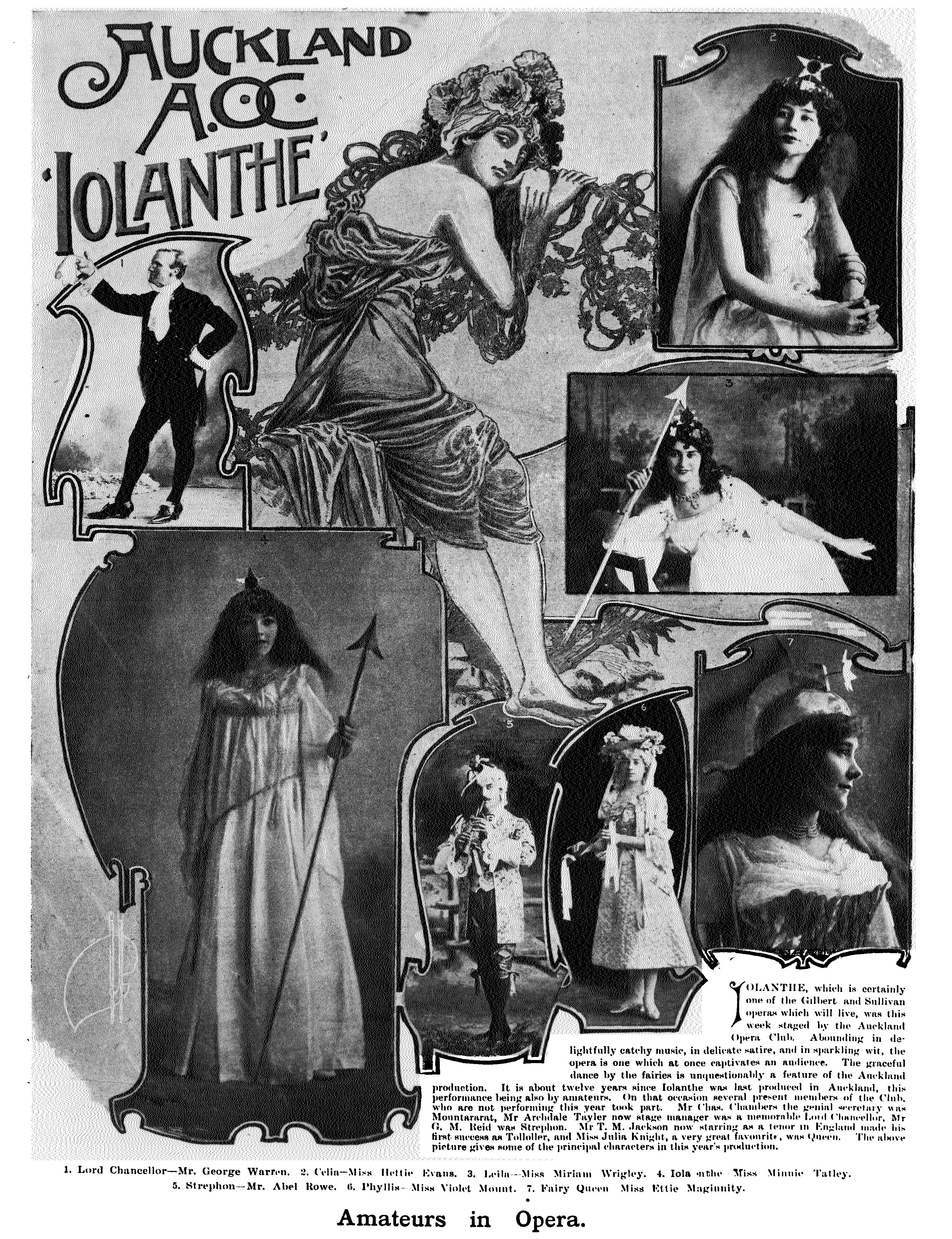 New Zealand Graphic, 26 October 1901
But there was better luck with Gilbert and Sullivan’s Iolanthe, given by the Auckland Amateur Opera Club in November—with Violet as Phyllis: ‘Miss Violet Mount was in delightful voice and unquestionably scored the first honours of the evening.’28
She travelled from Auckland to give concerts in other North Island cities―Hawera in December 1901 and New Plymouth in January; and later that month she again ‘assisted’ contralto Alice Hollander, this time at the Choral Hall in Auckland, singing the cavatina from Verdi’s Ernani.
To Sydney
However, Violet Mount’s sojourn in Auckland was short-lived and, after the obligatory Complimentary Farewell and a performance of Schumann’s Paradise and the Peri, she left for Sydney in May 1902 aboard the Mararoa, the rest of the Mount family remaining in Auckland.29
Violet opened in Sydney with performances on successive days: first, on Monday 14 July, she gave an invitation matinée at Centenary Hall, ‘best heard in Grieg’s Solvieg’s Song’. She must have briefed a local journalist, for in his/her report it was finally disclosed that Violet had studied with singing teachers in Europe in1883: with a Herr Odenwald in Germany (probably Dresden, as disclosed in another interview) and with Mme Caut in Paris. I have (as yet) not been able to identify either of them.30
And on the following day she assisted the Florentine tenor Carlo Dani in his ‘final’ concert in Sydney at the Town Hall. The Watchman was full of admiration for Violet’s performance: she had ‘clear enunciation, sweetness of tone and an expressive style of singing’.31 In the event, she was retained by Dani for his touring company and gave several more performances with him, the ‘Waltz Song’ from Gounod’s Romeo et Juliette being her calling card.

Alfred Hill, 1910, by May and Mina Moore
National Portrait Gallery, Canberra

Roberto Hazon, 1890
National Library of Australia, Canberra
Then in August she sang in a complimentary farewell concert for composer Alfred Hill. Violet had got to know (and had performed with) several of Hill’s brothers in New Zealand. The main event was a performance of Hill’s Maori cantata, Hinemoa, and Violet sang ‘several songs’.32
However, business dropped off in the summer months and Violet felt the need to advertise in the Sydney Morning Herald for work.33 This initiative seems to have borne fruit, as in December she was hired ‘at great expense’ to be the principal soprano in a concert party playing the towns of the Northern Rivers region of New South Wales (Lismore. Byron Bay, Grafton, Ballina, Tweed Heads).34 And she was to repeat the experience with another touring company the following June.
Next came a series of recitals in the Town Hall played by the city’s organist, Arthur Mason. One of these focused on Wagner and Violet sang ‘Elisabeth’s Greeting’ from Tannhäuser.35 In March Violet was appointed soprano soloist for St Patrick’s Church in the Rocks, a role which was to provide her with consistent work. And April brought a Sydney Philharmonic Society performance of Haydn’s The Creation with Violet as soprano soloist. The Italian Roberto Hazon conducted, and Violet was later to claim that he had had a major influence on her singing.36 She must have sung well as the Society booked her again in September for Mendelssohn’s Elijah.
Also in September, Violet sang in the first performance in Sydney of Liza Lehman’s song cycle ‘The Daisy chain’.37 And later that month, Violet was to meet and sing with the visiting Australian contralto Ada Crossley, by now an international concert artist and living in London. Violet’s first encounter with her was at a reception given for Crossley where Violet sang. Then, on 6 November, Mount and Crossley performed together with the Sydney Philharmonic Society in Sydney in Elijah. Both singers received outstanding response from the audience and very generous reviews in the media.38
By this stage in her career, twenty-eight years old Violet Mount had built a strong reputation as a singer―in Wellington, Auckland and Sydney. But her career had quite simply not taken off as other women before her in Australia had managed―among them Nellie Melba, Frances Saville and Ada Crossley. And each of them, in order to take their careers on to a new level, had made the choice to relocate to much bigger markets in Britain or continental Europe.

Violet Mount, 1905, by Appleby, Sydney
State Library of New South Wales, Sydney
This is exactly the advice that Crossley gave to Violet. And some time later Crossley was to write to Violet, ‘asking her to go straight to her [in London] and promising her many engagements.’39 But it was to be a further three and a half years after that Elijah before Violet took the plunge.
The following years, 1904 and 1905, provided Violet with a constant stream of work in Sydney, much of it of the bread-and-butter kind―including oratorios, disaster relief concerts and many farewells for Australian singers and other musicians leaving for the northern hemisphere. There were perhaps two more outstanding events: in April 1904 she sang the role of Elsa in Act One of Wagner’s Lohengrin for the Sydney Philharmonic Society under Roberto Hazon at the Town Hall;40 and June saw the arrival in Sydney of the German pianist Albert Friedenthal, at whose concert she had performed in Wellington four years earlier, again singing the pianist’s own songs.41
It seems likely that father Lambton Mount sailed from Sydney to London on the Rimutakain May 1904.42 In 1905 Violet led the cast as Arline in Balfe’s The BohemianGirl, first at Penrith in May, then at the Palace Theatre in Sydney in September, where her acting was said to be ‘very spirited’.43
More Farewells than …
However, 1905 saw the start of a two-year ‘farewell’ period for Violet as she moved towards leaving Australia and New Zealand, sailing with her mother to London in May 1907.
‘Farewells’ have for so long been synonymous in Australian mythology with Dame Nellie Melba, who very regularly gave performances so named as she approached the end of her illustrious career. But what Violet Mount’s life story shows is that farewells were common currency—for herself and for so many of her musical friends and colleagues.
The planning process for Violet’s farewell from Sydney started in July 1905, leading to the event itself taking place at the Town Hall on 20 September. There were many performers, but Violet’s own main contributions were the ‘Bell Song’ from Delibes’ Lakméand ‘Casta diva’ from Norma, in both of which she ‘sang brilliantly’.44
Then in December Violet returned to Auckland to give a farewell concert ‘before going to Europe’, singing ‘Ah! fors’è lui’ from La traviata, the ‘Bell Song’, ‘Villanelle’ and a Rossini song:
Always a sweet soprano, Miss Mount’s voice has materially increased in power since she was last heard here.45
By February of 1906 Violet was back in her home city of Melbourne, where she opened with an invitation concert at the Pianola Hall in March, followed by Elijah at the Town Hall for the Melbourne Philharmonic Society. While Violet was gratefully received, the star attraction was the Scottish-born baritone Andrew Black, who was touring Australia and was to settle there, perhaps the only leading singer from the ‘Golden Age’ to immigrate.

Andrew Black, 1905
Elisabeth Kumm collection

Melboune Town Hall, c.1906
State Library Victoria, Melbourne
The obligatory Complimentary Farewell Concert for Violet in Melbourne came on 2 May 1906—still twelve months before her actual departure. It was given at the Town Hall, where …
a large audience received the young artist with great enthusiasm … Her voice is a bright, clear, ringing soprano of very wide range—she touched F sharp in alt with exact truth of intonation and perfect sweetness—and she has trained it to an astonishing degree of flexibility … She was accompanied by her mother Mrs Lambton Mount.46
Still marking time, Violet organised in September an operatic event at the Masonic Hall in Melbourne, where she was Marguerite in Acts 3 and 5 of Faust, plus giving arias from Rigoletto, Dinorah and Mignon.47
October saw a return for Violet with Andrew Black, this time in Haydn’s Creation at the Town Hall, a performance they repeated when Violet returned to Sydney in March 1907.48
Her final farewell was, fittingly, given at Her Majesty’s Theatre in Ballarat, the hometown of her father’s family, on 9 May. In ‘Lo! Here the gentle lark’ her obligato flautist was another Amadio, Master Adrian, half-brother of John, and the whole was accompanied by Violet’s mother.49
Violet, ‘Australia’s best soprano’, and her mother finally left Melbourne for London on 24 May 1907 (Empire Day) on the White Star liner Afric.50 She was thirty-one.
What would the future hold?

Mathilde Bauermeister, 1900s
The Newberry, Chicago

L'Incognita, photo by Bassano
The Sketch, 15 April 1908
London: Becoming L’Incognita
When Violet and her mother arrived in London, Violet was quite clear responding to inquisitive reporters: it was to be opera or the concert stage. And strenuous efforts were made in that direction.
In October 1907 she sang at a ‘semi-private’ event where she ‘scored an unequivocal success’.51 Maybe. At that time, she (and presumably her mother) were living with an ‘aunt’ in Queen’s Road Bayswater.52 Was Ada Crossley any help to her? Not much, it seems. Did she go to see Melba, who had helped so many young Australian singers?
In November it was announced that Violet was studying with Mme Bauermeister in London. Born in Hamburg, the mezzo-soprano Mathilde Bauermeister had sung at Covent Garden for thirty-seven years. Melba had organised her Farewell. And in January-February 1908 it was rumoured that Violet had been offered a three-year engagement touring with the Carl Rosa Opera Company—which Violet turned down.53 And she was said to have auditioned unsuccessfully for Covent Garden.
In truth, without causing any stir, from January 1908 Violet had already started, under her own name, to perform in music halls around London—at Putney, Uxbridge, Stoke Newington, Park Lane and Hyde Park.54
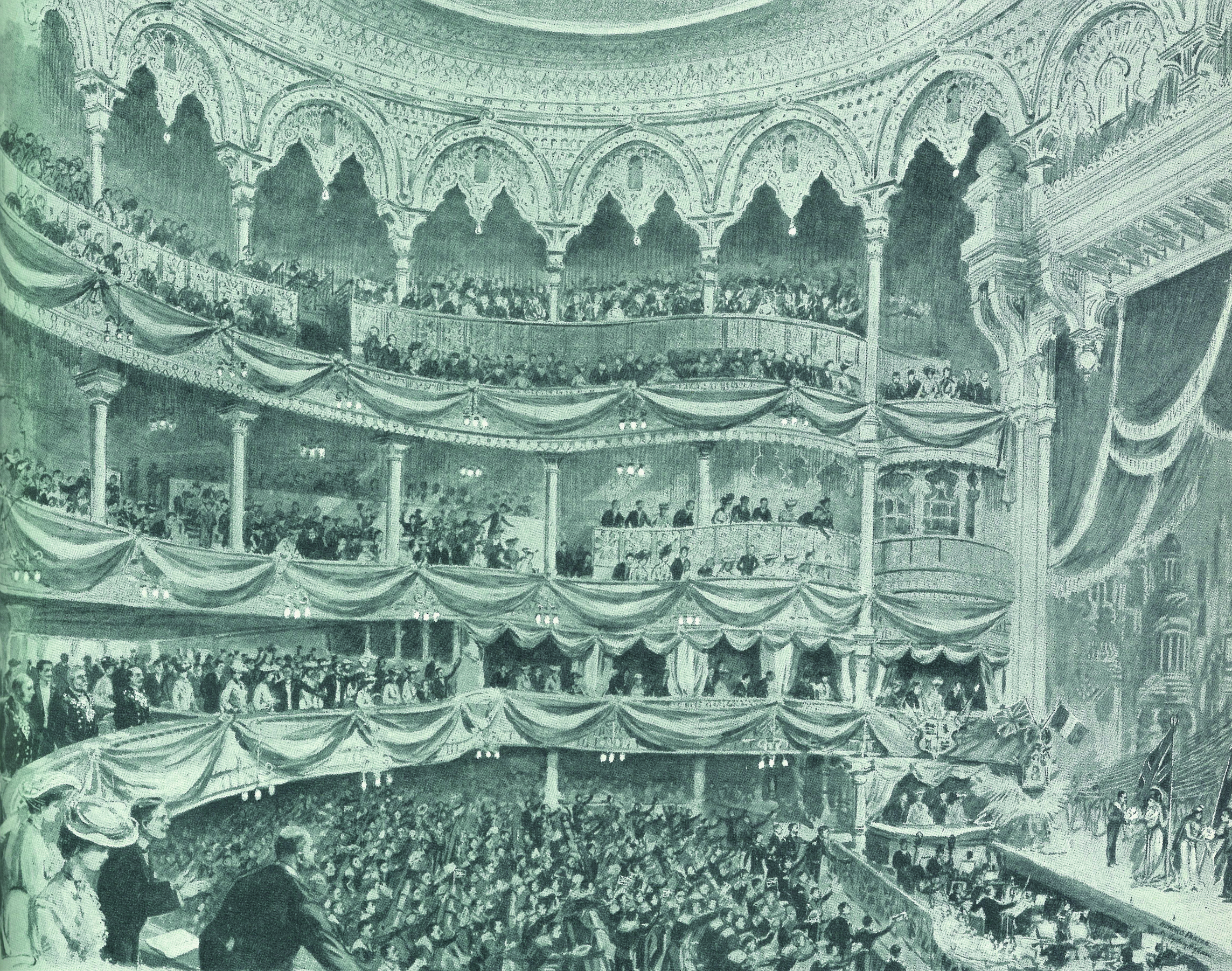 The Alhambra in 1905
It was in March of 1908 that the decisive change in Violet’s fortunes took place. It was reported in these words:
Mystery surrounds the identity of the talented singer, L’Incognita, who created such a sensation at the Alhambra, London, on Thursday evening. A short time ago Mr Alfred Moul, the managing director, received a letter from a firm of solicitors, asking him to give a hearing to a young protegee of theirs. He consented, and the girl, closely veiled, sang before him. Mr Moul discovered that she possessed a voice of remarkable range and purity of tone, and pressed her to appear at the Alhambra, naming a very high fee. She consented to do so for one performance only, on condition that she should not be required to give her name, that no announcement should be made … and that she should be allowed to wear a mask. These were hard conditions but Mr Moul accepted them with the result that the unknown duly made her single appearance and took the house by storm.55
Thus, at thirty-two years old, Violet Mount, L’Incognita, was to embark on a new career, not in opera houses or concert halls, but in the music halls. Immediately following her debut at the Alhambra, she was given a contract of indefinite duration on an exclusive basis to sing nightly.
But who was she? Was she the daughter, as rumoured, of an impoverished nobleman? From the start, she was headlining in the Alhambra’s ubiquitous advertisements. It was in a prime location in London, Leicester Square, the Alhambra being one of the leading halls in the capital with a long line of stars who had performed there.
By the late nineteenth century, music hall was well established in Australia, as in Britain and America. However, there was simply not enough employment for Australian performers in Sydney, Melbourne and the other major cities, and so many came to Britain to find work.

Florrie Forde, 1900s, photo by Foulsham & Banfield
Theatre Heritage Australia

Annette Kellerman, 1910s, by H. Walter Barnett
National Portrait Gallery, London
The majority of the emigrant Australian music hall artists were from working-class backgrounds, performing popular material for primarily working-class audiences, among them the singers Florrie Forde, Albert Whelan and Billy Williams. But there were also successful novelty acts, including the ‘living statue’ La Milo (Pansy Montague), the champion swimmer turned to vaudeville, Annette Kellermann, the ‘world’s greatest liar’, Louis de Rougemont, and the New Zealand-born coloratura ‘siffleur’ (whistler), Borneo Gardiner.
And there was a handful of classically trained Australian-born singers, who, usually unable to break into the opera houses, came to work on the halls in Britain. Among these were contralto Alice Hollander (whose conversion was mentioned earlier), sopranos Syria Lamonte (in 1898 the first woman singer to make gramophone records in Britain), Ada Colley and Florence Esdaile, and baritone Hamilton Hill (who popularised Boer War songs).
Nevertheless, that kind of singer remained the exception rather than the rule in music halls. And an unnamed but a first-rate coloratura soprano in a mask was unique, well appreciated and newsworthy.56
Not to miss the excitement The Times sent along one of their music reporters, who, true to form, sniffily appreciated the performance, while finding fault:
‘L’Incognita’ has a clear and powerful high F, and considerable skill in singing scales and florid passages; it is to be hoped that the money she earns by this engagement will be applied to the continuance of her musical studies, and in particular to the acquirement of better pronunciation both of French and of Italian.57
In mid-April one of the leading illustrated magazines in Britain, The Sketch, carried the by now famous masked singer on its front page, full page, the photograph by the fashionable Bassano.58 And L’Incognita’s first season at the Alhambra went right through to early September, at which point it was suggested that she was to make a tour in Scottish halls and venture abroad to the continent.59

The Phono Trader and Record, April 1908

Was she the sister of the great Luisa Tetrazzini?
Victoria & Albert Museum, London
Within weeks of first appearing at the Alhambra, she was in the studios of the Gramophone Company in London, recording arias for their Zonophone label which featured in her act: ‘Caro nome’ from Rigoletto, ‘Ah! fors’e lui’ from La traviata, the ‘Shadow Song’ from Meyerbeer’s Dinorah and the ‘Mad Scene’ from Lucia diLammermoor.60
The legendary recording producer Fred Gaisberg recalled her entry into the studio wearing her mask: ‘I remember her as a first-class artist with a very pleasing and graceful stage presence.’61
At one of those recording sessions, she was a third persona, Violetta Viamonti—it was issued on HMV. Did she wear her mask for it?62
But, really, who was this L’Incognita? Speculation was rife. If not the daughter of a poor peer, was she perhaps the sister of the great Luisa Tetrazzini? Or was she the real Tetrazzini moonlighting—she was then wowing audiences at Covent Garden in Rigoletto, Lucia di Lammermoor and La traviata.
Her season at the Alhambra completed, in July 1908 L’Incognita appeared at the Grand in Corporation Street, Birmingham, the first of many Stoll-Moss theatres:
Last night every seat in the building was occupied and L’Incognita, who has already achieved considerable distinction in the Metropolis, was given a hearty welcome to this city. She possesses a rich soprano voice. Wearing a black mask, L’Incognita last evening rendered ‘Lo! Here the gentle lark’ and the Polonaise from Mignon in a beautiful clear, rich and telling voice. The applause lasted for several minutes and was led in a hearty manner by the leader of the orchestra.63
Birmingham was followed in August by the Olympia in Liverpool, L’Incognita ‘an artiste of great ability’,64 then the Hippodrome in Coventry. She was to return to London in September—to the Empire at Shepherd’s Bush—then back north to the Stoll-owned Empires in Nottingham and Manchester, where she was introduced as ‘the greatest soprano ever heard on the Vaudeville Stage’.65

The masked singer who is creating quite a sensation at the Alhambra
The Tatler, 10 June 1908

Caricature of Sir Oswald Stoll by Ape
Vanity Fair, 4 January 1911
There was every reason that she would suit Sir Oswald Stoll and his Empire group of theatres. Not only was he Australian born, but he was also committed to presenting music hall as suitable for everyone. And L’Incognita, was fully booked up in Stoll’s theatres in the provincial cities of England and Wales to the end of a year of massive change for her.
This pattern for L’Incognita continued into1909 with her first engagement north of the border at the Empire, Glasgow, her name on the advertisements still in the largest typeface. Then, in February, she made a return to the Alhambra in London for six weeks, before going on to Vienna, where she appeared at the Apollo Theatre.66
After that she returned to the Stoll’s provincial theatres before arriving in July at one of his major London venues, the Hippodrome. From September, for Violet it was back touring in provincial theatres, several of them for a second time around.
L’Incognita’s outstanding, top-of-the-bill career in the music halls of Britain was to sustain itself steadily through the following years. 1910 was fully booked for her, although without a return to London, while 1911 showed a slight slowdown, but included her first performances in Northern Ireland—at the Hippodrome in Belfast. The census of 1911 showed that Violet was living with both her parents at Lauderdale Mansions in Maida Vale.
 The London Coliseum today, londoncoliseum.org
However, the pace was kept up through 1912-1914, and she made a return to the metropolis in February 1912, singing at the Victoria Palace, then again in April 1913 at Stoll’s top London theatre, the Coliseum, where Albert Chevalier was also on the bill.
And she was to return to the Coliseum in October—in the same week that the legendary French actress, Sarah Bernhardt performed there.
28 July 1914 saw the start of the Great War and, although music hall theatres generally remained open, business contracted substantially, 1915 being a particularly bleak year for music hall performers before a slight revival in 1916. It appears that L’Incognita had only one booking in 1917—at the Hippodrome in Newcastle.
In her innumerable appearances as L’Incognita, what had she sung to her music hall audiences? She would always start with one or two bel canto arias, filled with trills and runs and sustained top notes. A regular starter was the dazzling Polonaise (‘Je suis Titania’ but doubtless sung in English) from Ambroise Thomas’s Mignon, or the Jewel Song from Gounod’s Faust, or ‘Ah! fors’è lui’ from La traviata, or the ‘Shadow Song’ from Dinorah. And she continued to sing Bishops’ ‘Lo! Here the gentle lark’, which she had performed before regularly in New Zealand and Australia and was to go on with in duet with flautist John Amadio.
Then she would end with a popular song of the day – ‘I dreamt I dwelt in marble halls’, or ‘Annie Laurie’, or ‘Killarney’, or ’Home Sweet Home’ (a Melba favourite).
In 1919 and 1920, Violet Mount returned to the studio for Zonophone, recording ten new arias and songs, including: ‘Calm and peaceful’ from Il trovatore, ‘Casta diva’ from Norma, ‘Beauty’s Sleep’ by Arditi and the ‘Doll Song’ from Tales of Hoffmann.

Hamilton Gardens in St John’s Wood, London
www.onthemarket.com
And by 1921 the Mounts had moved home from Maida Vale to live at 7 Hamilton Gardens, St Johns Wood, surrounded by expatriate Australian artists, musicians and other singers (including Ada Crossley).67
Probably the wartime slowdown for L’Incognita was exacerbated by the fact that by 1917 her music hall act was already some nine years old and in need of rejuvenation. And this came along in the shape of partnership on stage with the outstanding New Zealand-born flautist, John Amadio.
L’Incognita and Amadio
One of a dynasty of flautists and other musicians, John Amadio was born in Christchurch in 1886 and brought up in Wellington, before moving aged seventeen to Sydney, then Melbourne. However, initially taught by his stepfather, he started playing with the Wellington Orchestral Society at eleven. In 1911 he was principal flute in Dame Nellie Melba’s touring opera company in Australia.
John moved to London in 1920, where he was to tour with a range of top-flight artists, including Nellie Melba, Luisa Tetrazzini, Emma Calvé, Galli-Curci and his second wife, Florence Austral.

Palace Theatre, Grimsby
Grimsby Local History Library

Royal Hippodrome, Preston
Lancashire City Council
Already a star in his own right, Amadio was to tour in music halls as a duo with L’Incognita from October 1920, and they were given equal billing. To great applause, they opened at the Palace in Grimsby, going on immediately to Liverpool, Darlington and Rochdale, in each place greeted warmly. They were usually advertised as ‘The Phenomenal Soprano and Wizard of the Flute in the Magic of Flute and Voice’.68
The partnership continued touring around UK music halls through to 1924, at which point it came to an abrupt end—the final engagement being at the Royal Hippodrome in Preston in July 1924.69 When Amadio went on to perform in the USA in 1925 with soprano wife Florence Austral, it effectively spelled the end of L’Incognita’s performing career. She was approaching fifty. Violet’s only future appearances on stage came in a touring pantomime in the north of England, ‘Dick Whittington and his Cat’ in 1925 and in a concert at the Star, Tonbridge, in 1928.
But a lasting legacy of her time performing with John Amadio came in the form of three gramophone records made for Zonophone in September 1921—‘La Villanelle’ by dell’Acqua. ‘Lo! Here the gentle lark’ by Bishop and ‘Sweet Bird’ by Handel. Already well-known by the halls’ audiences, they were an ideal catch for Zonophone and the recordings sold very well, and the three pieces were at the centre of their live performances together.
As an aside, it’s curious to note that, although Australian and New Zealand newspapers knew from the start that Violet Mount and L’Incognita were one and the same person, this was never revealed in the British media.

John Amadio with his wife soprano Florence Austral, 1930
National Library of Australia, Canberra
From 1925 onwards, Violet Mount is less easy to find. That year she gave written evidence in the divorce proceedings in Melbourne between John Amadio and his first wife, Leonora Soames Amadio. Violet was now living at Birchington Road, West Hampstead.70
The following year, Violet visited Australia House (which had opened in 1918) with her aged father.71 Lambton Mount died at 95 in London in June 1931, remembered in Australia for his friendship with Adam Lindsay Gordon and for his long-distance foot races.72
That’s all …
But in 2009 I was lucky enough to find Violet’s great-niece Linda Mount, and she sent me this email about the singer’s last years. It gives us a rare glimpse into the more private personality of Violet Mount, the woman:
I remember her well when she was older and retired. She came to live in Weybridge in Surrey to be near her brother Ray and his family, my father being one of his sons, Jack. I don't remember exactly when she died but it was in the mid-60s sometime. She was extremely fit, lived independently and never went to hospital until she was in her 90s when she had a short illness and died.
I remember her being a very feisty old lady who enjoyed debating various topics, particularly with her brother. I am sure she must have been quite a dramatic singer and after a glass of wine at Christmas she would suddenly burst into an aria or two during the lunch! If she had had a good time, she would also sing some opera when she waved one off from her flat! Certainly, as a child it was quite something.
I also remember she had some friends who lived in Weybridge so I think she had quite a happy retirement. I was a teenager when she died and I cannot remember more about her. It is nice to have a couple of old records of her singing and so we can hear how good her voice was. I gather the reason she was called L'Incognita or the Masked Soprano was because her father felt it was unladylike to appear on stage so everyone could see her face—how times have changed!73
In fact, Violet Mount died, not in the mid-1960s, but in September 1972. Living a year longer than her father, she was ninety-six. Sadly, her passing was not noted—neither in Britain, nor in Australia or New Zealand.
But the neglect of Violet Mount since that time seems hard to explain, when her surviving recordings reveal an Australian bel canto soprano only equalled by Nellie Melba and Joan Sutherland.
L’incognita and Violetta Viamonti Recordings
Based on a full discography by David Mason
All of Violet Mount’s recordings, made under the pseudonyms L’Incognita and Violetta Viamonte, were made for the Gramophone Company’s subsidiaries, Zonophone and HMV. In total there were 21 recordings issued under the L’Incognita name, all on Zonophone (plus 4 unissued takes) and just one as Violetta Viamonte on HMV.
The early recordings were from 1908-09 and the later ones from 1919-21. All but one of the L’Incognita records were later reissued, most of them twice over, indicating that the company thought they still would sell.
L’Incognita: issued recordings (all Zonophone)
La traviata, Ah fors’è lui (Verdi), Matrix 8146, recorded April 1908
Dinorah, Shadow Song (Meyerbeer), 8147, April 1908
Mignon, Io son Titania Thomas), 8164, April 1908
Lucia di Lammermoor, Mad Scene (Donizetti), 8196, 1908
Rigoletto, Caro nome (Verdi), 8199, 1908
Hamlet, Mad Scene (Thomas), 21620, 10 June 1919
Rosebuds (Arditi), 21644, June 1919
Il trovatore, Calm and peaceful was the night (Verdi), 21657, 1919
Norma, Gentle Godess (Bellini), 21658, 1919
The Tales of Hoffmann, Doll Song (Offenbach), 21723, 1919
Beauty’s Sleep, (Arditi), 21725, 1919
Mireille, Waltz Song (Gounod), 21920, 1920
The Daughter of the Regiment, None can gainsay (Donizetti), 21922, March 1920
Maritana, Scenes that are brightest (Wallace), 21923, March 1920
Der Freischütz, Softly sighs the voice of even (Weber), 21935, 1920
Tom Jones, Waltz Song (German), 21936, 1920
A Masked Ball, You’d fain be hearing (Saper vorreste) (Verdi), 22111, September 1920
Il trovatore, Silent the sombre wings of night (Verdi), 22126, October 1920
Il pensiero, Sweet Bird (Handel), 493, 23 September 1921 (with John Amadio, orchestra George W. Byng)
Villanelle (dell’Acqua), 494, 23 September 1921 (with John Amadio, orchestra George W. Byng)
Lo! Here the gentle Lark (Bishop), 495, 23 September 1921 (with John Amadio, orchestra George W. Byng)
Note: This ‘Lo! Here the gentle lark’ recording was included in the 4CD set, From Melba to Sutherland: Australian Singers on Record(Decca Eloquence 2016)
Bibliography
Warren Bebbington (ed), Oxford Dictionary of Australian Music, Oxford University Press, Melbourne, 1998
J.S. Bratton (ed), Music Hall: Performance and Style, Open University Press, Milton Keynes, 1986
Doug W. Fox, Lacrosse in Australia: Lambton L. Mount and the Foundation Years, self-published, Melbourne, 2021
Edouard Garceau, The Little Doustes, (translated by Vera A Chappell) Frederick Muller, London, 1935
Victor Glasstone, Victorian and Edwardian Theatres: An Architectural and Social Survey, Thames and Hudson, London, 1975
K.J. Kutsch & Leo Riemens, A Concise Dictionary of Singers: From the Beginning of Recorded Sound to the Present, Chilton Book Company, Philadelphia, 1962/1969
Barbara & Findlay Mackenzie, Singers of Australia: From Melba to Sutherland, Lansdowne, Melbourne, 1967
W. Macqueen-Pope, The Melodies Linger On: The Story of Music Hall, WH Allen, London, 1950
Raymond Mander & Joe Mitchenson, British Music Hall: A Story in Pictures, Studio Vista, London, 1965
Roger Neill, ‘Going on the Halls’, unpublished, part of uncompleted dissertation, Goldsmiths College, London, 2013
―― DIVAS: Mathilde Marchesi and her Pupils, NewSouth (University of New South Wales Press), Sydney, 2016
――, Melba’s Farewell, Decca Eloquence (CD), Sydney, 2017
――, ‘Re-discovering Syria Lamonte: Pioneering Recording Artist, Theatre Heritage Australia (online), Melbourne, 2023
――, The Simonsens of St Kilda: A Family of Singers, Per Diem Projects, King’s Sutton, 2023
――, ‘Florrie Forde at 150: Melba for the Masses’, Theatre Heritage Australia (online in three parts), Melbourne, 2025
Roger Neill & Tony Locantro, From Melba to Sutherland: Australian Singers on Record(4CD set), Decca Eloquence, Sydney, 2016
Adrienne Simpson, Opera’s Farthest Frontier: A History of Professional Opera in New Zealand, Reed, Auckland, 1996
Douglas Sladen (ed), The Poems of Adam Lindsay Gordon, Constable, London, 1912
J.B. Steane, The Grand Tradition: Seventy Years of Singing on Record 1900-1970, Scribner’s, New York, 1974
John Mansfield Thomson, The Oxford History of New Zealand Music, Oxford University Press, Auckland, 1991
Angela Woollacott, To Try Her Fortune in London: Australian Women, Colonialism and Modernity, Oxford University Press, New York, 2001
Endnotes
1. This recording has been transferred from an ancient shellac 78rpm record with all the clicks and buzzes left intact; nevertheless, Mount’s bel canto singing shines through
2. Kutsch and Riemens (1962/1969), p.203
3. The Lambton Mount Lacrosse Club in Melbourne exists to this day
4. Le Breton in 1876, Winifred in 1877, Lambton Le Breton in 1881, Rupert Henry Le Breton in 1886 and Frank Raymond De Tito in 1887
5. This Karlsruhe, a Norddeutscher-Lloyd vessel, was built in Glasgow in 1889
6. Argus, 1 May 1893, p.4
7. Argus, 10 April 1893, p.2
8. La fille du regiment was to become a core role in Joan Sutherland’s career many years later
9. Punch (Melbourne), 26 August 1897, p.18
10. Table Talk, 8 October 1897, p.9; Australasian (Melbourne), 16 October 1897
11. Punch (Melbourne), 9 December 1897, p.16
12. Punch (Melbourne), 7 July 1898, p.16
13. Argus, 8 October 1931; he later annoyed Melba, when he missed the boat to take him from Tasmania to New Zealand in 1903; and, sadly, in 1931 he was imprisoned for 21 days in London, having been accused of ‘an act of indecency’ at Victoria Station
14. New Zealand Free Lance, 11 May 1901
15. Evening Post (Wellington), 10 June 1899
16. Evening Post, 8 July 1899
17 Evening Post, 30 August 1899
18. Evening Post, 21 June 1900
19. The song is frequently, incorrectly, rendered by journalists and others as ‘Lo! Hear the gentle lark’
20. Evening Post, 29 November 1900
21. Flautist remained the spelling used in Australia and New Zealand at that time; more on John Amadio later
22. Evening Post, 18 December 1900
23. Don Ross, ‘The World of Music Hall in 1906’, Call Boy, London, June 1972
24. New Zealand Free Lance, 11 May 1901
25. New Zealand Free Lance, 6 July 1901
26. Auckland Star, 12 August 1901
27. New Zealand Free Lance, 12 October 1901
28. Observer (Auckland), 2 November 1901
29. Otago Witness, 28 May 1902
30. Australian Star, 11 July 1902
31. Watchman (Sydney) 26 July 1902
32. Daily Telegraph (Sydney), 18 August 1902; born in Melbourne in 1869, Alfred Hill was already the leading composer in Australia-New Zealand
33. Sydney Morning Herald, 15 November 1902
34. Northern Star (Lismore), 3 January 1903
35. Sydney Morning Herald, 19 February 1903
36. Daily Telegraph (Sydney), 3 April 1903
37. Sydney Morning Herald, 21 September 1903; words by Alma Tadema and Robert Louis Stevenson
38. Daily Telegraph (Sydney), 7 November 1903
39. Sydney Mail, 5 June 1907
40. Sydney Morning Herald, 11 April 1904
41. Sydney Morning Herald, 6 June 1904
42. New Zealand Times, 12 May 1904
43. Sydney Morning Herald, 9 August 1905
44. Sydney Morning Herald, 21 September 1905
45. Observer (Wellington), 2 December 1905
46. Argus (Melbourne), 3 May 1906
47. Argus (Melbourne), 20 September 1906
48. Sydney Morning Herald, 22 March 1907
49. Ballarat Star, 11 May 1907
50. Punch (Melbourne), 30 May 1907
51. Punch (Melbourne), 24 October 1907
52. Daily Telegraph (Sydney), 31 October 1907; who is the ‘aunt’? I can’t see that mother Mary had sisters, so maybe it was a sister of father Lambton, born in Canada
53. Sydney Morning Herald, 12 February 1908
54. Daily Telegraph (London) and others, 19 March 1908
55. Worcestershire Advertiser, 21 March 1908
56. Curiously, while Australian newspapers joyfully reported that L’Incognita was in fact Violet Mount, British papers never revealed the connection
57. Times (London), 1 April 1908
58. Sketch (London), 15 April 1908
59. Sydney Morning Herald, 9 September 1908
60. Zonophone was a subsidiary of The Gramophone Company in London
61. Gramophone, February 1943
62. David Mason points out that Zonophone recordings by ‘Madame Violetta’, some of them with Ernest Pike, were not by Violet Mount but by English mezzo-soprano Edna Thornton
63. Evening Despatch (Birmingham), 21 July 1908
64. Liverpool Echo, 4 August 1908
65. Manchester Evening News, 14 January 1909
66. Mercury (Clevedon), 20 March 1909
67. In 1939 she lived at 51 Boundary Road, Primrose Hill (Hampstead); they had been at 7 Hamilton Gardens until the mid-1930s; Violet's mother, Mary Mount, died in January 1922 in Marylebone, Herald (Melbourne), 1 February 1922
68. Hampshire Independent, 11 August 1922
69. Lancashire Evening Post, 11 July 1924
70. Telegraph (Brisbane), 26 September 1925
71. Australasian (Melbourne), 25 February 1926
72. Sydney Morning Herald, 15 June 1931
73. Email from Linda Mount to Roger Neill, 26 August 2009
Acknowledgements
With especially grateful thanks to Tony Locantro, who originally introduced me to Violet Mount and several other Australian singers and is a constant editor of my writings. To David Mason for providing a full discography of Violet Mount’s recordings. And to Elisabeth Kumm, publisher and magician with illustrations.
Also, thanks to Jamie and Linda Mount, relations of the subject. And to my wife, Sophie Wilson, who always provides valuable perspective.


