Ada Crossley
-
James Hay: A tenor lowly-born who married into a world of wealth

 ‘Over the Moon’ by H.M. Brock, designed for the front cover of the programs for the D’Oyly Carte Opera Co.’s 1919–1920 season at the Princes Theatre, London. Courtesy of David Lovell.Having trained with the best teachers, performed with prestigious companies, and married a wealthy widow, South Australian-born tenor James Hay should have led a charmed life, but as JEFF CLARKE discovers, marrying into ‘a world of wealth’ does not necessarily bring happiness.
 James Hay, dated 1923. Photographer unknown. British Library, London.
On 1 july 1958, in Brighton, England, a 73-year-old single gentleman passed away in the town’s General Hospital. The death certificate records that he died of cerebral arteriosclerosis, a thickening of the arteries that supply the brain which would have undoubtedly caused a degree of dementia. The fact that the ‘occupier’, a member of the hospital administration, registered the death suggests that no family or friends were there, or even knew of his passing. Furthermore, that the certificate states Occupation Unknown confirms that very little was known about him. No grant of probate was ever recorded, so either his estate was not large enough to need one, or possibly he died intestate.
He was Peter James Hay; an Australian classical singer who had once lived at the swankiest of addresses—a bachelor pad on London’s Pall Mall, had studied with the great Polish tenor Jean de Reszke, had sung with Tetrazzini, and had for a number of years been a principal tenor of the celebrated D’Oyly Carte Opera Company.
There is much we don’t know about his later life or how he came to die in such lonely circumstances in Brighton, but his early life is better documented.
His father, Peter Hay, was a Scottish sheep farmer who had arrived in South Australia in the early 1880s. With his wife Sarah Ann (née Hair) he bought a small farm in Luton near the town of Clare, SA. In that remote rural setting Peter James was born on 21 August 1885. When appearing in The Gentle Shepherdin Scotland many years later, he would recall his early life: ‘My grandfather was a Presbyterian Minister in Edinburgh, but he emigrated to Australia, and there my father took up sheep farming. I remember as a wee laddie minding the sheep, and another recollection which remains with me very clearly is that of my grandfather rocking me on his foot as a tiny child, and singing many of the old airs and melodies reminiscent of the tunes which run through The Gentle Shepherd. I never saw a train until I was fourteen years of age, so you may imagine how remote we were from the busy highways of life.’1 His father too would sing his young son to sleep with songs of Scotland, something Hay would later acknowledge as the root of his musical ability. ‘I owe all my success to my father, who gave me an appreciation of the best in music, and taught me the right idea of singing.’2 He recalled that his father had a fine tenor voice, and trained his son in the old Scottish folk songs. His guiding principle was expressed in these words: ‘The author of the song is the man who wrote the words.’ Even when Hay was at the height of his career, after years of training, it was noted that he sang with a noticeable Scots burr. It can be heard on the only recording that survives of him singing, a recording of D’Oyly Carte’s HMS Pinafore in which he sings the role of Ralph Rackstraw.
When Hay was 14 years old the family moved to Western Australia, where amongst other musical pursuits, he became a choirboy at Perth Cathedral. ‘On leaving school I went into business, but I used to devote all my spare time, and some of my time that was not spare, to music, the only thing in which I was interested. As a result, I occupied many different positions for only brief spaces of time—much to the annoyance of my father. He died when I had been at work for a year or so, and I found myself obliged to think seriously of my future.’3
His first singing teacher in Perth was a man called Lardeth, thereafter he studied with Mr. J.B. Huntingdon of whom he spoke glowingly in later years, declaring that throughout his subsequent studies in London and Paris and with the great Jean de Reske, ‘no alteration was ever considered necessary in the foundations of the art imparted at this Perth master’s hands.’4
Soon after his father’s death, Hay left Perth for Melbourne, but before he went, he gave a final recital at the Boulder Mechanic’s Institute. There was a good ‘front’ house for the concert, but, as the Kalgoorlie Miner reported, ‘the program did not contain the lighter items that appeal to a goldfield’s populace, and consequently there was poor attendance in the back of the hall’5 Those that attended certainly couldn’t complain of being short-changed, since the program was astonishingly long, concluding with ‘Take a Pair of Sparkling Eyes’ from The Gondoliers.

Amy Sherwin, dated 1898. Photo by London Stereoscopic and Photographic Company.
State Library of New South Wales, Sydney

Jean de Reszke, photographed by Benque & Co., Paris in 1892
Isabella Stewart Gardner Museum, Boston
Hay arrived in Melbourne with nothing but a letter of introduction and a reputation for being hopeless at business and for wasting his time on music. ‘Then we’ll try you at music,’ said a benevolent Scotsman to whom he was introduced and who soon took him under his wing. ‘I dinna think ye’ll ever dae ower much at business,’ said the old man, ‘but ye micht dae weel at the music.’ ‘I’ll take you to Marshall Hall, and if he says you have a chance of a musical career, I’ll back you for a couple of years till you can make your own living.’ Though Hay acknowledged the help of the generous man numerous times when recounting his career, he never divulged the Scotsman’s name. Marshall Hall’s advice was that he should take up singing professionally and go to Paris to study. Hay replied that he had no money, but the generous Scot provided the necessary financial backing for the crossing.
On the way over to Europe, Hay met the Tasmanian-born operatic soprano Amy Sherwin, with whom he subsequently studied in London for six months. Madame Sherwin had studied with Stockhausen, and Hay later acknowledged her to be a great practical teacher. Moving to Paris he commenced studies with a celebrated French baritone by the name of Monsieur Brouhy, before being taken on as a pupil with Jean de Reszke under whose guidance he remained for eighteen months. Hay recalled the experience: ‘His system, if such it can be called, consisted chiefly in singing a phrase more like an angel, than a human being. “Do it like that” added the great one in French, and of course you did—not! However we used to do operas in his little theatre in the Rue de la Faisanderie, and learned interpretation according to our brain –power. He always threw out the stupid pupils, no matter how fine their voices were.’6

Luisa Tetrazzini, 1908. Photo by E.F. Foley, New York.
Boston Public Library, Boston.

Ada Crossley, 1905. Photo by H. Walter Barnett, London.
National Portrait Gallery, London
Returning to England in 1909 he gave a recital at London’s Aeolian Hall which de Reszke had arranged for him. The Daily Telegraph reviewing the concert on 1 December found his performance of an aria from Gluck’s Iphigenia en Tauride ‘rather lacking in dramatic spirit’, but found good taste and delightful charm in his rendering of chansons by Fauré and Debussy. Overall, the recital was deemed to be a success, resulting in numerous subsequent engagements. The first was with the Chappell Ballad Singers, followed by six promenade concerts for Sir Henry Wood at the Queen’s Hall including singing with the Royal Choral Society in Missa Solemnis. On one occasion he was called on to deputise for the indisposed Gerard Elwes in Elgar’s The Dream of Gerontius. ‘Next I had the invaluable experience of singing Berlioz’s Faust with Richter and studying oratorio under Rendegger. I then toured with Tetrazzini and Madame Ada Crossley for a couple of years.’7
Perhaps it is testament to either his quixotic nature, or to his passion for singing that only a week after his London debut recital at the Aeolian Hall, he travelled all the way to Coleraine, Northern Ireland, to sing in a concert in aid of a local rowing club. Or maybe the fee made the journey worthwhile. He was billed as ‘The New English Tenor’.

Ivor Novello with his mother, Madame Novello-Davies, 1916. Photo by Lallie Charles.
National Portrait Gallery, London

Opera singer Ruby Heyl, 1913. Photo by Matzene, Chicago.
J. Willis Sayre Collection of THeatrical Photographs, University of Washington Libraries
In 1913 we find him taking part in a concert organised by Madame Clara Novello-Davies, to promote the compositions of her son Ivor Novello. Although the newspapers claimed that all the artists taking part in the concert had been trained by Madame Davies, Hay never acknowledged that he received any tuition from the Welsh Impresaria. Other singers taking part were Ruby Heyl who later had a career in the Chicago Opera Company; Charles Mott, a young English baritone of much promise, and much admired by Elgar, who was tragically killed in action in 1918; and Sara Melita (née Davies) who had sung at the Queen’s Hall Proms with Hay. The Referee found Hay’s rendering of Novello’s song “The Valley” particularly pleasing.8 Ivor himself was not at the concert, as he was in America “for the production of his new opera”,9 so we cannot be certain whether he and Hay ever met.
Immediately afterwards Hay embarked on his afore-mentioned tour with Madame Tetrazzini. It appears that most of her concerts were in Wales, where she was feted and most rapturously received. When in North Wales, the party stayed at the Pwll-y-crochan Hotel, the finest that Colwyn Bay could offer. The list of guests published by the North Wales Weekly News on August 1 tells us that not only did the great soprano travel with her own maid, Monsieur Tetrazzini was there with his valet, as was James Hay, Esq. of Walton-on-Thames.
‘All this time I had been anxious to go on the stage. So I applied to Mr D’Oyly Carte, of the Gilbert and Sullivan operas. He engaged me, but when I asked him what parts I would play he dashed my hopes. “Parts!” he exclaimed. “When you have never been on the stage before! You start in the chorus.”
‘It was rather a drop for me, but my determination to go on the stage conquered my pride, and I accepted his offer.
‘After a few months I was given a trial as Col. Fairfax in The Yeomen of the Guard, and after that I played parts until March 1915.’
In his later interviews with the press, Hay always said his debut as Fairfax took place in Glasgow in 1912, but as we have seen, unless the company gave him time off to sing for Clara Novello-Davies and Mme Tetrazzini, which is most unlikely, he cannot have joined till the summer of 1913.
We first see him being billed as a company principal in October when he is announced as one of two new tenors expected in Cambridge. The other was Dewey Gibson. Two months later, The Era, in possibly his first review as a principal, as Nanki-Poo in The Mikado at the Borough Theatre, Stratford, East London, reported that ‘Mr James Hay was heard to distinct advantage in the rôle of Nanki-Poo, and he played the persistent lover very successfully.’10
Between 1913 and 1915, Hay played the roles of Ralph Rackstraw in HMS Pinafore, Earl Tolloller in Iolanthe, Frederic in The Pirates of Penzance, Prince Hilarion in Princess Ida, Nanki-Poo in The Mikado, and Colonel Fairfax in The Yeomen of the Guard.
He left the company in March 1915, but we do not know where he spent the rest of the war years. It seems unlikely that he saw active service. By this time, he had begun a relationship with a wealthy London widow, a multi-millionairess, Stella Ettlinger, many years his senior. It may be that he and Stella fled to safer territories, though their names do not appear on known passenger lists.

Elsie Griffin as Mabel and James Hay as Frederic in Act I of The Pirates of Penzance
Courtesy of David Lovell

Griffin and Hay in Act II of Pirates
Courtesy of David Lovell
The war safely over, Hay returned to D’Oyly Carte in 1919. Richard D’Oyly Carte’s son Rupert had now taken over the running of the company and was firmly wielding a new broom. Rupert began re-costuming and re-designing the operas, launched a West End London repertory season, not at the Savoy but at the larger Princes Theatre (now the Shaftesbury), and created a second company which would tour smaller towns and cities. Hay returned to the principal company, then known as the Repertory Company, and adding Duke of Dunstable in Patience to his roles, he continued to play Ralph, Frederic, Hilarion, Nanki-Poo, and Fairfax. It was a short-lived spell however as in June 1920, he left and returned to Australia to join a new J.C. Williamson company which was being put together to tour Australia with seven of the operas.
 Leo Sheffield as Captain Corcoran, Elsie Griffin as Josephine, Frederick Hobbs as Dick Deadeye, James Hay as Ralph Rackstraw and Sydney Granville as Bill Bobstay in HMS Pinafore. Courtesy of David Lovell.
Before he went, he managed to fit in an appearance at the Kings Theatre, Hammersmith, in a production of Audran’s comic opera La Cigalegiven by the Selfridge Operatic and Dramatic Society. The Stage found that ‘as Chevalier Franz de Bornheim, Mr. James Hay showed a tenor of unusual sweetness; his work is accompanied by a good deal of finely-felt singing, and his rendition of “Trifle Not With Love” is extremely fine.’11
Meanwhile in Australia, the Melbourne journal Table Talk reported that ‘Rehearsals for the Gilbert and Sullivan opera season under the J.C. Williamson Ltd. management have already commenced at Her Majesty’s. On the way out from England are Charles R. Walenn, who was such a favourite when he last appeared in the Gilbert and Sullivan opera under the J.C. Williamson management; Gayford Hobbs [i.e. Frederick Hobbs] (baritone), James Hay (tenor). Both of the last-mentioned artists have been figuring with great success in the Gilbert and Sullivan revival in London. Also coming to Australia is Albert Kavanagh, already popular here by his appearance in the role of Popoff in the Clarke and Meynell production of “The Chocolate Soldier.” Others to be included amongst the principals will be Eileen Castles, who achieved great success in Gilbert and Sullivan opera in America; Ethel Morrison, Strella Wilson, and others. The operas will be produced by Minnie Everett, and the conductor will be Gustave Slapoffski.’12
 Program for HMS Pinfore, Melbourne, 16 October 1920. From JCW Prompt Scrapbook 8, Vol. 4, National Library of Australia, Canberra.
The opening season consisted of productions of The Gondoliers, in which Hay played Marco for the first time, The Mikado, The Yeomen of the Guard, Iolanthe, Patience, HMS Pinafore and The Pirates of Penzance. The tour opened at Her Majesty’s Theatre, Melbourne on Saturday, 7 August 1920, with a performance of The Mikado, before visiting Sydney, Perth, Adelaide, Brisbane, and Toowomba in October 1921. The company then returned to Melbourne by which time Princess Ida and Trial by Jury had been added to the repertory.

The Bulletin, 19 August 1920, p.34

The Bulletin, 10 February 1921, p.34
In most announcements of the tour, Hay was referred to as ‘the new tenor’. It is surprising that more wasn’t made of his Australian roots, although the Sydney Morning Herald reviewing The Mikado, and wrongly calling him a Victorian, at least gave him a glowing notice: ‘To James Hay, a Victorian, came most of the applause. As Nanki Poo his make-up was excellent, and the trueness and sweetness of his voice quickly won favor, which was added to as the entertainment proceeded. His rendering of “A Wandering Minstrel” was delightful.’13

James Hay as Hilarion and Sylvia Cecil in the title role of Princess Ida, London
Wilson & Lloyd

James Hay as Frederic and Elsie Griffin as Mabel in The Pirates of Penzance, London
Wilson & Lloyd
At the end of his engagement, Hay returned to London. He frequently recounted the story of an occurrence when he happened to call into Rupert D’Oyly Carte’s office one morning in January 1922 ‘with nothing particular in view, and Pinafore hopelessly in full swing at the Prince’s Theatre. While chatting, a message of despair came through that Derek Oldham had fallen ill, inquiries on all sides had failed, and the day’s matinee would have to be postponed.’ To the amazement of his old friends in the company, Hay was on stage ready in his old costume before the curtain rose. He continued to play Ralph Rackstraw until the end of the season, and soon took over for some performances as Hilarion (in Princess Ida) too. In July he was re-engaged fully as a company principal sharing the tenor roles with Dewey Gibson and Leo Darnton.
 The Sphere, 25 November 1922, p.x
In November of that year, in a much reported celebrity Mayfair wedding, he finally married Stella Ettlinger, a wealthy widow fifteen years his senior, following what the papers declared was a 14-year romance. If true, they must have met immediately on his first arrival in London in 1908. On the marriage certificate Hay gave his address as 14 Pall Mall, an address that even on the highest salary that D’Oyly Carte could pay, he could not have possibly afforded. Clearly Stella was supporting him there. She herself lived in nearby fashionable Hertford Street. The marriage took place at Christ Church, Down Street, Mayfair and Lady Dorothy D’Oyly Carte, titled wife of Rupert, and society doyenne attended the wedding.

James Hay, with his bride Mrs Stella Ettlinger, 14 November 1922
From Daily Mirror,15 November 1922, p.11

14 Pall Mall, London
www.rightmove.co.uk
The wedding was widely reported in the national press, with photographs of the happy couple. Their portraits appeared in the society magazine The Sphere,flanking a photo of the Wimbledon Centre Court, currently under construction. The British press were duly congratulatory and respectful. Some of the Australian reports of the wedding were less complimentary: ‘News that James Hay, the Gilbert and Sullivan opera tenor, has married a diamond merchant’s widow worth £40,000 a year, will satisfy Australian friends who found money for sending young Hay to England some years ago. He did very well when at last he got going, and some of his G. and S. performances in his native country were most artistic in all respects. But Nature had given the gentle tenor no physique to speak of. He was on the small side as a stage hero, and, before he left Australia, his sweet tenor had become as hard as a brick, whilst his throat was said to hold out no hope of the voice standing any more hard work. A wife with £40,000 a year should be an easier profession for him than the stage.’14

Album cover featuring drawing of Bill Bobstay, the Bo’sun’s Mate
ebay

His Master’s Voice factories at Hayes, from an aeroplane
From Opera at Home, The Gramophone Co. Ltd., London, 3rd ed., 1925
During the tour of 1922, and despite having a voice ‘as hard as a brick’, or maybe because of it, Hay returned to London numerous times to record the role of Ralph Rackstraw for HMV. The recording studios were out in Hayes Middlesex and it must have made for long tiring days to get back to wherever the company were playing in time to perform that night. Correspondence has survived between Leyden Colledge, the producer of the recordings for The Gramophone Company and Rupert D’Oyly Carte showing that the two did not always see eye to eye.15 Rupert was very keen that the singers should all be current members of his company, but Colledge had already rejected Derek Oldham and Dewey Gibson, saying they did not have the right sort of voices for recording. Of Gibson, he claimed ‘the recorders tell me his voice is quite hopeless for our purposes.’ Hay recorded most of the show, however some of the numbers are sung by the tenor Walter Glynne, who was Colledge’s preferred choice for the role. Glynne had replaced Hay in the D’Oyly Carte company back in 1915 when Hay left at the start of the war. Glynne as a singer was clearly happier on the concert platform and did not return to the stage after the war. This recording of Hay as Ralph is the only known one we have of his voice.
For this, his third stint with D’Oyly Carte, Hay remained with the company until June 1923. It is not clear why he left at that point, but possibly Stella had grown unhappy with him being constantly on the road, and demanded more time at the marital home. He was soon signed up however to take part in a new production in Scotland, which alternatively may have been the reason he left.
The Scots poet Allan Ramsay’s pastoral The Gentle Shepherd was an early 18th century ballad opera and often cited as the first Scottish Opera. In London an actor-manager, Nigel Playfair, had revived the fortunes of the Lyric Theatre, Hammersmith, and in 1920 had produced a much celebrated and admired production of Gay’s The Beggar’s Opera. It was no doubt on the wave of interest caused by this revival that plans were announced to produce Ramsay’s Scottish equivalent, written in 1725, two years before The Beggar’s Opera. The show was staged in Glasgow and Edinburgh in September 1923. The Stagereported that ‘Mr James Hay acts and sings capitally in the title role.’16 A much-promised West End transfer however never happened, despite favourable notices for the production in Scotland.
 The Stage (London), 5 June 1924, p.17
The following year an offer to sing the role of Camille de Rosillon in The Merry Widowenticed him back to the stage, with the added advantage that he could remain at home in London. At that time, most of the roles in Basil Hood and Adrian Ross’s 1907 English version of the show had different names, and the character was then called Camille de Jolidon. The merry widow herself was called Sonia, not Hanna her original name. Such changes might appear unnecessary and bizarre to us today. The show opened at the Lyceum Theatre on 28 May 1924 and ran until the end of November when it closed to allow the Christmas pantomime Ali Baba to take the stage. It starred matinee idol Carl Brisson as Danilo, George Graves as Baron Popoff (Baron Zeta) and Nancie Lovat in the title role. Following the Christmas season the show went out on the road in 1925, but Hay did not go with it.
By 1925 he was back with D’Oyly Carte, but this time as principal tenor with the smaller New Company. This company only toured four operas each year, and stayed only a week in each town, playing smaller towns, and often smaller theatres. It was consequently a more gruelling schedule, and Hay was engaged as the sole principal tenor which meant that he was ‘on’ every night. In 1925 the New Company were performing Patience, Iolanthe, The Mikado and Ruddigore, and Hay accordingly played The Duke of Dunstable, Earl Tolloler, Nanki-Poo and Dick Dauntless. It is probably true to say that the tenor roles in the first two of those operas are not as demanding as those of the latter two; nevertheless it was a punishing tour with more travelling than he had experienced hitherto.
 Cast list for the Sydney season of Ruddigore, August 1927. National Library of Australia, Canberra.
Plans were afoot in Australia to mount another J.C. Williamson G&S tour, and in January 1926, Hay left the D’Oyly Carte Company for the last time. Also leaving the New Company to go to Australia with him were contralto Winifred Williamson, soprano Kathleen Anderson, and leading baritones Bernard Manning and Sydney Granville with his wife Anna Bethel.
The tour was to include the first Australian production of Ruddigore, and Hay who had given many performances as Dick Dauntless was given the responsibility of staging it. Ruddigore received its Australian premiere on Thursday, 23 June 1927 at Adelaide’s Theatre Royal.
The Australian premiere of a Gilbert and Sullivan opera was an event of some significance to the nation’s theatregoers, and the production received considerable coverage in the press. Hay gave many interviews prior to the opening, and introduced the country to the opera in a special radio broadcast, which was followed the next night by a transmission of the first act.
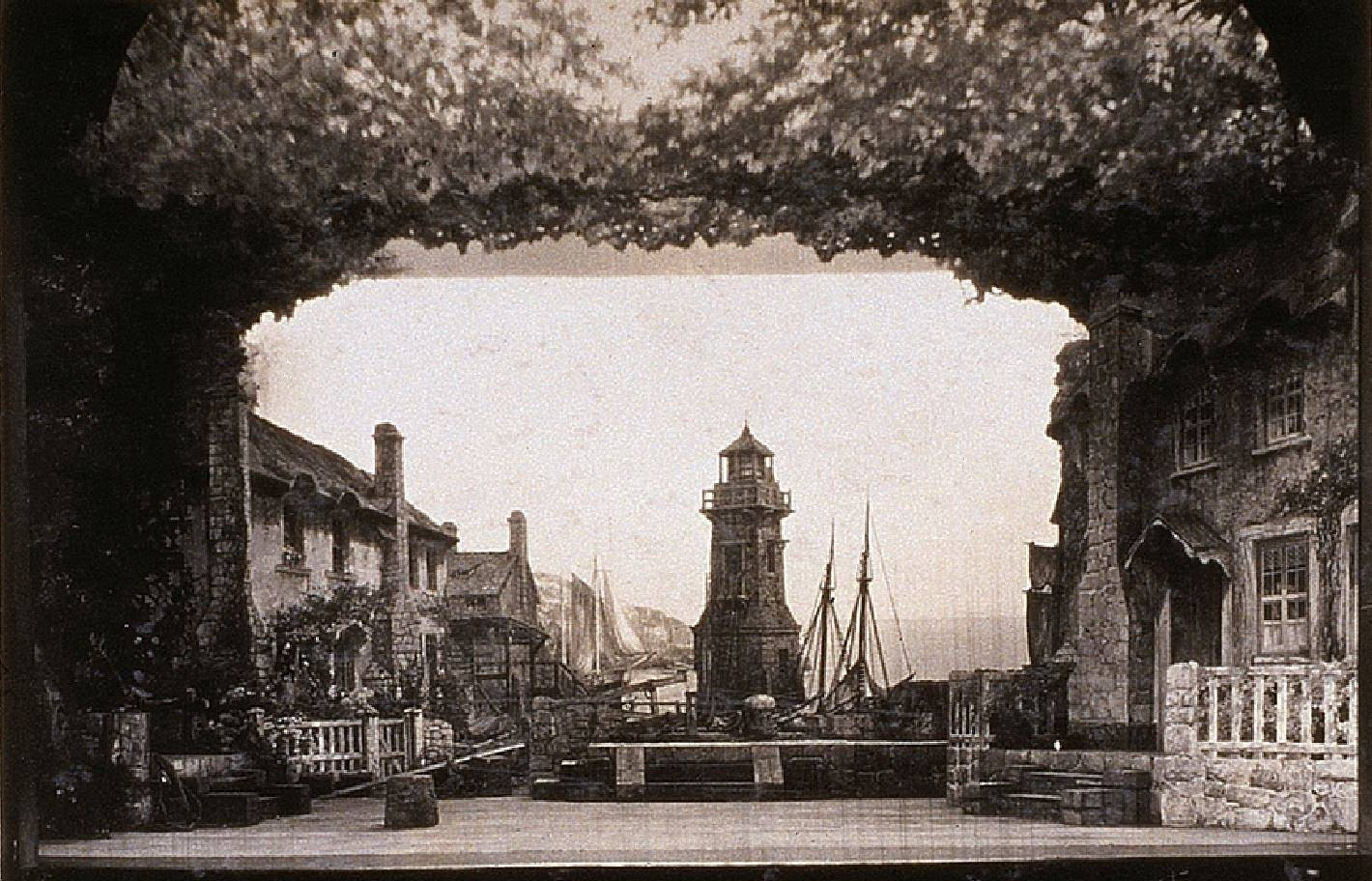 The Colemans’ Act 1 set for Ruddigore. Book 07-0028, JCW Scene Books, Theatre Heritage Australia.
The Triad wrote that the production ‘reflects considerable credit upon the efforts of James Hay as producer; because, through his observance of traditional accuracy, we have been able to witness a performance which should pass muster even in the very stronghold of Gilbert and Sullivan—The Savoy itself … James Hay, invoking the shade of Captain Marryat, tripped a most wonderful hornpipe to the noise of a kettle drum heard above a nest of shrilling fifes; the same player’s song about a “Bold Mounseer” was one of the features of the first act.’17
Of course, no-one who saw the show in Australia had anything to compare it to, so how close it was to the London production we cannot know. Presumably Hay had largely re-created the show he knew from the D’Oyly Carte production, and we assume that the same changes were introduced, principally the new overture by Geoffrey Toye, and the replacement of the Act Two finale with a short reprise of the end of Act One. Robin’s Act Two number ‘Away, Remorse’ remained cut, however we must give Hay credit for re-instating the lovely duet for Rose and Richard—‘The Battle’s Roar is Over’. It’s perhaps not surprising that he restored it, since it’s the tenor’s only romantic music in the piece, and Hay was after all playing the tenor role. He also moved the number from Act One to Act Two. The duet had been cut in the D’Oyly Carte revival, much to the disappointment of G&S lovers all over Britain who wrote in numbers to the press to complain (although it is on the first recording of the show made in 1924).
Sadly few photographs of the production have survived. Probably the costumes were sent over from London, as they were for the other shows. New scenery was designed and painted by W.R. Coleman & W. Coleman Jr. who provided the scenery for many of J.C. Williamson’s productions. As these sets were still in use in the 1940s, we have access to pictures of them. Act One shows a rather strange lighthouse that certainly doesn’t look like anything you would find in Cornwall, and, as others have observed, the cottages look more like the chocolate box Cotswold variety than anything Cornish. Act Two is more traditionally baronial, though the curtained entrance at the back is a peculiarly un-architectural feature.
 The Colemans’ Act 2 set for Ruddigore. Book 01-0104, JCW Scene Books, Theatre Heritage Australia.
The complete tour lasted from 3 April 1926 when it opened in Adelaide with The Gondoliers, to the summer of 1928 and included many towns and cities in Australia and New Zealand. By the time the company reached Tasmania in February 1928, it claimed to have travelled over 26,000 miles, ‘a record in the history of theatrical touring’. As well as the usual major Australian cities, and New Zealand, the company also performed in Toowoomba, Armidale, Hobart, Launceston, Geelong, Broken Hill, and Newcastle. Singing every night, plus extensive travelling is a recipe for wrecking voices, and in May 1928 when the G&S company added Lilac Time, the musical comedy about the life of Schubert, to its repertory, the Adelaide Advertiser wrote: ‘Mr James Hay would be the first to grant that the pristine freshness of his tenor voice that has charmed so many thousands in the Gilbert and Sullivan operas has gone, but he still has a serviceable voice, and he has the artistry that enables him to “lift” a scene the moment he appears on the stage. It is a rare gift and its charm is its lack of self-consciousness. From the moment Mr. Hay appeared as Franz von Schober the piece began to sparkle, and if it were more the sparkle and effervescence of sherbet and champagne, there were few to quarrel with it on that score.’18
 Sydney Mail, 7 September 1927, p.10
Clearly Hay’s voice was showing signs of wear and tear from so many years on the road, although it sounded, according to the Perth Sunday Times, that there was life in it yet: ‘The recent operation in Melbourne on the throat of tenor James Hay, of the Gilbert and Sullivan Co., has worked wonders for the singer of “Sparkling Eyes” and other delightful ditties. It was an ex-West Australian medico who suggested to Jimmy that his huskiness could be cured. This was effected in less than 24 hours, J.H. not losing a night’s work.’19
Hay left the J.C. Williamson company after the performances of Lilac Time in May 1928. By the time the company appeared in Armidale in July Leo Darnton was billed as the leading tenor. Many of the company stayed on for a new contract that would take them on even more punishing one, two and three night visits to such places as Wagga Wagga, Cootamundra, Maitland, Warwick, Maryborough, Rockhampton, as well as return visits to Armidale, Toowoomba, and Geelong.

The Bulletin, 6 May 1926, p.34

Strella Wilson, 1928. Photo by Ruskin, Melbourne.
Flickr
It is to be noted that when Hay left London for Australia in 1926, Stella did not travel with him. Was their marriage already over? Whatever the state of things then, Hay did not appear in any rush to return to the UK, so one can only conclude that to all intents and purposes, it was.
In the second half of 1928 and the early months of 1929 he made numerous radio broadcasts, many with G&S soprano Strella Wilson, returning to a more classical repertoire, and helping to inaugurate a Schubert Festival in Melbourne. He and Wilson also sang together in cinemas before showings of films, a popular practice at that time.
In an interview in April 1929 Hay told his Australian readers that he was preparing to go abroad again, and the Adelaide News reported that he would be passing through Adelaide on the SS Comorin on his way back to England.
We then lose track of him until the following year when he was to be heard in concerts on the radio for the BBC.
In 1932, Hay returned to the stage briefly, when he stepped into the breach to help out an amateur company in Burton-on Trent, Staffordshire, whose Frederic in Pirates had gone down sick. It was a generous gesture, but perhaps a sad last performance for one who had played the role so many times in London’s Princes Theatre, and all over Australia.
Thereafter Hay disappeared from the public’s gaze, as did so many singers in their later years. A surprising number turned to the hospitality profession and took on the management of public houses, but Hay followed a rather different course. It is not till 1946 that we find him in a very different occupation, teaching singing to wayward young boys in what were then called ‘approved’ schools.
And what of Stella? In the late 1920s Stella had left London and bought a large and comfortable mansion called Lindal Mount, on the banks of the Thames at Bray, near Maidenhead, a fashionable market town west of London.
In 1936 we find Hay living close by at 1 Laburnham Road in Maidenhead. It appears that they could not live together but were never far apart. She continued to call herself Mrs. Ettlinger-Hay until 1938 when she changed her name by deed-poll to Ettlinger-Stewart (Stewart was her maiden name).

During the 1940s, Stella took an apartment in Viceroy Lodge, a fashionable sea-front block in Brighton. Electoral roles show that James Hay lived there with her during 1945.
Royal Pavilion & Museums, Brighton & Hove

Stella’s final Brighton home was at Embassy Court. Many celebrities had apartments in this luxurious Art Deco block including Terence Rattigan, Rex Harrison and Max Miller.
RIBA, London
The 1939 Register (undertaken at the start of World War II) shows Stella still at Lindal Mount, and Hay now lodging with Albert and Susannah Baker at 187 Hersham Road, in nearby Walton-on-Thames. He is divorced, and describes himself as a musician. It appears that the two continued to live separate lives, though not far away from each other, until astonishingly they appear on a 1945 electoral roll in Brighton living together again at Viceroy Lodge, a fashionable apartment block on the sea-front. Was this an attempt to re-kindle old affections, or a temporary war-time measure of expedience? Whatever, it appears not to have been long-lasting, as the following year Hay took up residence at his final place of employment: Mile Oak Approved School for young offenders where he taught music and singing. Approved schools had been established in 1933 for the residential education and reforming of wayward children, usually boys. Mile Oak took boys of 12–15 years old and was a large forbidding place. Though situated just outside Brighton, on the downs, it was run by the London County Council for the edification of young offenders from the whole of the capital. The teaching staff were resident too and James Hay was provided with his own bungalow in the extensive grounds of the institution.

Early postcard view of Portslade Industrial School, which in 1933 became the Mile Oak Approved School
ebay

The bungalows at Portslade/Mile Oak School, where Hay resided
ebay
A newspaper report in the Norwood News in October 1946 records a rather bizarre and extraordinary event as our last glimpse of Hay in the public eye. ‘On Saturday at the Croydon Youth championship swimming gala held at Central Baths, the voice of Mr. James Hay, formerly principal tenor of the D’Oyly Carte Opera Company, interrupted a swimming lesson. The lesson was being given by the boys of the Shiverers Swimming Club, Hove, under the direction of their president, Mr. Carl Wootton, who proved how simple swimming can be once the beginner has the confidence to float. Mr. Hay, mistaking “swimming” for “singing”, launched forth into opera and afterwards introduced his choir of lads, who sang in perfect harmony whilst the Shiverers swam in time. The effect was beautiful, and there was tremendous applause, not only for its perfection but for its originality.’20
The description of this most unusual and original performance gives us a unique last image of Hay.
By the time of his death in 1958, seemingly alone and unknown in Brighton General Hospital, his career appears to have been forgotten. But not in Clare, South Australia. Only a few years earlier an article in the Northern Argus of South Australia had reminded its readers of Clare’s notable past talent as it prepared the program for the South Australia Eisteddfod. Hay was high on the list: ‘Then we remember James Hay of Mintaro, famous operatic singing personality in the great auditoriums of the world with his rich tenor voice.’21
The town of Clare was justly proud of its illustrious son.
Endnotes
1. Sunday Post, 26 August 1923, p.16
2. The West Australian, 5 April 1921, p.6
3. The West Australian, 5 April 1921, p.6
4. The West Australian, 5 April 1921, p.6
5. Kalgoorlie Miner, 15 June 1907, p.10
6. Adelaide News, 14 April 1926, p.7
7. Adelaide News, 14 April 1926, p.7
8. The Referee, 15 June 1913, p.5
9. London Evening Standard, 14 June 1913, p.12. According to Sandy Wilson in his book Ivor, the opera referred to was, in fact, an operetta, The Fickle Jade, which he had written for a competition organised by Chappell & Co., the music publishers, who would eventually publish his most famous compositions. He won second prize, but The Fickle Jade was never performed, although some of its melodies appeared in later shows.
10. The Era (London), 3 December 1913, p.15
11. The Stage (London), 3 June 1920, p.16
12. The Referee, 1 December 1920, p.11
13. Sydney Morning Herald, 20 November 1920, p.14
14. The Bulletin, 30 November 1922, p.36
15. Letters between Rupert D'Oyly Carte and Leyden College, 1922, in the collection of Chris Webster
16. The Stage (London), 6 September 1923, p.18
17. The New Triad, Vol. 1, No. 3, 1 October 1927, p.60
18. The Advertiser (Adelaide) 28 May 1928, p.13
19. Sunday Times (Perth) 6 May 1928, p.2
20. Norwood News, 11 October 1946, p.2
21. Northern Argus (Clare), 17 February 1954, p.5
Bibliography
Tony Joseph, The D’Oyly Carte Opera Company, 1875–1982: An unofficial history, Bunthorne Books, Bristol, 1994
Cyril Rollins & R. John Witts, The D’Oyly Carte Opera Company in Gilbert and Sullivan Operas, Michael Joseph Ltd, London, 1961
Raymond Walker, Backdrop to a Legend: The scenic design of the D’Oyly Carte Opera Company, Raymond J. Walker, 2018
Robin Wilson & Frederic Lloyd, Gilbert & Sullivan—The D’Oyly Carte Years—The Official Picture History, Weidenfeld and Nicolson, London, 1984
Sandy Wilson, Ivor, Michael Joseph, London, 1975
Acknowledgements
David Lovell
George Low
Raymond Walker
Further sources
‘Refrain, audacious tar’from HMS Pinafore—Violet Essex and James Hay (recorded 27 July 1922—conducted by Harry Norris).
Courtesy of Chris Webster.


