
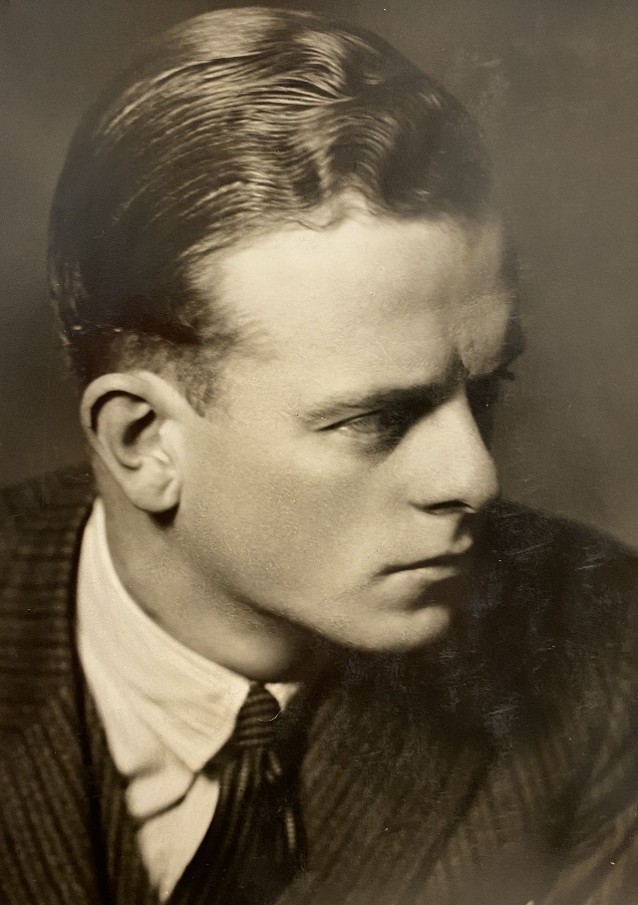
 Lloyd Lamble, sometime in the mid-1930s. Athol Shmith photo. Courtesy Australian Performing Arts Collection, Arts Centre Melbourne.Between 1984 and 1994, Australian born actor Lloyd Lamble wrote his autobiography. Living in South Hampstead in London and only recently retired, he was aged in his early eighties when it was finally completed. Originally entitled The Strutting and the Fretting, the first draft had been painstakingly typed out and then hand corrected in pencil—in some parts rearranged. The final version, entitled Hi diddle dee dee, An Actor’s Life for Me, had been much polished and was dated 1994.1 The manuscript is divided into ‘2 Acts’—Act 1 covering his first 36 years in Australia.
In writing his memoirs, Lamble was probably inspired by the many actor contemporaries who had published a biography in the last decades of the twentieth century. (The long list of biographies included Australians he knew; the biography of Peter Finch by Trader Faulkner was published in 1979, Leo McKern’s autobiography came out in 1983, Michael Pate’s in 1986, and Vincent Ball’s in 1995) In style, his memoirs most resembles Leo McKern’s—an eclectic mix of personal history and anecdotes. However, unlike McKern’s, Lloyd Lamble’s memoirs never found a publisher, an unusual outcome for an actor who had worked on stage, radio and screen for almost sixty years. It must have been disappointing. In addition to working on the manuscript for over a decade, Lamble had gone to some effort to assemble his story. There is ample evidence that he checked his understanding of some events with friends. For example. surviving in the papers of Coral Browne is Lamble’s handwritten request to use a brief but typically ‘fruity’ anecdote from their days working together with Gregan McMahon. In this case, Browne declined to let him tell yet another ‘Coral Browne’ story.2
Born in Melbourne on 8 February 1914, Lloyd Nelson Lamble was the youngest of four sons born to William Henry Lamble, a prominent musician and secretary of the Musicians Union, and Alma Frances nee Potter. A proficient gymnast and fine singer, he left Wesley College aged 17 to become a junior announcer at radio station 3DB, later progressing to senior positions at 3KZ and 3AW, broken up by some work as a dance band singer.3 Bob Walker, 3KZ’s biographer, described the young Lloyd Lamble as ‘tall, good looking, with blond hair and rich of voice.’4 It was while he was at 3AW that he moved into radio acting with the Lee Murray Radio Players, and not surprisingly, he then found his way to the stage.5 His first professional stage role was in Ivor Novello’s Fresh Fields at Melbourne’s Comedy Theatre in 1934—at very short notice, after the leading player contracted laryngitis.6
However, Lamble’s breakthrough role was in 1936, in Emlyn Williams ‘exciting throat-gripping thriller’—Night Must Fall, directed by Gregan McMahon. His leading role as Baby-face Dan was a triumph, The Age newspaper reporting that ‘Lamble exhibited once more a talent which should be nurtured with great care. His scene with Elaine Hamill [playing Olivia Grayne] in the second act was wholly brilliant…’.7 The play toured east coast Australia and New Zealand, with great success in 1936. ‘It would be a difficult matter to find an actor, even in London or New York, who could handle this remarkable character as masterly as Lloyd Lamble’, reported Dunedin’s Evening Star.8 The musical comedy Wild Violets with JC Williamson followed. In the aftermath of these successes, in 1937 Lamble started his own acting and radio school, which included elocution lessons for aspiring radio artists. He married non-theatrical Marjorie Barrett in Melbourne in March 1937. Their honeymoon was in Adelaide, because Lamble was performing in that city at night.9
Surviving examples of his radio work showcase an attractive, authoritative voice—a refined Australian accent (or a received accent), exactly what one expected to hear from radio broadcasters at the time. Historian Richard Lane identifies The Last of Mrs Chaney on the Lux Radio Theatre in 1939 as Lamble’s first important radio performance. Lane states that by the late 30s, Lamble had evolved to be one of the most sought-after actors for the medium.10 In time, Lamble proved capable of operating in almost every radio genre—comedy, (including straight man for comedian Roy Rene) in numerous radio dramas, and in variety—as a compere and straight man for Bob Dyer.11

As Lennie in Of Mice and Men. With Ron Randell, May 1940.
Australian Performing Arts Collection, Arts Centre Melbourne

Lloyd Lamble with US actress Terry Walker in Claudia, 1942. Athol Shmith photo.
Author’s Collection
The early 1940s also saw Lamble under contract to David Martin at Sydney’s new Minerva theatre in a string of productions. These included Gaslight, Quiet Wedding, Room for Two, Rachel Crothers’ Susan and God and Noel Coward’s Design for Living. Lennie, in Of Mice and Men was a favourite role, Lamble recalled. Fellow performers at this time included a long list of others who were making their name, or had already done so—John Wood, Ron Randell, Fifi Banvard, Claude Flemming, Trilby Clark, Marjorie Gordon and Muriel Steinbeck. A reviewer for The Bulletin in May 1940 reported that ‘Lamble is acting so well these days… it is becoming worthwhile to go to any Minerva production just to watch his development.’12
In his manuscript, Lamble described the war years in Sydney as a professionally exciting time. His reputation was at its zenith—an east coast Australian tour of Rose Franken’s new comedy-drama Claudia in 1942 was very successful. In addition to his stage work he made fund raising appearances and even appeared in a few films—including the short propaganda film The Grumblens and the feature Strong is the Seed (An underwhelming film about wheat farming). In 1941 Lamble also found time to author a play entitled The Rabbit Habit—a preoccupation with procreation. Apparently, this was only ever performed as a produced reading sometime in the 1940s, with Lamble, Peter Finch, George Blackshaw, Gwen Plum, Kitty Bluett and Bettina Dixon taking the parts.13
The war years also saw dramatic and less happy changes in his personal life. Appearing together in the romantic comedy Dinner at Eight in Sydney in late 1939, Lamble had begun a relationship with actress Barbara Smith. Smith had studied at London’s RADA and was now forging her own career on stage in Australia. News of the affair brought Marjorie to Sydney, where Lamble ‘asked for his freedom,’ in a meeting he admitted was excruciating.14 A divorce was granted in 1943.
At the same time Lamble was enjoying such success on stage and radio, his political views were becoming more pronounced. With his growing concern about what he believed was the exploitation of actors by management, in 1942 he was elected President of Actor’s Equity, a position he held for much of the 1940s. He said that he understood poverty for actors. ‘I’ve lived on the smell of an oil rag’ he told one Sydney paper in 1940.15 Even in his 1994 memoirs, and despite a change of political preferences later in life, he still held strong feelings about this: ‘One cannot escape the feeling that to most management, actors are scum,’ he wrote.16
It was Lamble’s close association with Actor’s Equity and his sympathy towards causes of the political left, combined with the collapse of his relationship with Barbara Smith, that hastened his decision to leave Australia. The Commonwealth Investigation Service, the forerunner of ASIO17 began to keep a file on his activities in the mid-1940s—such as his membership of the Friends of Republican Spain and association with the New Theatre League. His ASIO file, since declassified, seems innocuous today, but in the emerging cold war environment he was deemed a security concern. His mail was intercepted (or at least a list of who he corresponded with was kept), and a record was even made (somehow) of annotations in his copy of Frank Hardy’s Power Without Glory. When he read poetry at a Communist Party of Australia fundraising event in August 1946, this was noted—in fact any mention of him at meetings was recorded.18 On one occasion, an ASIO operative listened in, when he and a friend chatted outside a pub, after closing time.19
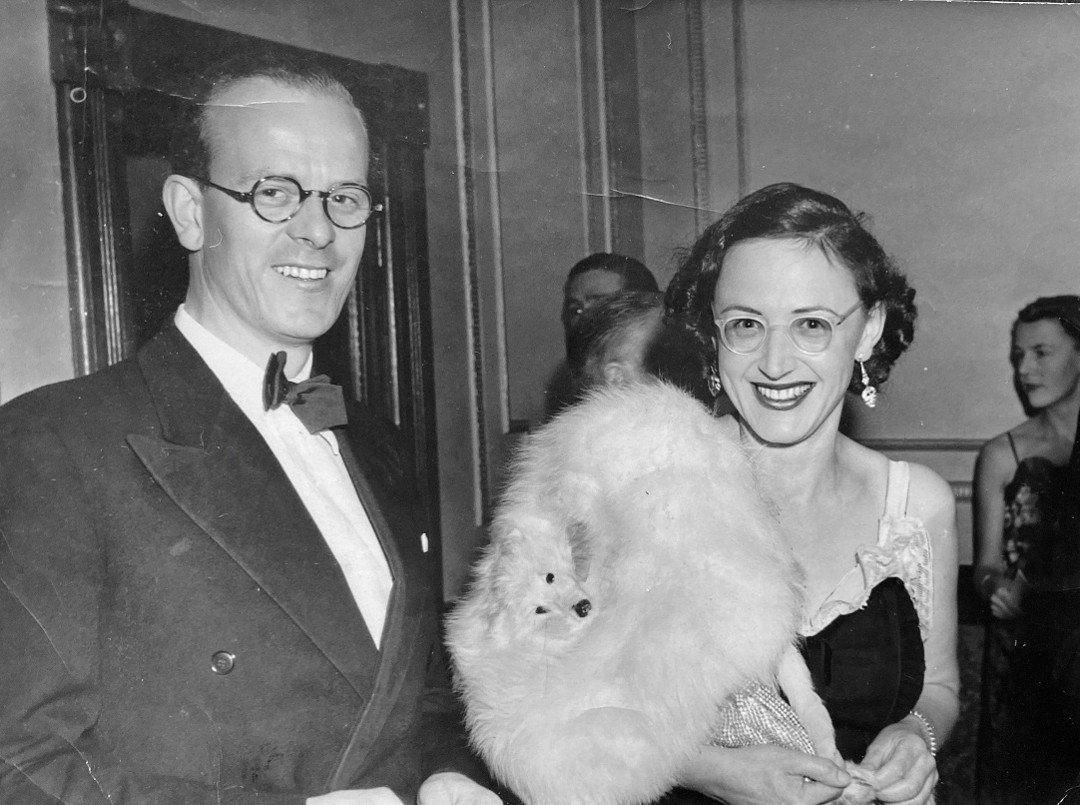 Lloyd Lamble and Barbara Smith in 1941. Private collection.
In 1942, Lamble fathered a child by Barbara, although—most unusually for the time—the couple had yet to formalise their relationship through marriage—'a defiant act of revolution on both our parts,’ Lamble was to claim.20 However, while acting and directing a highly successful tour of New Zealand in 1944, Lamble met Lesley Jackson, a 29-year-old actress from Wellington, and again, began an intense affair. He returned to Australia in late 1944, Barbara then being pregnant in Sydney with their second child. Lamble however, set up a new home with Lesley.
The end of the relationship with Barbara was another traumatic experience, he records. Not surprisingly, it divided his friends and acquaintances and in time, deeply embarrassed his own family. Both the Smith and Lamble families insisted Lloyd ‘do the right thing’ by Barbara and their two children and marry her.21 The estranged couple did marry in Sydney on September 20, 1945, but Lloyd left Barbara immediately after the wedding and returned to Lesley.
Lamble’s ongoing anxiety during the years 1945-1951 sometimes relates to Barbara’s not unreasonable expectation that he should provide financial support to her, to bring up their two very young children on her own. This tension remained for some time, although a divorce was finalised in March 1949.22

Lamble at home in Sydney, 27 March 1941, photographed by R. Donaldson
Mitchell Library, State Library of New South Wales & ACP Magazines
Notwithstanding further triumphs—including touring with his own company in 1945; performing the comedy Under the Counter with visiting actor Cicely Courtneidge in 1947–8; and a very successful run of Edward My Son with British actor Robert Morley in 1949—there was soon less work for him. As Stephen Alomes has written, in the new Cold War era, accusations of communist sympathies became the means and the justification for theatre managements to marginalise politically active figures like Lamble. However, there was worse to come.
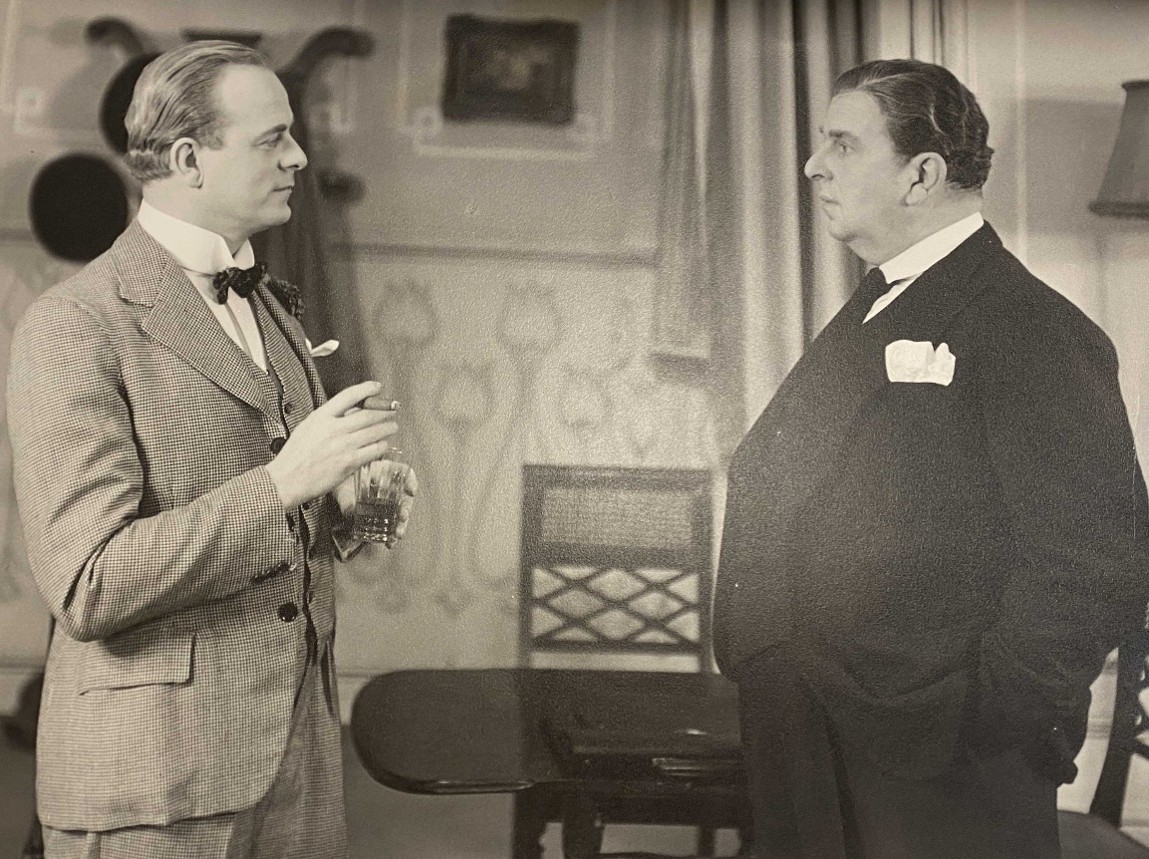 Lloyd Lamble and visiting British actor Robert Morley in Edward, My Son in 1949. Australian Performing Arts Collection, Arts Centre Melbourne.
On the matter of whether he really was a Communist, Lloyd Lamble’s autobiography is evasive. He explains he was ‘led towards communism by others’.23 But in a long investigative article written in 1990, David McKnight and Greg Pemberton suggested that it was ‘puritanical, anti-intellectual Australia’ that viewed young actors ‘as radicals because they belonged to the arts world and were strong trade unionists.’ Lamble’s contemporary, Michael Pate, also a member of the New Theatre, recalled; ‘I found it stimulating … [But] we were Australians first. In no way would we have thought to be subversive to Australia. We were radical thinkers in that we didn’t agree with all the opinions of the establishment.’24
However, in June 1950, the Victorian Royal Commission into Communism publicly named Lloyd Lamble as a communist.25 He was increasingly blacklisted. As a consequence of the slump in acting work, at one point he had to resort to door-to-door sales to make ends meet.26
Not surprisingly therefore, in late 1950, Lamble and Lesley Jackson decided to leave Australia. The couple departed Adelaide in early January 1951 on the Norwegian Cargo-Passenger ship, MS Torrens. There was a degree of secrecy—Lamble had hoped to slip out of the country because he did not wish to be caught up in another dispute with Barbara about the child support payments that he was only sometimes making.27
It was an immensely exciting time to travel to Britain and there is a long list of Australian actors who moved there after the war, keen to try their luck. Allan Cuthbertson left for Britain in April 1947. Reflecting the high hopes of many, Cuthbertson told a journalist: ‘There is so much to learn in London now with the great theatrical revival’.28 Gwenda Wilson and Dorothy Alison both left Australia in 1949 and Betty McDowall—who famously found the London acting scene ‘tough as hell’— departed in 1951. Peter Finch had arrived in London in late 1948, but had the advantage of the patronage of Laurence Olivier, who had seen him on stage in Australia.
The second part of Lamble’s memoirs is entitled ‘Act 2’ and deals with his life after the move to the UK. Film historian Brian McFarlane described Lamble as evolving into a ‘sturdy character player’ during this period.29
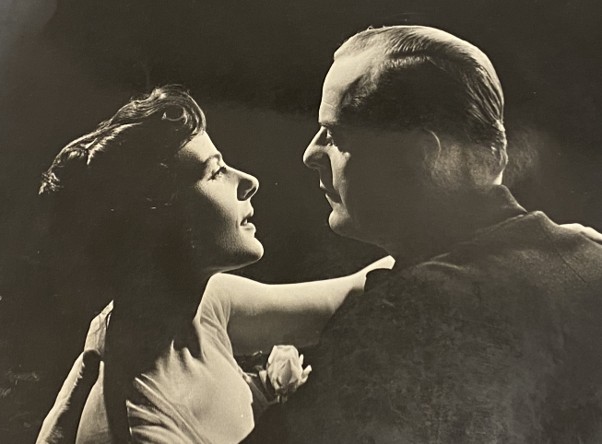 In his first London play—The Martin’s Nest (April-May 1951) with Yvonne Mitchell at the Westminster Theatre. Australian Performing Arts Collection, Arts Centre Melbourne.
On arrival in London, Lamble was again desperately short of money. However, he had the good fortune to be picked up by the very large Al Parker agency —a stroke of luck that most of his Australian acquaintances missed out on. Within a few weeks he had a part in the comedy-drama The Martin’s Nest. Although indifferently received, it was followed by more work at the Q Theatre—a mix of drawing room comedies, suspense and drama, including Traveller’s Joy, Night Call and Captain Carvallo. Lamble’s first experience of BBC Television also occurred at this time. This was the era of live television, broadcast from the BBC’s studios at Lime Grove or the Alexandra Palace. The experience of working on The Passing Show in April 1951 was ‘pure hell’ he recalled, largely because of the constraints of the technology. Very simply, the cameras often broke down.30
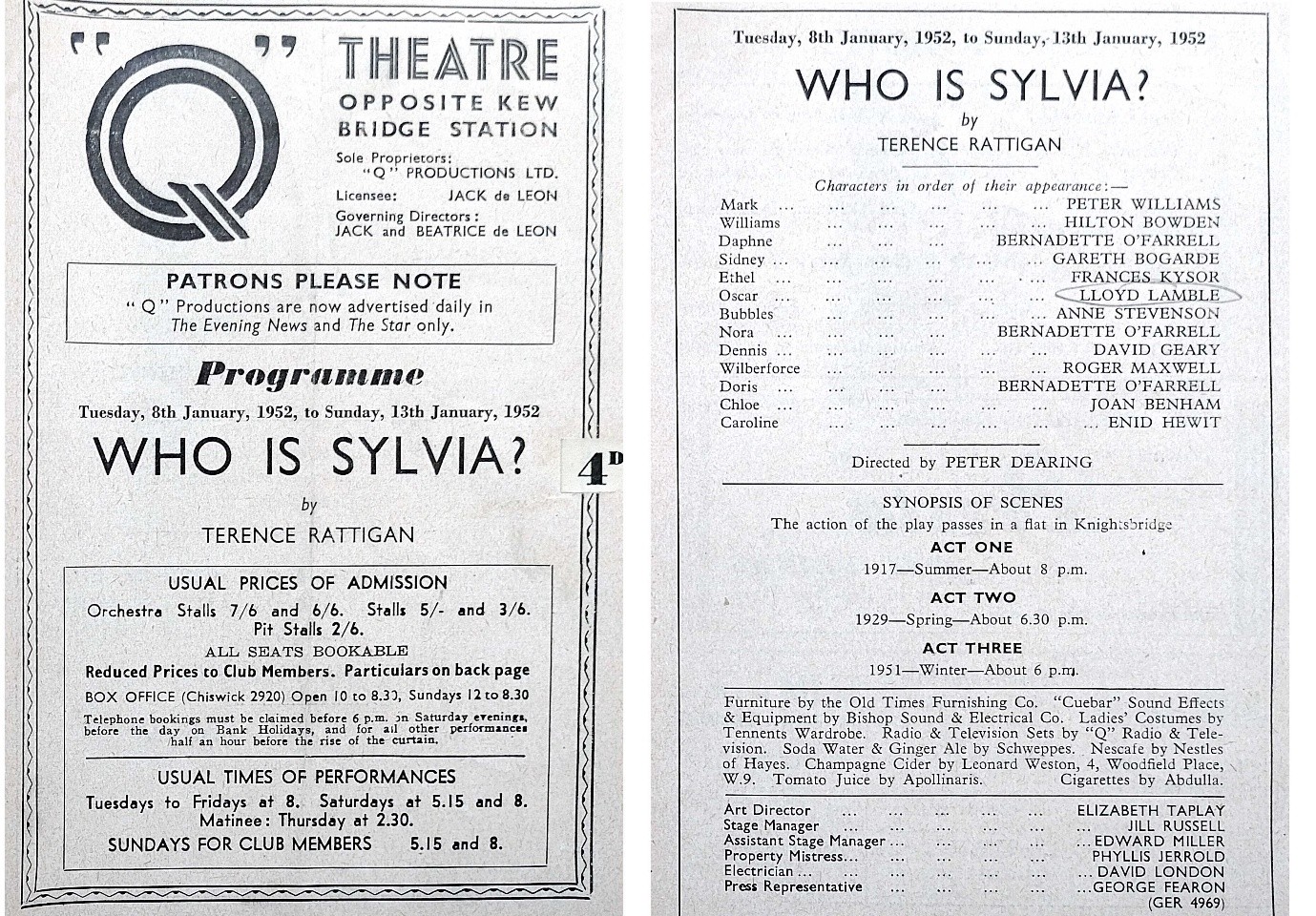 Who is Sylvia at the Q Theatre, Kew, London in 1952. Rattigan’s play of male obsession had already enjoyed a long run in the West End. National Library of Australia Prompt Collection.
Although some of his professional experiences in the UK are recounted in his memoirs, much is not. The various online film databases list over 160 known screen appearances by Lloyd Lamble in the 44 years 1951 to 1995 (See the Internet Movie Database, for example). The BBC Genome provides further information and includes radio performances as well as TV. Interestingly, this confirms that he was sometimes given roles in British-made productions set in Australia. These including several radio plays and TV episodes for the BBC—Lasseter’s Reef (1953), Overland Patrol (1965), a dramatization of the Petrov Affair (1966) and a dramatization of the Faraday school kidnapping in Life at Stake (1978).
Not surprisingly, Lamble always said he preferred the stage. Film he much preferred over TV—and yet his later screen career in the UK became increasingly dominated by supporting roles in TV. 31
His first UK feature film performances in the 1950s included some leading roles—such as the stage manager in Curtain Up (1952), a comedy about a theatre company preparing a play, and as Inspector Freddie Frisnay in Terence Fisher’s mystery Mantrap (1953). Watched today, his speaking voice is a feature—reminding us of his extensive experience as a radio actor. Authoritative men in uniform soon became his speciality; especially Police Inspectors. He told one journalist; ‘I suppose that by now directors are so used to seeing me in police roles, that I'm the first person they think of when casting.’32
His modest successes in the cinema did not go unnoticed back in Australia. In December 1952, a sharp-eyed ASIO agent spotted a magazine carrying a photo of Lamble with Australians Bill Kerr and Don Sharp, all taking roles in the war film Appointment in London (1953). Worried that the Royal Air Force was helping to make the film and may not have known that a ‘security risk’ was in the cast, a report was made by ASIO.33

Lamble in Appointment in London (1953), a film about Bomber Command. The impressive photo, probably for makeup purposes, suggests a role more prominent than it really was.
Australian Performing Arts Collection, Arts Centre Melbourne
Lamble’s memoir studiously avoids comparing his success with others, but there is an inference throughout that he was conscious of the different fortunes of Australians working in the UK. One of the other Australian actors on Appointment in London, Bill Kerr, had arrived in 1947 with less acting experience than he. Eight years Lamble’s junior, his part as a cheerful flying officer was a leading role opposite Dirk Bogarde. By contrast, Lloyd Lamble’s role as the RAF Weather Officer was uncredited.
In fact, these minor character roles became the norm for him in film and increasingly in television as the 1960s and 1970s progressed.
Lamble does acknowledge how simple luck could make such a difference in a career. He recalled ruefully that he was offered the role of the nasty British Colonel Henniker in the play Carrington VC but declined it, because he felt the money wasn’t good enough. Instead, fellow Australian Allan Cuthbertson took it. The play opened at the Westminster Theatre in 1953 and was a great success, with Cuthbertson being asked to reprise the role for Anthony Asquith’s very successful film version the next year. But far from being a role that helped him break new ground,34 Cuthbertson felt it typecast him as ‘the sneering Englishman’.35 Surprisingly, Lamble has little else to say about Cuthbertson, although he knew him moderately well. They knew each other in Australia and had worked together in several British films—Barnacle Bill (1957), The Boys (1962), Term of Trial (1962), and in the Sci/Fi TV Series Journey to the Unknown (1969).
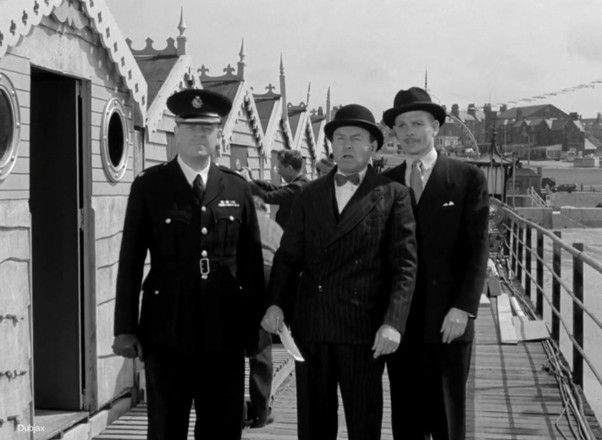 Lloyd Lamble playing yet another Police officer, with Maurice Denham and Allan Cuthbertson in Barnacle Bill 1957. Lamble described this as his last major film part.36 Source of screengrab—Author’s copy.
In fact, Lamble complained that the national connection with other Australians counted for little in the way of actual employment offers—jobs for mates. In his memoir, he could only recall two occasions where expat Australian directors gave him work in the UK—to help out a fellow Aussie.37 However, he and Lesley were still well known enough to be asked to appear in episodes of a local TV series, during their return to Australia and New Zealand in late 1965. In the children’s show The Adventures of Seaspray, he appeared as the conman Miller, in the episode Stalemate. Lesley appeared in another episode; The Rain of Death.
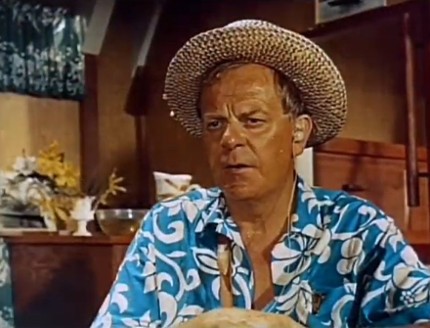 Lloyd Lamble’s guest appearance in the Australian children’s TV series The Adventures of Seaspray, episode Stalemate (1966). Source of screengrab Daily Motion.
Across his screen career there were some roles Lloyd Lamble was well remembered for. Amongst them was Superintendent Kemp-Bird in the three St Trinian’s comedies—a running sub plot across the films being his tortured relationship with Sergeant Ruby Gates (played by Joyce Grenfell). Lamble was also particularly pleased with his leading part in the 1960 series No Wreath for the General38 and in the well-received, made for TV film The Naked Civil Servant (1975)39 where he played Quentin Crisp’s father.
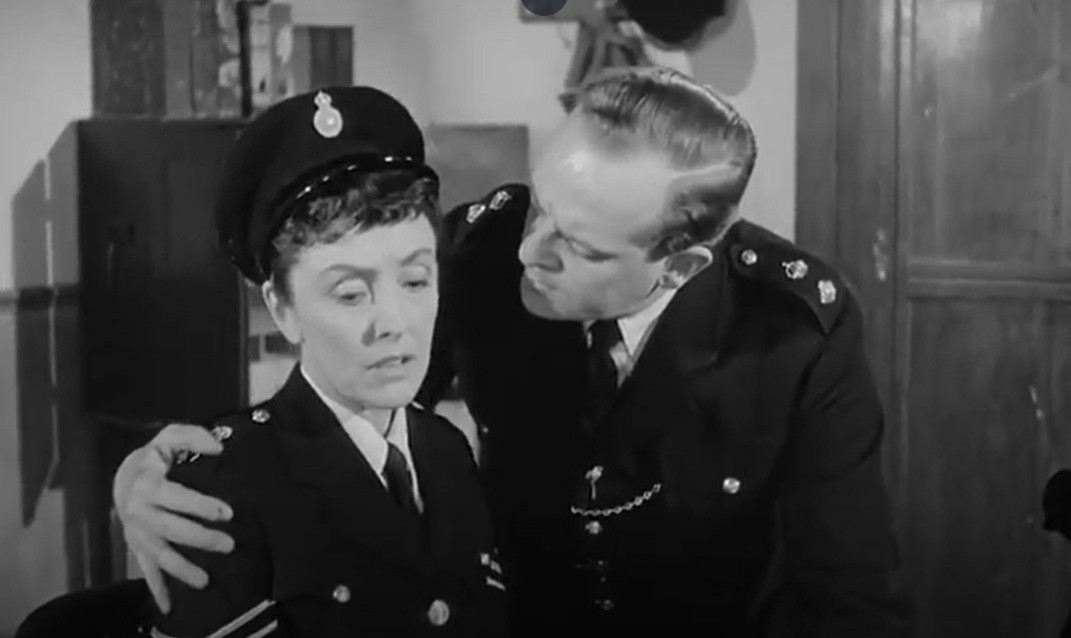 Superintendent Kemp-Bird (Lamble) coerces Sergeant Ruby Gates (Grenfell) into working undercover at St Trinian’s. The Belles of St Trinian’s (1954) Source of screengrab—Internet Archive.
He was a regular character in several British TV series, including Emergency Ward 10 (1966) and The Kids from 47A (1973-1974).
Lamble recounted that he was particularly annoyed to have been tricked twice, (in two years!) into accepting parts in Stanley Long’s soft-core sex films On the Game (1974) and Eskimo Nell (1975). Lamble reported that he and Lesley were sickened by aspects of the latter film when they saw the final product.40
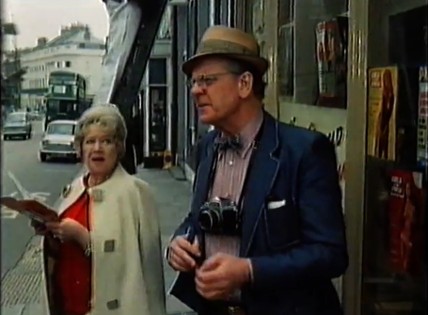 One of Lloyd Lamble’s many minor screen roles. In the film No Sex Please, We’re British (1973) Lamble and fellow Australian Mavis Villiers played American tourists in London. Source of screengrab—YouTube.41
Surprisingly, Lamble’s biography also tells us much less than one might hope about his British stage appearances. It is fortunate that the National Library of Australia collected a representative sample of British theatre programs that showcase his work. Some of these demonstrate Lamble’s interest in promoting Australian theatre. For example, in 1976 Lamble performed with other Australians in John Power’s The Last of the Knucklemen at the Edinburgh Festival. A year later he appeared in Jim McNeil’s The Old Familiar Juice, performed at London’s Roundhouse Theatre. He was still active with an association of Australian performing Artists in Britain until the late 1970s.
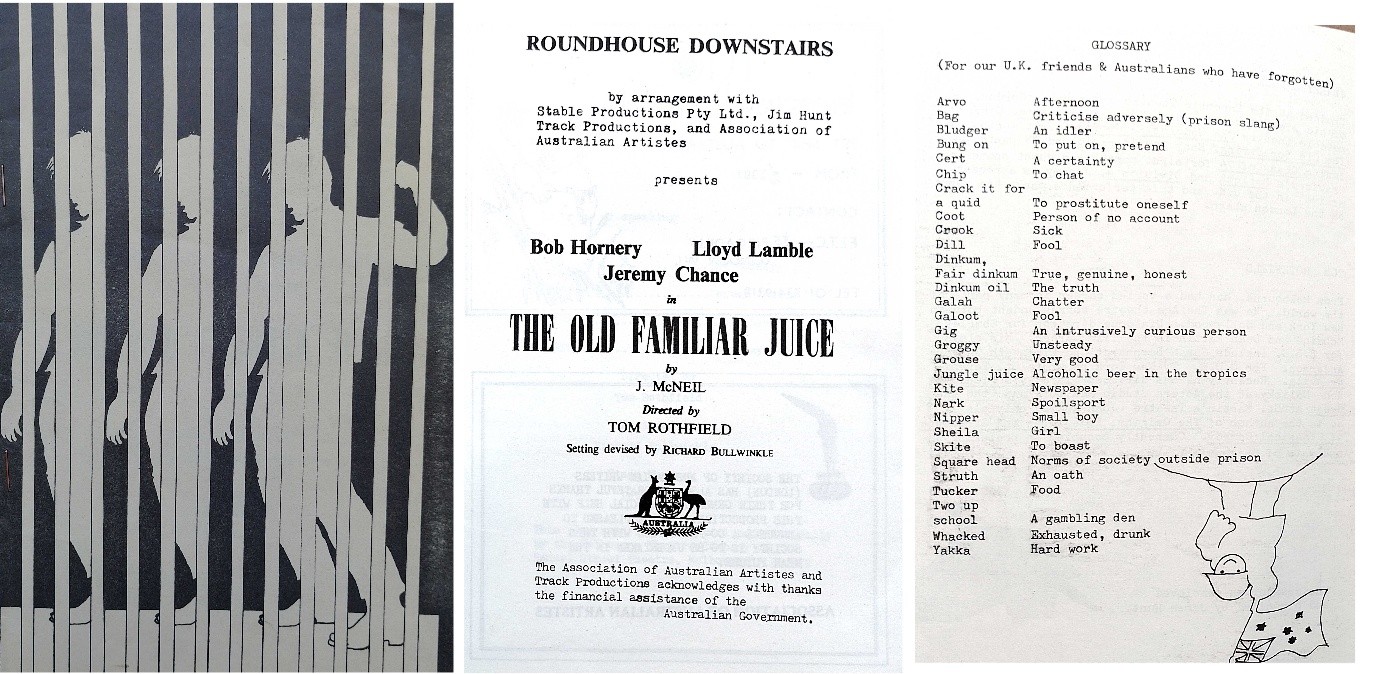 The program for Jim McNeil’s Australian prison play, The Old Familiar Juice, April 1977 Roundhouse Theatre London. It carried a helpful Australian glossary. National Library of Australia’s Prompt Collection.
Newspaper reports reveal that at times he also directed for the stage, for example, the 1955 Christmas holiday show at Amersham’s Playhouse was Rebecca of Sunnybrook Farm featuring his wife, Lesley Jackson.42 His memoir also mentions his unhappy experience directing both Sandy Wilson’s The Buccaneer and Ian Douglas’ Lucky Boy, at almost the same time, in August 1953,43 as a result of which he fell out spectacularly with Wilson. Lamble wrote that Wilson ‘told me to take my uncouth person back to Australia where it belonged.’ 44
Lamble’s memoir is strengthened by the inclusion of some less positive but very human experiences. He mentions his decision to split with agent Al Parker, which he later came to regret. He had somehow gained the impression that a smaller agent would work harder for him. But the parts continued to get smaller. Parker was enraged that he had left his agency, and he wrote Lamble a ‘vitriolic letter… [which] claimed quite rightly that he had got me established in all aspects of the business, despite the fact that I was a Communist.’ Lamble threatened to sue him if he described him that way again. 45
Some of the anecdotes used by Lamble portray the vicissitudes for actors of the era. For example. he was scathing of Douglas Fairbanks Junior’s use of ‘idiot boards’ (cue cards) when they appeared together in several episodes of the early TV series Douglas Fairbanks Presents in 1953-4. Fairbanks apparently didn’t want to learn lines for TV scripts.46 More fondly, from his Australian stage days only a few years before, he recalled that Robert Morley became understandably bored while performing Edward, My Son. Morley had written the script with Noel Langley and was now touring it to selected locations in the anglosphere, including Australia and New Zealand in 1949-50. The challenge for Lloyd Lamble was to cope with Morley’s off-script ad-libs, which, he good humouredly explains, he was able to do.47 Lamble appeared again with Morley in several British films of the 50s, and they became friends.
While Lamble’s memoir does not state so, newspaper reports suggest that he increasingly turned to the stage in the 1970s and 80s—at the same time his screen appearances were becoming less substantial. These were roles with repertory companies in provincial theatres, which included Osborne’s The Picture of Dorian Gray (1975), several seasons of playing Dickens in A Christmas Carol (1976-7)48 and George Bernard Shaw’s Mrs Warren’s Profession (1978). In the 1980s he appeared in Alan Bleasdale’s vasectomy comedy Having a Ball (1984), On Golden Pond with Dundee Rep (1985), William Douglas Home’s Marriage Rites (1986) and Gigi (1988)—where he took the Honoré Lachaille role that Maurice Chevalier had made famous. At the 1977 Edinburgh festival he performed two solo performer plays, as a double bill. ‘It was a tremendous feeling—holding an audience, alone [for two and a half hours], he recalled.49 Of his career choices at this time, he said; ‘The field is wide and I will do anything that is interesting financially or artistically.’ 50
Between 1988 and 1990 he took on the character role of Charles the butler, in a popular revival of Me and My Girl at London’s Adelphi Theatre. But by 1990 and now aged in his mid-70s, he finally chose to retire—with an enormous body of work behind him.
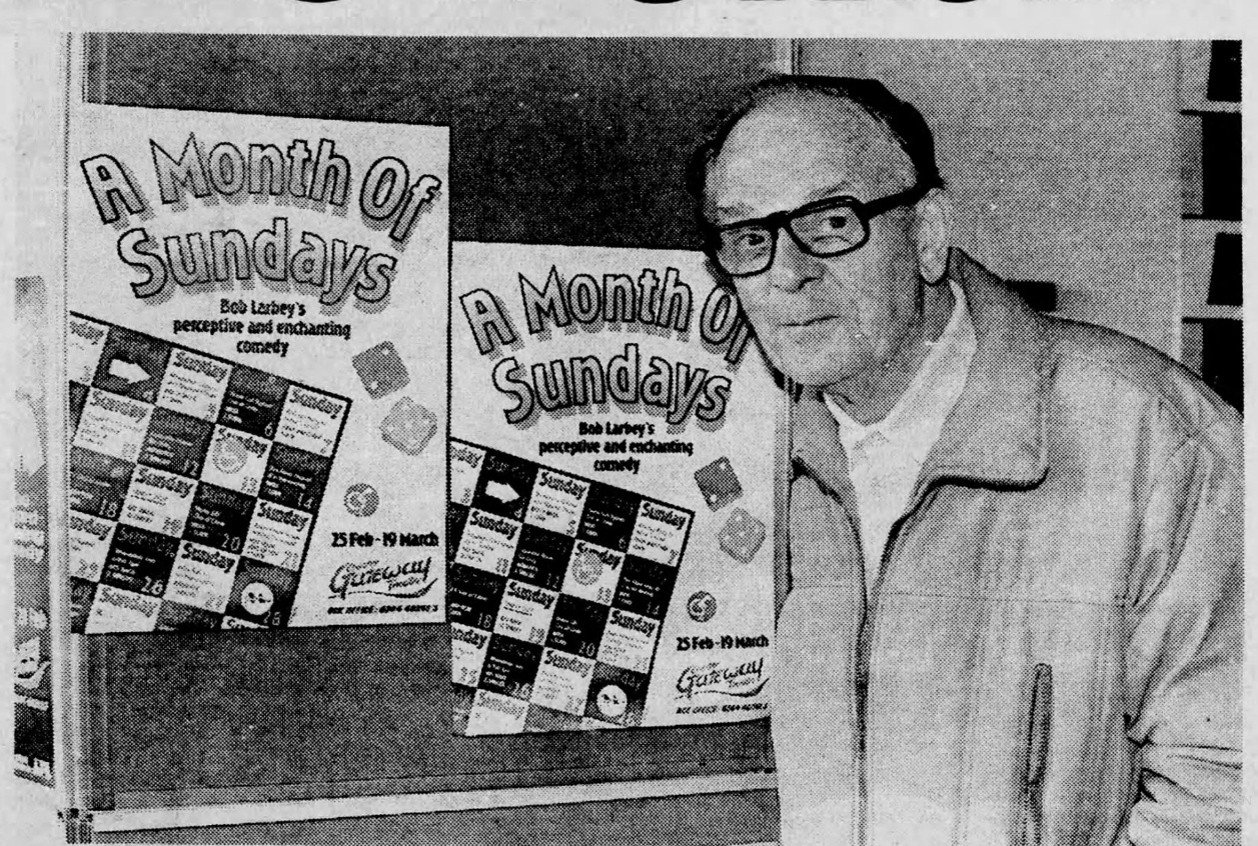 Lamble helping to advertise Chester’s Gateway Theatre production of A Month of Sundays in 1988.51
A persistent theme of Lamble’s memoir is the financial insecurity he observed in the profession and sometimes suffered himself. The foreword to his manuscript cited a 1970s British Equity survey on actors’ earnings, with its dismal finding that 64% of actors earned no money at all in any given 12-month period. He ended the foreword with these words: ‘This then, is the story so far of one such ‘nearly’ actor, one who had everything going for him—one who still might make it.’ 52 At one stage, he even seriously considered calling his autobiography ‘Who the hell is Lloyd Lamble?’53 Even when the final version was complete, he still felt it necessary to dedicate it to ‘all those thousands of actors who never quite made it’—apparently, he felt he was one too.
But Lamble did try to do something about his financial situation. He invested in property, with mixed results. He also took some time off acting to invest in the business of marketing the new, revolutionary, lightweight Sony video recorders. He indicates that he spent two years out of acting, which he felt gave him new skills and broadened his world views.54

Lloyd Lamble, c.1990. This is one of a series of A4 sized photos he had made to send out to fans.
Author’s collection
Lamble’s account of friend and fellow Australian actor-writer John Sherman is by far his memoir’s longest and most poignant personal recollection. Melbourne-born Sherman had met Lamble through their shared politics and involvement in worker’s theatre. They crossed paths again in London, where Sherman was struggling to get regular work. Sherman did get a role playing the Australian patient in the 1949 film version of the play The Hasty Heart, with Richard Todd and Ronald Reagan, probably thanks to his slight resemblance to Chips Rafferty. However, ill-health, bad luck and outrageous antisemitism stymied his career and he returned to Australia. Most touching of all is Lamble’s memory of meeting the ailing Sherman again on his first trip home to Australia in September 1965. Sherman, now working as a scriptwriter but very ill, insisted on inviting Lamble to dinner, and whilst cooking him a gourmet meal, told him ‘Oh yeah—I’ve been a bit crook, but she’ll be apples. I’ll be OK again soon.’58 Sherman died several months later. It is an interesting anecdote that reveals another side to Lloyd Lamble.
Unfortunately, on the last few pages of the final version of his memoir, Lamble admitted that he had been warned by friends that what he had written appeared to be a ‘whinge.’ His pet dislikes do indeed pop up and distract the reader in the later part of the narrative—amongst them a dislike of jazz, armchair socialists, anger at poor pronunciation on the BBC, the use of Ms instead of Miss or Mrs, suspicion of members of Catholic Action (whom he was convinced tried to wreck his career) and the growing use of coarse language on stage.
Lewis Cowan, an actor friend who read the draft, provided Lamble with an interesting critique. It resonated enough with Lamble that he included it in the last few pages of the final version. Cowan wrote: ‘You have led a life of such variation – done so many things outside the scope or experience of the majority of men—let alone actors—and above all, you are still working… A failed actor? Never!’59
Cowan was right, of course, but Lamble felt unable to go back and rework his memoirs again.
In later life, Lamble built a relationship with his two children by Barbara and apologised to her for the pain he had caused.60 He also had the pleasure of adopting and raising two children with Lesley.61
Lamble was assured by friends that he had an impressive body of work to be proud of. His remarkable 60-year career on radio, TV, the stage and film, his political idealism, blacklisting and subsequent journey to Britain as one of the great wave of post-war Australian actors, remains a story worth celebrating. But undoubtedly his own worst critic, even the final version of his autobiography needed a ghost writer and a serious edit before it could be published.
Lloyd Lamble died in Cornwall in March 2008.
Lloyd Lamble media available online
Unnamed. Mo with Lamble. A 5-minute Episode on 3AW from1936 at the Australian Old Time Radio website. Also featuring Sadie Gale. https://www.australianotr.com.au/1936.html
The Shadow, Episode: Return to Life—November 19, 1943, at YouTube
https://www.youtube.com/watch?v=dFRNVN589fc
The Shadow, Episode: The Juggernaut—December 26, 1943, at YouTube
https://www.youtube.com/watch?v=jw7mz2xyaPw
The Shadow, Episode: Murder with Music, Ep. 10, 1946 at NFSA
https://www.nfsa.gov.au/collection/item/shadow-murder-music-ep-10-1946
Maytime. 3DB program c 1949. At the Internet Archive. https://archive.org/details/Maytime
The Haunted Hour. Donovan Joyce productions.
2 undated episodes at the Australian Old Time radio website. https://www.australianotr.com.au/blog/archives/10-2014
The Adventures of Seaspray—TV Series at Daily Motion
Episode: Stalemate. (1966)
https://www.dailymotion.com/video/x9ngw9g
Curtain Up (1952) —Feature Film, YouTube
https://www.youtube.com/watch?v=UsfRQtNNI-w&t=32s
Mantrap (1953)—Feature Film, YouTube
https://www.youtube.com/watch?v=UsfRQtNNI-w&t=32s
The Kids of 47A (1974)—TV Series, YouTube
https://www.youtube.com/playlist?list=PLU50uATJi3xRwF40fveDf2x0Fhkm1PuFI
Crown Court (1975)—TV Series, YouTube
An Evil Influence Parts 1-3
https://www.youtube.com/watch?v=5RQEkrDz0-U
Endnotes
1. Copies of the final version reside in the Australian Performing Arts Collection in Melbourne, the State Library of New South Wales in Sydney and the Australian National Library in Canberra. The draft is held in private hands.
2. Australian Performing Arts Collection. Coral Browne Collection, correspondence,19 July 1984
3. Lamble, 1994, p.61-82
4. Walker, 1984, p.22
5. Lane,1994, p.185-6. And see for example The Argus (Melbourne), 13 May 1933
6. Lamble, 1994, p83-4
7. The Age (Melbourne), 17 February 1936, p.12
8. Evening Star (NZ), 3 August 1936, p6
9. The Herald (Melbourne), 24 February 1937, p.18
10. Lane, 1994, p.186
11. Lamble, 1994, p.211
12. The Bulletin (Sydney), 8 May 1940
13. Lamble, 1994, p.114. The manuscript for the play is now held by the National Archives of Australia.
14. Lamble, 1994, p.115
15. Daily News (Sydney),12 February 1940, p.2
16. Lamble, 1994, p.114
17. Australian Security Intelligence Organisation—the equivalent of Britain’s MI5 or the FBI in the US.
18. ASIO file—Lloyd Lamble, p23
19. ASIO file—Lloyd Lamble, p22
20. Lamble,1994, p188
21. Lamble, 1994, p189
22. The Daily Telegraph (Sydney), 12 September 1948
23. Presumably he meant Equity Secretary, Hal Alexander. Lamble, 1994, p.243
24. David McKnight and Greg Pemberton, The Age (Melbourne), 1990
25. The Age (Melb) 21 June 1950, p.6
26. Lamble, 1994, p.248
27. The most comprehensive list of Lamble’s Australian productions is found in Lane, 1994, p.378-9
28. The Australian Women’s Weekly, 19 April 1947, p.17
29. McFarlane, 2003, p.376
30. Lamble, 1994, p.278
31. The Stage (London), 4 July 1991, p.6
32. Leicester Evening Mail (UK), 21 December 1957, p.4
33. ASIO file—Lloyd Lamble, p.13
34. Lamble, 1994, p.151
35. Porter, 1965, p.247
36. Lamble, 1994, p.316
37. Lamble, 1994 p.299
38. Lamble, 1994, p.316
39. Lamble, 1994, p.267
40. Lamble, 1994, p.353
41. This short scene with the American tourists was cut from some releases.
42. Bucks Examiner (UK) 14 January 1955, p.2
43. The Stage (London) 27 August 1953, p.8
44. Lamble, 1994, p.291
45. Lamble, 1994, p.304-305
46. Lamble, 1994, p.278
47. Lamble, 1994, p.235-236
48. Lamble writes of three tours of this play. Lamble, 1994, p.361-366
49. Lamble, 1994, p.366
50. The Stage (London), 4 July 1991, p.6
51. Cheshire Observer (UK) 17 February 1988, p.39
52. Lamble, 1994, p.5
53. Lloyd Lamble written summary of career, 13 March 1985. Private Collection.
54. Lamble, 1994, p.337
55. National Archives of Australia
56. The Daily News (Perth), 13 September 1947, p.18
57. The Australian Women’s Weekly, 21 October 1953
58. Lamble, 1994, p.311-316
59. Lamble, 1994, p.396
60. Lamble, 1994, p.189
61. Lamble, 1994, p.371
References
Stephen Alomes, When London Calls: The expatriation of Australian creative artists to Britain, Cambridge University Press, 1999
Trader Faulkner, Peter Finch, a biography, Angus & Robertson,1979
Lloyd Lamble, The Strutting and the Fretting, Unpublished first draft of autobiography, c.1988.
Lloyd Lamble, Hi diddle dee dee, An Actor’s Life for Me, Unpublished final version of autobiography, c.1994
Richard Lane, The Golden Age of Australian Radio Drama, Melbourne University Press, 1994
Brian McFarlane (ed.), The Encyclopedia of British Film, BFI-Methuen, 2003
David McKnight & Greg Pemberton, ‘Seeing Reds’, The Age (Melbourne), Good Weekend Magazine (insert), 21 July 1990, p.35
Andrew Pike & Ross Cooper, Australian Film 1900-1977, Oxford University Press, 1980
Hal Porter, Stars of Australian Stage and Screen, Rigby Ltd, 1965
R.R. Walker Dial 1179, The 3KZ Story. Lloyd O’Neil,1984, Online at the World Radio History Website
J.P. Wearing, The London Stage 1950-1959: a calendar of productions, performers, and personnel, Rowman and Littlefield, 2014

