Florence Austral
-
Horace Stevens (Part 1)
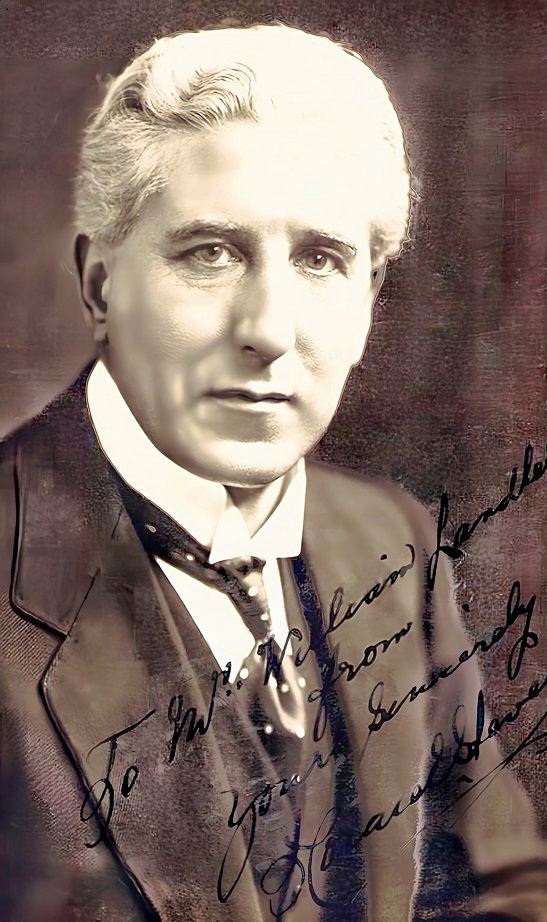
.jpg) In the first of a series of articles DAVID HIBBARD presents an overview of the life and times of the Australian bass-baritone.
Horace Stevens: A brief history of his career and repertoire
Introduction
It is of no surprise that Australia has produced a plethora of excellent opera singers in the brief time Europeans have lived here. Dame Nellie Melba, though not our first opera star, is certainly one of the best remembered. She has gone down in public consciousness in part for her exceptional voice and in part for a steely desire for self-publicity. Currently there are at least five biographies of Melba on the market, including her autobiography Memories and Melodies. Opera historian Roger Neill has produced his excellent book on the students of Mathilde Marchesi, which includes not only Melba, but Australians Ada Crossley, Fanny and Martina Simonsen, and their sister Frances Alda.
Neill has also written an essay on the mysterious Australian dramatic soprano, Margherita Grandi, which places the histories well and truly into the post-world war two era. Opera Australia historian and archivist Brian Castles-Onion AM has produced a series of CDs displaying the talent of Sutherland’s contemporaries, which includes interviews he was able to undertake before some of these legends were lost to us forever.
The histories have been predominantly directed at our female stars. The glamorous Marjorie Lawrence had her autobiography Interrupted Melody turned into a Hollywood movie, and a further biography, Wotan’s Daughter has been produced following a renewed interest in her re-released live recordings. Another Brünnhilde, Florence Austral was celebrated in an autobiography by James Moffat, accompanied by a two CD set released by Larrikin Records, but what of our male singers? There have been several world class talents, and particularly in the inter-war period Australian exported a trio of exceptional baritones; Harold Williams, John Brownlee and Horace Stevens. Brownlee is remembered in America because of his time at the Met, and as director of the Manhattan School of Music. In addition, he is the subject of a biography A memoire of Don Juan, and features on the justifiably famous Fritz Busch recordings of Mozart Operas from Glyndebourne in the thirties. Harold Williams is less well remembered, although the recent re-release of the first ever complete recording of Mendelssohn’s Elijah from 1930 has brought renewed interest in his career.
Horace Stevens, on the other hand, remains an enigma. He was of an earlier generation to his aforesaid baritone colleagues, born in the same decade as singers of the golden age like Caruso, van Rooy and Tetrazzini. He arrived on the British music scene in 1919 as a dramatic baritone with his voice fully matured and nurtured by the sophisticated Melbourne musical scene of the Edwardian era. His very first performance as Elijah created such a stir, he was hailed as the greatest exponent of the role since Sir Charles Santley (an opinion echoed by Santley himself), and later endorsed by no less a personage than Sir Edward Elgar who described him as the greatest Elijah, “not excepting Santley”. His operatic debut as Wotan at Covent Garden at the age of 47 resulted in adulations from Melba, something so unusual, it was remarked upon in the newspapers of the time.

Sir Edward Elgar

Sir Charles Santley
This “out of time” quality alone is worth further investigation. By the time Stevens was creating such a stir, his operatic contemporaries had either died or retired. The interesting point to make here is that often one’s introduction to the singers of the “golden age” is an acoustic recording where the singer sounds like they’re a mile away, calling through the scratches and hiss. With Stevens we can hear what a robust sound these singers must have made, with his later electrical recordings.
The other important point I would like to make about Stevens is his pedagogic pedigree. While the majority of singers at this point in history went to Europe for their singing lessons, Stevens was a home-grown product. As a child he was taught by Mr. Charles Truelove, the chorus master of All Saints Church, St Kilda. As an adult, he seems to have been taught solely by Bessie Jukes, a close friend of his mother’s, and to whom he credited his technique quite late in life. The longevity of Stevens voice, and it sounds just as impressive in recordings made before he left Britain in 1937, also points to the amazing musical scene in Melbourne in the Edwardian era. Though he had sung no opera by the time he arrived in Britain, his knowledge of concert repertoire was astounding. He maintained a life-long love of choral works, many of which we may never hear again, due to the financial resources and sheer numbers required to stage them.
This brings me to my third and final point. We know so much more of singers in the Victorian and post-World War Two eras, than we do of the Twenties. After the First World War Europe was in a parlous financial state, and understandably the health of the Arts was not at the top priority for governments. Without the Aristocracy to fund opera and concerts, a group of concerned musicians set about creating Government funding of the Arts. This passed without a murmur in Europe, but Britain was less inclined. In 1922 the British Broadcasting Corporation (BBC) was created and, despite a rocky beginning, was able to save institutions like the Proms. Opera in Britain was not as smooth: as then, like today, its social desirability attracted too many cooks, but by 1931 Covent Garden was funded by the British Government. Against this unstable background, it is amazing that Stevens made the extraordinary impact that he did. When he returned to Australia with the Fuller Opera Company in 1934, it was expected the newly formed Australian Broadcasting Commission (ABC) would assist with the running of the company, and Australia would have a National Opera. Against the background of the Great Depression, this proved not to be the case, although Stevens continued to lobby for a national company, and was able to assist Gertrude Johnson in her efforts to create the National Theatre in the forties.

Stanley Parker caricature of Stevens as 'Wotan'
Table Talk (Melb.), Thursday, 8 November 1934, p.22

John Frith caricature of Stevens as 'Kurvenal'
The Bulletin, 6 February 1935, p.18
During the research and writing of this thesis, the writer has pondered the question “why is the Australian public so much more interested in our female opera singers, than our males”? At one stage I conjectured that it may have been a form of sexism. I suspect the true answer, though, lies in several interviews Stevens gave in the thirties where the interviewers felt compelled to point out that men in the arts weren’t “sissies”. There is something of this attitude even today. The male singers of this era we return to as a nation are Peter Dawson, who, one might argue, never had the size of voice to sing the great orchestral works, and Malcolm McEachern, who put aside his career as Hagen to become Mr. Jetsam in a popular music hall duet. Stevens remained a true artist. A friend of Ralph Vaughan Williams and Sir Edward Elgar, he is truly an Australian legend.
Preliminary considerations
Horace Stevens is an important singer for several reasons. He spans three very distinct eras in classical singing, providing a link between those scratchy acoustic recordings of the early part of the twentieth century, to his connection with a generation of post Second World War vocalists who recorded onto magnetic tape, and in stereo.
Secondly the study of his repertoire provides a window into the lost world of the great tradition of Victorian choral music, with its massive groups and extraordinary compositions, sometimes of a gargantuan size, both in physical resources required for their staging and in the physical stamina required for their length. The texts of these works comprise an eclectic group of subjects taken from the Bible, religious and secular poetry and historical subjects.
Finally, Stevens was a part of a largely forgotten group of Australian musicians who travelled to Britain, Europe and both North and South America after the First World War with remarkable success. Considering the paucity of operatic performance in Australia, their success is nothing short of miraculous. Many of these artists, Stevens included, were involved in the unsuccessful attempt by Sir Benjamin Fuller to start a full-time opera company in Australia in 1934. After his retirement from professional singing, Stevens indeed pursued a long-held desire by assisting his colleague Gertrude Johnson in the formation of an opera school to prepare a generation of young singers for their turn as Australia’s operatic ambassadors to Europe.
Stevens was born in 1876. Fifteen years younger than Melba, he was three years younger than Caruso and Chaliapin and the same age as DeLuca, the great baritone. While these singers are remembered as the golden generation that performed from 1900-1920, during this period Stevens was a successful dentist and a popular recitalist in Melbourne. Not that he was estranged from the performances of international singers. Australia, and particularly Melbourne, was visited by some of the greatest vocalists in the world, due in no small part to the influence of Melba.
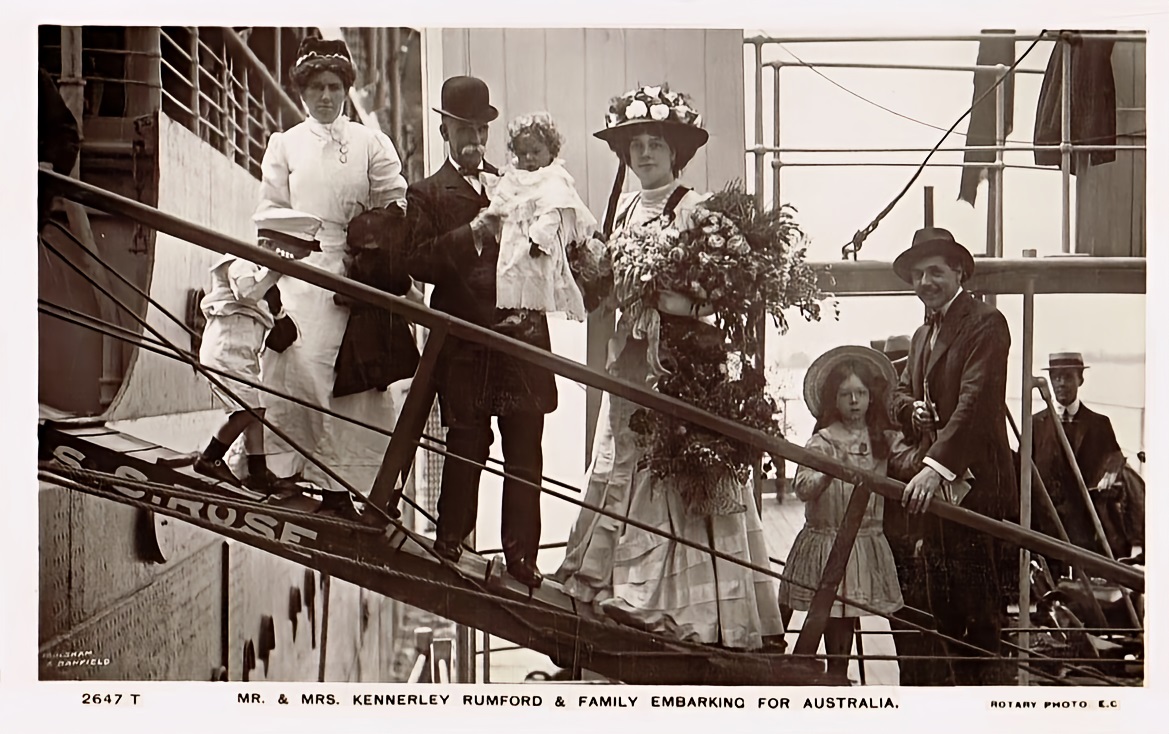 Clara Butt, Kennerly Rumford and family embark for their 1907- 08 tour of Australia and New Zealand for J & N Tait
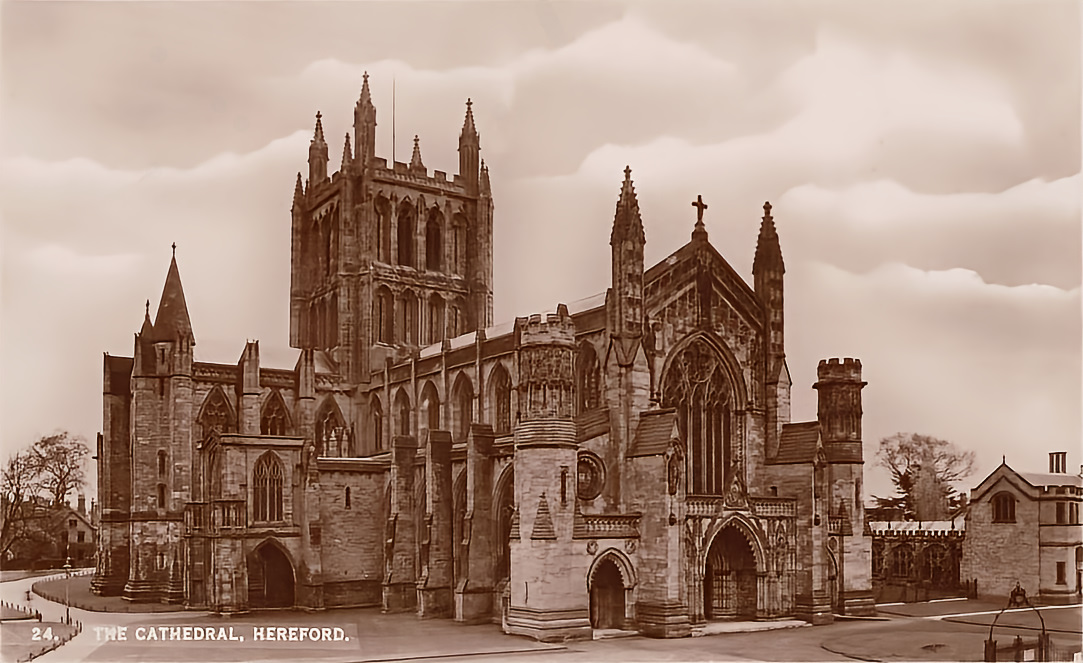
Because of the era in which he was born, and the artists with whom he sang, Stevens becomes a missing link between the operatic “Golden Age”, the mid-19th century and ultimately with today. I have sung with one of Stevens’s pupils on many occasions in the early part of my career as a singer and have been influenced and educated by that experience. We can experience the era of electrical recordings through Stevens whereas many of his contemporaries only survived to record in an acoustic format.1 The quality of his voice in his live recording of Elgar’s The Dream of Gerontius from Hereford Cathedral in 1927 gives the listener an insight into the two singers he was so often compared with, Sir Charles Santley and the French basse chantante, Pol Plançon, both of whom recorded before the First World War.
The repertoire with which Stevens rose to prominence is also of interest, and possibly a reason why he is not better known today. While it is true that his operatic output remains at the core of modern operatic repertoire, nevertheless Stevens didn’t appear on a professional operatic stage until 1923, at the age of 47. Prior to that he was famous in his home state of Victoria as an amateur recitalist, and a soloist with many of the local, long-standing choral societies and remembered predominantly as a “concert singer”. He continued as a concert singer well into his 60s, performing his last Elijah in 1939.
It is difficult, from a 21st century perspective, to understand the importance the community choral group played in Victorian and Edwardian society. By the time Stevens was performing in the United Kingdom in the 1920s and 30s, it was already waning. In an interview from 1934, at the beginning of his Australian concert tour, he remarked that “due to the popularity of wireless more than 25 per cent of musical societies have been forced to close”.2 These were not small groups. A photograph in my possession of the Murwillumbah Philharmonic Society from 1950 shows a group of over 50 performers, whose repertoire extended from William Byrd to Benjamin Britten. In 1852 the Handel and Haydn Society of Boston boasted a membership of 200.3 The Fairbairn production of Hiawatha that featured so prominently in the career of Stevens, was said to have utilized 800 choristers. There were certainly so many that they had to dress in tents erected outside the Royal Albert Hall, in Kensington Gardens.
Understandably, much of the repertoire of this period can no longer be performed. The resources are no longer there. The Early Music renaissance has allowed the choral masterpieces of Handel to remain in repertoire, simply because he used much smaller choral resources, often one singer per part. Other pieces like Mendelssohn’s Elijah, are performed regularly with smaller groups. Coleridge-Taylor’s Hiawatha, although glorious, is a victim of modern sensibilities to the plight of the Native American, while a massive choral work like Bantock’s Omar Khayyam was regarded as a “bulky novelty” when revived in 1927.4

Swindon Libraries

Stevens as 'Hiawatha'
Many of these pieces have, though, had very good modern recordings made of them and can be rediscovered in the privacy of one’s lounge room. When one considers that great composers like Gounod, Elgar and Vaughan Williams composed specifically for these great choruses, they remain an important area of musical achievement, and help to illuminate an era in which a performer could survive purely as a concert singer.
My research has uncovered so many Australian musicians who worked with their British colleagues to keep opera as a valid art form in inter-war England. Conductors like Aylmer Buesst, who assisted John Barbirolli and Adrian Boult, both with the British National Opera and the re-formed Covent Garden in 1931. Forgotten singers like Sydney-born soprano Leah Myers who created a storm in the 1923 Covent Garden season performing the lead role in Charpentier’s Louise. Sydney-born baritone, Harold Williams and Melbourne-born bass baritone Frederick Collier. So many stories. Their brief appearances in the Stevens story belies their importance in the history of Australian music.
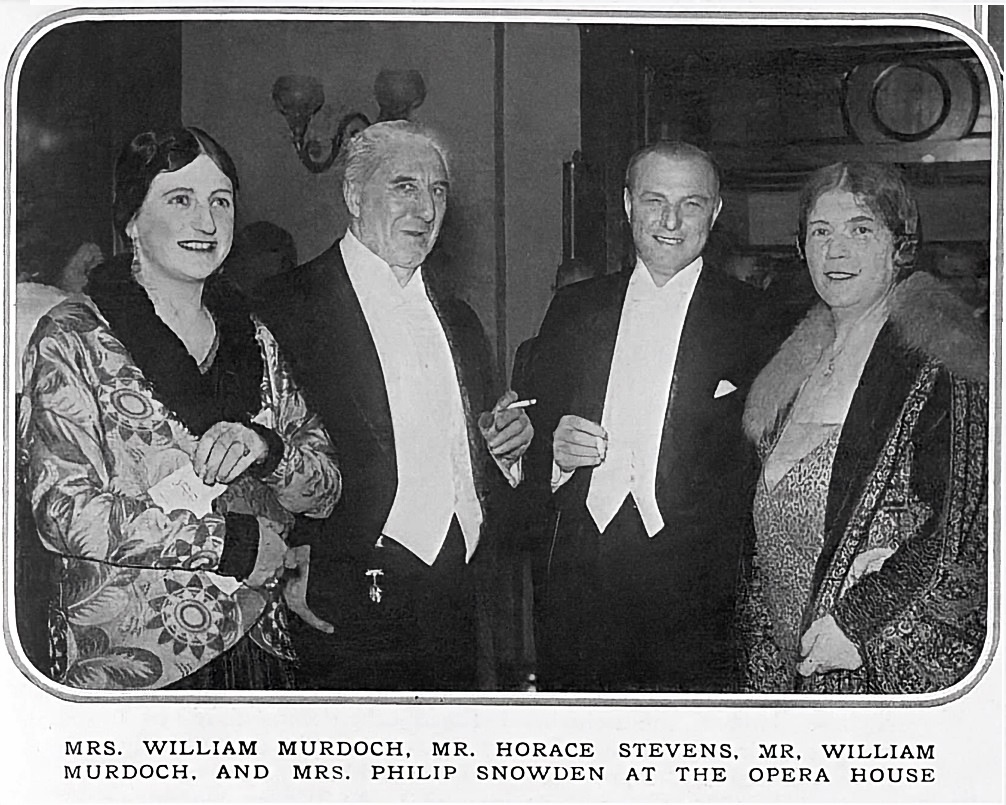 Horace Stevens and "friends" at the re-opening of Covent Garden (photo by Sasha) The Tatler (London), 23 September 1931, p.521
Williams was, like Stevens, a digger in the war driving an ambulance, although one story has him discovered by General Birdwood singing in the trenches of Gallipoli and moved to the entertainment corps. Collier, a little younger than Stevens was a product of Archbishop Thomas Carr, Roman Catholic prelate of Melbourne’s attempt to inject some Catholic blood into an art form that had attracted mostly Protestants.
All these Australians arrived in Britain with extensive musical experience in their home country. Stevens’s background with the Melbourne Philharmonic had grounded him in the repertoire of the great oratorios. It must be remembered that when he made his historic debut as Elijah in Leeds in 1919, he had been performing in the piece since 1888, first as a boy, then in the title role from 1902. As a youth he had observed the great Charles Santley sing the role in 1890. Unlike many Australian singers, his vocal education had been an all-Australian affair. His mother’s life-long friend, Bessie Jukes eased the transition from boy soprano to baritone, and, as he remembered in an interview during his brief return to Australia in 1920, she had coached him on all his repertoire since then, until the war.5
There are several remarkable aspects to the British career of Stevens, not the least being that by 1922 he had performed with Sir Henry Wood, Sir Thomas Beecham, Malcolm Sargent and Adrian Boult. He was introduced to Sir Edward Elgar in 1926 and recorded with him in 1927. He sang with Ralph Vaughan Williams throughout the twenties and premiered his Sea Symphony in the United States. During his visit to North America, he was bass soloist in the American premiere of the Bach B minor Mass with the New York Philharmonic.
All these accomplishments are remarkable, but to that I add his operatic accomplishments. By all accounts not the most animated performer, nevertheless it appears he may have been Australia’s first, native-born Wotan. There is more information coming to light every day, but for now, this brief introduction will help fill in the blanks of an extraordinary time, and an amazing Australian performer.
Australian Singers 1890-1950: A Literature Review
Two books form the principal secondary sources for Australian singers of Horace Stevens’s lifetime: Opera for the Antipodes by Alison Gyger,6 and Singers of Australia by Barbara and Findlay Mackenzie.7 The Mackenzie’s present brief biographies of Australian singers from 1880 to 1966. The book is now dated but when it was written many of these singers were either still alive, or fresh in the memories of people who knew them. As Horace Stevens was a very private man, accounts by contemporary colleagues and friends are a vital window into the life of this great artist.
Opera for the Antipodes is a fascinating overview of the Australian operatic world from 1881 to 1939. The only section that deals with Stevens directly discusses the Fuller tour of 1934-35 in some detail. The book is of great interest also, for information about the Australian cultural world prior to the First World War in which Stevens established his career. The earlier development of opera in Australia in the period between 1861-1880, prior to Stevens, is outlined in The Golden Age of Australian Opera.8 This book is useful as it discusses some of the older singers who sang with the young Stevens, for example the tenor Armes Beaumont.
There are several books which present biographies of individual Australian singers of this period. Four biographies of Dame Nellie Melba are currently extant, plus her autobiography Melodies and Memories.9 Melba’s very presence was such an inspiration to young singers. She regularly returned to Australia to hear and advise young singers, many of whom she took under her wing. At a time when it took a month by steamer to travel between Australia and England, her international schedule was exhaustive.
After Melba, the Australian singer most often written about is the Wagnerian soprano, Marjorie Lawrence. Less familiar to Australians, her career was mainly in North America, where she made regular appearances at the Metropolitan Opera. A famed beauty, her vocation was interrupted by polio. Her autobiography, Interrupted Melody 10 was made into a Hollywood film 11, and recently a biography, Wotan’s Daughter 12 has been published.

Marjorie Lawrence
photo by Delar, N.Y. (1947) - National Library of Australia, Canberra

Florence Austral
National Library of Australia, Canberra
A direct contemporary of Stevens and his partner on both the operatic and concert stage, soprano Florence Austral was the subject of a biography by James Moffat.13 There are some errors in the references to Stevens, particularly regarding his 1927 American concert tour.
Stevens’s famous contemporary, Peter Dawson, also wrote an autobiography, Fifty Years of Song,14 and an excellent biography of this artist was written by Horace Stevens’s last student, Russell Smith.15 Given the popularity of Dawson between 1900-1950, I was initially surprised how little his story connected to Stevens’s career. Dawson’s reputation has been raised to mythical proportions, but during my studies it became clear that he was in a different milieu to Stevens. Although Dawson appeared in the Proms two or three times, and attempted to sing Elijah once, he was primarily engaged for popular entertainment, in which he was a highly-paid success.

Peter Dawson
photo by Harrods (c.1933) - National Library of Australia, Canberra

Harold Williams
National Library of Australia, Canberra
During the 1930s there were three Australian baritones frequently appearing together in reviews and articles: Horace Stevens, Harold Williams and John Brownlee. Brownlee, like Lawrence, is better known in the USA, appearing regularly on the stage of the Metropolitan Opera, and later directing the Manhattan School of Music. He is commemorated in Giovanni: the life and times of John Brownlee by Lloyd Bell.16 Harold Williams is treated in a chapter within Singers of today by Donald Brook.17 Sadly, written after Stevens’s retirement, and a year before his death, Brook’s book does not include Stevens, but is a significant source of information concerning many of Stevens’s fellow performers, including Norman Allin and Muriel Brunskill, who also were part of the 1934-35 Fuller tour of Australia. While the biography Malcolm McEachern: Master of Song by Howard C. Jones documents the life of the Albury-born bass.
Despite the significant presence of Australian singers on the International opera and concert stage at this time, it is remarkable there are so few books detailing their lives and careers. Many of the women are discussed in Roger Neill’s Divas: Mathilde Marchesi and her pupils,18 but material discussing male singers is comparatively sparse.
Understanding the Context.
The accounts of pre-Federation and early Edwardian Melbourne in Manning Clark’s History of Australia 19 illustrate the vibrancy and sophistication of the city, although in country Victoria people were shooting each other. The Kelly gang was formed the same year Stevens was born. The incomplete collection of The Australian Musical News (1911-1963) at the State Library of Queensland 20 and chapter two of The Australian Symphony from Federation to 1960 21 by Rhoderick McNeill also shows how musically sophisticated Australians were during this period.
The era of Stevens’s professional life in Britain between 1919 and 1937 is best understood from the biographies and autobiographies of the conductors and musical leaders of the era. Many of the problems encountered by singers of the age were a direct result of the mighty shadow cast by conductor Sir Thomas Beecham. His efforts to control operatic Britain both during and immediately after the First World War were set against the social and fiscal difficulties that the war had created. Beecham’s autobiography22 finishes at the beginning of 1923, the year Stevens made his operatic debut at Covent Garden as Wotan. The centenary tribute by Allan Jefferson23 did not illuminate the period surrounding 1923, where Beecham left the Garden, and 1931, when he returned. However, the musical politics of the era is well presented in A History of the Royal Opera House. Covent Garden. 1732-1982.24 A key contribution to operatic stabilization was made through the continued political lobbying of publisher William Boosey, which resulted in the Government funding Covent Garden in 1931. This is chronicled in his autobiography, Fifty Years of Music.25
Charles Reid’s biography of conductor Malcolm Sargent26 mentions Stevens in a way that shows his importance in the musical world of Britain at the time. It gives vital information on the preparation and performance of the fabled Hiawatha performances at the Royal Albert Hall.
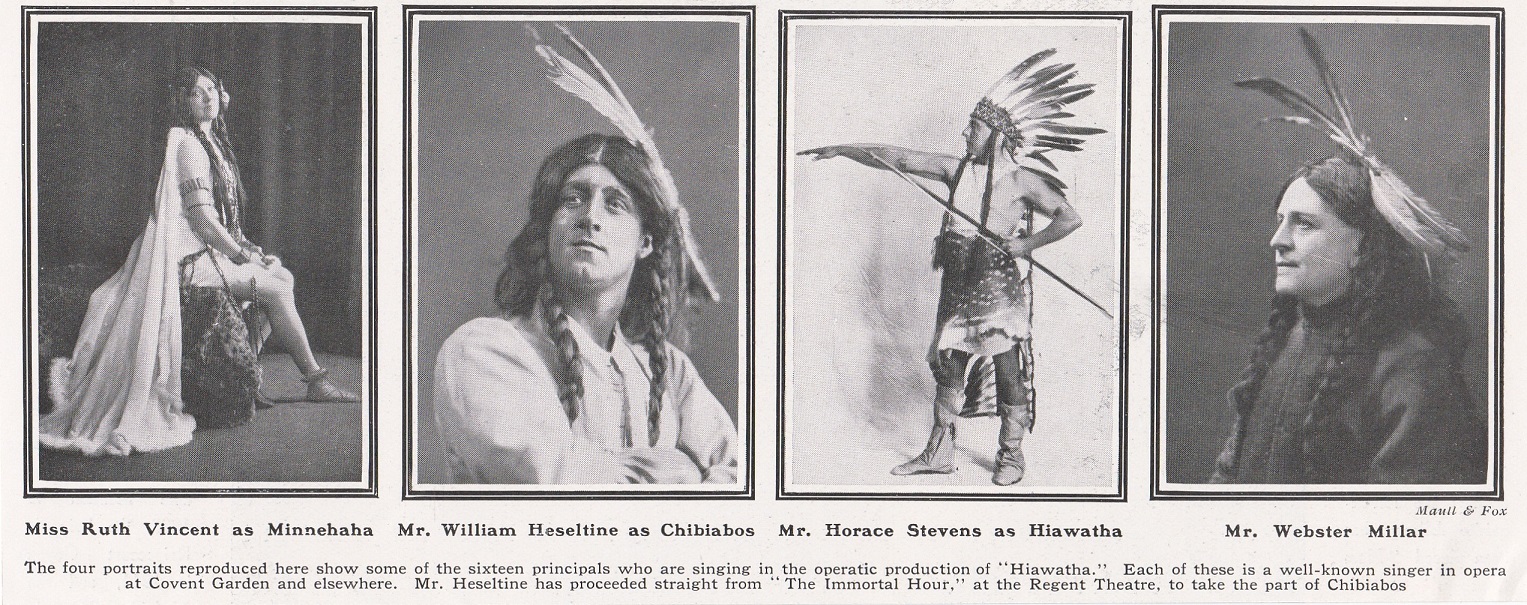 HIAWATHA perfomed as an Opera at the ALBERT HALL, The Sphere (London), Saturday, 24 May 1924, p.11
As Stevens’s professional career was tied so closely to the support of Sir Henry Wood, the related chapters in My Life of Music27 are pertinent. Although Stevens is not directly mentioned, Wood describes the British debut of fabled heldentenor Lauritz Melchior at the Proms. Stevens was the Wotan at that concert, and Wood points out that each singer in the concert performance of Die Walküre sang in their native language.
Finally, the conductor Eugene Goossens’s28 letter to his father en route to take over the Sydney Symphony Orchestra is perhaps more evocative of the personality of the conductor than of the singers he dismisses as teachers in Australia.
What is documented about Stevens?
Aside from Singers of Australia and Opera for the Antipodes, there is little published about Stevens in secondary sources. The essay on Horace Stevens in the Australian Dictionary of Biography29 is a very important source and features some interesting anecdotes. The author, James Griffin, knew Stevens personally, according to his son, and many of the references at the end list ‘private information’. I have been able to access Griffin’s other named sources which include the Mackenzie book, Isabelle Moresby’s Australia makes Music30 and Melbourne Savages by David Dow.31 The Moresby account of Stevens has the friendly, chatty aura of an interview, although it mistakenly puts Stevens’s Covent Garden debut in 1927 rather than 1923. The Dow book is reverential towards Stevens, while detailing some of the robust exploits of the Savage Club members.
A Century of Harmony, the centenary history of the Royal Melbourne Philharmonic Society, by W.A. Carne is a very important source. Through its chronological list of all appearances as the Youth to Sir Charles Santley’s Elijah in 1890 to his final official appearance with the choir in Beethoven’s Ninth Symphony in 1935. He is not mentioned in the cast of Hiawatha in 1939 but did perform in it and was broadcast in the role by the ABC.
There are several mentions of Stevens in Frank van Straten’s National Treasure,32 the story of Gertrude Johnson’s creation of the National Theatre. Stevens and Johnson knew each other when they were performing together in Melbourne before the First World War. Given the tone of some of Stevens’s interviews when he returned to Australia, the germ of an idea to train young singers in stage craft had already taken root by 1934. He assisted Johnson and coached from time to time. Brian Castles-Onion, in his obituary for Robert Allman for The Australian 33 mentioned that young singers were sent to Stevens first, to gauge their suitability in the field of opera.
The Record Collector34 has a fascinating article by Wayne Turner and Graham Oakes which appears to have information that could only be gathered from first hand sources, including a story of the 12-year-old Stevens suffering from stage fright at his first audition. It makes a couple of obvious errors. The contralto for the Santley performances of Elijah was not Adelina Patti, but Janet Patey. However, the article includes some descriptions of Stevens’s performances by colleagues Sir Keith Falkner, Norman Allin and Rispah Goodacre. The Record Collector article claims that Stevens sang in The Golden Cockerel, Madame Butterfly and The Marriage of Figaro, though I have found no press reviews to confirm or consolidate this information.35
Stevens is so closely associated with the three major oratorios of Sir Edward Elgar, particularly The Dream of Gerontius, it came as no mild surprise that he didn’t meet Elgar until 1926, the year before their celebrated collaboration at Hereford Cathedral which produced the magical live recording of ‘Jesu, by thy suff’ring dread’. Michael Kennedy’s essay ‘Some Elgar interpreters’ in the book Elgar Studies36, is effusive in his praise for Stevens’s performance. Bearing in mind the recording itself, (initially re-issued on Lp in 1972 and re-released on CD in 2011), one can only agree. It has been said that the acoustic of Hereford Cathedral was perfectly attuned to Stevens’s voice. One certainly hears none of the American critic’s complaints that sometimes he was drowned out by the orchestra.
Regarding Stevens’s limited recording career, I was fortunate to obtain a copy of Herman Klein’s contemporary reviews for the magazine The Gramophone.37 Klein is extremely complimentary about Stevens’s voice and, usefully, most of the recordings he reviews are issued on the Truesound Transfers discs discussed below. Klein also provides critical comparisons with contemporary singers in the same repertoire. Most of these recordings are also available for comparison.
Singers to Remember,38 by Harold Simpson, gives a good, if somewhat basic account of Stevens’s career. It ignores his amateur career in Melbourne, and, like many of the later articles and biographies, places his death in 1954. There is also mention of him singing Hagen from Götterdämmerung. The Moffat biography of Florence Austral also states that he took part in a performance of that opera with her. It was never reviewed, if it happened. The excerpts at the Cincinnati May Festival in 1927 contain no Hagen sections.
James Glennon devotes one and a half pages to Stevens in his book Australian Music and Musicians.39 It is a brief and basic account of his life. The dates and repertoire are correct. There is no mention of Elgar and Sir Henry Wood becomes Sir Thomas Wood not once, but twice.
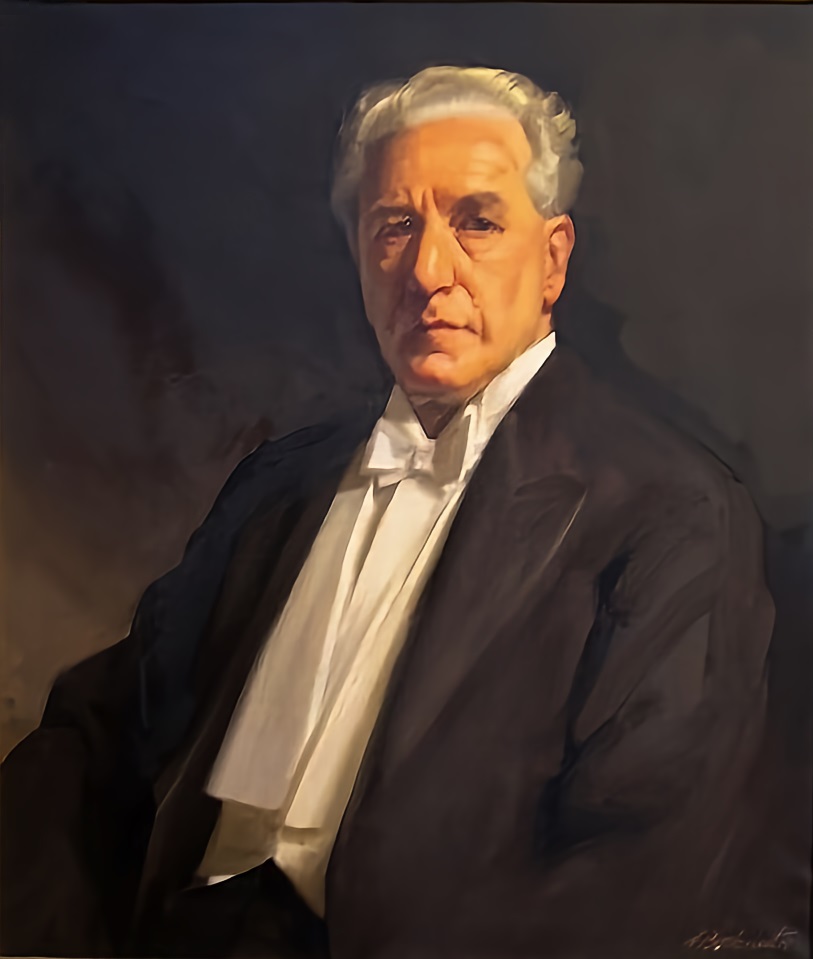 Portrait of Horace Stevens by Ernest Buckmaster (Entered into the 1936 Archibald Prize)
The Recorded Legacy
One of the most challenging aspects of researching Horace Stevens is the difficulty in obtaining recordings, not only of Stevens himself, but also for much of the music he sang, which is no longer fashionable, or requires resources that are, at best, difficult to assemble.
In dealing with Stevens’s recordings, the Eloquence release on Decca,40 Pearl’s 20 Great Bass Arias and songs volume 241 and The Elgar Edition on Warner Music42 (formerly EMI) all contain the same excerpt; ‘Jesu, by thy suff’ring dread’. At the start of my research at the beginning of 2017, YouTube had one Stevens recording; an obscure aria, ‘Sulla Poppa’, from La Prigione d’Edimburgo (Frederico Ricci).43 This performance is of interest because it appears to be Stevens’s only recording not in English (his Italian is impeccable), and that there is no evidence that he sang it in public. The year it was recorded, it was sung at the Proms by Herbert Heyner.
Two volumes of Stevens recordings are available on Truesound Transfers.44 Restored by Christian Zwarg, they contain his important recordings, including the Elijah arias, both in early versions for Vocalion records, and later versions for the fledgling Decca corporation. ‘Hiawatha’s Vision’ is also there, and gloriously sung.
Lastly, there is Elgar’s Interpreters on Record. Volume 5.45 This set contains excerpts from The Dream of Gerontius from 1936, conducted by Adrian Boult. We hear Stevens at 60, about to leave England forever, and despite Boult’s extremely slow tempi, the voice sounds powerful and fresh.
Finally, I needed to familiarise myself with the music Stevens sang. Whenever possible I tried to obtain contemporary recordings or versions that retained similar performance sensibilities. Stevens recorded the arias from Elijah, but the first recording of the complete oratorio was made in 1930 featuring compatriot Harold Williams.46 Sir Malcolm Sargent left an early recording of Handel’s Israel in Egypt47 without bass solos. The bass chorus sings ‘The Lord is a Man of War’. It doesn’t include the interpolated aria from Ezio, ‘Nasce al Bosco’, that Stevens sang, but it presents an interesting insight.
Stevens sang in the British premiere of Handel’s Eracle under Beecham. A later live recording from 1958 at La Scala exists48 that shows an older performance practice with basses singing the castrato roles, now usually undertaken by counter tenors, and the tenor arias sung by Franco Corelli, not a voice we would associate with Handel today. The Vaughan Williams Sea Symphony,49 and the three Elgar oratorios50 are all available under Sir Adrian Boult, with whom Stevens worked on a regular basis. Parry’s Job,51 Coleridge Taylor’s Hiawatha52 and Bantock’s Omar Khayyam53 are available on excellent, modern recordings. Stevens’s repertoire as a boy soprano can be heard on the Nostalgia Naxos release; Master Ernest Lough. Wings of a Dove.54
Leff Pouishnoff, who shared the concert stage with Stevens on his tour of Australia in 1934, can be heard on a double CD set for APR.55 Sadly, his lieder recordings with Walter Widdop are yet to be released.
The performers with whom Stevens shared the operatic and concert stages are available on several excellent compilation CDs, and to finish, to give some of the flavour of the 1920s music scene, Whispering Jack Smith,56 the performer who provided light relief during Stevens’s Armada Concert on BBC Radio, and the Coon-Sander’s Nighthawks,57 who finished off the Cincinnati May Music Festival, after the concert performance of Götterdämmerung, both have dedicated CDs.
To be continued...
Endnotes
1. Many of Stevens’s operatic contemporaries had remarkably brief lives. Caruso was dead at 48; Emmy Destinn, Puccini’s first Fanciulla del West died in 1930 at the age of 52.
2. The Argus, 20 February 1834, p 5. Trove. Accessed 21 March 2017.
3. Michael Broyles, Growth, Change, and Discoveries in the Nineteenth Century, p.57, The Handel and Haydn Society; Bringing Music to Life for 200 Years, The Handel and Haydn Society in association with David Godine, Publisher, 2014.
4. The Times, 29 October 1927, p.10. Trove. Accessed 3 May 2017.
5. Table Talk, 19 August 1920, p.25. Trove. Accessed 19 April 2017.
6. Alison Gyger, Opera for the Antipodes: Opera in Australia 1881-1939, Currency Press, 1990
7. Barbara and Findlay Mackenzie, Singers of Australia from Melba to Sutherland, Lansdowne Press, 1967
8. Harold Love, The Golden Age of Australian Opera. W.S. Lyster and his companies. 1861-1880, Currency Press, 1981
9. https://trove.nla.gov.au/book/resulty?q=Damje+Nellie=Melba Accessed 11 March 2018.
10. https://trove.nla.gov.au/book/result?q=Marjorie+Lawrence Accessed 11 March 2018.
11. http://www.imdb.com/title/tt0048210/ Accessed 11 March 2018.
12. Richard Davis, Wotan’s Daughter. The Life and Times of Marjorie Lawrence, Wakefield Press, 2012
13. James Moffat, Florence Austral. One of the Wonder Voices of the World, Currency Press, 1995
14. http://trove.nla.gov.au/book/result?q=Peter+Dawson Accessed 11 March 2018.
15. Russell Smith and Peter Burgis, Peter Dawson. The World’s Most Popular Baritone, Currency Press, 2001
16. Lloyd Bell, Giovanni: The Life and Times of John Brownlee, [Philadelphia]: Xlibris, c 2002
17. Donald Brook, Singers of Today, Tapp and Toothill Ltd., 1949
18. Roger Neill, Divas. Mathilde Marchesi and her Pupils, Newsouth, 2016
19. Charles Manning Clark, A History of Australia, Melbourne University Press, 1962
20. http://onesearch.slq.qld.gov.au/primoexplore/search?vid=SLQ&searchscope=SLQPCIEBSCO&query=any,contains,Australian%20Musical%20News
21. Rhoderick McNeill, The Australian Symphony from Federation to 1960, Chapter 2, Ashgate, 2014
22. Sir Thomas Beecham, A Mingled Chime, Hutchinson and Co., 1944
23. Alan Jefferson, Sir Thomas Beecham. A Centenary Tribute, MacDonald and Jane’s, 1979
24. Andrew Saint, B.A. Young, Mary Clarke, Clement Crisp, Harold Rosenthal, A History of the Royal Opera House: Covent Garden. 1732-1982, The Royal Opera House, 1982
25. William Boosey, Fifty Years of Music, Ernest Benn Limited, 1931
26. Charles Reid, Malcolm Sargent. A Biography, Hamish Hamilton, 1968
27. Sir Henry Wood, My Life in Music, Victor Gollancz. Ltd., 1938
28. Carole Rosen, The Goossens. A Musical Century, Andre Deutsch, 1993
29. http://adb.anu.edu.au/biography/stevens-horace-ernest-8653 Accessed 1 March 2017.
30. Isabelle Moresby, Australia Makes Music, Longmans, Green and Company, 1944
31. David M. Dow, Melbourne Savages: A History of The First Fifty Years of The Melbourne Savage Club, The Melbourne Savage Club, 1947
32. Frank Van Straten, National Treasure. The Story of Gertrude Johnson and the National Theatre, Victoria Press, 1994
34. Wayne Turner. Graham Oakes, The Record Collector. Vol. 46. No. 3, Editor: Larry Lustig, September 2001
35. The absence of Horace Stevens in the credits for such productions listed in J.P. Wearing's The London Stage 1920-1929 and The London Stage 1930-1939 [Scarecrow Press. 1984] indicates that such performances took place outside of London.
36. Raymond Monk (editor), Elgar Studies, Scholar Press, 1990
37. William R. Moran (editor), Herman Klein and The Gramophone. Collected Reviews. 1923-1934, Amadeus Press, 1988
38. Harold Simpson, Singers to Remember, The Oakwood Press
39. James Glennon, Australian Music and Musicians, Rigby Limited, 1968
40. Decca Eloquence, From Melba to Sutherland. Australian Singers on Record, Compilation Producers: Tony Locantro and Roger Neill, 482 5892
41. Pearl, 20 Great Bass Arias & Songs. Volume II, GEMM CD 9173, Pavilion Records Ltd.
42. Warner Classics, The Elgar Edition, 9 CD. 50999 95694 2 3 Mono ADD.
43. https://youtu.be/WSXzyhUh288
44. Horace Stevens 1. TT-3002. Horace Stevens 2. TT-3003. Source Materials provided by Chris Mankelow (Sunday Opera records). Christian Zwarg Compilation, discographical research and digital audio restoration: Christian Zwarg.
45. Elgar Editions, Elgar’s Interpreters on Record. Volume 5. EECD003-5 Broadcasts from the Leech Collection at the British Library. (1935-1950) add Mono.
46. Divine art. HISTORIC SOUND. Mendelssohn: Elijah. 27802 mono ADD
47. Dutton, G.F. Handel: Israel in Egypt , CDLX 7045
48. MYTO., G.F. Handel. Eracle, 2 CD 00159
49. Warner Classics, British Composers. Vaughan Williams. The Nine Symphonies, Sir Adrian Boult. 5099 0 87494 2 3 Stereo ADD.
50. Warner Classics, Elgar Choral Works, Sir Adrian Boult.0946 3 67931 2 2 Stereo ADD.
51. Hyperion, Sir Hubert H. Parry, Job. CDA67025 DDD
52. Argo, Scenes from the Song of Hiawatha, The Decca Record Company. 430 356-2 ZH2
53. Lyrita Itter Broadcast Collection, Granville Bantock, The Complete Omar Khayyam, Norman Del Mar. BBC. REAM.2128
54. Nostalgia Naxos, Master Ernest Lough. Wings of a Dove, ©2005, Naxos Rights International. 8.1 2083 2
55. APR Leff Pouishnoff, The Complete 78 rpm and Selected Saga LP Recordings, APR 6022
56. Flapper, Whispering Jack Smith, Past CD. 7074
57. ASV Mono. Living Era,. Everything is Hotsy-Totsy Now. The Coon-Sanders Nighthawks, CD AJA 5199
-
Horace Stevens (Part 4)
 DAVID HIBBARD's overview of the life and times of the Australian bass-baritone Horace Stevens continues with Part 4.
From January to March 1920, Stevens gave concert performances in Edinburgh, Belfast and London, Wagner featuring regularly. Returning to Australia in April 1920, to receive his discharge and pack up his family in preparation for a return to Britain, he nevertheless found time to perform in Melbourne. A Savage Club Concert at the Melbourne Town Hall in June,1 a Royal Victorian Liedertafel concert in August,2 and on 26August he made a triumphant return to the Royal Melbourne Philharmonic as Elijah, under Alberto Zelman. “All accounts agree on a very fine performance, with Mr Horace Stevens the outstanding feature of the performance”.3
He departed from Melbourne with his wife, Nellie, and his three sons; Kemble, Southerland and Dudley on 28 August 1920, to undertake a brand-new life as a full-time concert artist at the age of 44.4

Elsa Stralia, 1922
State Library of South Australia, Adelaide

Eugene Goossens, 1922
National Portrait Gallery, London
1920-1926
As outlined towards the end of Part Three, Horace Stevens began his professional career in Britain during 1919 while awaiting demobilisation back in Australia. In 1919 the Brand Lane Concerts for that year advertised a sterling line-up of musicians including Dame Nellie Melba, Clara Butt, Ferrucio Busoni, Alfred Cortot, and “there is to be a new Elijah from whom the highest things are expected, in the person of Captain Horace Stevens, Madame Stralia, Miss Astra Desmond, and Mr John Coates also appearing in the same oratorio”.5 The Brand Lane concerts were popular concerts, founded by G.W. Lane in 1894. Elsa Stralia, who appeared with Horace was an Australian dramatic coloratura soprano. Born Elsa Fischer, from Adelaide, she was six years younger than Horace but had been singing principal roles at Covent Garden since 1912.6
On the 29 September 1919, Horace Stevens performed in his first Promenade Concert. The “Proms” were the brainchild of Sir Henry Wood and Robert Newman (1858-1926), an ex-stockbroker turned impresario. In accordance with the Victorian Ideal of “improving” the masses, the concerts were designed to bring affordable music, well performed, to the middle classes. They occurred in The Queens Hall until it was bombed in May 1941.7 The first Promenade concert occurred on 10 August 1895,8 and the tradition has continued unbroken to the present.
Prom 38 for the 1919 season, on Monday, 29 September, began with the entire first half as an extensive, all-Wagner program, conducted, as usual by Wood. The concert included excerpts from Siegfried, Tannhäuser, Lohengrin, Götterdämmerung, Die Walküre, and Die Fliegender Holländer. Stevens performed ‘Wotan’s Farewell’ (to his daughter Brünnhilde) from Act Three of Die Walküre, an extensive extract that leads into the ’Magic Fire Music’ that concludes the opera. It is reasonable to presume that his coaching with Sir Henry under the ’Non-Military employment scheme’ was probably to perform this very piece.9 This performance of Wotan’s Farewell began a lasting association between Stevens and this work, perhaps only exceeded by his connection to the role of Elijah. On 6 June 1930, he recorded the ‘Farewell’ for Decca, conducted by Julian Clifford. Because Decca decided to include the Fire Music section on this recording, it appears this may be the first studio recording of the whole, dramatic scene.10
In 1920 Horace sailed for Australia to be demobilised. On his return to Britain, on 28 August, he almost immediately made his first recordings at the London studios of the Vocalion Recording Company. These recordings were listed as taking place in August 1920. They are two songs from a group of Four Songs of the Fair, by Easthope Martin (1882-1925):11 ‘Fairings’ and ‘The Ballad Monger’. The songs were composed for low voice in 1912. Pleasant, but undemanding music, the quality of the recordings is remarkably good. The Vocalion company pressed the recordings on red, rather than black shellac, which was not as robust.
On 1 December 1920 he performed in Purcell’s King Arthur, with the Westminster Choral Society at the Central Hall. The reviewer found that “on the whole, the performances was remarkably successful, considering the difficult conditions”. “The five soloists gave us some good things; Miss Carrie Tubb was very well suited by the Cupid recitatives, Mr Arthur Jordan was splendidly rhythmic in ‘Come if you dare’ and Mr Horace Stevens made much of the broad phrases of the greeting to Britannia”.12
In 1921 Stevens performed with the Leeds Symphony Orchestra under the direction of Beecham’s protégé, Eugene Goossens (1893-1962). There was an extensive programme for the two concerts. Stevens sang for the first time the two lengthy monologues for Hans Sachs from Wagner’s Die Meistersinger von Nürnberg. The first, listed in the programme as ’The Elder’s Scent’, which I believe to be ’Was düftet doch die flieder ‘or the ‘Flieder Monologue’ (and more correctly ‘the Lilac’s scent’), is a five-and-a-half-minute monologue, where Hans Sachs compares the poetry of Walther von Stoltzing, the noble poet, to the scent of the lilac that sweetly rises into the air. The second (of three), ‘Mad! Mad!’ (Wahn, Wahn, überall Wahn), is just over six minutes. Goossens programmed them one after the other, which is quite an effort for the vocalist. Despite this, they are perfect Horace Stevens repertoire, vocally. The odd thing about programming these two, lengthy solos is that, taken out of context from the drama of the opera, they require a degree of acting ability to successfully achieve a connection with the audience. For a performer who was yet to stand on an operatic stage, this must have been quite intimidating. Later in the concert, following performances of Dvorak’s Symphony ‘From the New World ‘and Sibelius’s En Saga, Stevens performed the beautiful song cycle Songs of Sun and Shade, by Samuel Coleridge Taylor (1875-1912). Composed the year before the composer’s death, they are a dreamy, mature work, comprising five songs.

Lauritz Melchior
Society of Swedish Literature in Finland

Horace Stevens as Wotan
The Australian Musical News, 1 December 1923
In August 1921, Horace Stevens returned to the Proms with further extensions to his Wagnerian repertoire. At the second Proms concert, on 15 August, he performed the Dutchman’s exciting aria ‘Die Frist ist um’, from The Flying Dutchman, as well as the scene for the Dutchman and Senta, ’Wie aus der ferne’. Although the Proms archive lists their programmes in the language of composition, it appears the singers performed in their own language. Sir Henry Wood writes that performances would be in English, German and in one famous case, Danish.13 At Prom No.14 of 1921 Stevens sang the parts of both Wotan and Alberich in excerpts from Das Rheingold, the prologue to Wagner’s ‘Ring Cycle’. In Prom No. 20 he sang in concert performances of both Acts One and Three of Die Walküre, which also marked the British debut of the legendary heldentenor, Lauritz Melchior (1890-1973). Australian compatriot, bass Malcolm McEachern (1883-1945) sang Hunding.14
I was intrigued as to why Stevens sang most of the three Ring Wotan’s in concert, (the Siegfried ‘Wanderer’ he sang in the Proms the following year), but on stage, only sang the Walküre Wotan. I wrote to John Wegner, who sang all three Wotan’s in the first Adelaide ‘Ring Cycle’ in 1998. He replied on 14 August 2017: “The three Wotan roles are very different to sing. If he (Stevens) was thoroughly prepared for the Walküre as his debut opera, then he probably learned enough to make it comfortable enough to do it again. … Walküre is the most difficult of the three because of the length of the role (1 ½ hours solo singing) with an incredible pitch range, emotional range and vocal stamina. If you start getting it wrong and you might not finish the night …Siegfried is a completely different kettle of fish … the tessitura is higher”. To paraphrase the end of the letter, John points out that without sufficient time to prepare the SiegfriedWanderer, the tessitura would have beaten him, and as the era of the extended production rehearsal was still a further thirty years in the future, this would explain it. John also points out that although Rheingold has the least for Wotan to sing, as a constant physical presence onstage, it is tiring in its own way”.
In November 1921, Stevens performed in the Leamington Spa Orchestral Concert, conducted by Walter Warren, described as an “able conductor”.15 This concert is interesting in that Stevens’s repertoire expands into more standard dramatic baritone fare. From Tannhäuser (Wagner) he sang the recitative and Aria ’O du mein Holdes Abendstern ‘(Song to the Evening Star), an aria that requires an ability to float on a reasonably high tessitura. It was received “very favourably”. His second item was probably the famous ‘Credo’ from Verdi’s Otello, Iago’s appeal to a “cruel God”. The reviewer is full of praise. The song “surpassed all that had gone before”. He finished his contribution to the concert, which included the Fideliooverture and the ‘New World’ Symphony, with a song, Harlequin by Comfort and Wilfred Sanderson Parry, and composed that very year. He encored with ‘The Ballad Monger’ from Songs of the Fair he had recorded the previous year.
In 1921 Stevens appeared in the first of his “Ballad Concerts” at St James’ Hall in London. The brainchild of Samuel Chappell, one of the Chappell music printer brothers, and managed by John Boosey of Boosey and Hawkes, these concerts were, prior to the 1890s, the forerunner to the Proms Concerts, providing easily accessible, quality music to the general public.16 Their fame, as The Classical Monday Pops, was enough to be included amongst the punishments meted out in Gilbert and Sullivan’s The Mikado (for the Music Hall Singer). In March 1922, Stevens performed the Stanford Cavalier Songs at a Ballad Concert, in “vigorous style”.17
Directly, he travelled to Kirkcaldy, near Fife in Scotland, to perform Sir Arthur Sullivan’s The Golden Legend, as Lucifer. Composed for the Leeds Festival in 1886, the same year as his Savoy comedy,18 Ruddigore, it is based on a poem by Longfellow. The part of Lucifer, once again, saw Stevens floating his voice into the higher tessitura of the bass baritone, similar in style to Gounod’s Mors et Vita. “A stirringly dramatic Lucifer in the person of Mr Horace Stevens, there was a fine rendering of the prologue”.19

Ad for The Dream of Gerontius in Leicester
Leicester Evening Mail, 29 April 1922

Florence Austral as Brünnhilde
National Library of Australia, Canberra
On 6 April 1922, a young Malcolm Sargent conducted Elgar’s The Dream of Gerontius in Leicester with the combined choirs of the Leicester Mowbray Choral Society, the Leicester Choral Union and the Melton Mowbray Choral Society. The orchestra was semi-professional, comprising amateurs and professionals. He selected John Coates (1865-1941) as Gerontius, Phyllis Lett as the Angel, and Horace Stevens as the Priest and Angel of the Agony. Stevens’s inclusion amongst some extremely established singers shows how highly he was esteemed after such a relatively short time performing in Britain. Sargent considered this performance of Gerontius to be his own “true beginning.”20
In August 1922, Stevens was back at the Proms performing the same Fliegender Holländer program, but this time the role of Senta was the legendary Australian soprano Florence Austral (1894-1968). She had made her Covent Garden debut in May of that year, substituting as the Walküre ‘Brünnhilde’ for an indisposed Elsa Stralia.21 Theirs was to be a long and fruitful relationship lasting through the twenties. Like Stevens, both were members of Sir Benjamin Fuller’s Opera Company tour of Australia in 1934, and both advised young singers with Gertrude Johnson’s National theatre in the 1940s. In his ADB entry on Stevens, James Griffin states that Horace would pedantically re-chalk stage positions on the floor, which would irritate Austral in later years.22 Chalking the stage marked stage positions and lighting cues in the days before duct tape.
Also, in the 1922 Proms, excerpts from Das Rheingold were again performed, this time with Stevens undertaking the parts of Wotan, Alberich and Donner on the 29 September, Walküre, on the 2 October with Carrie Tubb (1876-1976), as Brünnhilde, Archibald Winter as Siegmund and Malcolm McEachern as Hunding. On the 9 October, for Prom Number No. 50, Stevens performed the Wanderer in excerpts from Act 1 and Act 3 of Siegfried. His Erda was Doris Manuella, his Mime, Sydney Russell.
In January 1923, the “Eminent Baritone”23 was performing in a “Grand Orchestral Concert with the Scottish Orchestra” before joining a concert performance of Handel’s masque, Acis and Galatea at Grantham in Lincolnshire. The bass part in this Masque (premiered in 1718), ‘Polyphemus’ the cyclops, sits a little lower than much of the repertoire Stevens was, up to this date, singing. The tour de force recitative and aria ‘I rage, I melt, I burn’ and ‘O Ruddier than the Cherry’, are usually a mainstay of true bass singers. An incident occurred during the performance: Stevens missed some music at a page turn and came in too early for his next entrance.24 He stopped the performance to apologise to the audience.
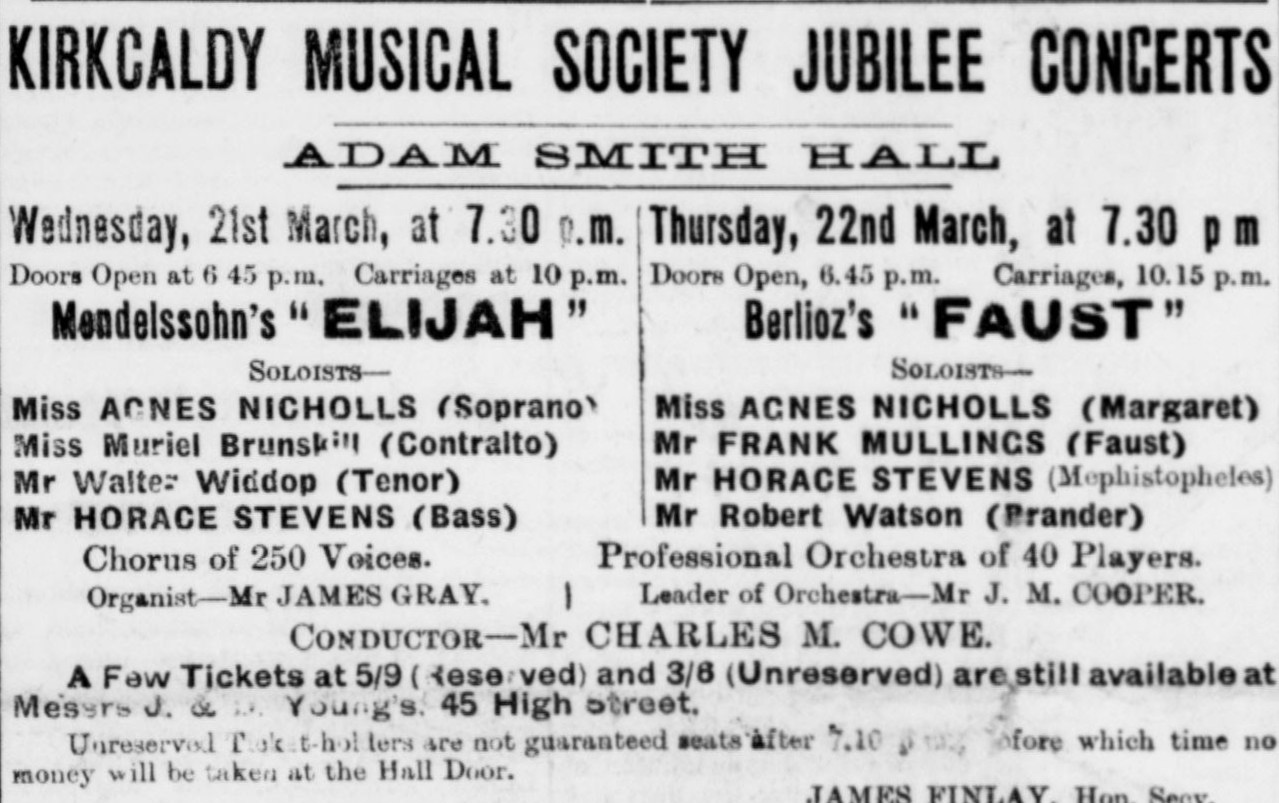 Flintshire Advertiser, 17 March 1923
In March Stevens was back in Scotland, at Kirkcaldy, with the Kirkcaldy Musical Society’s Jubilee. He performed Elijah and Mephistopheles in the Damnation of Faustby Berlioz. “The Prophet’s part upon which everything hangs” wrote the Fife Free Press “was in the capable keeping of Mr Horace Stevens who earned a reputation at the Society’s concert last year. We confess to a little disappointment. It was not a consistent performance, and though the singing of the great ‘It is enough’ was very fine, at other points Mr Stevens did not quite realise the hopes we had for him in this role.”25 Despite featuring such brilliant soloists as Walter Widdop and Muriel Brunskill, as well as Stevens, the Berlioz was dismissed as “possibly blasphemous” and using all the instruments of the orchestra.
Also, in March, Stevens recorded ‘The Wayside Cross’. Composed by American hymn writer, Evelyn Sharpe (1884-1969), it shows off the remarkable Stevens gift for floating high notes, although his over emphasis of the consonants, particularly the rolled ‘r’s sounds almost comical.26 In June 1923 he recorded his superb Messiah arias, ‘Why do the Nations’ (with da capo) and ‘The Trumpet shall sound’ and his first recording of ’Lord God of Abraham’ from Elijah. In July, under the curious assumed name of ‘Stephen Langley’, he recorded his first version of ‘The Drum Major’ by Frederic Weatherly (1848-1929), composed in 1907, and ’The Veterans Song’ with lyrics by Weatherly and composed by Stephen Adams (1841-1913) the nom de composeur of Michael Maybrick, the composer of the perennial favourite ‘The Holy City’.27 Both these were recorded for Aeolian, which was the parent of Vocalion records and after 1924 became Aeolian Vocalion.
In 1923, after a series of legal actions involving the control of the Covent Garden Estate, which had begun in 1916,28 Sir Thomas Beecham staged his final season at Covent Garden until 1931. Australian singers were well represented, with Melba performing Marguerite in Faust, Florence Austral singing the three ‘Ring’ Brünnhilde’s and Aida, Gertrude Johnson as The Queen of the Night, Frederick Collier singing Peter in Hansel and Gretel, Sydney mezzo Leah Myers making a brief sojourn into soprano repertoire as Charpentier’s Louise and Horace Stevens making his theatre debut as Wotan in DieWalküre, second cast to the American bass baritone Robert Parker.29 There is no local review of any of the performances of the second cast, but news arrived back in Australia by July. The London correspondent of The Age wrote “Mr. Horace Stevens, who has done a great amount of concert work in this country, made a still more ambitious first appearance as Wotan, no less, in the Valkyrie. For a stage debut, his performance was remarkable. In particular, he sang Wotan’s music, which suits him well, with admirable taste and skill, and took full advantage of his great chance in the farewell to Brünnhilde in the last act”.30 The correspondent to The Daily Herald of Adelaide listed the Australians Eda Bennie, Florence Austral, Beatrice Miranda, Leah Myers, Elsa Treweek, Frederick Collier (listed as a baritone) and “Horace Stevens, basso, in Wagnerian roles”.31 In December 1923, Stevens was mentioned in a letter to the Sydney Morning Herald from local singing teacher Roland Foster, that the success of Australian singers overseas should lead to a National Opera Company, using these singers as a basis.32 At 47 years of age, Horace Stevens had made a mark in his first operatic performances.
Stevens sang The Damnation of Faust again that November in Nottingham33 and The Dream of Gerontius in September in a double bill with Holst’s Hymn of Jesus that also featured Florence Austral.34 He sang Vaughan Williams’s A Sea Symphony with soprano Muriel Childe in Belfast in October with the Belfast Symphony Orchestra under E. Godfrey-Brown (1874-1955). His performance “added to a previously held, high opinion”. Amongst a raft of encores, he performed ‘Honour and Arms’ from Handel’s Samson, ‘Vision Fugitive’ from Massenet’s Herodiade and Peter Warlock’s ballad ‘Captain Stratton’s Fancy‘(composed only three years earlier).35
In 1924 Stevens was involved once again in the double bill of The Dream of Gerontius and Hymn of Jesus, this time at the Royal Albert Hall with the Royal Choral Society under the direction of Sir Landon Ronald (1873-1938). His colleagues for this occasion were the tenor Arthur Jordan, and the mezzo-soprano Margaret Balfour (1892-1961).36
In February 1924 he also recorded two of his finest sides for Vocalion: the other two Elijah arias, ‘It is enough’ and ‘For the mountains shall depart’, both from the second part.37 The Gramophone reviewer, Herman Klein, considered his version of ‘It is enough’ “an original, rather than a traditional reading. It is too full of sforzandos and staccatos for my taste, but in a large auditorium would doubtless sound well.” This is exactly the reason I love this recording. To achieve these effects, Stevens plays with his exemplary technique, to show the absolute beauty that can be achieved with this aria. In way of contrast, one should listen to the superb Wagnerian, Friedrich Schorr in 192938 which is fairly straight compared to Stevens’s version, and without embellishment. Klein is more supportive of the second aria, remarking upon the successful use of mezza-voce to get across a ‘difficult melody’.39
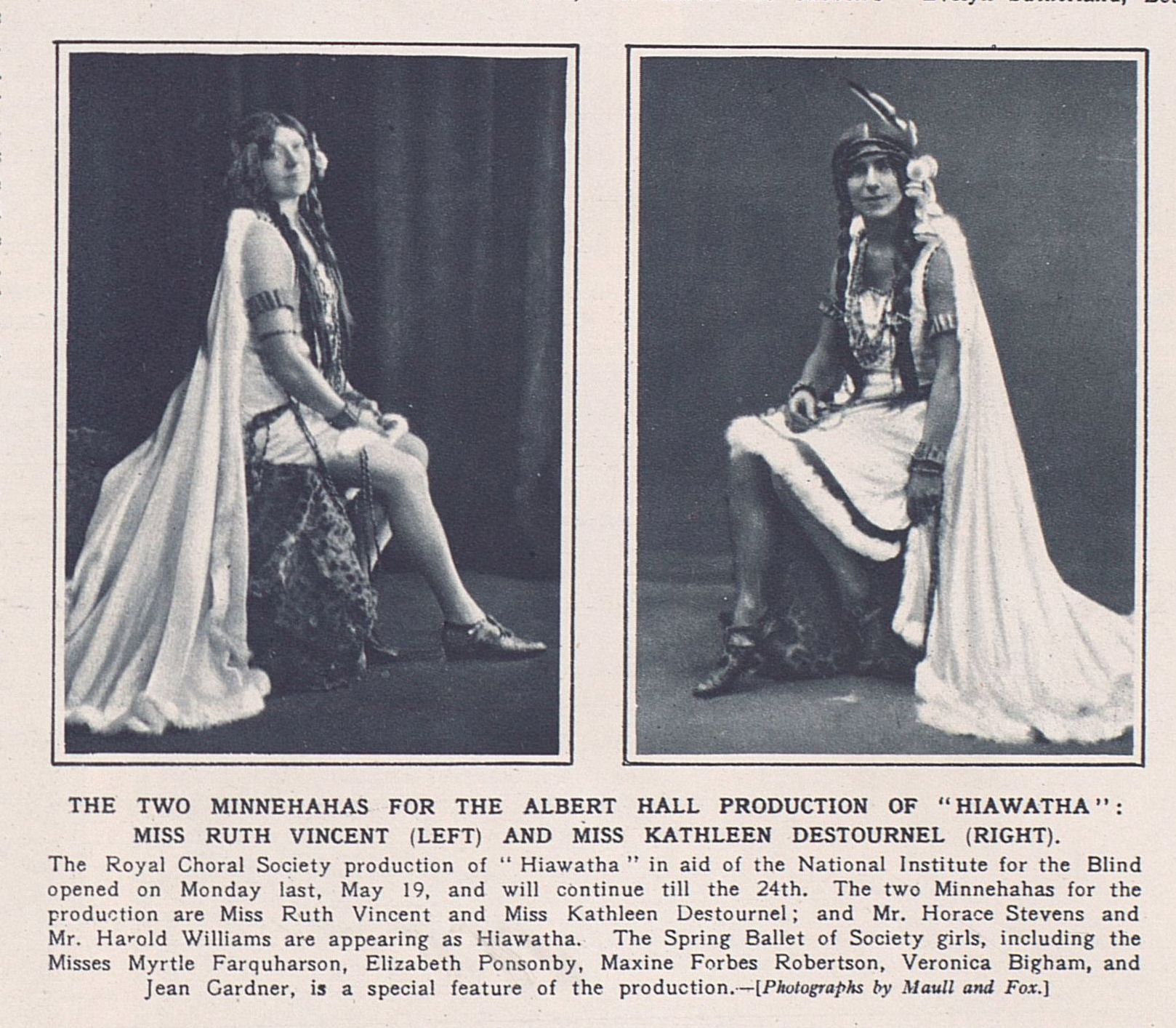 The Sketch (London), 21 May 1924
The British Empire Exhibition ran from 23 April 1924 to 31 October 1925. During this year of celebration, the entrepreneur Thomas Fairbairn was requested by the National Institute for the Blind to organise a charity event, whereby the cantata Hiawatha was staged. It had been performed as a complete, three-part cantata at the Royal Albert Hall on 22 March 1900. The scale of the set was huge. The back cloth was 10,000 square feet, and the production featured a waterfall and a snow storm.40 Because of the number of choristers, ’back-stage’ changing facilities were erected in tents in Hyde Park. The cast included a genuine Mohawk Chief Os-Ke-Non-Ton.41 Of the three casts, the opening night included Horace Stevens, Frank Mullings, Maggie Teyte and Ruth Vincent. Eugene Goossens conducted the orchestra, while Coleridge-Taylor’s son, Hiawatha, conducted the Ballet Music.42 After 1924, Goossens departed for the USA, leaving the performances in the charge of Malcolm Sargent, who wrote lovingly of the music, which he had first conducted in 1919.43 The performances proved so popular that the work was staged “for a fortnight each year from 1924 until 1939”.44
In 1925 Stevens recorded ‘Hiawatha’s Vision’ from part three of the Cantata; Hiawatha’s Departure. It is an edited version, possibly to cater for the limited recording time on the disc, cutting 24 bars from figure 26 to three bars before figure 27.45 This monologue has an extremely high tessitura, so the cut probably makes it easier to sing. Stevens approaches the piece with his usual, faultless diction, and elegant phrasing.46
October 1924 was a busy month, beginning with a performance of Elijah at the Alexandra Palace in North London. “Mr Stevens very cleverly combined subtlety with forceful expression”.47 On the 18 October he was in Norfolk to perform in an ‘all-star’ Yarmouth Festival, attended by King George V and Queen Mary. Dame Ethel Smyth and Ralph Vaughan-Williams conducted their own compositions, Horace performing the baritone solos in Vaughan-Williams’s A Sea Symphony. Under the baton of Sir Henry Wood, he once again sang ‘Wotan’s Farewell’ in a ’Special Wagner Programme’ which featured excerpts from ‘The Ring’, Parsifal and Tristan and Isolde. Other featured soloists included Maggie Teyte, Florence Austral, Malcolm McEachern and Margaret Balfour. The programming of the concert series was concentrated. Stevens sang the A Sea Symphony on Friday morning, the Wagner programme on Friday evening, and Elijah on Wednesday morning.48
By 1925 Stevens was a regular performer on wireless broadcasts. On the 26 January he appeared in an Australia Day broadcast with three compatriots, soprano Gertrude Johnson (1894-1973), a famous Queen of the Night and Micaela for British National Opera,49 tenor (Joseph) Browning Mummery (1888-1974), a famous lyric tenor who performed Rodolfo to Melba’s Mimi in her 1924 Covent Garden Farewell, and pianist and composer Roy Agnew (1891-1944), whose piano works were featured in recitals by Moisewitch and Cortot.50 The conductor for the evening was British, Sir Dan Godfrey (1868-1939), founder of the Bournemouth Symphony Orchestra. The program included the singers and orchestra performing Six Bush Songs by William G James (1892-1977).51
A broadcast on the 8 March by Stevens included the Four Serious Songsof Brahms, plus a set of Oriental Songs by Welsh composer, Bryceson Treharne, (1879-1948) who had previously been composition lecturer in Adelaide.52
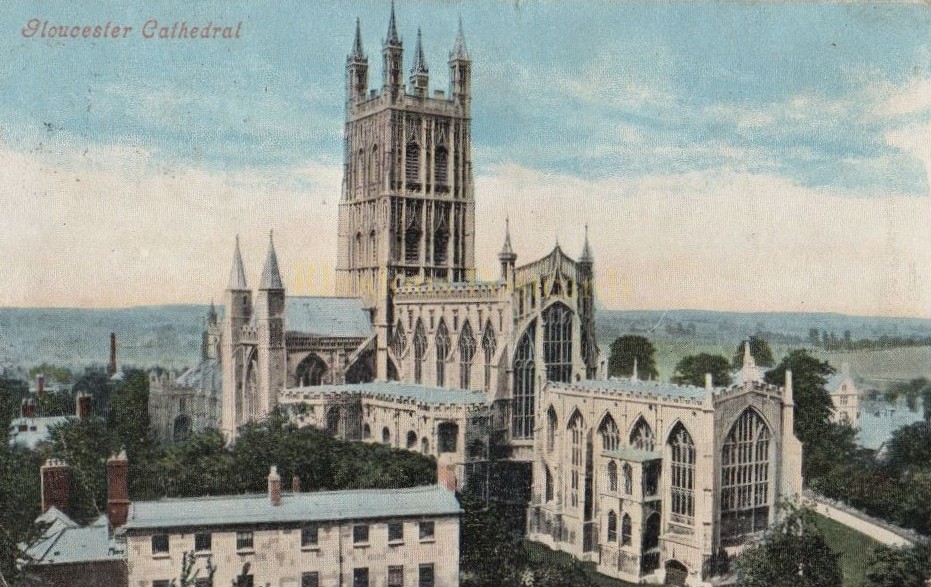
The Three Choirs Festival is one of the oldest musical festivals in the world, dating back to at least 1719 and comprising the choirs of the Cathedrals of the “three counties”, Hereford, Gloucester and Worcester. In 1925 it was the turn of Gloucester Cathedral to host the festival. This was the first year the BBC broadcast a Three Choirs concert. The London Symphony Orchestra was engaged, conducted by Sir Ivor Atkins, excepting the featured works by Dame Ethel Smyth and Ralph Vaughan Williams, which the composers themselves directed.53 In a massive program, Horace performed in Elijah, Sir Hubert Parry’s Job (in the relatively minor role of the Narrator), A Sea Symphony and in the premiere of Dame Ethel Smyth’s Mass in C. His reviews were consistently good, “powerful and impressive”.54 Sir Edward Elgar attended the festival to direct The Apostles but according to an email I received from Diana McVeagh of the Elgar Society, Stevens did not meet him until the following year in Worcester.
The Times headlined their review of Stevens’s performance “A Great Elijah”. Following a musical setting of The Lord’s Prayer, set by Leo Williams, during which the audience stood, “the main business of the day was begun by Mr. Horace Stevens singing the opening recitative of Elijah. The majority of the audience seemed to be armed with vocal scores, and in some of them, at any rate, the names of famous singers of past festivals had been pencilled against favourite arias. No doubt the words “Horace Stevens, 1925” will be added to many of them, and the name will deserve its place beside those of Santley, Ffrangçon-Davies and the rest, for his whole treatment of the part of Elijah is on the great scale. Mr Stevens singing was dramatic in the sense that he makes a musical picture a distinct personality which dominates the whole work, but it is singularly free from that over-assertiveness which sinks into theatricality.”55
Amongst his recordings for 1925 was the song cycle Maud (1898) by Arthur Somervell (1862-1937) to poems by Alfred, Lord Tennyson. The recording was reviewed in The Gramophone. “Somervell’s song cycles exhale the essence and the perfume of the poems which they reflect in music … for the Vocalion Horace Stevens however, has done four songs, all of them absolutely first rate, viz; A voice from the cedar tree (K. 05186) on one side of the disc; and on the other (a) O that ‘twere possible, (b) O let the solid ground, and (c) Go not, happy day.56 I commend first for the composition, as well as the singer’s artistic juxtaposition of energetic emphasis, tenderness , and strong gusts of passion.”57
Endnotes
1. The Argus(Melbourne), 11 June 1920 p.8. Trove. Accessed 19 April 2017.
2. The Argus(Melbourne), 13 August 1920 p.8. Trove. Accessed 21 May 2017.
3. W.A. Carne, A Century of Harmony: The official Centenary History of the Royal Melbourne Philharmonic Society, Royal Melbourne Philharmonic Society, Melbourne, 1954, p.167
4. Table Talk, 19 August 1920, p.25. Trove. Accessed 19 April 2017.
5. The Manchester Guardian. 4 September 1919, p.10. ©The Manchester Guardian Archives, 1901-1959. Accessed 4 August 2017.
6. Barbara & Findlay MacKenzie, Singers of Australia from Melba to Sutherland, Lansdowne Press, 1967, pp.109-111.
7. Thomas Russell, The Proms, Max Parrish & Co. Ltd., 1949, p.58.
8. Sir Henry Wood, My Life in Music, Victor Gollancz. Ltd., 1938, pp.71-72.
9. https://www.bbc.co.uk/proms/events/by/date/1919
10. Decca K527, K528 (mx MA 1464-1, MA 1465-1, MA 1466-3, MA 1467-2)-London, 06.06.1930
11. Truesound Transfers. Horace Stevens 2. TT-303 Copyright 2009 Christian Zwarg. Raschdorffstr.15, D-13409 Berlin
12. The Times, 1 December 1920, p.10. ©Times Newspapers Ltd. Accessed 21 June 2017.
13. ibid, Wood, pp 311-312
14. https://www.bbc.co.uk/proms/events/by/date/1921
15. Leamington Spa Courier, 18 November 1921. British Newspaper Archive. Accessed 4 August. 2017.
16. William Boosey, Fifty Years of Music, Ernest Benn Ltd., London, 1931, pp.102-111.
17. The Observer, 12 March 1922, p.6. The Observer Archives, 1901-2003. Accessed 10 August 2017.
18. http://www.hyperion-records.co.uk/dc.asp?dc=D_CDA67280
19. The Scotsman, 23 March 1922. British Newspaper Archive. Accessed 10 August 2017.
20. Charles Reid, Malcolm Sargent, A biography, Hamish Hamilton, 1968, p.105.
21. ibid, Barbara & Findlay MacKenzie, p.148.
22. James Griffin, Australian Dictionary of Biography, Volume 12, MUP, 1990.Accessed23 July 2017, http://adb.anu.edu.au/biography/stevens-horace-ernest-8653
23. Forfar Dispatch, 18 January 1923. British Newspaper Archive. Accessed 10 August 2017.
24. Grantham Journal, 24 February 1923. British Newspaper Archive. Accessed 10 August 2017.
25. Fife Free Press and Kirkcaldy Guardian, 24 March 1923. British Newspaper Archive. Accessed 10 August 2017.
26. Vocalion R-6109 Mx 03167 London 03 1923
27. Aeolian Aco-G-15247 mx C-58888 London 07 1923
28. Sir Thomas Beecham, A Mingled Chime, Hutchinson and Co., 1944. Reprint White Lion Publishers, 1973, pp.185-190.
29. J.P. Wearing, The London Stage, 1920-1929,Rowan & Littlefield. Accessed online 27 March 2014.
30. The Age (Melbourne), 21 July 1923. Trove. Accessed 26 November 2017.
31. Daily Herald (Adelaide), 23 May 1923, p 3. Trove. Accessed 26 November 2017.
32. The Sydney Morning Herald, 20 December 1923. Trove. Accessed 26 November 2017.
33. Nottingham Journal, 12 November 1923. British Newspaper Archive. Accessed 10 August 2017.
34. Sheffield Daily Telegraph, 29 September 1923. British Newspaper Archive. Accessed 10 August 2017.
35. Northern Whig, 29 October 1923. British Newspaper Archive. Accessed 10 August 2017.
36. The Times, 25 February 1924, p.10. ©Times Newspapers Ltd. Accessed 8 September 2017.
37. Vocalion D 01245 (mx 3474/5) London 02 1924
38. https://www.youtube.com/watch?v=U7jJRHrjOGc
39. William Moran (ed.), Herman Klein and the Gramophone. Being a series of essays on the Bel canto (1923) The Gramophone and the singer (1924-1934) and reviews of new classical vocal recordings (1925-1934) and other writings from the Gramophone by Herman Klein, Amadeus Press, 1990, p.93.
40. The Manchester Guardian, 8 May 1924. p.6. ©The Manchester Guardian. Accessed 8 September 2017.
41. https://www.royalalberthall.com/about-the-hall/news/2012/june/june-story-of-the-month-the-royal-choral-society-and-the-royal-albert-hall/ accessed 8 Sep. 2017
42. ibid, The Manchester Guardian.
43. ibid, Charles Reid, pp.84-85.
44. ibid, Royal Albert Hall website.
45. S. Coleridge-Taylor, Scenes from the Song of Hiawatha, No. 3. Hiawatha’s Departure, Novello and Company Limited, London, Copyright 1900.
46. Aeolian (London) Vocalion K-05176 (mx 03913) London 04. 1925.
47. Daily Telegraph, 13 October 1924, p.5. The Telegraph Historical Archive.Accessed 4 August 2017.
48. Thetford and Watford Times and People’s Weekly Journal, 18 October 1924. British Newspaper Archive. Accessed 26 April 2017.
49. Frank van Straten, National Treasure, the story of Gertrude Johnson and the National Theatre, Victoria Press, 1994.
50. Isabelle Moresby, Australia makes Music, Longman’s, Green and Company, 1948, pp.130-132.
51. 2LO London - 26 January 1925-BBC Genome.
52. The Observer, 8 March 1925, p.15. ©The Observer, 1901-2003. Accessed 3 May 2017.
53. Three Choirs Festival http://www.3choirs.org/ Accessed 5 November 2017.
54. Cheltenham Chronical, 12 September 1925. British Newspaper Archive. Accessed 3 May 2017.
55. The Times, 9 September 1925, p.10. ©Times Newspapers Ltd.Accessed 16 May 2017.
56. Vocalion K05186 (mx 03934X & 039345)
57. ibid, Herman Klein.
-
Violet Mount: Becoming L’Incognita
 ROGER NEILL uncovers the life and career of another extraordinary but neglected Australian vocalist―Violet Mount―a Melbourne-born singer with a rich soprano voice who went on to woo the music halls of Britain as the masked singer L'Incognita.
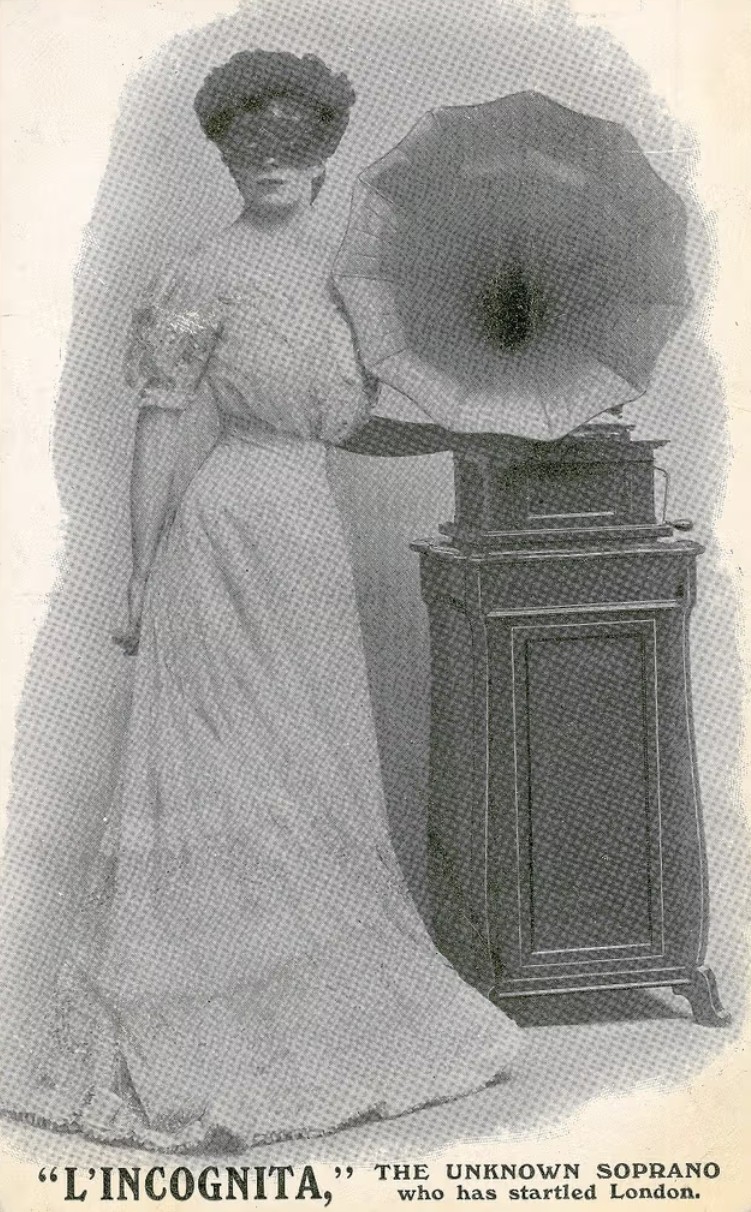 On Wednesday 18 March 1908 at 10.25pm, a masked woman walked for the first time on to the stage of the Alhambra music hall in Leicester Square, London. She was eighth in the pecking order that night, top-of-the-bill being Edouard Garceau, fresh from the chansons of Montmartre. She had been advertised that day as ‘L’Incognita’ and she sang the dazzling ‘Shadow Song’ from Meyerbeer’s Dinorah, taking the high E with ease. She ‘took the house by storm.’1
Violet Mount (aka "L'Incognita") - Meyerbeer: DINORAH, Shadow Song, 1913
But who was she?
Although she has been ignored in all the standard works on singers from Australia and New Zealand, Violet Mount, ‘L’Incognita’, was much admired by K.J. Kutsch and Leo Riemens in what has become the standard international Concise Biographical Dictionary of Singers. They wrote:
Strange rumours about the identity of the singer grew up after the appearance of her records. People conjectured that behind the pseudonym was Luisa Tetrazzini, who had just had great triumphs in England, or Alice Verlet or Yvonne de Tréville. Actually, they were made by the Australian music-hall singer Violet Mount, who was at that time appearing at the Alhambra Music Hall … The records, which appeared under the name L’Incognita and sold in large numbers, presented a lovely coloratura soprano, who possessed a thoroughly trained and virtuoso voice, which would not have been suspected of a music-hall singer.2
Violet Emily Le Breton Mount was born on 15 March 1875 at Caulfield, south-east of Melbourne’s CBD, the house of her paternal grandfather, Dr Mount. For quite differing reasons, her parents were rather extraordinary people.
Her father, Lambton Le Breton Mount, was born in Montreal, Canada, in 1839, the seventh son of Dr Edward Henry Mount and Emily Catherine Le Lièvre Mount (née Le Breton), who had immigrated to Australia from Canada in 1853, settling in gold-rush Ballarat, where Dr Mount practised as a surgeon and general practitioner. It was in Ballarat that Lambton met and befriended Adam Lindsay Gordon, who was to become the ‘father of Australian poetry’. In 1866, Gordon and Mount set up a sheep station at Bunbury in Western Australia. However, there were problems and the venture folded. To the end of his long life, Lambton remembered how he and Gordon ‘rode together’.
The sheep business was to be a portent for a stop-start career that Lambton was to have, much of it as an innovator in the glass manufacturing sector. This was his working life until he retired in his late sixties. However, he was a man of enormous energy, famous for his long-distance running (‘pedestrianism’)―one such being the 285 kilometres from Beechworth to Melbourne. In 1876 he imported forty lacrosse sticks from Canada, establishing that sport in Australia.3 And in 1887-88 he was President of the Victorian Chamber of Manufactures and a commissioner for the Centennial International Exhibition in Melbourne.
But he was also very conscious of his position in Australian society as a ‘gentleman’. And, in the late nineteenth and early twentieth centuries, gentlemen’s daughters led cloistered, lady-like lives and did not take paid work―particularly not on the rackety stage. And this set of beliefs was to affect Violet Mount’s whole life and career.

Lambton Le Breton Mount, c.1878
The Gold Museum, Ballatat

Adam Lindsay Gordon
State Library Victoria, Melbourne
Violet Mount’s mother was Mary Frances Mount (née Glynn), who was born in the St Kilda East suburb of Melbourne on 28 December 1855. Her parents were both immigrants from Cork, Ireland, her father a builder. Mary was a talented pianist and singer, who was to have a profound effect on her daughter’s growth as a musician, playing as her accompanist throughout her early years.
Where (and how) Mary learned that pianistic expertise is not known to me. There are many skills involved in successfully accompanying singers (and other musicians), among them: the ability to sight-read the music; the ability to transpose from one key to another at will; sensitivity both to follow the interpretive wishes of the singer and to provide advice on interpretive matters.
A Melbourne childhood
Violet was Lambton and Mary’s first child, born just nine months after their marriage. And there were five siblings to come, four brothers and a sister Winifred.4 Of these, it appears that only Winnie shared her sister’s musical gift, providing obligato violin to Violet’s singing in early concerts, but not going on to pursue music as a career.
Did Violet (or Winnie) go to school? There is no evidence that they did. So, if not, were they home-schooled by their mother Mary (or by a governess)? Given the later evidence of Lambton’s genteel opposition to Violet having a professional career on the stage, this might well seem to be another part of his beliefs concerning the restricted role of women and girls in the Victorian/Edwardian world.
Nor is there evidence of music teachers being employed by the Mounts—and as a consequence there are no early listings of performances of any kind. They must have been taught their music by Mary and if so, she must have been a remarkable teacher. Perhaps it is no surprise that the three of them first appear in print in Table Talk of 2 December 1892 with products for sale at a church sale of work—Mary offering her ‘fine art’, while Violet (17) and Winnie (15) had made confections.
The next we hear of them is leaving Melbourne on 29 April 1893 on a German steamer, the Karlsruhe,5 whose eventual port will be Bremen, but the Mounts were to disembark at Southampton. The family group consists of ‘Mrs L.L. Mount, Miss Violet Mount, Miss Winnie Mount, Masters Harold and Ray Mount’.6 The boys are the two youngest, with their older male siblings left behind with father Lambton in Melbourne, who was to put their house and furniture up for sale to fund the expedition.7
At the time, it was quite unclear as to why they went on this long voyage. Was it to find music teachers for Violet in Europe? Or just to have a holiday experience? I have yet to discover when they returned to Melbourne but in August 1896, at an ‘At Home’ in Caulfield, Violet sang and her mother Mary both sang and accompanied.
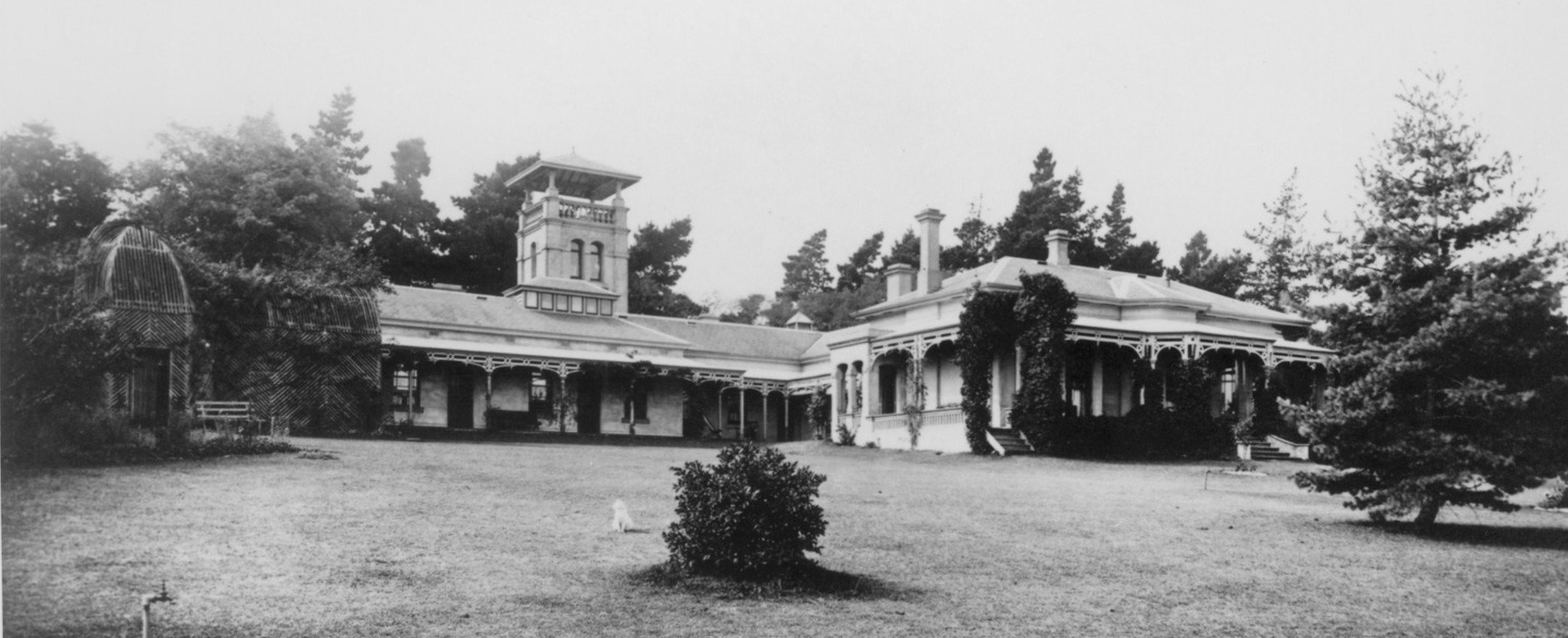 Keroongola—where the Mount family lived during 1896-1898. State Library Victoria, Melbourne.
Returned to Australia, they lived until 1898 at Keroongola in Orrong Road, St Kilda East. And on 28 June 1897 Violet was ‘heard to advantage’ in Marie’s famous aria, ‘Convien partir’, from Donizetti’s bel canto comedy La fille du régiment in a pupil concert for the Howard Conservatoire.8 This conservatoire had been opened in Melbourne the previous year but both the founder, George Howard and its leading singing teacher, the ageing prima donna Fanny Simonsen, died in 1896 and the business was taken forward by Howard’s widow, Mme Houyet-Howard. It offered the full range of musical tuition, singing now being taught by the English tenor William Parkinson and others. Violet was later to disclose that it was Parkinson who was the one who taught her there.
She appeared again in the conservatoire’s second student concert of the year in August, where she gave Agathe’s aria, ‘Softly sighs the breath of evening’ (‘Leise, leise’), from Weber’s Der Freischütz, this time accompanied by a thirty-piece orchestra.9 She was announced to sing a lead role (Plaintiff) in Gilbert and Sullivan’s Trial by Jury in October, a charitable performance.10 And in December Mme Howard gave an ‘At Home’ which featured Violet singing Anton Strelezki’s then-popular ‘Dreams’ with Winnie Mount providing obligato violin.11
To start out on her performing career as an amateur at the age of twenty-two with two showpiece arias shows how confident Violet Mount must have been in her capabilities. In fact, the Weber aria was to have form: it was later sung by Kiri Te Kanawa when she won the Sun Aria competition in Melbourne in 1965 and then by the Finnish soprano Karita Mattila, who sang it when winning the inaugural Cardiff Singer of the World competition in 1983.
It was a promising start and Violet went on the following year to sing at a number of private events in Melbourne, one of them (2 July) including the young baritone Horace Stevens, and another was an ‘At Home’ (7 July) given by her mother at the Mount home in St Kilda East, which included the New Zealand-born tenor Walter Kirby.12 He was to turn out to be a fortunate contact for Violet.13
To New Zealand
In 1899 the Mount family moved from Melbourne to Wellington. It seems that father Lambton was the instigator of the move as his glass manufacturing business was struggling in Australia and …
He came to New Zealand to test the colony’s mineral wealth. He thought Wellington would provide a fine field for glassworks …14
However, the major beneficiary of the migration was undoubtedly Violet, whose singing career simply took off in Wellington with many concert performances that were to be paid for. Did her ‘gentleman’ father approve of the reality that she was becoming a professional?
Violet made her debut in New Zealand on 13 June 1899 in a concert given by the Ladies Musical Society at the Art Gallery in Wellington, conducted by Mrs Alfred Levi. Looking forward to the event, the Evening Post reported:
She is the possessor of a fine soprano voice and has for many years studied at the Howard Conservatoire in Melbourne and in Germany and Paris.15
She sang her aria from La fille du regiment and two songs, ‘creating a favourable impression’. It was a start. Then in July she was in a chamber concert at Choral Hall, where she sang a wider range of arias and songs, accompanied this time by Cyril Towsey, and received fulsome endorsement:
She is gifted with a soprano voice of considerable power and singularly sympathetic timbre, and she sings with ease and displays great intelligence in the management of the words.16
On 29 August, booked by her new friend Walter Kirby, she sang at a concert at the Opera House, attended by the Governor, the Earl and Countess Ranfurly. Again, she sang the Weber aria and Tosti’s ‘Goodbye’.17

NZ Sporting Review, 2 March 1899

Wanganui Chronicle, 12 October 1899
In subsequent months, engagements for Violet came usually twice a month, including: a cantata, Corder’s Margaret; German pianist Albert Friedenthal’s farewell concert (where she sang two of the pianist’s own songs); another concert with Walter Kirby at Wanganui; and in June 1900 she performed in her first opera, Gilbert and Sullivan’s The Grand Duke(as Julia Jellicoe), at the Opera House. She got a mixed review:
Miss Mount’s ability as a singer is well known, but as an actress she is unable, as yet, to give a particularly telling reproduction of a comedienne’s part.18
In November 1900 she sang (perhaps for the first time in public) Henry Bishop’s ‘Lo! Here the gentle lark’,19 accompanied on the flute by Charles Hill, eldest brother of Australasian composer Alfred Hill, with her mother at the piano.20 The song, with its testing coloratura, had already held the stage over many decades, recorded by (among others) Nellie Melba, Galli-Curci, Joan Sutherland, Kiri Te Kanawa―and Violet Mount (as ‘L’Incognita’) with Australasian flautist John Amadio.21 It was to remain in her repertoire throughout.
And the following month she was soloist in Stanford’s Te Deum at a Jubilee event at the Canterbury Hall in Christchurch, among the many speakers prime minister RJ Seddon.22

Alice Hollander, 1900s, by The Biograph Studio
Elisabeth Kumm collection

Jean Gerardy, 1900s, by Falk, Sydney
Elisabeth Kumm collection
Early in the new year, Violet was recruited to ‘assist’ at a concert given by the Australian contralto Alice Hollander at Sydney Street Hall in Wellington. Although she was some seven years younger than Violet, Hollander was already further ahead in her career, which was looking to be in conventional concert halls. Yet it was not long after this meeting that Alice Hollander made an unusual career choice, moving into music halls in Britain:
A good voice is just equivalent to capital, which should be banked where it will draw the best interest … And people who pretend this is not the mainspring of all we do, and talk Art with an exaggerated capital A, are merely ‘foozling’ … The business aspect of the question is that the concert platform is limited to the concert season, whereas the halls are open all year round.23
Hollander implemented this radical strategy in the years before the arrival of Violet Mount in London in 1907. There were few ‘serious’ singers on the halls. Hollander herself would play several music-halls every night, singing just one song at each venue and picking up a handsome fee every time. At some stage, Violet will have recognised the good business sense in Hollander’s working life―and this proposition may well have been put to Violet’s business-oriented father.
Violet was to sing Irish songs, presumably learned in Melbourne at her Irish mother’s knee, at the Opera House in Wellington on St Patrick’s Day 1901―‘Kate O’Shea’, ‘Kathleen Mavourneen’ and ‘The Minstrel Boy’.
However, it was not to be many weeks before the family moved again, this time north to Auckland. And (again) it was father Lambton who instigated the move, having ascertained that there were rich sandstone deposits in the area ideal for glass manufacture.24
That month (May) there was a first Complimentary Farewell Concert for Violet Mount in Wellington, given at the Opera House. She sang ‘Ernani involami’, Chaminade’s ‘L’été’, the trio from The Bohemian Girl, and the grand sextet from Lucia di Lammermoor (with two brothers of Alfred Hill among others).
But before the Mounts left the city, the Wellington Liedertafel with Violet Mount and others gave a concert performance at the Art Gallery of Offenbach’s one-act operetta The Rose of Auvergne.
The New Zealand Free Lance waved farewell to them from Wellington in July 1901:
Miss Violet Mount, the sweet singer from Melbourne, who had practically become a Wellingtonian, left last week to take up her residence with her people in Auckland. Wellington’s loss is Auckland’s gain, for the Mount family is highly musical. Mr Mount, who has successfully floated a glass manufacturing concern in the Queen City of the North, is a sound critic and Mrs Mount is both songstress and pianist. Violet is the flower of the flock and the Mount family simply adore her.25
Her performing life in Auckland picked up immediately, this time with more opera. But first, Violet was hired to assist the Belgian international cellist Jean Gerardy in a series of concerts.26 In October it was announced that Violet would create the lead role in Auckland-based surgeon-composer George de Clive-Lowe’s new comic opera, The LadyTypist. In the event, it does not seem to have got past rehearsals stage.27
 New Zealand Graphic, 26 October 1901
But there was better luck with Gilbert and Sullivan’s Iolanthe, given by the Auckland Amateur Opera Club in November—with Violet as Phyllis: ‘Miss Violet Mount was in delightful voice and unquestionably scored the first honours of the evening.’28
She travelled from Auckland to give concerts in other North Island cities―Hawera in December 1901 and New Plymouth in January; and later that month she again ‘assisted’ contralto Alice Hollander, this time at the Choral Hall in Auckland, singing the cavatina from Verdi’s Ernani.
To Sydney
However, Violet Mount’s sojourn in Auckland was short-lived and, after the obligatory Complimentary Farewell and a performance of Schumann’s Paradise and the Peri, she left for Sydney in May 1902 aboard the Mararoa, the rest of the Mount family remaining in Auckland.29
Violet opened in Sydney with performances on successive days: first, on Monday 14 July, she gave an invitation matinée at Centenary Hall, ‘best heard in Grieg’s Solvieg’s Song’. She must have briefed a local journalist, for in his/her report it was finally disclosed that Violet had studied with singing teachers in Europe in1883: with a Herr Odenwald in Germany (probably Dresden, as disclosed in another interview) and with Mme Caut in Paris. I have (as yet) not been able to identify either of them.30
And on the following day she assisted the Florentine tenor Carlo Dani in his ‘final’ concert in Sydney at the Town Hall. The Watchman was full of admiration for Violet’s performance: she had ‘clear enunciation, sweetness of tone and an expressive style of singing’.31 In the event, she was retained by Dani for his touring company and gave several more performances with him, the ‘Waltz Song’ from Gounod’s Romeo et Juliette being her calling card.

Alfred Hill, 1910, by May and Mina Moore
National Portrait Gallery, Canberra

Roberto Hazon, 1890
National Library of Australia, Canberra
Then in August she sang in a complimentary farewell concert for composer Alfred Hill. Violet had got to know (and had performed with) several of Hill’s brothers in New Zealand. The main event was a performance of Hill’s Maori cantata, Hinemoa, and Violet sang ‘several songs’.32
However, business dropped off in the summer months and Violet felt the need to advertise in the Sydney Morning Herald for work.33 This initiative seems to have borne fruit, as in December she was hired ‘at great expense’ to be the principal soprano in a concert party playing the towns of the Northern Rivers region of New South Wales (Lismore. Byron Bay, Grafton, Ballina, Tweed Heads).34 And she was to repeat the experience with another touring company the following June.
Next came a series of recitals in the Town Hall played by the city’s organist, Arthur Mason. One of these focused on Wagner and Violet sang ‘Elisabeth’s Greeting’ from Tannhäuser.35 In March Violet was appointed soprano soloist for St Patrick’s Church in the Rocks, a role which was to provide her with consistent work. And April brought a Sydney Philharmonic Society performance of Haydn’s The Creation with Violet as soprano soloist. The Italian Roberto Hazon conducted, and Violet was later to claim that he had had a major influence on her singing.36 She must have sung well as the Society booked her again in September for Mendelssohn’s Elijah.
Also in September, Violet sang in the first performance in Sydney of Liza Lehman’s song cycle ‘The Daisy chain’.37 And later that month, Violet was to meet and sing with the visiting Australian contralto Ada Crossley, by now an international concert artist and living in London. Violet’s first encounter with her was at a reception given for Crossley where Violet sang. Then, on 6 November, Mount and Crossley performed together with the Sydney Philharmonic Society in Sydney in Elijah. Both singers received outstanding response from the audience and very generous reviews in the media.38
By this stage in her career, twenty-eight years old Violet Mount had built a strong reputation as a singer―in Wellington, Auckland and Sydney. But her career had quite simply not taken off as other women before her in Australia had managed―among them Nellie Melba, Frances Saville and Ada Crossley. And each of them, in order to take their careers on to a new level, had made the choice to relocate to much bigger markets in Britain or continental Europe.

Violet Mount, 1905, by Appleby, Sydney
State Library of New South Wales, Sydney
This is exactly the advice that Crossley gave to Violet. And some time later Crossley was to write to Violet, ‘asking her to go straight to her [in London] and promising her many engagements.’39 But it was to be a further three and a half years after that Elijah before Violet took the plunge.
The following years, 1904 and 1905, provided Violet with a constant stream of work in Sydney, much of it of the bread-and-butter kind―including oratorios, disaster relief concerts and many farewells for Australian singers and other musicians leaving for the northern hemisphere. There were perhaps two more outstanding events: in April 1904 she sang the role of Elsa in Act One of Wagner’s Lohengrin for the Sydney Philharmonic Society under Roberto Hazon at the Town Hall;40 and June saw the arrival in Sydney of the German pianist Albert Friedenthal, at whose concert she had performed in Wellington four years earlier, again singing the pianist’s own songs.41
It seems likely that father Lambton Mount sailed from Sydney to London on the Rimutakain May 1904.42 In 1905 Violet led the cast as Arline in Balfe’s The BohemianGirl, first at Penrith in May, then at the Palace Theatre in Sydney in September, where her acting was said to be ‘very spirited’.43
More Farewells than …
However, 1905 saw the start of a two-year ‘farewell’ period for Violet as she moved towards leaving Australia and New Zealand, sailing with her mother to London in May 1907.
‘Farewells’ have for so long been synonymous in Australian mythology with Dame Nellie Melba, who very regularly gave performances so named as she approached the end of her illustrious career. But what Violet Mount’s life story shows is that farewells were common currency—for herself and for so many of her musical friends and colleagues.
The planning process for Violet’s farewell from Sydney started in July 1905, leading to the event itself taking place at the Town Hall on 20 September. There were many performers, but Violet’s own main contributions were the ‘Bell Song’ from Delibes’ Lakméand ‘Casta diva’ from Norma, in both of which she ‘sang brilliantly’.44
Then in December Violet returned to Auckland to give a farewell concert ‘before going to Europe’, singing ‘Ah! fors’è lui’ from La traviata, the ‘Bell Song’, ‘Villanelle’ and a Rossini song:
Always a sweet soprano, Miss Mount’s voice has materially increased in power since she was last heard here.45
By February of 1906 Violet was back in her home city of Melbourne, where she opened with an invitation concert at the Pianola Hall in March, followed by Elijah at the Town Hall for the Melbourne Philharmonic Society. While Violet was gratefully received, the star attraction was the Scottish-born baritone Andrew Black, who was touring Australia and was to settle there, perhaps the only leading singer from the ‘Golden Age’ to immigrate.

Andrew Black, 1905
Elisabeth Kumm collection

Melboune Town Hall, c.1906
State Library Victoria, Melbourne
The obligatory Complimentary Farewell Concert for Violet in Melbourne came on 2 May 1906—still twelve months before her actual departure. It was given at the Town Hall, where …
a large audience received the young artist with great enthusiasm … Her voice is a bright, clear, ringing soprano of very wide range—she touched F sharp in alt with exact truth of intonation and perfect sweetness—and she has trained it to an astonishing degree of flexibility … She was accompanied by her mother Mrs Lambton Mount.46
Still marking time, Violet organised in September an operatic event at the Masonic Hall in Melbourne, where she was Marguerite in Acts 3 and 5 of Faust, plus giving arias from Rigoletto, Dinorah and Mignon.47
October saw a return for Violet with Andrew Black, this time in Haydn’s Creation at the Town Hall, a performance they repeated when Violet returned to Sydney in March 1907.48
Her final farewell was, fittingly, given at Her Majesty’s Theatre in Ballarat, the hometown of her father’s family, on 9 May. In ‘Lo! Here the gentle lark’ her obligato flautist was another Amadio, Master Adrian, half-brother of John, and the whole was accompanied by Violet’s mother.49
Violet, ‘Australia’s best soprano’, and her mother finally left Melbourne for London on 24 May 1907 (Empire Day) on the White Star liner Afric.50 She was thirty-one.
What would the future hold?

Mathilde Bauermeister, 1900s
The Newberry, Chicago

L'Incognita, photo by Bassano
The Sketch, 15 April 1908
London: Becoming L’Incognita
When Violet and her mother arrived in London, Violet was quite clear responding to inquisitive reporters: it was to be opera or the concert stage. And strenuous efforts were made in that direction.
In October 1907 she sang at a ‘semi-private’ event where she ‘scored an unequivocal success’.51 Maybe. At that time, she (and presumably her mother) were living with an ‘aunt’ in Queen’s Road Bayswater.52 Was Ada Crossley any help to her? Not much, it seems. Did she go to see Melba, who had helped so many young Australian singers?
In November it was announced that Violet was studying with Mme Bauermeister in London. Born in Hamburg, the mezzo-soprano Mathilde Bauermeister had sung at Covent Garden for thirty-seven years. Melba had organised her Farewell. And in January-February 1908 it was rumoured that Violet had been offered a three-year engagement touring with the Carl Rosa Opera Company—which Violet turned down.53 And she was said to have auditioned unsuccessfully for Covent Garden.
In truth, without causing any stir, from January 1908 Violet had already started, under her own name, to perform in music halls around London—at Putney, Uxbridge, Stoke Newington, Park Lane and Hyde Park.54
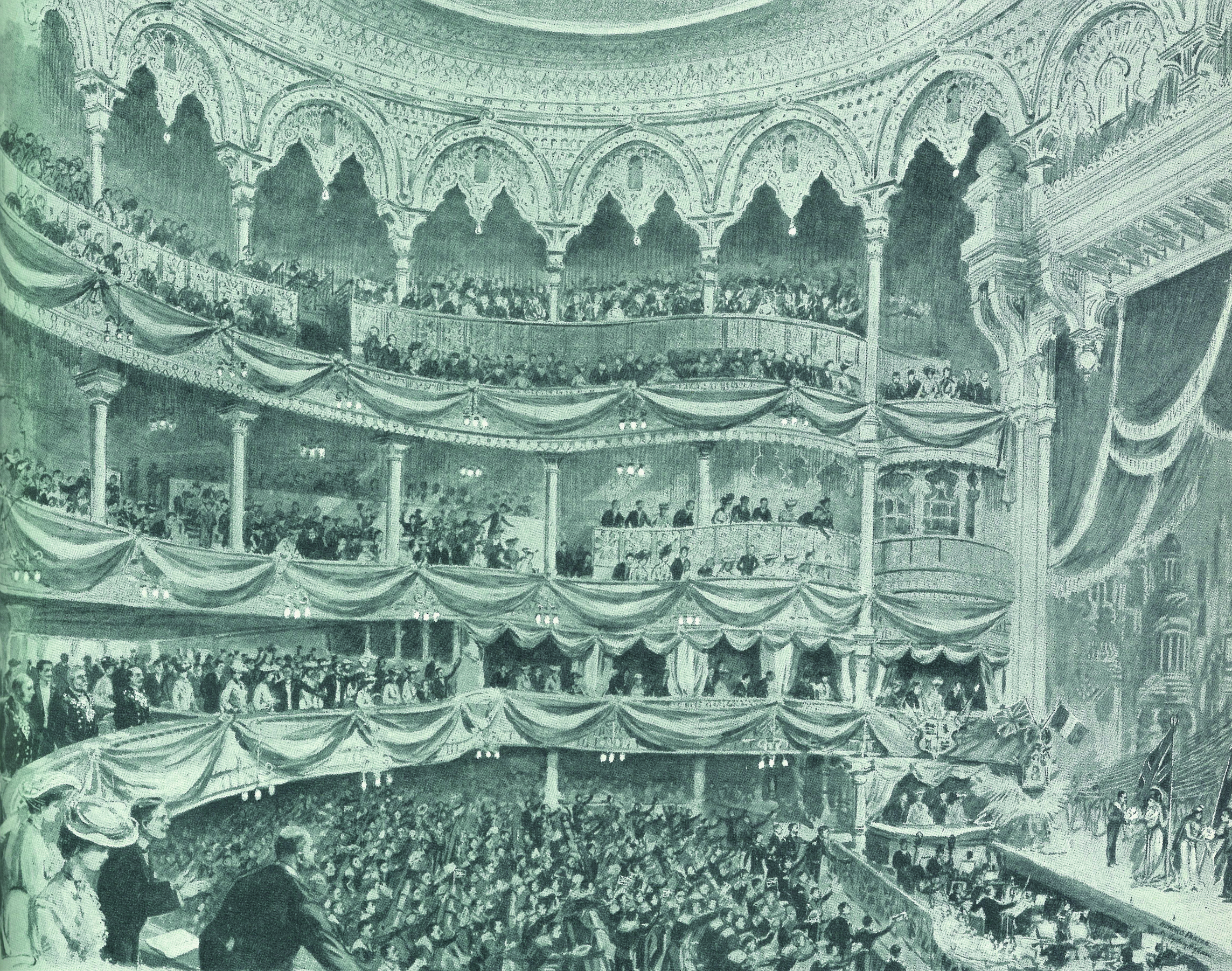 The Alhambra in 1905
It was in March of 1908 that the decisive change in Violet’s fortunes took place. It was reported in these words:
Mystery surrounds the identity of the talented singer, L’Incognita, who created such a sensation at the Alhambra, London, on Thursday evening. A short time ago Mr Alfred Moul, the managing director, received a letter from a firm of solicitors, asking him to give a hearing to a young protegee of theirs. He consented, and the girl, closely veiled, sang before him. Mr Moul discovered that she possessed a voice of remarkable range and purity of tone, and pressed her to appear at the Alhambra, naming a very high fee. She consented to do so for one performance only, on condition that she should not be required to give her name, that no announcement should be made … and that she should be allowed to wear a mask. These were hard conditions but Mr Moul accepted them with the result that the unknown duly made her single appearance and took the house by storm.55
Thus, at thirty-two years old, Violet Mount, L’Incognita, was to embark on a new career, not in opera houses or concert halls, but in the music halls. Immediately following her debut at the Alhambra, she was given a contract of indefinite duration on an exclusive basis to sing nightly.
But who was she? Was she the daughter, as rumoured, of an impoverished nobleman? From the start, she was headlining in the Alhambra’s ubiquitous advertisements. It was in a prime location in London, Leicester Square, the Alhambra being one of the leading halls in the capital with a long line of stars who had performed there.
By the late nineteenth century, music hall was well established in Australia, as in Britain and America. However, there was simply not enough employment for Australian performers in Sydney, Melbourne and the other major cities, and so many came to Britain to find work.

Florrie Forde, 1900s, photo by Foulsham & Banfield
Theatre Heritage Australia

Annette Kellerman, 1910s, by H. Walter Barnett
National Portrait Gallery, London
The majority of the emigrant Australian music hall artists were from working-class backgrounds, performing popular material for primarily working-class audiences, among them the singers Florrie Forde, Albert Whelan and Billy Williams. But there were also successful novelty acts, including the ‘living statue’ La Milo (Pansy Montague), the champion swimmer turned to vaudeville, Annette Kellermann, the ‘world’s greatest liar’, Louis de Rougemont, and the New Zealand-born coloratura ‘siffleur’ (whistler), Borneo Gardiner.
And there was a handful of classically trained Australian-born singers, who, usually unable to break into the opera houses, came to work on the halls in Britain. Among these were contralto Alice Hollander (whose conversion was mentioned earlier), sopranos Syria Lamonte (in 1898 the first woman singer to make gramophone records in Britain), Ada Colley and Florence Esdaile, and baritone Hamilton Hill (who popularised Boer War songs).
Nevertheless, that kind of singer remained the exception rather than the rule in music halls. And an unnamed but a first-rate coloratura soprano in a mask was unique, well appreciated and newsworthy.56
Not to miss the excitement The Times sent along one of their music reporters, who, true to form, sniffily appreciated the performance, while finding fault:
‘L’Incognita’ has a clear and powerful high F, and considerable skill in singing scales and florid passages; it is to be hoped that the money she earns by this engagement will be applied to the continuance of her musical studies, and in particular to the acquirement of better pronunciation both of French and of Italian.57
In mid-April one of the leading illustrated magazines in Britain, The Sketch, carried the by now famous masked singer on its front page, full page, the photograph by the fashionable Bassano.58 And L’Incognita’s first season at the Alhambra went right through to early September, at which point it was suggested that she was to make a tour in Scottish halls and venture abroad to the continent.59

The Phono Trader and Record, April 1908

Was she the sister of the great Luisa Tetrazzini?
Victoria & Albert Museum, London
Within weeks of first appearing at the Alhambra, she was in the studios of the Gramophone Company in London, recording arias for their Zonophone label which featured in her act: ‘Caro nome’ from Rigoletto, ‘Ah! fors’e lui’ from La traviata, the ‘Shadow Song’ from Meyerbeer’s Dinorah and the ‘Mad Scene’ from Lucia diLammermoor.60
The legendary recording producer Fred Gaisberg recalled her entry into the studio wearing her mask: ‘I remember her as a first-class artist with a very pleasing and graceful stage presence.’61
At one of those recording sessions, she was a third persona, Violetta Viamonti—it was issued on HMV. Did she wear her mask for it?62
But, really, who was this L’Incognita? Speculation was rife. If not the daughter of a poor peer, was she perhaps the sister of the great Luisa Tetrazzini? Or was she the real Tetrazzini moonlighting—she was then wowing audiences at Covent Garden in Rigoletto, Lucia di Lammermoor and La traviata.
Her season at the Alhambra completed, in July 1908 L’Incognita appeared at the Grand in Corporation Street, Birmingham, the first of many Stoll-Moss theatres:
Last night every seat in the building was occupied and L’Incognita, who has already achieved considerable distinction in the Metropolis, was given a hearty welcome to this city. She possesses a rich soprano voice. Wearing a black mask, L’Incognita last evening rendered ‘Lo! Here the gentle lark’ and the Polonaise from Mignon in a beautiful clear, rich and telling voice. The applause lasted for several minutes and was led in a hearty manner by the leader of the orchestra.63
Birmingham was followed in August by the Olympia in Liverpool, L’Incognita ‘an artiste of great ability’,64 then the Hippodrome in Coventry. She was to return to London in September—to the Empire at Shepherd’s Bush—then back north to the Stoll-owned Empires in Nottingham and Manchester, where she was introduced as ‘the greatest soprano ever heard on the Vaudeville Stage’.65

The masked singer who is creating quite a sensation at the Alhambra
The Tatler, 10 June 1908

Caricature of Sir Oswald Stoll by Ape
Vanity Fair, 4 January 1911
There was every reason that she would suit Sir Oswald Stoll and his Empire group of theatres. Not only was he Australian born, but he was also committed to presenting music hall as suitable for everyone. And L’Incognita, was fully booked up in Stoll’s theatres in the provincial cities of England and Wales to the end of a year of massive change for her.
This pattern for L’Incognita continued into1909 with her first engagement north of the border at the Empire, Glasgow, her name on the advertisements still in the largest typeface. Then, in February, she made a return to the Alhambra in London for six weeks, before going on to Vienna, where she appeared at the Apollo Theatre.66
After that she returned to the Stoll’s provincial theatres before arriving in July at one of his major London venues, the Hippodrome. From September, for Violet it was back touring in provincial theatres, several of them for a second time around.
L’Incognita’s outstanding, top-of-the-bill career in the music halls of Britain was to sustain itself steadily through the following years. 1910 was fully booked for her, although without a return to London, while 1911 showed a slight slowdown, but included her first performances in Northern Ireland—at the Hippodrome in Belfast. The census of 1911 showed that Violet was living with both her parents at Lauderdale Mansions in Maida Vale.
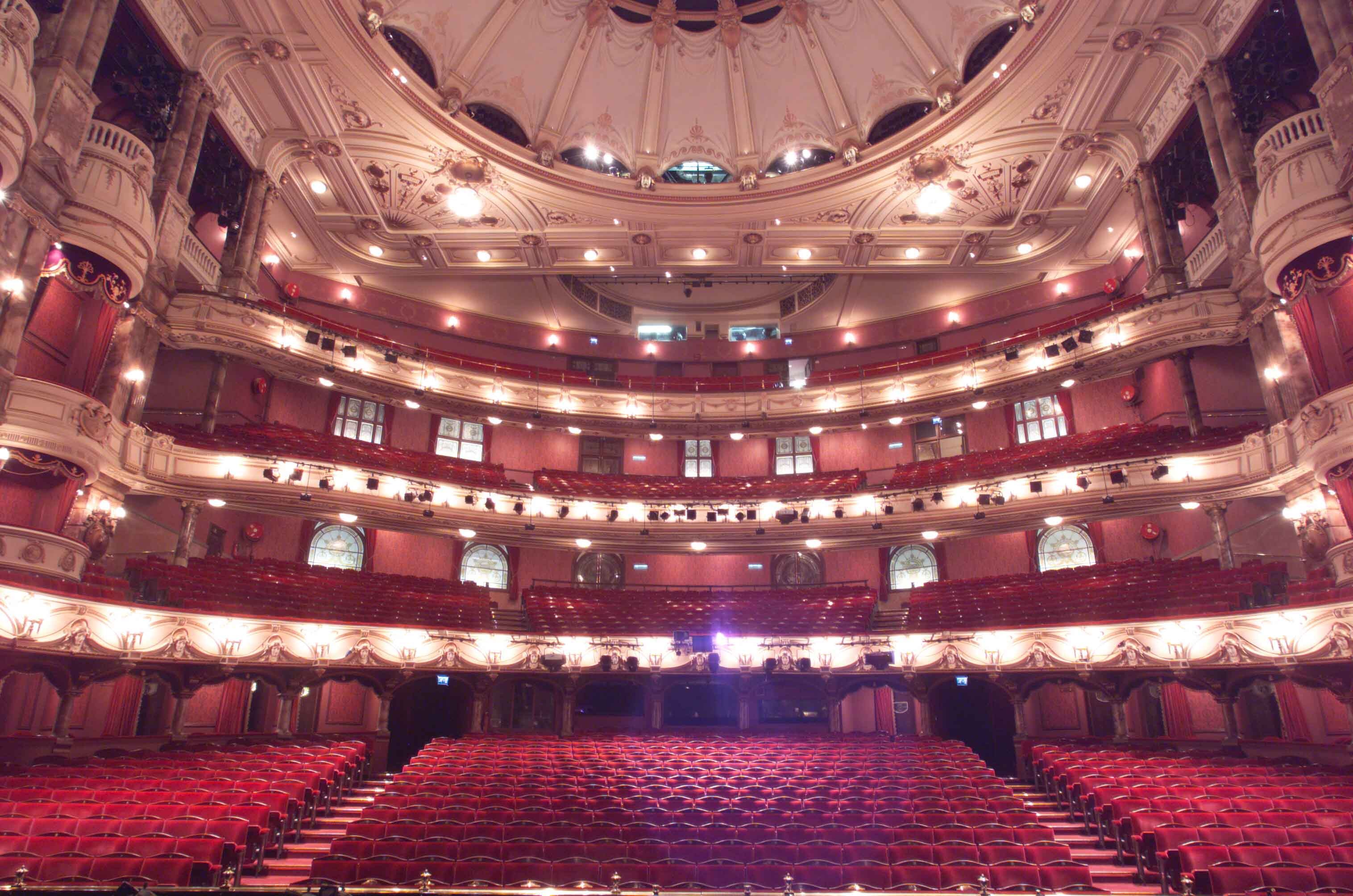 The London Coliseum today, londoncoliseum.org
However, the pace was kept up through 1912-1914, and she made a return to the metropolis in February 1912, singing at the Victoria Palace, then again in April 1913 at Stoll’s top London theatre, the Coliseum, where Albert Chevalier was also on the bill.
And she was to return to the Coliseum in October—in the same week that the legendary French actress, Sarah Bernhardt performed there.
28 July 1914 saw the start of the Great War and, although music hall theatres generally remained open, business contracted substantially, 1915 being a particularly bleak year for music hall performers before a slight revival in 1916. It appears that L’Incognita had only one booking in 1917—at the Hippodrome in Newcastle.
In her innumerable appearances as L’Incognita, what had she sung to her music hall audiences? She would always start with one or two bel canto arias, filled with trills and runs and sustained top notes. A regular starter was the dazzling Polonaise (‘Je suis Titania’ but doubtless sung in English) from Ambroise Thomas’s Mignon, or the Jewel Song from Gounod’s Faust, or ‘Ah! fors’è lui’ from La traviata, or the ‘Shadow Song’ from Dinorah. And she continued to sing Bishops’ ‘Lo! Here the gentle lark’, which she had performed before regularly in New Zealand and Australia and was to go on with in duet with flautist John Amadio.
Then she would end with a popular song of the day – ‘I dreamt I dwelt in marble halls’, or ‘Annie Laurie’, or ‘Killarney’, or ’Home Sweet Home’ (a Melba favourite).
In 1919 and 1920, Violet Mount returned to the studio for Zonophone, recording ten new arias and songs, including: ‘Calm and peaceful’ from Il trovatore, ‘Casta diva’ from Norma, ‘Beauty’s Sleep’ by Arditi and the ‘Doll Song’ from Tales of Hoffmann.

Hamilton Gardens in St John’s Wood, London
www.onthemarket.com
And by 1921 the Mounts had moved home from Maida Vale to live at 7 Hamilton Gardens, St Johns Wood, surrounded by expatriate Australian artists, musicians and other singers (including Ada Crossley).67
Probably the wartime slowdown for L’Incognita was exacerbated by the fact that by 1917 her music hall act was already some nine years old and in need of rejuvenation. And this came along in the shape of partnership on stage with the outstanding New Zealand-born flautist, John Amadio.
L’Incognita and Amadio
One of a dynasty of flautists and other musicians, John Amadio was born in Christchurch in 1886 and brought up in Wellington, before moving aged seventeen to Sydney, then Melbourne. However, initially taught by his stepfather, he started playing with the Wellington Orchestral Society at eleven. In 1911 he was principal flute in Dame Nellie Melba’s touring opera company in Australia.
John moved to London in 1920, where he was to tour with a range of top-flight artists, including Nellie Melba, Luisa Tetrazzini, Emma Calvé, Galli-Curci and his second wife, Florence Austral.

Palace Theatre, Grimsby
Grimsby Local History Library

Royal Hippodrome, Preston
Lancashire City Council
Already a star in his own right, Amadio was to tour in music halls as a duo with L’Incognita from October 1920, and they were given equal billing. To great applause, they opened at the Palace in Grimsby, going on immediately to Liverpool, Darlington and Rochdale, in each place greeted warmly. They were usually advertised as ‘The Phenomenal Soprano and Wizard of the Flute in the Magic of Flute and Voice’.68
The partnership continued touring around UK music halls through to 1924, at which point it came to an abrupt end—the final engagement being at the Royal Hippodrome in Preston in July 1924.69 When Amadio went on to perform in the USA in 1925 with soprano wife Florence Austral, it effectively spelled the end of L’Incognita’s performing career. She was approaching fifty. Violet’s only future appearances on stage came in a touring pantomime in the north of England, ‘Dick Whittington and his Cat’ in 1925 and in a concert at the Star, Tonbridge, in 1928.
But a lasting legacy of her time performing with John Amadio came in the form of three gramophone records made for Zonophone in September 1921—‘La Villanelle’ by dell’Acqua. ‘Lo! Here the gentle lark’ by Bishop and ‘Sweet Bird’ by Handel. Already well-known by the halls’ audiences, they were an ideal catch for Zonophone and the recordings sold very well, and the three pieces were at the centre of their live performances together.
As an aside, it’s curious to note that, although Australian and New Zealand newspapers knew from the start that Violet Mount and L’Incognita were one and the same person, this was never revealed in the British media.

John Amadio with his wife soprano Florence Austral, 1930
National Library of Australia, Canberra
From 1925 onwards, Violet Mount is less easy to find. That year she gave written evidence in the divorce proceedings in Melbourne between John Amadio and his first wife, Leonora Soames Amadio. Violet was now living at Birchington Road, West Hampstead.70
The following year, Violet visited Australia House (which had opened in 1918) with her aged father.71 Lambton Mount died at 95 in London in June 1931, remembered in Australia for his friendship with Adam Lindsay Gordon and for his long-distance foot races.72
That’s all …
But in 2009 I was lucky enough to find Violet’s great-niece Linda Mount, and she sent me this email about the singer’s last years. It gives us a rare glimpse into the more private personality of Violet Mount, the woman:
I remember her well when she was older and retired. She came to live in Weybridge in Surrey to be near her brother Ray and his family, my father being one of his sons, Jack. I don't remember exactly when she died but it was in the mid-60s sometime. She was extremely fit, lived independently and never went to hospital until she was in her 90s when she had a short illness and died.
I remember her being a very feisty old lady who enjoyed debating various topics, particularly with her brother. I am sure she must have been quite a dramatic singer and after a glass of wine at Christmas she would suddenly burst into an aria or two during the lunch! If she had had a good time, she would also sing some opera when she waved one off from her flat! Certainly, as a child it was quite something.
I also remember she had some friends who lived in Weybridge so I think she had quite a happy retirement. I was a teenager when she died and I cannot remember more about her. It is nice to have a couple of old records of her singing and so we can hear how good her voice was. I gather the reason she was called L'Incognita or the Masked Soprano was because her father felt it was unladylike to appear on stage so everyone could see her face—how times have changed!73
In fact, Violet Mount died, not in the mid-1960s, but in September 1972. Living a year longer than her father, she was ninety-six. Sadly, her passing was not noted—neither in Britain, nor in Australia or New Zealand.
But the neglect of Violet Mount since that time seems hard to explain, when her surviving recordings reveal an Australian bel canto soprano only equalled by Nellie Melba and Joan Sutherland.
L’incognita and Violetta Viamonti Recordings
Based on a full discography by David Mason
All of Violet Mount’s recordings, made under the pseudonyms L’Incognita and Violetta Viamonte, were made for the Gramophone Company’s subsidiaries, Zonophone and HMV. In total there were 21 recordings issued under the L’Incognita name, all on Zonophone (plus 4 unissued takes) and just one as Violetta Viamonte on HMV.
The early recordings were from 1908-09 and the later ones from 1919-21. All but one of the L’Incognita records were later reissued, most of them twice over, indicating that the company thought they still would sell.
L’Incognita: issued recordings (all Zonophone)
La traviata, Ah fors’è lui (Verdi), Matrix 8146, recorded April 1908
Dinorah, Shadow Song (Meyerbeer), 8147, April 1908
Mignon, Io son Titania Thomas), 8164, April 1908
Lucia di Lammermoor, Mad Scene (Donizetti), 8196, 1908
Rigoletto, Caro nome (Verdi), 8199, 1908
Hamlet, Mad Scene (Thomas), 21620, 10 June 1919
Rosebuds (Arditi), 21644, June 1919
Il trovatore, Calm and peaceful was the night (Verdi), 21657, 1919
Norma, Gentle Godess (Bellini), 21658, 1919
The Tales of Hoffmann, Doll Song (Offenbach), 21723, 1919
Beauty’s Sleep, (Arditi), 21725, 1919
Mireille, Waltz Song (Gounod), 21920, 1920
The Daughter of the Regiment, None can gainsay (Donizetti), 21922, March 1920
Maritana, Scenes that are brightest (Wallace), 21923, March 1920
Der Freischütz, Softly sighs the voice of even (Weber), 21935, 1920
Tom Jones, Waltz Song (German), 21936, 1920
A Masked Ball, You’d fain be hearing (Saper vorreste) (Verdi), 22111, September 1920
Il trovatore, Silent the sombre wings of night (Verdi), 22126, October 1920
Il pensiero, Sweet Bird (Handel), 493, 23 September 1921 (with John Amadio, orchestra George W. Byng)
Villanelle (dell’Acqua), 494, 23 September 1921 (with John Amadio, orchestra George W. Byng)
Lo! Here the gentle Lark (Bishop), 495, 23 September 1921 (with John Amadio, orchestra George W. Byng)
Note: This ‘Lo! Here the gentle lark’ recording was included in the 4CD set, From Melba to Sutherland: Australian Singers on Record(Decca Eloquence 2016)
Bibliography
Warren Bebbington (ed), Oxford Dictionary of Australian Music, Oxford University Press, Melbourne, 1998
J.S. Bratton (ed), Music Hall: Performance and Style, Open University Press, Milton Keynes, 1986
Doug W. Fox, Lacrosse in Australia: Lambton L. Mount and the Foundation Years, self-published, Melbourne, 2021
Edouard Garceau, The Little Doustes, (translated by Vera A Chappell) Frederick Muller, London, 1935
Victor Glasstone, Victorian and Edwardian Theatres: An Architectural and Social Survey, Thames and Hudson, London, 1975
K.J. Kutsch & Leo Riemens, A Concise Dictionary of Singers: From the Beginning of Recorded Sound to the Present, Chilton Book Company, Philadelphia, 1962/1969
Barbara & Findlay Mackenzie, Singers of Australia: From Melba to Sutherland, Lansdowne, Melbourne, 1967
W. Macqueen-Pope, The Melodies Linger On: The Story of Music Hall, WH Allen, London, 1950
Raymond Mander & Joe Mitchenson, British Music Hall: A Story in Pictures, Studio Vista, London, 1965
Roger Neill, ‘Going on the Halls’, unpublished, part of uncompleted dissertation, Goldsmiths College, London, 2013
―― DIVAS: Mathilde Marchesi and her Pupils, NewSouth (University of New South Wales Press), Sydney, 2016
――, Melba’s Farewell, Decca Eloquence (CD), Sydney, 2017
――, ‘Re-discovering Syria Lamonte: Pioneering Recording Artist, Theatre Heritage Australia (online), Melbourne, 2023
――, The Simonsens of St Kilda: A Family of Singers, Per Diem Projects, King’s Sutton, 2023
――, ‘Florrie Forde at 150: Melba for the Masses’, Theatre Heritage Australia (online in three parts), Melbourne, 2025
Roger Neill & Tony Locantro, From Melba to Sutherland: Australian Singers on Record(4CD set), Decca Eloquence, Sydney, 2016
Adrienne Simpson, Opera’s Farthest Frontier: A History of Professional Opera in New Zealand, Reed, Auckland, 1996
Douglas Sladen (ed), The Poems of Adam Lindsay Gordon, Constable, London, 1912
J.B. Steane, The Grand Tradition: Seventy Years of Singing on Record 1900-1970, Scribner’s, New York, 1974
John Mansfield Thomson, The Oxford History of New Zealand Music, Oxford University Press, Auckland, 1991
Angela Woollacott, To Try Her Fortune in London: Australian Women, Colonialism and Modernity, Oxford University Press, New York, 2001
Endnotes
1. This recording has been transferred from an ancient shellac 78rpm record with all the clicks and buzzes left intact; nevertheless, Mount’s bel canto singing shines through
2. Kutsch and Riemens (1962/1969), p.203
3. The Lambton Mount Lacrosse Club in Melbourne exists to this day
4. Le Breton in 1876, Winifred in 1877, Lambton Le Breton in 1881, Rupert Henry Le Breton in 1886 and Frank Raymond De Tito in 1887
5. This Karlsruhe, a Norddeutscher-Lloyd vessel, was built in Glasgow in 1889
6. Argus, 1 May 1893, p.4
7. Argus, 10 April 1893, p.2
8. La fille du regiment was to become a core role in Joan Sutherland’s career many years later
9. Punch (Melbourne), 26 August 1897, p.18
10. Table Talk, 8 October 1897, p.9; Australasian (Melbourne), 16 October 1897
11. Punch (Melbourne), 9 December 1897, p.16
12. Punch (Melbourne), 7 July 1898, p.16
13. Argus, 8 October 1931; he later annoyed Melba, when he missed the boat to take him from Tasmania to New Zealand in 1903; and, sadly, in 1931 he was imprisoned for 21 days in London, having been accused of ‘an act of indecency’ at Victoria Station
14. New Zealand Free Lance, 11 May 1901
15. Evening Post (Wellington), 10 June 1899
16. Evening Post, 8 July 1899
17 Evening Post, 30 August 1899
18. Evening Post, 21 June 1900
19. The song is frequently, incorrectly, rendered by journalists and others as ‘Lo! Hear the gentle lark’
20. Evening Post, 29 November 1900
21. Flautist remained the spelling used in Australia and New Zealand at that time; more on John Amadio later
22. Evening Post, 18 December 1900
23. Don Ross, ‘The World of Music Hall in 1906’, Call Boy, London, June 1972
24. New Zealand Free Lance, 11 May 1901
25. New Zealand Free Lance, 6 July 1901
26. Auckland Star, 12 August 1901
27. New Zealand Free Lance, 12 October 1901
28. Observer (Auckland), 2 November 1901
29. Otago Witness, 28 May 1902
30. Australian Star, 11 July 1902
31. Watchman (Sydney) 26 July 1902
32. Daily Telegraph (Sydney), 18 August 1902; born in Melbourne in 1869, Alfred Hill was already the leading composer in Australia-New Zealand
33. Sydney Morning Herald, 15 November 1902
34. Northern Star (Lismore), 3 January 1903
35. Sydney Morning Herald, 19 February 1903
36. Daily Telegraph (Sydney), 3 April 1903
37. Sydney Morning Herald, 21 September 1903; words by Alma Tadema and Robert Louis Stevenson
38. Daily Telegraph (Sydney), 7 November 1903
39. Sydney Mail, 5 June 1907
40. Sydney Morning Herald, 11 April 1904
41. Sydney Morning Herald, 6 June 1904
42. New Zealand Times, 12 May 1904
43. Sydney Morning Herald, 9 August 1905
44. Sydney Morning Herald, 21 September 1905
45. Observer (Wellington), 2 December 1905
46. Argus (Melbourne), 3 May 1906
47. Argus (Melbourne), 20 September 1906
48. Sydney Morning Herald, 22 March 1907
49. Ballarat Star, 11 May 1907
50. Punch (Melbourne), 30 May 1907
51. Punch (Melbourne), 24 October 1907
52. Daily Telegraph (Sydney), 31 October 1907; who is the ‘aunt’? I can’t see that mother Mary had sisters, so maybe it was a sister of father Lambton, born in Canada
53. Sydney Morning Herald, 12 February 1908
54. Daily Telegraph (London) and others, 19 March 1908
55. Worcestershire Advertiser, 21 March 1908
56. Curiously, while Australian newspapers joyfully reported that L’Incognita was in fact Violet Mount, British papers never revealed the connection
57. Times (London), 1 April 1908
58. Sketch (London), 15 April 1908
59. Sydney Morning Herald, 9 September 1908
60. Zonophone was a subsidiary of The Gramophone Company in London
61. Gramophone, February 1943
62. David Mason points out that Zonophone recordings by ‘Madame Violetta’, some of them with Ernest Pike, were not by Violet Mount but by English mezzo-soprano Edna Thornton
63. Evening Despatch (Birmingham), 21 July 1908
64. Liverpool Echo, 4 August 1908
65. Manchester Evening News, 14 January 1909
66. Mercury (Clevedon), 20 March 1909
67. In 1939 she lived at 51 Boundary Road, Primrose Hill (Hampstead); they had been at 7 Hamilton Gardens until the mid-1930s; Violet's mother, Mary Mount, died in January 1922 in Marylebone, Herald (Melbourne), 1 February 1922
68. Hampshire Independent, 11 August 1922
69. Lancashire Evening Post, 11 July 1924
70. Telegraph (Brisbane), 26 September 1925
71. Australasian (Melbourne), 25 February 1926
72. Sydney Morning Herald, 15 June 1931
73. Email from Linda Mount to Roger Neill, 26 August 2009
Acknowledgements
With especially grateful thanks to Tony Locantro, who originally introduced me to Violet Mount and several other Australian singers and is a constant editor of my writings. To David Mason for providing a full discography of Violet Mount’s recordings. And to Elisabeth Kumm, publisher and magician with illustrations.
Also, thanks to Jamie and Linda Mount, relations of the subject. And to my wife, Sophie Wilson, who always provides valuable perspective.


